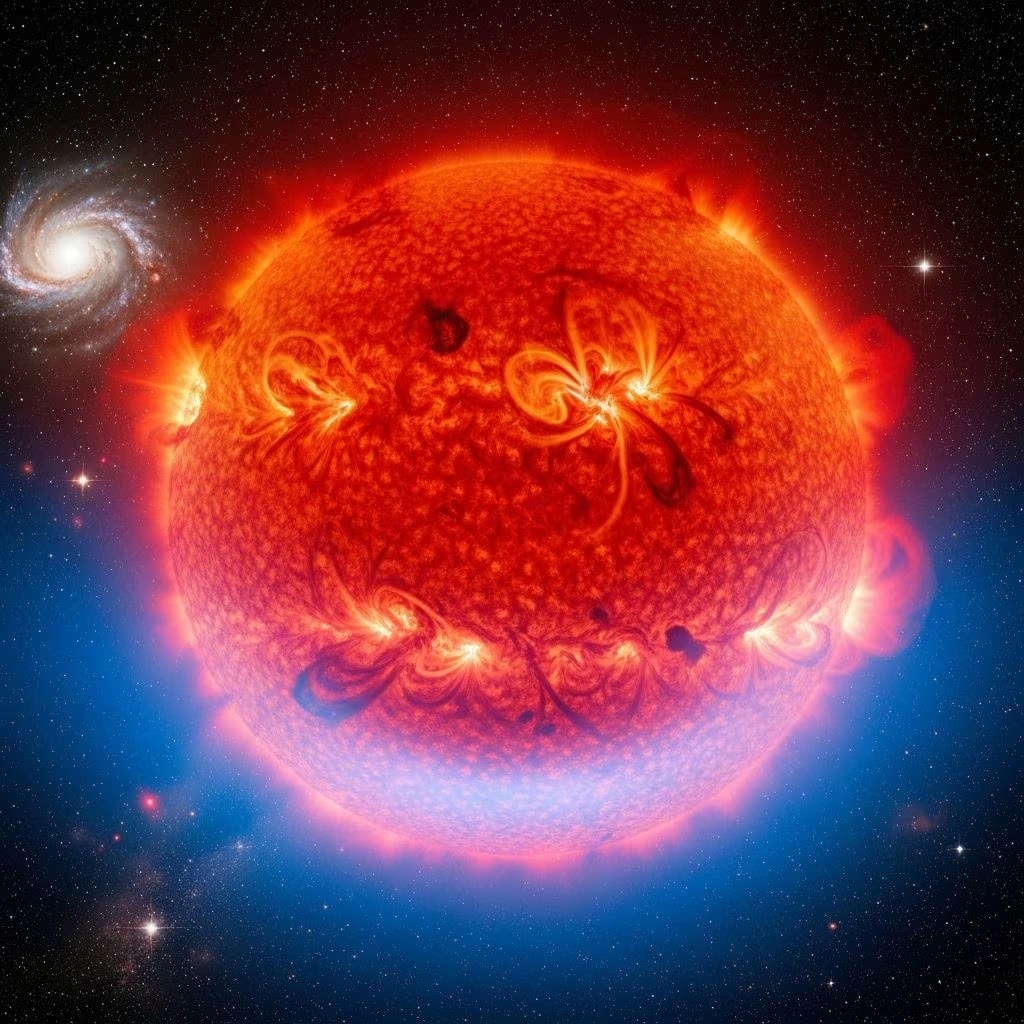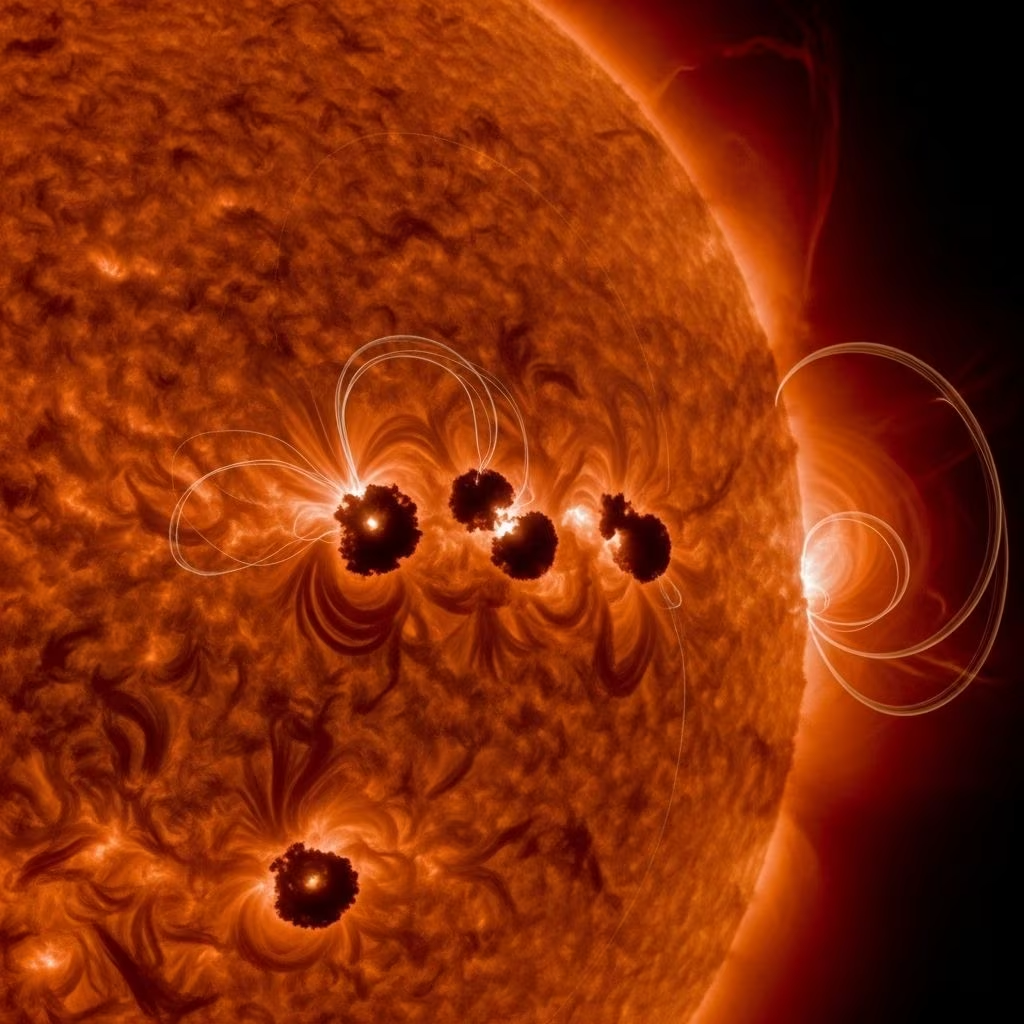
The Sun, often perceived as a fixed anchor at the heart of our solar system, is in fact on an astonishing and complex journey through space. This article unveils the real motion of the Sun, providing a detailed look at its dynamic path, the forces driving its movement, and the broader cosmic story in which our star, the planets, and even the very concept of a ‘solar system’ are deeply interwoven.
Is the Sun Stationary in Our Solar System?
It is a common misconception that the Sun is motionless at the center of the solar system. While it does serve as the gravitational focal point for the planets, asteroids, and comets that orbit it, the Sun itself is far from stationary. Our entire solar system, including the Sun, is engaged in motion—on scales from the solar system itself to the galactic and intergalactic realms.
- The Sun rotates on its axis, completing a rotation in about 25 days at its equator and roughly 35 days at its poles.
- The Sun orbits the center of the Milky Way galaxy, taking between 225 and 250 million years for a single revolution.
- The solar system as a whole moves through the galaxy, contributing to the composite journey of every object within it, including Earth.
Historical Context: From Geocentric to Heliocentric, and Beyond
For centuries, ancient and medieval astronomers believed in a geocentric model, with Earth at the universe’s center. The Copernican revolution replaced this with a heliocentric perspective in the 16th century, recognizing the Sun as the center of planetary orbits. Yet, modern astronomy reveals a further layer: the Sun itself is part of much greater cosmic motions.
How Does the Sun Move Within the Solar System?
Most of the observable motion within our solar system is dominated by the gravitational influence of the Sun. The planets, asteroids, and comets follow elliptical orbits around the Sun due to its immense mass. Yet the Sun is not entirely static at the solar system’s barycenter (gravitational center):
- The barycenter is the true center of mass of the solar system and is slightly offset from the exact center of the Sun, especially due to the mass of Jupiter and Saturn.
- As a result, the Sun actually “wobbles”—it moves around the barycenter in a subtle, complex way.
Helical Motion and the Solar System’s Path
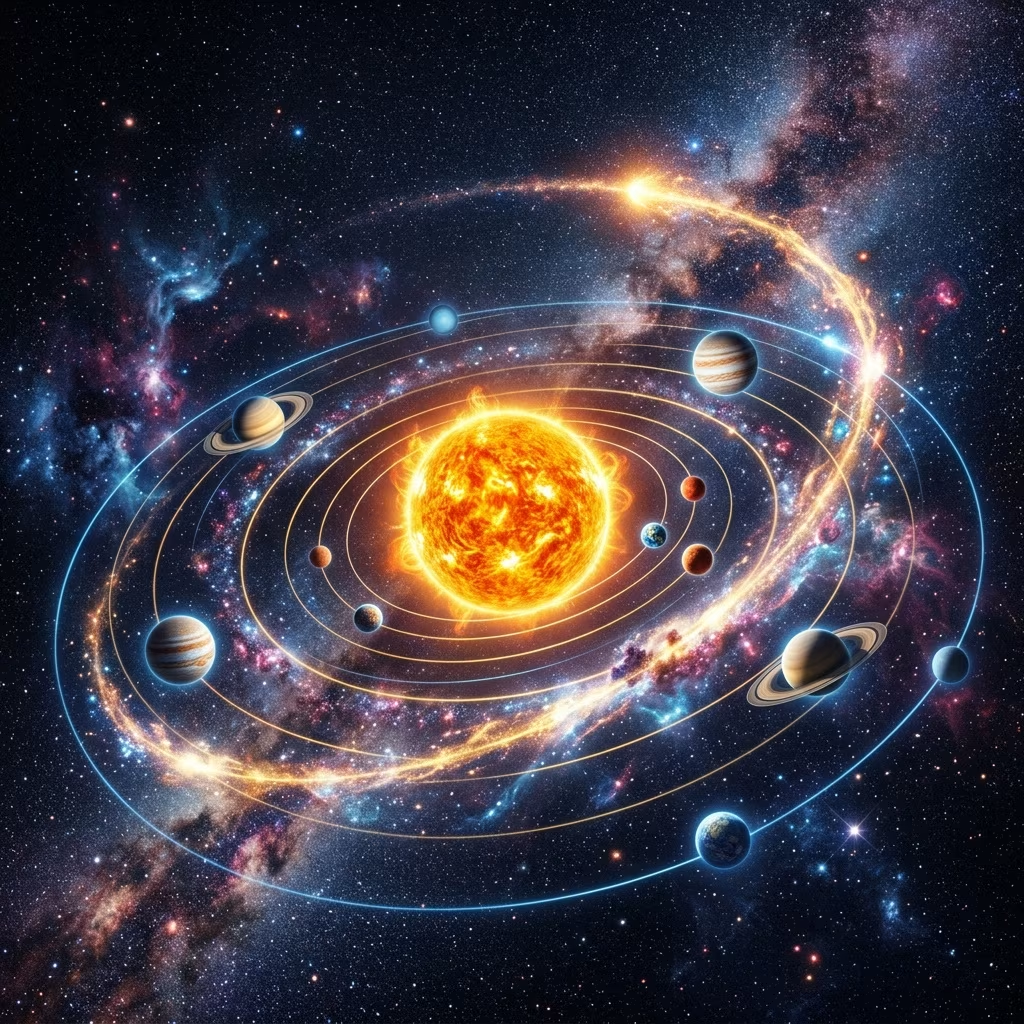
Many visualizations depict the solar system as a series of concentric orbits around a static Sun. However, this does not capture the reality. While the planets orbit the Sun, the whole system is traveling through space. This combination produces a helical (spiral-like) motion, similar to beads on a moving string. Each planet traces out a spiraling path as the Sun pulls them along its own course through the galaxy.
The Sun’s Path Around the Milky Way
The Sun’s motion reaches far beyond the solar system. Our star is located about 26,000–27,000 light-years from the galactic center, situated in one of the spiral arms known as the Orion Arm. The Sun, with its retinue of planets and other objects, is one of hundreds of billions of stars orbiting the Milky Way’s center.
| Parameter | Value | Notes |
|---|---|---|
| Distance from Galactic Center | 26,000–27,000 light-years | Located in Orion Arm/Local Spur |
| Orbital Speed | ~220–240 km/s (790,000–864,000 km/h) | Approx. 514,000 mph |
| Time for One Orbit (Galactic Year) | 225–250 million years | Known as a Cosmic Year |
This means that since its formation about 4.6 billion years ago, the Sun has completed between 20 and 25 full orbits around the Milky Way’s center, often called galactic years.
Shape of the Orbit: Not a Simple Circle
The solar system’s path through the galaxy is not a flat, two-dimensional ellipse. Rather, it oscillates, rising above and dipping below the galactic plane over tens of millions of years. These up-and-down movements are sometimes called solar oscillations and occur approximately every 30–35 million years as the solar system crosses the galactic mid-plane.
- This oscillation through the galaxy’s crowded center and sparse outer regions can influence the solar system’s environment, potentially even playing a role in comet showers and, some propose, in Earth’s mass extinctions.
What Drives the Sun’s Motion?
The primary driver of the Sun’s motion around the galactic center is gravity—the combined mass of the visible material (stars, gas, dust) and an even greater amount of dark matter, along with the supermassive black hole known as Sagittarius A* lurking at the Milky Way’s core.
- Gravity from dark matter, distributed throughout the galactic halo, provides the extra pull needed to explain the Sun’s high orbital speed.
- Sagittarius A* (the central black hole) keeps the orbits of stars organized around the dense hub of the Milky Way.
The Interstellar Neighborhood: Local Bubble and Cloud
The Sun is not only weaving around the galaxy, but also traveling through different regions of interstellar space. Currently, our solar system is moving through the Local Interstellar Cloud, which itself is inside a larger region called the Local Bubble. These are zones of lower-density, ionized gas, shaped by ancient supernova explosions.
- Current speed relative to nearby stars: About 20 kilometers per second (relative to the so-called local standard of rest, toward the constellation Hercules).
Multiple Levels of Sun’s Movement
The Sun’s movement occurs on several interlinked levels, each with distinct characteristics and timescales:
- Axial Rotation: The Sun spins on its axis every ~25 days at its equator.
- Wobble Around Barycenter: The Sun moves around the solar system’s barycenter due largely to gravitational tugs from Jupiter and Saturn.
- Orbit Around the Galactic Center: As discussed above (225–250 million years per revolution).
- Motion Relative to Local Stars: About 20 km/s toward Hercules.
- Cascade of Movement: The Milky Way itself is moving relative to other galaxies, and ultimately, the universe’s large-scale structure.
Visualizing the Solar System’s Complex Motion
The combined effect of the Sun’s linear motion around the galactic center, along with planets orbiting the Sun, creates a helical trajectory—each planet traces a spiral through space. This is more accurate than imagining planetary motion as closed ellipses in a stationary frame.
Why Does the Sun’s Movement Matter?
The real movement of the Sun has profound consequences for our understanding of cosmic cycles, potential hazards from interstellar encounters, and even emerging research into the influence of changing galactic environments on solar and potentially terrestrial phenomena. By grasping this multi-layered journey, we appreciate not only our place in the cosmos but the deep interconnectedness of celestial mechanics at all scales.
Frequently Asked Questions (FAQ)
Q: Does the Sun orbit anything?
A: Yes. The Sun orbits the center of the Milky Way galaxy, traveling at about 220–240 km/s and taking roughly 225–250 million years for each orbit.
Q: Is the Sun completely stationary relative to the planets?
A: No. While the Sun is much more massive than any planet, its position shifts slightly in response to the gravitational influence of Jupiter and to a lesser extent Saturn—causing a subtle “wobble” around the solar system’s barycenter.
Q: How fast is the Sun moving through the galaxy?
A: The Sun travels at about 220–240 km/s (about 514,000–537,000 mph) in its orbit around the galactic center. Relative to nearby stars, it moves at 19–20 km/s toward the constellation Hercules.
Q: What is the Local Bubble and Local Interstellar Cloud?
A: These are regions of lower-density, hotter ionized gas through which the Sun is currently passing. They result from past supernovae and make up our immediate interstellar environment.
Q: Does the Sun’s path affect Earth?
A: The overall movement of the Sun through the galaxy brings the solar system through varying cosmic environments, which could, in subtle ways, impact the flux of cosmic rays and other potentially Earth-affecting phenomena. Major galactic crossings might even be linked with comet showers or disturbances to the Oort Cloud, although the evidence is still debated.
Summary: Sun’s Motions at a Glance
| Motion | Description | Timescale / Speed |
|---|---|---|
| Axial rotation | Sun spins on its own axis | ~25 days (equator), ~35 days (poles) |
| Barycentric wobble | Movement around solar system mass center | Varies, linked to planetary orbits (mostly Jupiter) |
| Galactic orbit | Revolution around Milky Way’s center | 225–250 million years per orbit, 220–240 km/s |
| Relative stellar motion | Movement with respect to nearby stars | 19–20 km/s toward Hercules |
| Galactic plane oscillation | Crossing above/below galactic disk | 30–35 million years per cycle |
Conclusion: Our Solar System’s Grand Journey
Understanding the Sun’s movement reshapes our sense of cosmic place—from a seemingly motionless center to a fellow traveler in a galaxy of moving parts, itself adrift in a much vaster universe. Next time you see the Sun rise and set, remember: that ancient star is on a remarkable path, taking every planet, comet, and particle of dust on an odyssey that has lasted billions of years—and will continue billions more.
References
- https://www.space.com/space-mysteries-does-the-sun-move-in-the-solar-system
- https://www.space.com/space-mysteries-does-the-sun-move-in-the-solar-system&rut=78016656ed5c77069eb40a32a1a345543291ad3f977072e2f9ceab27ae0bca12
- https://science.nasa.gov/sun/facts/
- https://www.livescience.com/space/cosmology/how-many-times-has-the-sun-traveled-around-the-milky-way
- https://www.youtube.com/watch?v=1lPJ5SX5p08
- https://www.astro22.com/the-movement-of-the-sun/
- https://www.youtube.com/watch?v=881Izz-wuSA
- https://shineofsolar.com/is-our-solar-system-moving/
- https://en.wikipedia.org/wiki/Sun
- https://en.wikipedia.org/wiki/Solar_System
- https://spaceplace.nasa.gov/menu/solar-system/science/space/sun/
- https://shineofsolar.com/do-solar-systems-move/
- https://planetsandbeyond.com/how-the-solar-system-moves/
- https://www.physicsforums.com/threads/the-sun-moves-through-space-right.546289/
- https://www.bestsixthings.com/post/how-the-solar-system-moves-a-journey-through-space