Mars’ Mysterious Moons: Phobos and Deimos
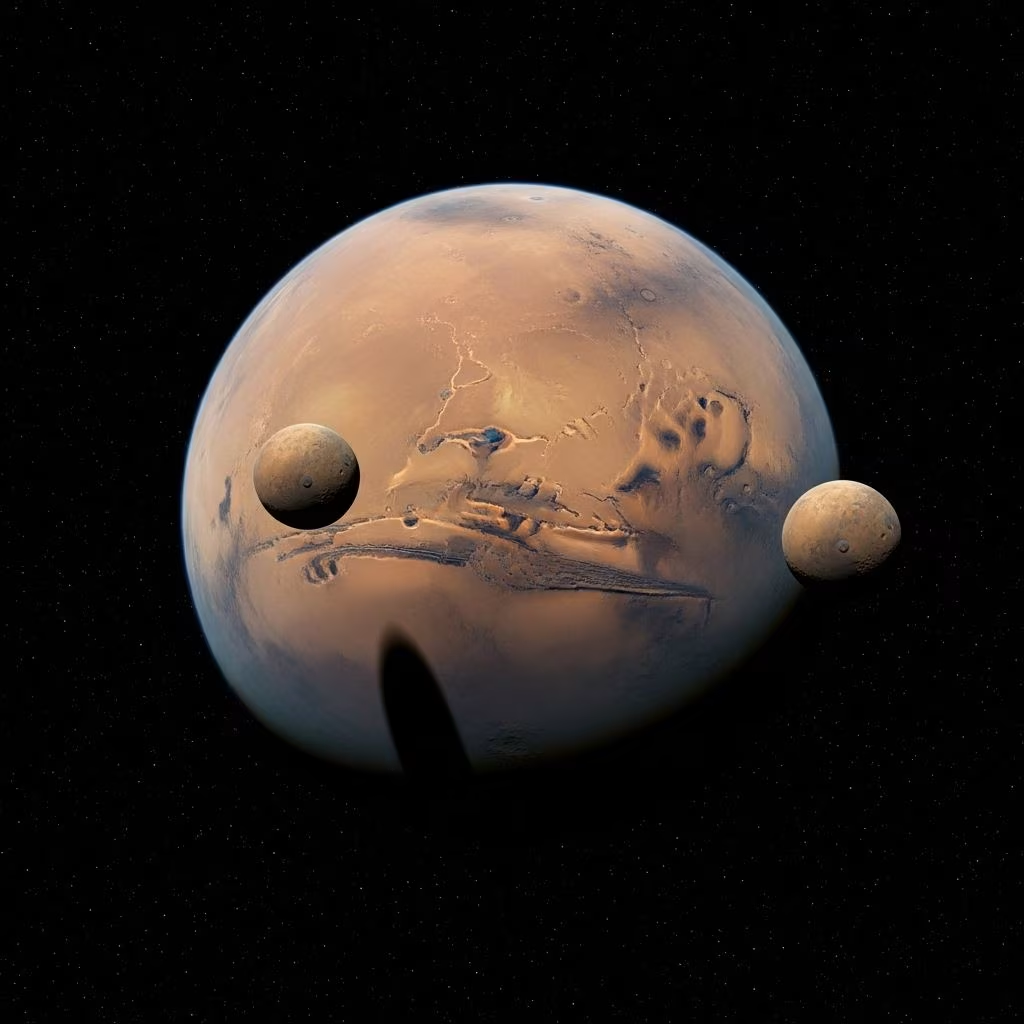
The planet Mars, a rust-colored beacon in the sky, is not alone in its journey around the Sun. It is accompanied by two remarkably tiny and oddly shaped natural satellites: Phobos and Deimos. These moons, named after characters representing fear and dread in Greek mythology, have captured the curiosity of astronomers since their discovery in the late 19th century. Despite their size, Phobos and Deimos play a significant role in revealing the mysteries of Mars’ history and the evolution of our Solar System.
Quick Facts About Phobos and Deimos
- Number of moons: 2
- Names: Phobos (“fear”) and Deimos (“dread”)
- Shape: Irregular, potato-like
- Discovery: Both observed by Asaph Hall in August 1877
- Size: Phobos ~22 km wide; Deimos ~12 km wide
- Distance from Mars: Phobos ~6,000 km; Deimos ~20,500 km
Naming, Mythology, and Discovery
The names Phobos and Deimos are rooted in mythology. In ancient Greek tales, Phobos and Deimos are the twin sons of Ares, the god of war (called Mars in Roman mythology), who would accompany their father into battle, symbolizing panic and fear on the battlefield.
- Phobos means “fear”
- Deimos translates to “dread”
The moons were discovered by American astronomer Asaph Hall in August 1877 using the U.S. Naval Observatory’s 26-inch refracting telescope, the largest in the world at that time. Their discovery echoed an earlier idea from the famed astronomer Johannes Kepler, who speculated, for the sake of celestial symmetry, that Mars should have two moons—an idea based more in philosophical musings than data.
Comparing Mars’ Moons to Other Moons
Mars’ moons are notably tiny, even compared to other irregular satellites in the Solar System. This small stature, along with their dark surfaces and peculiar shapes, sets them distinctly apart from our own Moon.
| Moon | Diameter | Average Distance from Parent | Orbital Period |
|---|---|---|---|
| Phobos | 22 km | 6,000 km | 7.7 hours |
| Deimos | 12 km | 20,500 km | 30.35 hours |
| Earth’s Moon | 3,475 km | 384,000 km | 27.3 days |
By comparison, both Phobos and Deimos are smaller than many asteroids, and their irregular, lumpy shapes and cratered surfaces give them the appearance of space rocks, not classical moons.
Physical Characteristics
Phobos: The Inner Satellite
- Size: Longest dimension ~22.2 km
- Surface: Covered in craters and grooves
- Orbital Speed: Orbits Mars every 7 hours, rising and setting twice each Martian day
- Unique Feature: Stickney crater—nearly half the moon’s diameter
- Albedo (Reflectivity): One of the least reflective bodies in the Solar System
- Surface Temperature: Varies from about −4°C on the sunlit side to −112°C in shadow
Phobos is so close to Mars that it appears to race rapidly across the sky, rising in the west and setting in the east in only about 4 hours. It is gradually spiraling inward due to tidal forces at a rate of about 2 cm per year and is expected to either crash into Mars or break up into a ring in about 40–50 million years.
Deimos: The Outer Satellite
- Size: Longest dimension ~12.6 km
- Shape: Smaller, smoother, and less heavily cratered than Phobos
- Orbital Speed: Takes about 30.35 hours for each orbit—just over a Martian day
- Distance from Mars: Orbits at about 20,500 km from the martian surface
Deimos is so far from Mars, and so small, that it would simply look like a bright star to someone standing on the planet. Its surface is smoother because it is covered by a thick layer of regolith—dust and broken rock from meteoritic impacts.
Astronomical Oddities: Orbits and Dynamics
- Phobos orbits closer to its planet than any other moon in the Solar System
- Its orbital period is shorter than a Martian day, causing it to move ‘backwards’ across the sky from west to east
- Deimos has a more typical prograde orbit, taking about 1.26 Martian days per revolution
Their small size and rapid orbits make the Mars moons unique examples of moon-planet dynamics in our Solar System.
Theories on Origin: Captured Asteroids or Martian Offspring?
The origin of Phobos and Deimos has been a subject of scientific debate for decades. Two main theories have emerged, both with compelling evidence—and lingering uncertainties.
- Captured Asteroids Theory: Their size, shape, and dark carbonaceous material are reminiscent of a class of asteroids called D-type asteroids, found in the outer asteroid belt. Their irregular, non-spherical shapes and low density also support this interpretation.
- Impact/Accretion Hypothesis: Alternatively, some scientists propose the moons formed from debris resulting from a giant collision on Mars—possibly the same event that formed the Borealis Basin on the planet’s northern hemisphere. Debris from this impact may have coalesced into the two moons.
Upcoming sample return missions and further orbital analysis may soon help resolve the mystery of the moons’ true origins.
Surface Features and Composition
- Phobos is marked by deep grooves and ridges that may be related to past impacts or tidal stresses. The largest and most distinctive is Stickney crater, a scar left by a massive collision that nearly shattered the moon.
- Deimos lacks large craters but is blanketed with loose regolith up to several hundred meters thick, hiding small craters and giving it a smoother appearance.
- Both moons are among the darkest objects in the Solar System, with reflectivity (albedo) comparable to carbon-rich asteroids, reinforcing their possible asteroidal origin.
Phobos and Deimos: Comparison Table
| Feature | Phobos | Deimos |
|---|---|---|
| Mean Diameter | 22.2 km | 12.6 km |
| Average Distance from Mars | ~6,000 km | ~20,500 km |
| Orbital Period | 7.66 hours | 30.35 hours |
| Albedo | 0.071 (very dark) | 0.068 (very dark) |
| Major Surface Feature | Stickney crater, grooves | Heavily mantled with regolith |
Possible Fate of Mars’ Moons
- Phobos is doomed to a dramatic end. Tidal interactions with Mars are gradually causing its orbit to decay at about 2 centimeters per year. In roughly 40–50 million years, it will either crash into Mars or be torn apart and form a faint ring around the planet.
- Deimos orbits farther out and is slowly drifting away from Mars, leading a far more stable and uneventful existence.
Exploration and Scientific Importance
Both moons have been photographed and measured by every major Mars orbiter and several flyby missions from the United States, Soviet Union, and the European Space Agency. Their unusual appearance and ambiguous origin hold keys to understanding:
- The formation and early history of Mars and its surroundings
- The processes that shape small body surfaces across the Solar System
- Potential for in-situ resource utilization in future human Mars missions
Sample return missions, such as Japan’s planned Martian Moons eXploration (MMX) mission, aim to collect and return samples from at least one moon, which could deliver vital clues to their origins and provide ground truth for theories about small bodies in our solar system.
Mars’ Moons in Modern Culture and Science Fiction
Phobos and Deimos have inspired science fiction writers and artists for generations. Their bizarre appearances and mysterious formation have made them settings for stories ranging from ancient Martian civilizations to secret alien bases. Their real story, revealed through telescopes, spacecraft, and robotic explorers, proves equally intriguing—showcasing how much we have yet to learn about our cosmic neighborhood.
Frequently Asked Questions (FAQs)
Q: Why are Mars’ moons so small and irregular in shape?
A: Both Phobos and Deimos are much smaller than Earth’s moon, with sizes and shapes that resemble asteroids. Their irregularity may be due to their weak gravity, preventing the moons from pulling themselves into spheres, and is one reason some scientists believe they are captured asteroids from the early Solar System.
Q: Could humans ever visit or land on Phobos or Deimos?
A: Yes, both moons have extremely low gravity, making landing technically easier than on Mars. They are strong candidates for future robotic missions, and possibly even human exploration as stepping stones to the Martian surface.
Q: Why does Phobos move across Mars’ sky so quickly?
A: Because Phobos orbits Mars much faster than the planet rotates, it rises in the west and sets in the east in just about four hours—crossing the sky twice each Martian day.
Q: What evidence is there for the origin theories of the Martian moons?
A: Their size, shape, and dark coloring resemble certain outer belt asteroids, supporting the capture theory. However, their nearly circular, equatorial orbits suggest they might have formed from orbiting debris generated by a giant impact on Mars itself.
Q: Are Phobos or Deimos at risk of crashing into Mars soon?
A: Phobos is gradually spiraling inward and will be destroyed or crash into Mars in about 40–50 million years. Deimos, meanwhile, is slowly moving farther away and is not at any risk of crashing into the planet.
Key Takeaways
- Mars has two tiny, irregularly shaped moons—Phobos and Deimos.
- They were discovered in 1877 and named after mythological Greek deities of fear and dread.
- Phobos orbits extremely close and is gradually spiraling into Mars. Deimos orbits farther away and leads a quiet orbital life.
- Their origins are still uncertain, but evidence suggests either a captured asteroid origin or formation from debris generated by a massive impact on Mars.
- Both moons continue to be targets for planetary science and possible future exploration missions, as they hold vital clues about Mars and the early Solar System.
References
- https://science.nasa.gov/mars/moons/
- https://en.wikipedia.org/wiki/Moons_of_Mars
- https://science.nasa.gov/mars/moons/facts/
- https://www.skyatnightmagazine.com/space-science/the-moons-of-mars
- https://en.wikipedia.org/wiki/Phobos_(moon)
- https://www.youtube.com/watch?v=waRMoNHivV8
- https://www.space.com/phobos-radar-unknown-structures-mars-express
- https://www.dlr.de/en/research-and-transfer/projects-and-missions/mmx/the-aim-phobos-and-deimos
- https://sci.esa.int/web/mars-express/-/31031-phobos
- https://production.mars.jpllab.net/all-about-mars/moons/summary/
- https://www.pas.rochester.edu/~blackman/ast104/mmoons.html
- https://www.astronomy.com/science/ask-astro-can-phobos-and-deimos-be-seen-from-the-surface-of-mars/
- https://marspedia.org/Moons_of_Mars_(Phobos_and_Deimos)
- https://starwalk.space/en/news/mars-moons-phobos-deimos
- https://www.space.com/mars-moons-phobos-deimos-shattered-moon-origins
- https://www.spaceacademy.net.au/library/guides/marsmoon/marsmoon.htm
- https://www.youtube.com/watch?v=XcHkXgesG0M