


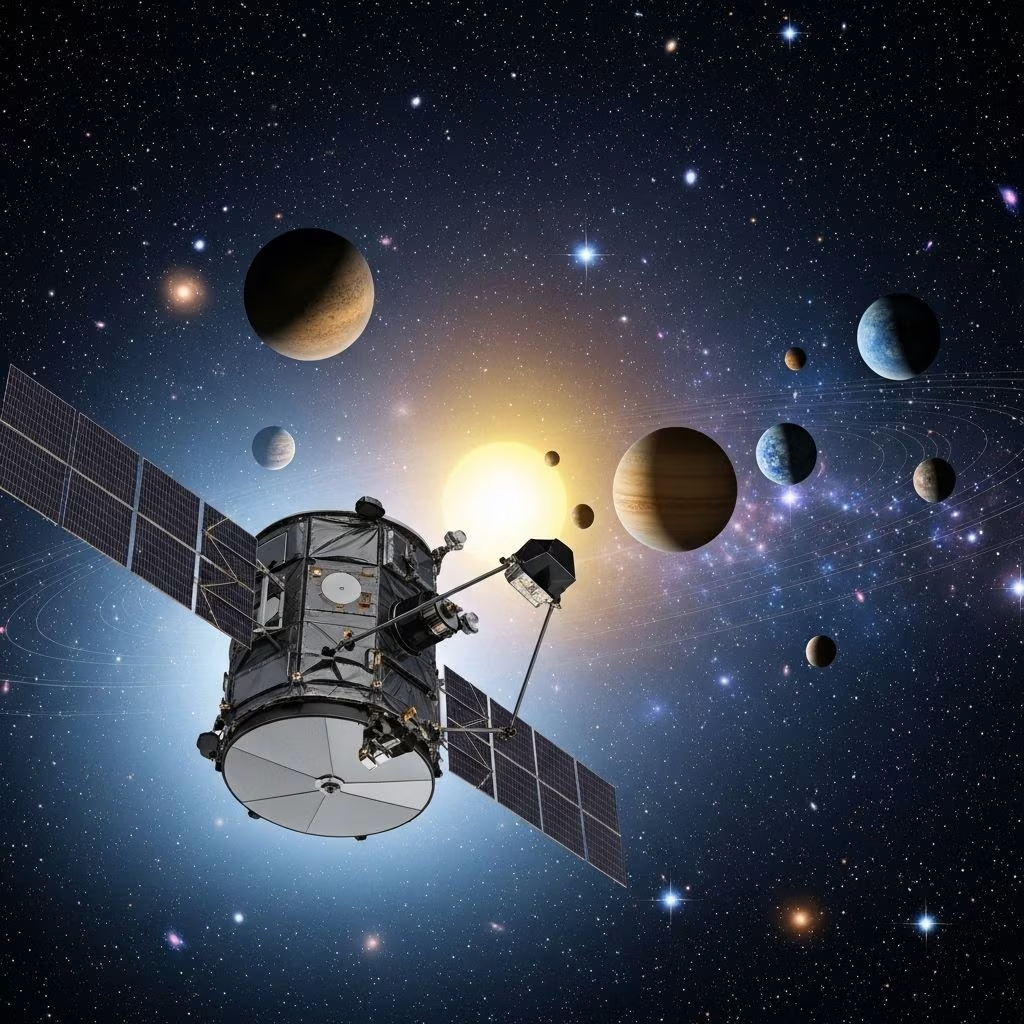
The Kepler Space Telescope revolutionized our view of the cosmos. Launched in 2009, this unmanned observatory was NASA’s pioneering mission dedicated to discovering planets beyond our solar system—the exoplanets—by scrutinizing distant stars for slight, periodic dips in brightness. Its findings propelled us into a new era of planetary science, revealing the existence of thousands of worlds and shaping our understanding of the galaxy.
Overview and Mission Objectives
Kepler was conceived with a singular purpose: to determine how common Earth-sized planets are in or near the habitable zone—the region around a star where temperatures allow liquid water to exist on a planet’s surface. Equipped with a powerful, wide-field photometer, Kepler monitored more than 150,000 stars simultaneously, seeking the minute dimming caused by a planet passing in front of its host star, an event known as a transit.
- Launch Date: March 7, 2009
- Primary Mission: 3.5 years (extended to over 9 years of fruitful observation)
- Mission Status: Retired October 30, 2018 (fuel depletion)
The Design and Instrumentation of Kepler
Kepler’s spacecraft design was built around its photometer, the only scientific instrument aboard, engineered for precision in detecting transiting exoplanets.
Core Spacecraft Specifications
| Parameter | Value |
|---|---|
| Manufacturer | Ball Aerospace & Technologies |
| Launch Mass | 1,039 kg |
| Dimensions | 4.7 meters × 2.7 meters |
| Power | ~1,100 watts |
| Primary Mirror Diameter | 0.95 meters |
| Photometer Field of View | ~115 sq degrees |
| Camera Resolution | 94.6 megapixels |
Innovative Camera and Detectors
The focal plane housed 42 charge-coupled devices (CCDs), each 2200×1024 pixels, arranged for a total of 94.6 megapixels—the largest deployed in space at its time. The array was cooled for stability, and specialized optics ensured optimal photometry (brightness measurements) rather than crisp imaging.
- CCD arrays were read out every 6.5 seconds to prevent saturation.
- Long cadence targets (up to 170,000 stars) were measured every 29.4 minutes, while short cadence (high-priority) targets (up to 512 stars) were measured every 58.9 seconds.
- Due to transmission constraints, only relevant pixel data—about 6% of the total—were sent to Earth, compressed and stored onboard before downlink.
Orbit and Field of View
Kepler’s Earth-trailing heliocentric orbit ensured an uninterrupted, thermally stable vantage point, ideal for sustained observation. Rather than orbiting the Earth, Kepler followed the planet around the Sun, always slightly behind, minimizing interference from Earth’s shadow or reflected light.
- Quarterly Rolls: Every 93 days, Kepler rotated to optimally orient its solar panels, shifting the stellar field on the detector array.
- Primary Field of View: Fixed for the original mission, covering a patch of the Milky Way rich with stars.
How Kepler Discovered Exoplanets
Kepler relied on the transit method—registering the periodic dimming of a star’s light as a planet crosses its disk. This allowed astronomers to measure the planet’s size (from the amount of dimming) and infer its orbital period (from the frequency of the dip), helping to estimate its distance from the star and potential habitability.
- Only planets with orbits edge-on from Earth’s perspective could be detected this way.
- The method favors large planets in close orbits but, with extended observation, Kepler was able to find smaller and more Earth-like planets.
Landmark Discoveries and Major Results
Kepler’s findings rewrote planetary science, revealing thousands of new worlds and a startling diversity of planetary systems.
- By mission end, 2,778+ exoplanets were confirmed, with thousands more candidates awaiting confirmation.
- Discovered Earth-sized planets in habitable zones, notably Kepler-186f and Kepler-452b.
- Identified a wide range of planetary types—including super-Earths, gas giants, mini-Neptunes, and planets orbiting binary stars.
- Statistically demonstrated that planets are commonplace in the galaxy; most stars likely host at least one planet.
Statistical Impact
Through detailed statistical analyses, Kepler data led to landmark insights:
- Estimated that there are more planets than stars in the Milky Way.
- Approximately 20–50% of Sun-like stars could host an Earth-sized planet in the habitable zone.
- Planetary diversity is far greater than previously imagined; true solar system analogs may be rare.
The K2 Mission: Extending Kepler’s Reach
After the failure of two reaction wheels in 2013, Kepler could no longer maintain precise orientation. Rather than retire the telescope, NASA engineers devised an ingenious solution: the K2 mission.
- K2 repurposed Kepler for a broader range of observations, including supernovae, star clusters, and objects within our solar system.
- In K2, the spacecraft was periodically rotated to prevent sunlight from entering the telescope, observing different fields every ~80 days.
Kepler’s Scientific Legacy and Impact
Kepler’s legacy profoundly shapes astronomy, exoplanet science, and the broader quest to understand our place in the universe.
- Provided the first comprehensive census of planetary systems in our galaxy.
- Inspired a new generation of astronomers, citizen scientists, and the public.
- Set the scientific stage for successor missions like the Transiting Exoplanet Survey Satellite (TESS) and James Webb Space Telescope (JWST).
Key Takeaways from the Kepler Mission
- Earth-sized planets in habitable zones are likely common.
- Exoplanet systems vary dramatically—many are unlike our own solar system.
- Transiting exoplanet discoveries require extensive follow-up to confirm their nature and characteristics.
- Data continues to fuel discoveries long after mission end, thanks to an open-access archive for astronomers worldwide.
Notable Planets Discovered by Kepler
| Name | Type | Notable Features | Year Announced |
|---|---|---|---|
| Kepler-22b | Super-Earth | First found in star’s habitable zone | 2011 |
| Kepler-186f | Earth-size | First Earth-size planet in habitable zone | 2014 |
| Kepler-16b | Gas giant | First planet found orbiting two stars (circumbinary) | 2011 |
| Kepler-452b | Earth-size | Older cousin of Earth, in habitable zone | 2015 |
| Kepler-62f | Super-Earth | Potentially rocky, in star’s habitable zone | 2013 |
Kepler’s Technical and Operational Challenges
Throughout its extended mission, Kepler overcame a host of technical hurdles, the most consequential being the loss of reaction wheels that stabilized its orientation.
- Reaction Wheel Failures: Limited the ability to precisely aim, prompting the rise of the K2 phase.
- Data Management: The huge volume of data required preselection of target stars and efficient onboard compression before transmission to Earth.
- Only a fraction of the possible light curves could be sent back due to limited bandwidth and memory.
Frequently Asked Questions (FAQs)
Q: What was Kepler’s primary mission?
A: Kepler’s primary mission was to determine how common Earth-sized and potentially habitable planets are around other stars by detecting the dimming effects of planetary transits across 150,000+ stars.
Q: How did Kepler find planets?
A: By continuously measuring the brightness of target stars and identifying periodic reductions in light—called transits—caused by planets passing in front of their stars from Earth’s perspective.
Q: What happened after Kepler’s main mission?
A: The spacecraft was repurposed for the K2 mission, pointing at different regions along the ecliptic and studying a variety of celestial phenomena beyond exoplanets.
Q: What is the significance of Kepler’s discoveries?
A: Kepler established that planets are common in the galaxy, especially Earth-size worlds in habitable zones, suggesting the possibility of life elsewhere.
Q: What happens to Kepler now?
A: As of October 2018, Kepler is retired and remains in a safe solar orbit, its data archive continuing to yield scientific discoveries.
Conclusion: A Legacy Beyond the Stars
NASA’s Kepler Space Telescope made history by uncovering thousands of worlds and revealing that planets fill our galaxy. It taught us that the search for another Earth is not science fiction, but a scientific quest in progress, continued by new missions and driven by Kepler’s extraordinary legacy.
References
- https://en.wikipedia.org/wiki/Kepler_space_telescope
- https://science.nasa.gov/mission/kepler/
- https://keplergo.github.io/KeplerScienceWebsite/the-kepler-space-telescope.html
- https://www.cfa.harvard.edu/facilities-technology/telescopes-instruments/keplerk2
- https://en.wikipedia.org/wiki/Kepler_spacecraft
- https://lweb.cfa.harvard.edu/kepler/papers/2004/SPIE.Glasgow.Koch.pdf
- https://archive.stsci.edu/kepler/manuals/archive_manual.htm
- https://www.jpl.nasa.gov/missions/kepler/
- https://keplergo.github.io/KeplerScienceWebsite/data/documentation/KSCI-19033-001.pdf
- https://archive.stsci.edu/missions-and-data/kepler
- https://www.telescopenerd.com/space-telescopes/kepler.htm
- https://www.space.com/17383-kepler-planet-hunting-nasa-telescope-infographic.html
- https://spacecraftandvehicles.com/spacecraft/orbital/space-telescopes/the-kepler-space-telescope/
- https://www.britannica.com/science/Keplerian-telescope
- https://study.com/academy/lesson/kepler-space-telescope-history-discoveries-missions.html
- http://www.spaceopedia.com/space-exploration/space-probes/scientific-observatories/kepler-telescope/
- https://sentinelmission.org/space-exploration-glossary/kepler-space-telescope/
- https://vajiramandravi.com/current-affairs/kepler-space-telescope/
- https://www.skyatnightmagazine.com/space-missions/a-history-of-the-kepler-space-telescope
- https://telescopicwatch.com/kepler-space-telescope/


