Where Is the Center of the Universe?
The universe is immense beyond comprehension. For centuries, humans have wondered: Where is the center of the universe? Is the Earth at the heart of everything, or is the center somewhere else? And with the Big Bang theory, shouldn’t there be a definitive starting point? Modern cosmology has delivered astonishing answers, fundamentally reshaping our understanding of space, time, and beginnings.
Key Concepts Covered
- Why does the universe have no center?
- Cosmological discoveries since the 1920s
- The Big Bang as a moment in time—not a place
- Analogies for understanding cosmic geometry
- Frequently asked questions about universe structure
A Century of Discovery: Hubble, Einstein & the Expanding Universe
Our understanding of the universe changed radically in the early 20th century, especially through groundbreaking work by Edwin Hubble and Albert Einstein.
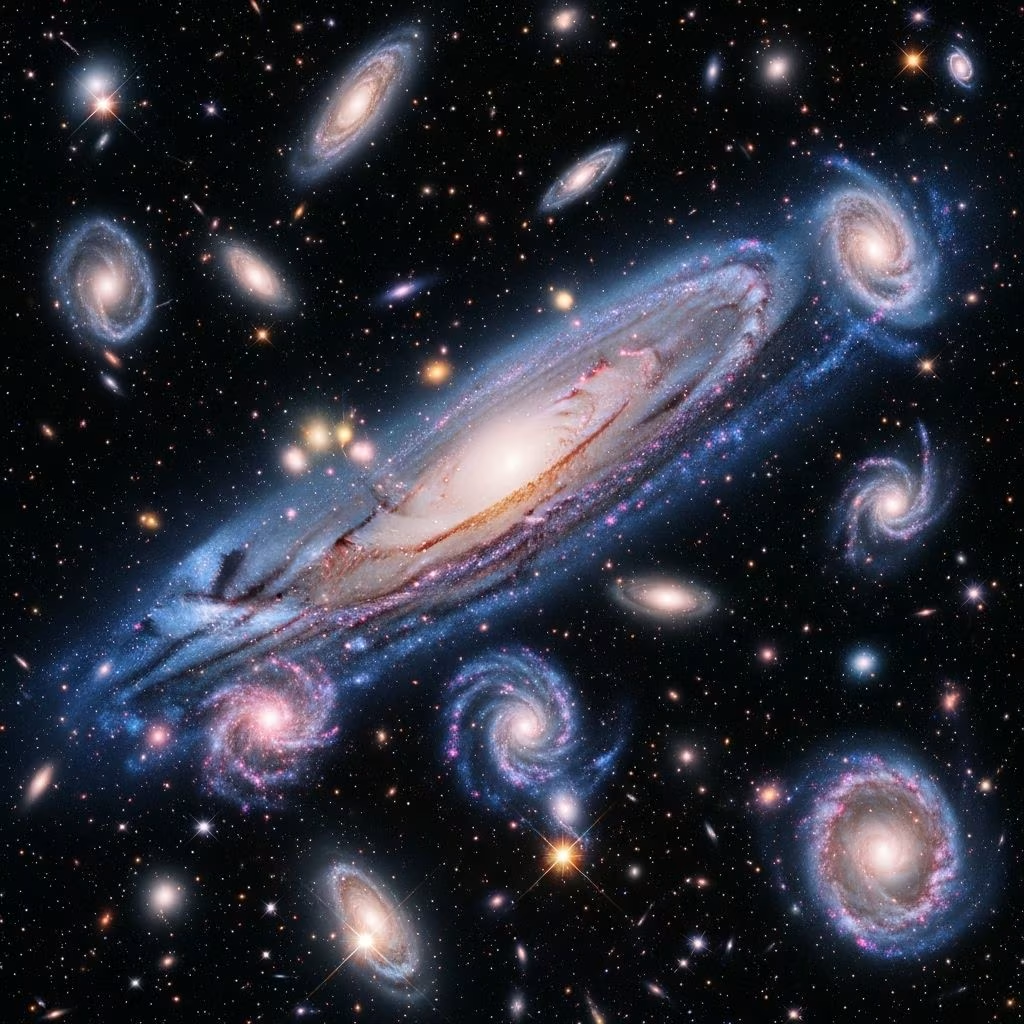
- Edwin Hubble’s Discoveries: In the 1920s, Hubble observed that “island universes”—what we now call galaxies—existed far beyond the Milky Way. He further found that these galaxies, regardless of their position, were receding from us. This revelation suggested the cosmos itself was expanding.
- Einstein’s Contribution: Einstein’s general theory of relativity had predicted that the universe was dynamic—not static, as previously believed. This led to the formation of the Friedmann-Lemaître-Robertson-Walker (FLRW) metric, a set of equations forming the backbone of modern cosmology.
Together, these discoveries revealed that the universe is not static. Instead, it began as a dense, hot state called the Big Bang and has been expanding ever since. But does this mean there is a central point from which everything originated?
There Is No Center of the Universe
Despite what intuition might suggest, there is no center of the universe. Scientific evidence and theoretical frameworks challenge the very idea of a cosmic heart or edge.
Why Is There No Center?
- No Edge — No Center: The universe, by definition, is everything that exists. If there is nothing outside it, there is no edge—and without an edge, a center cannot be defined.
- Infinite or Finite, But Unbounded: The universe might be infinite, so pointing to a center is logically impossible. Alternatively, if finite, cosmologists believe it likely curves back on itself, like the surface of a sphere. In this view, traveling far enough in any direction would eventually bring you back to your starting point—without encountering an edge.
Analogy: The Surface of the Earth
The surface of Earth provides a compelling analogy.
- Earth’s Core vs. Surface: The planet’s core is at the heart of a three-dimensional sphere, but the surface of the Earth—our everyday world—is two-dimensional and unbounded. No matter where you stand, you’re never at the center of the surface; any location could be considered the center.
- Walking Around the Globe: If you walk far enough on the planet’s surface, you’ll return to your starting point. The surface has no edge, and the concept of a center is arbitrary.
By analogy, if the universe curves in higher dimensions, the whole cosmos could be finite but without an edge or center—even if we can’t visualize it directly.
The Big Bang: Not a Point in Space
Common misconceptions present the Big Bang as an explosion from a particular point in the void. In reality, the Big Bang was not a location in space; it was rather a moment in time.
- Happened Everywhere at Once: The Big Bang occurred everywhere in the universe simultaneously—including precisely where you are right now.
- Expansion of Space: It wasn’t matter expanding into preexisting space. Instead, space itself expanded. Every part of the universe began stretching away from every other part.
This means the universe did not expand from a central spot. Modern cosmology regards the Big Bang as the beginning of the observable universe’s timeline, not its physical location.
Where Is the Big Bang?
- Every Point Is the Starting Point: Every observer, from any galaxy, can look back in time to the Big Bang. No spot is more central than another.
- The Big Bang as an Event: Rather than a blast from a specific place, the Big Bang is an event embedded in every region of space equally, marking the start of expansion for all.
Expanding Universe: What Exactly Is Expanding?
The universe’s expansion remains one of cosmology’s most profound insights—but what precisely is expanding?
- Not Into Anything: The universe is not expanding “into” something else. Instead, space itself is stretching, causing everything within it to move apart.
- No Privileged Location: As seen from any point in space, the expansion appears uniform in all directions. Each observer sees everything else moving away. This does not put any location at the center but makes every spot appear “central” from its own frame of reference[12].
- Infinite or Unbounded Expansion: If infinite, the universe never has a center to its expansion. If finite but unbounded, like the globe’s surface, expansion lacks a center.
What About Edges? Cosmic Boundaries
Another natural question is about the edge of the universe.
- By Definition, No Edge: The universe contains all that exists; thus, there can be no “outside” or observable edge.
- Observable Universe: What we can see—the observable universe—is limited by the travel time of light, not by physical boundaries. Beyond our observable horizon, there may be far more universe we just cannot detect.
Geometry of the Universe: Finite or Infinite?
Cosmological models have debated whether the universe is ultimately finite or infinite.
- Finite and Unbounded: Like Earth’s surface, the cosmos could be finite yet have no edges, curving back on itself through dimensions we can’t readily imagine. This means traveling space would never bring you to a boundary or center.
- Infinite: If truly infinite, then any location is as good as any other—no place could ever serve as a cosmic center.
- Current Evidence: Observations suggest the universe is flat on large scales, which lends weight to the infinite model, but the ultimate topology remains an open question in cosmology.
| Model | Has Center? | Edge? | Analogy |
|---|---|---|---|
| Infinite Euclidean | No | No | Flat plane |
| Finite & Unbounded (Curved) | No | No | Surface of a sphere |
| Finite & Bounded | Yes | Yes | Ball with surface boundary |
A Central Observer: Every Location Is “Central”
One of the most intriguing philosophical implications of cosmic expansion is that every observer—regardless of location—perceives themselves as standing at the center. Yet, cosmology tells us that no place is truly privileged.
- Cosmic Principle: The laws of physics are uniform throughout the cosmos. Each observer’s viewpoint is just as valid as any other’s; our position in the universe is not special[12].
- Is Earth at the Center? Historical models held Earth as special—the geocentric view—but modern science firmly rejects this. Earth is not the center. Neither is any galaxy, star, or planetary system[10].
- Observable Universe Center: Each observer’s “observable universe” is centered on them, limited only by how far light has traveled since the Big Bang.
Unraveling Common Myths
- The Big Bang was an explosion in space. False: The Big Bang marks the origin of space and time itself, not a blast from a point.
- The universe is expanding into something else. False: Space itself is growing; there is no external void into which the cosmos spreads.
- The universe has an edge and center. False: Current models offer no evidence for edges or center points.
Frequently Asked Questions (FAQ)
-
Q: Where is the center of the universe?
A: There is no center. Every location in the universe is equally valid; the cosmos expands everywhere at once.
-
Q: Did the Big Bang occur at a specific place?
A: No, the Big Bang was a moment in time happening everywhere simultaneously. It did not erupt from a spatial point.
-
Q: Is Earth special or central in the universe?
A: No. Earth’s position is not privileged; from the viewpoint of any observer, their location appears central to their observable universe, but this is true everywhere[12].
-
Q: What does it mean for the universe to be finite but unbounded?
A: It means the universe could have a limited size but no edges—like the surface of a sphere, where traveling indefinitely never encounters a border.
-
Q: Is there an edge to the universe?
A: No. The universe encompasses everything; an edge would require an outside region, which by definition does not exist.
Further Reading
- Space.com: Where is the center of the universe?
- IFLScience: Why There Is No Center Of The Universe?
- Wikipedia: Geocentrism
- Jagran Josh: Where is the centre of the universe?
Summary
Modern cosmology demonstrates that the universe has no center, challenging centuries of intuition. The Big Bang was a temporal, not a spatial, event. The universe has no edge; its expansion is everywhere and nowhere at once. Cosmology’s profound message: humanity does not occupy a privileged place in the cosmos. Instead, every point in space is equally valid—a realization as humbling as it is wondrous.
References
- https://www.space.com/where-is-the-center-of-the-universe
- https://www.space.com/astronomy/experts-ask-where-the-center-of-the-universe-is
- https://www.jagranjosh.com/general-knowledge/where-is-the-centre-of-the-universe-1820000938-1
- https://en.wikipedia.org/wiki/Center_of_the_universe
- https://www.iflscience.com/why-there-is-no-center-of-the-universe-69143
- https://www.astronomy.com/science/ask-astro-where-is-the-center-of-the-universe/
- https://www.youtube.com/watch?v=BOLHtIWLkHg
- https://math.ucr.edu/home/baez/physics/Relativity/GR/centre.html
- https://bigthink.com/starts-with-a-bang/true-center-universe/
- https://en.wikipedia.org/wiki/Geocentrism
- https://journalofcosmointel.com/index.php/journalofcosmointel/article/view/185
- https://www.mentalfloss.com/article/54573/scientific-evidence-you-are-and-arent-center-universe
- https://www.worldatlas.com/space/is-there-a-center-of-the-universe.html
- https://bigthink.com/starts-with-a-bang/where-exactly-is-the-center-of-the-universe/
- https://universemagazine.com/en/each-of-us-is-the-center-of-the-universe-paradox-of-space-expansion/
- https://www.zmescience.com/feature-post/space-astronomy/cosmology/where-is-the-center-of-the-universe-or-is-there-even-one/
- https://futurism.com/where-did-the-big-bang-happen-wheres-the-center-of-the-universe