When Is the Next Total Solar Eclipse Visible in the U.S.?
The wait for the next total solar eclipse over the United States is a long one: after the dramatic event of April 8, 2024, Americans will not witness another total solar eclipse until 2044. The upcoming eclipses are some of the rarest, awe-inspiring phenomena in astronomy, captivating millions across North America whenever the moon fully blocks the sun.
Highlights from the April 8, 2024 Total Solar Eclipse
- The 2024 eclipse swept across North America, starting in Mexico, crossing through Texas and 15 U.S. states—including Oklahoma, Illinois, Ohio, Pennsylvania, New York, Vermont, New Hampshire, and Maine—before moving into Canada and exiting the continent.
- Millions viewed either a partial or total eclipse; only those in the path of totality saw daylight transform into sudden darkness.
- Virginia Tech astrophysicist Nahum Arav describes totality as “a black hole in the sky,” a memory that stays with witnesses for a lifetime.
Understanding Solar Eclipses
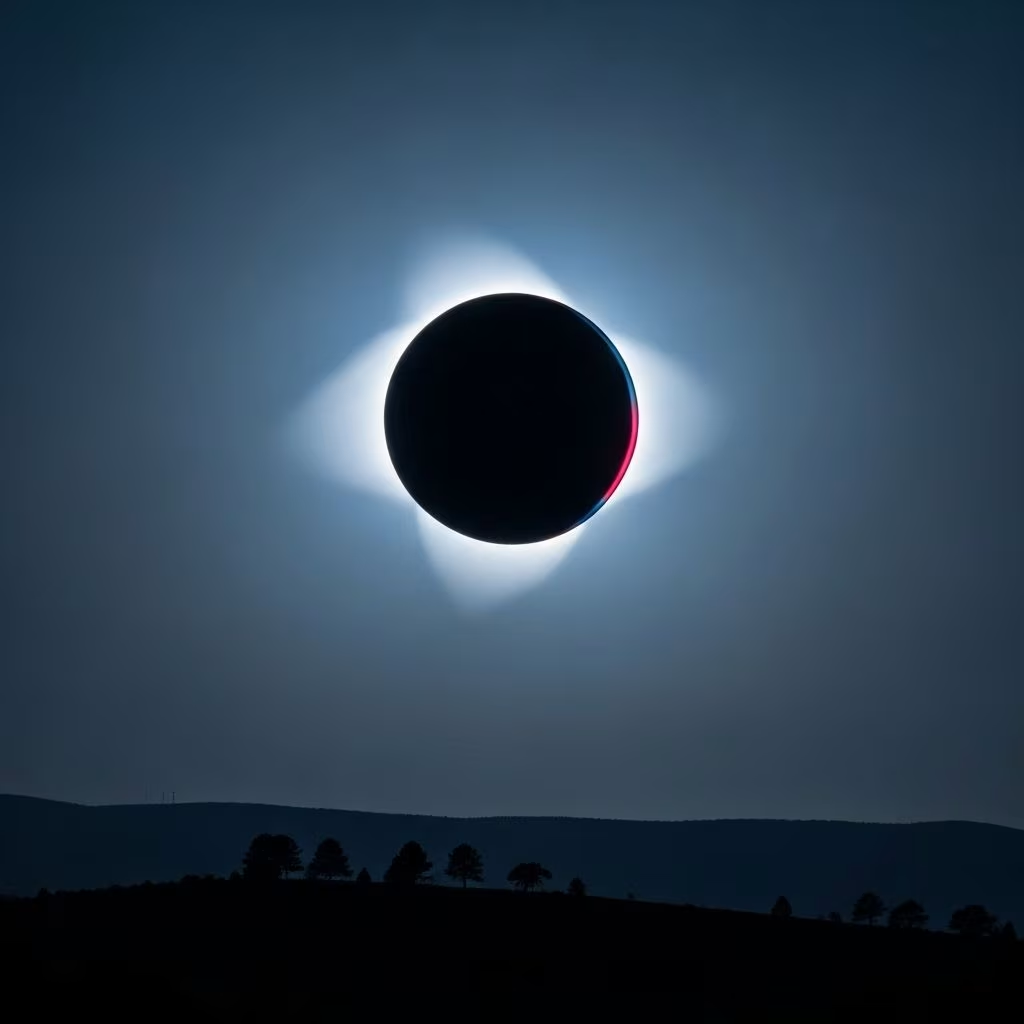
A solar eclipse occurs when the Moon passes directly between the Earth and the Sun, casting a shadow over parts of Earth. During a total solar eclipse, the Moon completely covers the Sun, resulting in an eerie midday darkness for observers in the path. Eclipses are predicted with exceptional precision due to their regularity and well-understood orbital mechanics.
Why Are Total Solar Eclipses So Rare in the U.S.?
The alignment required for totality—a perfect match of the Sun, Moon, and Earth—makes total solar eclipses visible from any given location infrequent. While partial eclipses occur more regularly, total eclipses traverse narrow bands across continents, sometimes missing populated regions altogether.
The Timeline: Upcoming Total Solar Eclipses in the United States
After April 2024’s spectacle, astronomy enthusiasts must look decades ahead for another chance to experience totality within U.S. borders. Below is a summary table of future total solar eclipses with paths crossing the U.S. through the 21st century.
| Date | Eclipse Type | U.S. Viewability | States/Regions in Path of Totality |
|---|---|---|---|
| April 8, 2024 | Total Solar | Path Traverses U.S. | Texas, Oklahoma, Arkansas, Missouri, Illinois, Indiana, Ohio, Pennsylvania, New York, Vermont, New Hampshire, Maine |
| August 23, 2044 | Total Solar | Limited States | Montana, North Dakota, South Dakota |
| August 12, 2045 | Total Solar | Widespread | California, Nevada, Utah, Colorado, Kansas, Oklahoma, Texas, Arkansas, Missouri, Illinois, Indiana, Ohio, Kentucky, West Virginia, Virginia, Georgia, Florida |
| March 30, 2052 | Total Solar | Southern U.S. | Pensacola FL, Tallahassee FL, Savannah GA, Charleston SC |
| May 11, 2078 | Total Solar | Southeast U.S. | New Orleans LA, Montgomery AL, Atlanta GA, Charlotte NC, Virginia Beach VA |
| May 1, 2079 | Total Solar | Northeast U.S. | Portland ME, Manchester NH, Boston MA, Hartford CT, New York NY, Philadelphia PA |
| September 14, 2099 | Total Solar | Central, Southeastern U.S. | (Path details to be confirmed) |
Key Details on Major Upcoming U.S. Total Solar Eclipses
2044: The Northern States Eclipse
The next total solar eclipse visible from the contiguous U.S. after 2024 happens on August 23, 2044, but only three states—Montana, North Dakota, South Dakota—fall within the narrow path of totality.
- Especially rare opportunity for observers in northern states.
- Brief episode of midday darkness over rural, sparsely populated regions.
2045: Widespread Visibility
The total solar eclipse of August 12, 2045 will sweep across more than a dozen states, from California and Nevada to Florida, creating one of the widest and most accessible paths of totality in U.S. history.
- Major cities and densely populated areas will have optimal viewing possibilities.
- An ideal time for planning extended travel or regional events around totality.
2052: Southeastern Showcase
On March 30, 2052, the southeastern U.S. will witness a dramatic total solar eclipse. Cities such as Pensacola and Tallahassee (Florida), Savannah (Georgia), and Charleston (South Carolina) are within the path, promising another rare spectacle.
2078: Deep South Path
- May 11, 2078: Totality will reach much of the Deep South, from New Orleans and Montgomery to Atlanta, Charlotte, and Virginia Beach.
- Generations may need to wait, but planning ensures a front-row seat to astronomical history.
2079: Major Northeastern Cities Experience Totality
- May 1, 2079 eclipse path includes urban centers: Portland, Manchester, Boston, Hartford, New York City, and Philadelphia.
- For many, this will be a chance to witness totality close to home in densely populated metropolitan areas.
Astronomical Certainty: How Eclipses Are Predicted
Scientists forecast eclipses with “Swiss clock” accuracy. Detailed astronomical models track the movements of the moon, earth, and sun, enabling predictions decades (or centuries) in advance.
- Eclipse paths are computed using orbital mechanics and observations, ensuring nearly mistake-proof predictions.
- Precise times, durations, and locations are publicized years ahead, often spurring tourism and educational outreach.
How to View a Total Solar Eclipse Safely
Viewing totality directly is safe only when the sun is 100% covered by the moon. Outside of this brief phase, observers must use certified eclipse glasses or indirect viewing instruments (like pinhole projectors) to protect their eyes from dangerous solar radiation.
- Direct naked-eye viewing is possible only during full totality.
- Partial phases require specialized solar viewing protection.
- Professional astronomy groups and public science agencies often offer safety advisories and distribute protective glasses for major events.
Partial and Annular Eclipses: Frequent but Less Dramatic
While total eclipses remain infrequent, Americans will witness several partial solar eclipses and annular solar eclipses—where the moon covers only part of the sun or creates a bright ring effect. These events also draw public interest and are worth experiencing with proper solar safety measures.
- October 2, 2024: Annular solar eclipse with partial visibility in South Pacific and South America. Southern Chile and Argentina see the full “ring of fire” effect.
- March 29, 2025 & September 21, 2025: Partial solar eclipses visible from parts of the Eastern Hemisphere.
Recent and Upcoming U.S. Lunar Eclipses
Lunar eclipses occur when the Earth’s shadow passes over the moon. These are more common and often visible from larger regions. The next significant lunar eclipse for the U.S. occurs on September 7, 2025, viewable from Europe, Africa, Asia, and Australia.
- March 13-14, 2025: Total lunar eclipse seen over North and South America, with totality lasting more than an hour for many observers.
- Lunar eclipses typically do not require eye protection and can be viewed safely with the naked eye.
Solar Eclipse Travel and Community Events
Whenever an eclipse path passes through populated regions, localities often organize viewing gatherings, science fairs, and public lectures. Astronomical clubs, observatories, and museums become pilgrimage spots for enthusiasts. Planning ahead is essential given the decades between prime eclipse events in the U.S.
- Large cities on the path of totality host major festivals, hotel bookings spike, and dedicated tour packages are offered for optimal viewing.
- Community engagement amplifies scientific literacy and public appreciation of natural phenomena.
Solar Eclipse Superstitions and Folklore
The dramatic visual effect of solar eclipses has inspired myths and superstitions for centuries:
- Some cultures believe banging drums during an eclipse brings good luck or scares away evil spirits.
- Folklore connects eclipses with life-changing omens, disruption of cosmic order, or messages from the gods.
Frequently Asked Questions (FAQs)
Q: When is the next total solar eclipse visible in the continental U.S.?
A: The next total solar eclipse will occur on August 23, 2044, and will be visible in parts of Montana, North Dakota, and South Dakota.
Q: What was the path of the April 8, 2024 total solar eclipse?
A: The path stretched from Mexico across Texas into the Midwest and Northeast, covering 15 states before exiting into Canada.
Q: How often do total solar eclipses occur in the U.S.?
A: Total solar eclipses occur about every 20 years somewhere in the contiguous U.S., though paths are narrow and may miss populated regions.
Q: What is the difference between a partial and total solar eclipse?
A: In a partial eclipse, only part of the sun is obscured by the moon, whereas in a total eclipse the moon fully covers the sun, resulting in darkness during midday.
Q: What safety precautions should be taken when viewing an eclipse?
A: Always wear solar-rated eclipse glasses except for the seconds or minutes of full totality. Never look directly at the sun without protection.
Preparation Tips for Future Eclipses
- Check eclipse forecasts and maps published years in advance by NASA, astronomy societies, and weather agencies.
- Reserve travel, accommodation, and event tickets early in regions lying within the path of totality.
- Organize and participate in community outreach, local astronomy clubs, and educational events to build excitement and awareness.
Conclusion: A Timeless Spectacle Worth Waiting For
While the wait for the next U.S. total solar eclipse stretches across decades, its celestial drama remains unmatched in human experience. As you mark your calendars for 2044, 2045, and beyond, remember that careful planning, safe viewing, and participation in shared scientific wonder make each eclipse a once-in-a-lifetime event for millions of observers.
References
- https://science.nasa.gov/eclipses/future-eclipses/
- https://www.timeanddate.com/eclipse/2025
- https://en.wikipedia.org/wiki/List_of_solar_eclipses_visible_from_the_United_States
- https://www.britannica.com/topic/Eclipses-in-2024-2025-and-2026
- https://www.weather.gov/fsd/suneclipse
- https://www.cbsnews.com/news/next-total-solar-eclipse-2044-2045/
- https://www.farmersalmanac.com/lunar-and-solar-eclipses
- https://www.timeanddate.com/eclipse/list.html
- https://science.nasa.gov/eclipses/
- https://skyandtelescope.org/observing/solar-and-lunar-eclipses-in-2025/
- https://www.usatoday.com/story/news/nation/2025/08/01/solar-eclipse-august-2-2027/85441432007/
- https://www.greatamericaneclipse.com/future
- https://www.space.com/when-next-total-solar-eclipse-us
- https://preventblindness.org/solar-eclipses/september-21-2025-partial-solar-eclipse/
- https://www.usatoday.com/story/news/world/2025/09/19/partial-solar-eclipse-september-2025/86236023007/
- https://en.wikipedia.org/wiki/Solar_eclipse_of_September_21,_2025
- https://www.space.com/stargazing/solar-eclipses/no-the-whole-world-wont-go-dark-on-aug-2-but-a-once-in-a-century-eclipse-is-coming