February 2025 brings an extraordinary astronomical event—a planetary parade, where seven of our solar system’s planets will align visibly across the night sky. This phenomenon provides an unmissable opportunity for stargazers and astronomy enthusiasts worldwide. Here’s your comprehensive guide to the event, with tips to maximize your viewing experience and understand the science behind this rare alignment.
What Is a Planetary Parade?
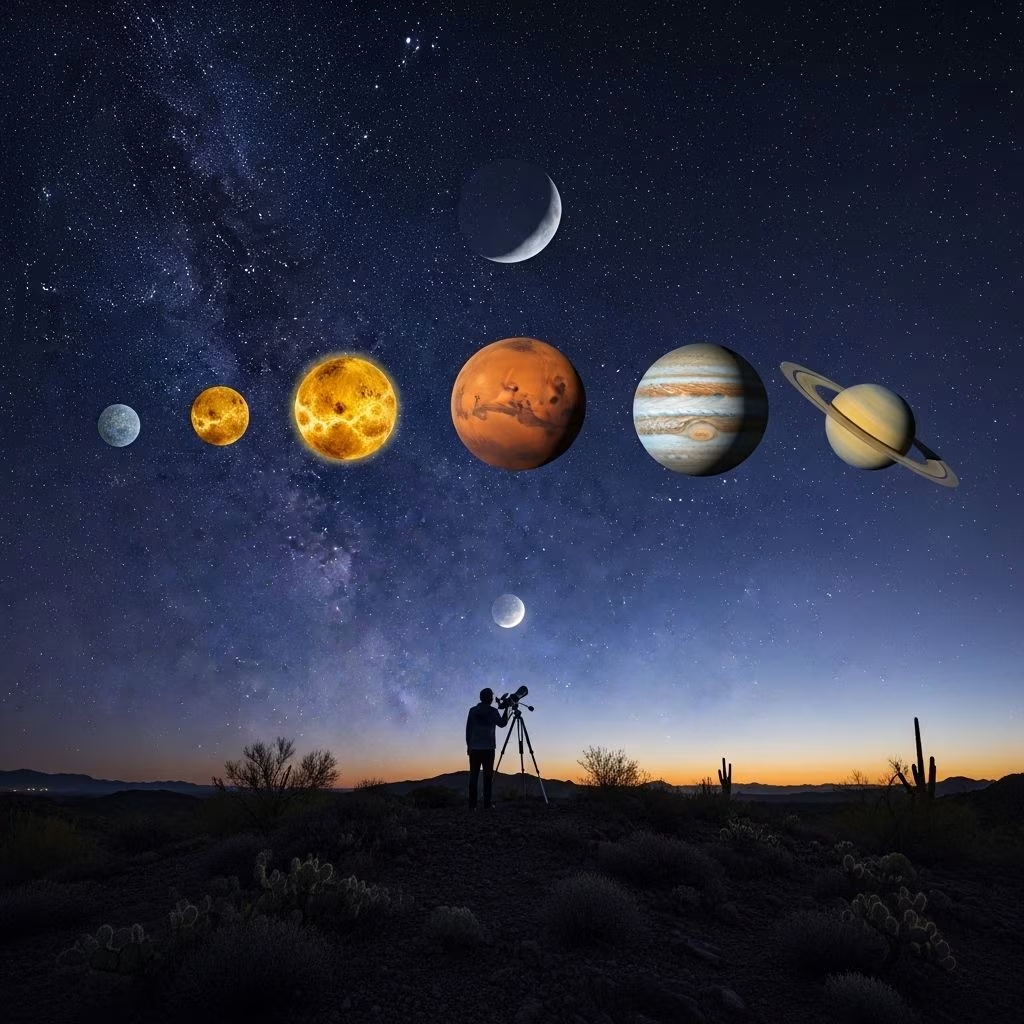
A planetary parade—also known as a planetary alignment—occurs when multiple planets appear along the same section of the sky from our perspective on Earth. Despite not physically lining up in a perfect row in space, their positions in the ecliptic plane group them visually in a captivating arc across the heavens. Such events are relatively rare and especially notable when several planets become visible simultaneously with the naked eye or modest optical aid.
- ‘Planetary parade’ or ‘alignment’ are terms used interchangeably to describe this spectacle.
- Anywhere from three to all visible planets can participate in such an alignment.
- For the 2025 event, a remarkable seven planets participate.
Which Planets Align in February 2025?
On February 28, 2025, seven planets will form a parade across the night sky. The planets participating in this alignment are:
- Mercury
- Venus
- Mars
- Jupiter
- Saturn
- Uranus
- Neptune
Of these, Mercury, Venus, Mars, Jupiter, and Saturn will be visible to the naked eye under clear skies. Uranus and Neptune are fainter and will require binoculars or a telescope to observe.
| Planet | Visibility | Special Notes |
|---|---|---|
| Mercury | Naked eye (low on horizon after sunset) | Can be tricky due to its proximity to the Sun |
| Venus | Naked eye | Brightest planet—near Pisces constellation |
| Mars | Naked eye | Reddish hue, near Gemini constellation |
| Jupiter | Naked eye | Near Taurus; very bright |
| Saturn | Naked eye (with effort) | Low, may be harder to spot due to Sun |
| Uranus | Binoculars/telescope | Faint blue-green, east of Jupiter |
| Neptune | Telescope | Dim blue dot; near Venus/Pisces |
Why Is the 2025 Planetary Parade Special?
The February 2025 planetary alignment stands out for two main reasons:
- Seven planets participate—a rare occurrence. The next similar event is not expected until 2040.
- Widespread visibility: The parade is observable from most locations worldwide, with peak visibility spanning several days.
This spectacle offers a unique chance to witness most of the solar system’s planets with ease. For many skywatchers, it may be a once-in-a-lifetime event.
When to See the Planetary Parade: Key Dates and Times
February 28, 2025 marks the parade’s peak, but the alignment spans from mid-January to early March. Depending on your latitude, you may see the grouping for several evenings before or after the main event.
- Peak Date: February 28, 2025
- Viewing Window: Shortly after sunset, typically 6:30 PM to 9:00 PM local time
- Duration: Visible for a few hours after dusk, best immediately after the Sun sets
Regional highlights:
- Tokyo: Parade first visible on February 22.
- New York: Best views on February 25.
- Western Europe: Excellent visibility within the last days of February and first week of March.
- Other parts of the world: Sightings possible through early March, depending on local conditions.
Where to Observe: Best Locations for Stargazing
The planetary parade is visible worldwide, provided you have clear skies and an unobstructed western horizon shortly after sunset. To maximize your viewing experience:
- Find a location with minimal light pollution, such as rural sites or designated dark sky parks.
- Choose a spot with an unobstructed view of the western horizon.
- Elevated terrain (hilltops, observatory decks) can help if your landscape has many obstructions.
- Avoid city lights for the best view, especially if you wish to glimpse Uranus and Neptune with optical aid.
How to Watch the Planetary Parade: Practical Tips
- Timing is crucial: Arrive before sunset and prepare to scan the sky during twilight, as Mercury and Venus set quickly.
- Use sky maps, star charts, or mobile apps to help pinpoint planetary positions by constellation.
- Start by locating Venus—the brightest planet—then work outward to spot others.
- Binoculars or small telescopes are essential for viewing Uranus and Neptune and enhance the experience for Saturn’s rings or Jupiter’s moons.
- Allow your eyes to adjust to the dark before expecting to see fainter planets.
- Dress comfortably for the weather; bring a chair or blanket for extended viewing sessions.
Planet Positions and Visual Appearance
Each planet will occupy a different place in the sky in relation to notable constellations:
- Mars: High above the horizon, glowing reddish near Gemini.
- Jupiter: Lower in the sky, near Taurus, easy to spot due to its brightness.
- Venus: Exceptionally bright, near Pisces.
- Mercury and Saturn: Both low to the horizon; Mercury appears briefly after sunset, while Saturn may be partially lost in twilight glare.
- Uranus: Slightly east of Jupiter, best seen with optical aid.
- Neptune: Near Venus, but requires a telescope; faint bluish speck.
How Planetary Alignments Occur
Planets orbit the Sun at various speeds and distances. Occasionally, from Earth’s perspective, several planets appear clustered close together, following the narrow band of the ecliptic. This apparent alignment is a product of cyclical orbital movements, not a true 3D line-up in space.
- Such alignments are rare because they require the right orbital configuration.
- Not all planets are equally spaced: the alignment is visual, not physical.
Next Planetary Parades: When’s the Next One?
If you miss the 2025 event, you’ll need to wait many years for a similar alignment. The next large-scale planetary parade involving this many planets isn’t forecast until 2040.
- Smaller alignments (3–5 planets) occur more often, but a seven-planet parade is exceptionally infrequent.
Photographing the Planetary Parade: Astrophotography Tips
- Use a sturdy tripod and a camera capable of long exposures.
- Choose a wide-angle lens to capture the full spread of planets across the horizon.
- Shoot during blue hour (twilight) when the planets are brightest and the sky darkens gradually.
- Bracket exposures to ensure you capture both bright and faint planets.
- Use planetarium software or star chart apps to plan your framing in advance.
Why This Event Matters: Educational and Cultural Value
Planetary parades stir wonder and curiosity, making them ideal for public science events, school activities, and personal exploration. They remind us of our place in the cosmos and often inspire budding astronomers worldwide.
- Perfect opportunity for families and communities to observe together.
- Many observatories and astronomy clubs hold special viewing nights—check local listings.
- Great moment to start or rekindle a passion for stargazing!
Frequently Asked Questions (FAQ) about the February 2025 Planetary Parade
Q: Will all seven planets be in a straight line?
A: From Earth, the planets will appear in a visually clustered arc along the ecliptic—not a perfect straight line, but close enough to be counted as a spectacular alignment.
Q: Can I see all planets without a telescope?
A: You can see Mercury, Venus, Mars, Jupiter, and Saturn with the naked eye (weather permitting). Uranus and Neptune require binoculars or a telescope.
Q: What if I miss the peak night?
A: There will be a several-day window before and after February 28 when the alignment is still visible. Check local sky conditions and sunset times to maximize your chances.
Q: Why are planetary parades so rare?
A: The rarity stems from the differing orbital speeds and periods of each planet; it takes many years for such a configuration to repeat.
Q: Are there any safety concerns while stargazing?
A: Ordinary stargazing is safe—just avoid looking at or near the Sun with optical devices and select safe locations free of traffic or hazards in the dark.
Additional Stargazing Tips
- Bring warm clothes, snacks, and a red-light flashlight to preserve your night vision.
- Help children and newcomers by pointing out Venus first, then guide them to other planets by position.
- Check weather forecasts in advance to choose the clearest possible night.
- Plan a local stargazing event—these moments are more memorable when shared!
Summary Table: 2025 Planetary Parade Quick Facts
| Feature | Details |
|---|---|
| Date of Peak | February 28, 2025 |
| Number of Planets | 7 |
| Naked-Eye Visible Planets | Mercury, Venus, Mars, Jupiter, Saturn |
| Optical Aid Needed | Uranus, Neptune |
| Observed Best | Shortly after sunset in western sky |
| Next Similar Event | 2040 |
Further Reading and Resources
- Explore real-time sky simulation apps for your region.
- Check astronomy websites for live webcasts if cloud cover prevents observation.
- Read more on planetary orbits and how alignments are predicted.
References
- https://www.skyatnightmagazine.com/news/planetary-alignment-2025
- https://www.youtube.com/watch?v=tRKn7d9K6uk
- https://www.space.com/stargazing/planetary-parade-february-2025-when-where-and-how-to-see-it
- https://starwalk.space/en/news/what-is-planet-parade
- https://www.youtube.com/watch?v=1UC26OGoIZ8
- https://www.wdef.com/planetary-parade-2025-what-to-know-as-7-planets-align-in-the-night-sky/
- https://www.space.com/watch-planetary-parade-february-2025-online-free-today
- https://science.nasa.gov/solar-system/skywatching/planetary-alignments-and-planet-parades/
- https://www.cbsnews.com/news/planetary-parade-january-february-planets-align-how-to-see/
- https://abc7.com/post/when-see-planet-parade-2025-keep-eye-venus-tonight-help-spot-rest-planets-night-sky-astronomers-say/15962974/
- https://timesofindia.indiatimes.com/etimes/trending/planet-parade-2025-the-best-time-and-places-to-watch-the-celestial-wonder-in-the-usa-today/articleshow/118630055.cms
- https://www.planetary.org/articles/calendar-of-space-events-2025
- https://www.jagranjosh.com/general-knowledge/february-planet-parade-2025-check-date-time-and-how-to-watch-rare-celestial-event-1740123436-1
- https://www.celestron.com/blogs/news/planetary-parade
- https://indianexpress.com/article/technology/science/planetary-parade-feb-28-2025-how-when-to-spot-all-planets-9859580/
- https://phys.org/news/2025-02-rare-planetary-parade-sky-tonight.pdf
- https://blog.joshuniverse.com/blog/2025-planetary-parade-a-skywatchers-guide/