Unveiling Planet Nine: The Search for the Solar System’s Hidden Giant
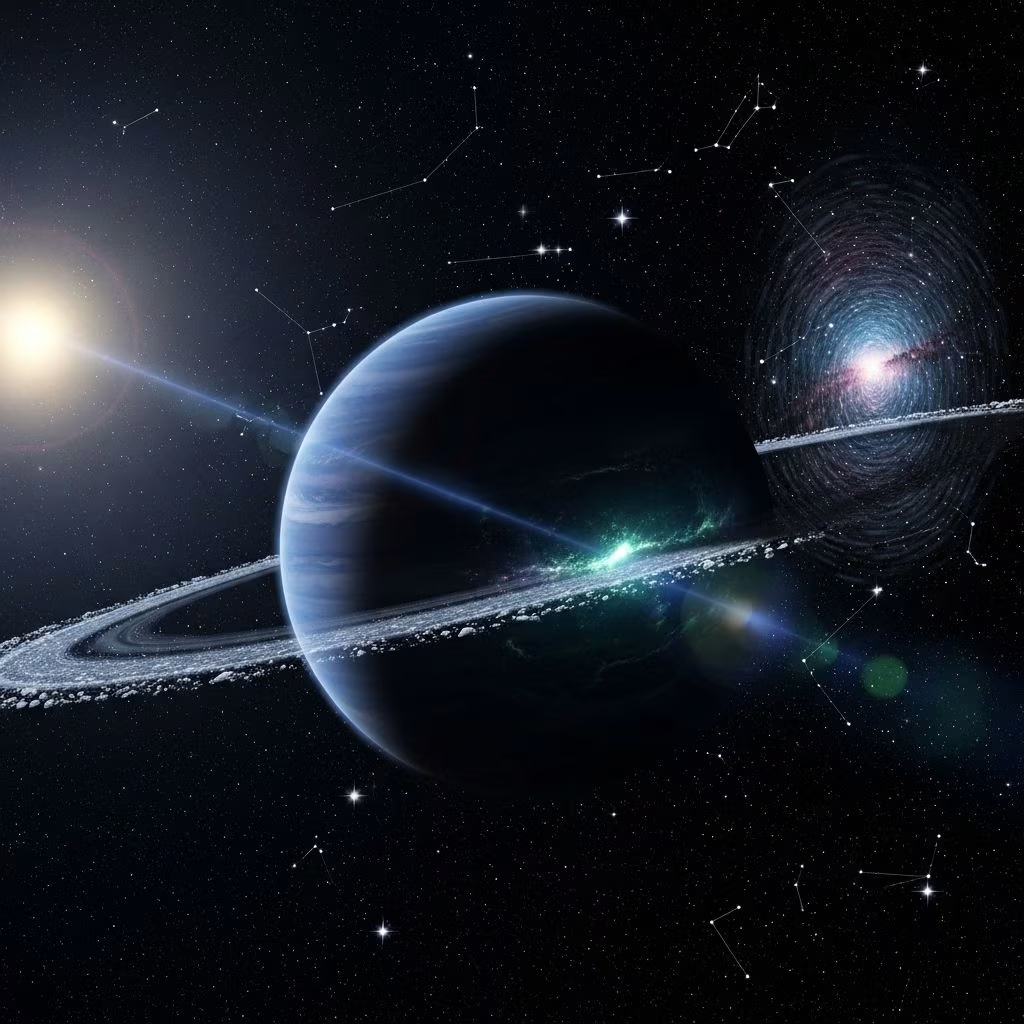
For decades, the outer reaches of our solar system have harbored a tantalizing mystery—a massive, unseen world theorized to shape the orbits of distant objects beyond Neptune. Recently, through an exhaustive analysis of deep infrared sky surveys taken 23 years apart, astronomers have identified the most compelling candidate yet for Planet Nine, a hypothetical planet whose existence could revolutionize our understanding of solar system architecture.
What is Planet Nine?
Unlike the older “Planet X” concept, which was proposed primarily to explain perceived regularities in mass extinctions on Earth and the supposed influx of comets, Planet Nine refers specifically to a super-Earth-sized world theorized in 2016 by astronomers Michael Brown and Konstantin Batygin to account for unusual orbital clustering found among objects in the Kuiper Belt, such as Sedna.
- Mass: Estimated to be several times that of Earth and greater than Neptune.
- Distance: Believed to orbit the sun at about 700 astronomical units (AU) — 700 times farther than Earth is from the sun.
- Eccentric Orbit: Its path likely extends far into the solar system, making detection extremely difficult.
At such distances, this world would be faint in visible light but expected to shine brighter in the mid- and far-infrared spectrum.
The Evidence: Infrared Sky Surveys 23 Years Apart
Recent progress in the hunt for Planet Nine comes from the analysis of data gathered by two pioneering infrared satellites:
- Infrared Astronomy Satellite (IRAS): Launched in 1983, IRAS mapped the infrared universe for nearly a year before decommissioning.
- AKARI Satellite: Operated by the Japanese Aerospace Exploration Agency (JAXA), active from 2006 to 2011, continuing the deep sky infrared survey.
Astronomer Terry Long Phan and colleagues at National Tsing Hua University, Taiwan, searched the IRAS and AKARI archives, aiming to spot objects that shifted position over the 23-year gap, a telltale sign of a distant solar system body.
The team discovered an object exhibiting movement of about 47 arcminutes over the intervening years—a tiny but significant change, consistent with predictions for Planet Nine’s slow progression against background stars at an estimated distance of 700 AU[11].
Accounting for Parallax: Measuring Motion in Deep Space
- As Earth circles the sun, our vantage point changes, causing apparent shifts (parallax) in the observed position of very distant objects.
- This effect had to be meticulously corrected to distinguish intrinsic movement from perspective-induced displacement.
Analysts compared an object’s location relative to stars in the IRAS (1983) and AKARI (2006–2011) epochs, searching for precisely the signature a distant planet would leave over decades[11].
Scientific Context: Theoretical Roots of Planet Nine
The birth of the Planet Nine hypothesis traces back to the discovery of strange groupings among the orbits of trans-Neptunian objects (TNOs)—bodies with orbits beyond Neptune. Extreme TNOs (ETNOs), like Sedna, display peculiar alignment and orbital tilts that seem best explained by the gravitational influence of a massive unseen perturber.
- Orbital Clustering: Thirteen large ETNOs show odd clustering and tilts, supporting the Planet Nine scenario.
- Perihelion Variations: Their closest approach to the sun varies in a pattern consistent with perturbations from a distant planet.
- Highly Inclined Orbits: Populations of objects with orbits askew from the main plane further bolster the case for Planet Nine’s gravitational effects.
This cumulative evidence led Brown and Batygin to suggest that our solar system possesses an as-yet-undetected ninth planet—one far beyond Pluto.
How Does Planet Nine Differ from “Planet X”?
| Feature | Planet Nine | Planet X |
|---|---|---|
| Origin of theory | 2016 (Brown & Batygin) | Early 20th century |
| Purpose | Explain Kuiper Belt object orbits | Explain comet influx, hypothesized mass extinctions |
| Evidence | Orbital clustering, ETNO tilts | Periodic cometary events (now disputed) |
| Current status | Strong candidate found (2023) | Poor evidence, largely discredited |
The Hunt Continues: Modern Technologies and Future Prospects
Despite promising infrared evidence, direct observation of Planet Nine remains elusive. The challenge lies in its faintness at enormous distances and its slow drift against background stars, requiring sensitive instruments and long-term sky monitoring.
- Vera C. Rubin Observatory: Under construction, this facility will offer comprehensive surveys capable of detecting faint, distant solar system bodies.
- Area coverage: A substantial portion of the predicted search zone has been eliminated by previous null results; ongoing and future observatories have an increasingly high probability of capturing Planet Nine if it exists.
Advancements in computational techniques and deep learning will further enhance astronomers’ ability to sift through vast datasets, correlating multiple survey epochs for subtle motion signatures.
Alternative Theories: Is Planet Nine a Captured Exoplanet?
Recent speculation suggests that Planet Nine might not have formed alongside the other solar system planets, but could instead be a planetary body captured from another star’s entourage billions of years ago[11]. If true, its existence could provide clues not only about our solar system’s past but also about the exchange of celestial bodies among stars in the crowded early galaxy.
- Such a capture could account for its unusual orbit and the gravitational peculiarities observed in distant TNOs.
- A definitive determination awaits direct spectral analysis and orbital mapping from future telescopes.
Planet Nine’s Possible Influence in the Solar System
- Orbital Shaping: The planet could be responsible for the remarkable bunching and tilting observed in the Kuiper Belt’s most distant objects.
- Cometary Dynamics: Its gravitational reach may explain patterns of comet influx toward the inner solar system, although previous links to mass extinctions are now considered unsupported.
- Extended Solar System: The existence of such a remote world would fundamentally revise the size and scope of the solar system, extending its outer edge deep into interstellar space.
Detecting the Undetectable: Why Is Planet Nine So Difficult to Spot?
At an estimated 700 AU from the sun, Planet Nine would emit most of its detectable radiation in the infrared, far beyond the sensitivity of most optical telescopes. Its expected brightness at mid- and far-infrared wavelengths makes analysis of historic and recent sky surveys essential for narrowing the search:
- Slow apparent motion: Its immense distance causes it to drift only fractions of an arcminute per year, requiring long-duration surveys for detection.
- Spectral challenges: Background cosmic infrared sources and instrument noise complicate the extraction of faint, moving signals.
- Survey overlap: Only with repeated scans over decades can astronomers pinpoint genuine candidates exhibiting expected positional shifts.
Latest Observational Milestones: IRAS and AKARI
The object singled out by Terry Long Phan’s team represents the strongest candidate yet for Planet Nine based on motion, spectral characteristics, and alignment with theoretical predictions:
- Detected through two all-sky surveys separated by 23 years.
- Moved approximately 47 arcminutes between epochs, compatible with predictions for a massive planet at ~700 AU.
- Analyzed thoroughly for parallax corrections and background contamination.
While more data is needed before a formal confirmation, this represents a major milestone in the quest for Planet Nine and a benchmark for future survey analyses.
Implications if Planet Nine Is Confirmed
- Solar System Redefined: The charted domain of our planetary family would expand, incorporating a massive world far beyond present boundaries.
- Planetary Formation: The origin—whether native or captured—would inform models of planet formation and migration in stellar nurseries.
- Kuiper Belt Dynamics: Decades of observed irregularities in outer solar system objects would gain a definitive explanation.
- Potential for Moons: Speculation includes the possibility of a retinue of moons, which could offer further windows into primordial solar system chemistry.
Frequently Asked Questions (FAQ)
What is the difference between Planet Nine and Pluto?
Planet Nine is hypothesized to be significantly larger and more distant than Pluto, with a mass possibly exceeding that of Neptune and an orbit hundreds of times farther from the sun. Pluto, by contrast, is a dwarf planet orbiting at approximately 39 AU.
How was the candidate for Planet Nine detected?
Astronomers analyzed infrared data from IRAS (1983) and AKARI (2006–2011), searching for objects that shifted their position in the sky over 23 years, with corrections for parallax effect due to Earth’s changing vantage point.
Why haven’t we seen Planet Nine directly?
Its extreme distance, faint infrared emission, and slow motion make it exceedingly difficult to detect in visible or near-visible light. Only sensitive infrared surveys can potentially reveal its presence.
Could Planet Nine have come from another star system?
Some astronomers propose that it may be a planet captured from another star, accounting for its unusual orbit, but further evidence is required to confirm this possibility[11].
What will happen next in the search for Planet Nine?
Future sky surveys, particularly from the Vera C. Rubin Observatory, promise deeper and broader coverage, with sophisticated algorithms better equipped to spot faint, distant bodies. Direct imaging and spectroscopic study would be the next step after a candidate is confirmed.
Conclusion: The Expanding Frontiers of Solar System Science
The evidence for Planet Nine, synthesized from decades of deep infrared sky monitoring and theoretical orbital dynamics, may soon resolve one of astronomy’s most persistent mysteries. Whether native to our solar system or an interstellar visitor, this elusive giant promises to enhance our understanding of planetary systems—and our place within them.
References
- https://www.space.com/astronomy/solar-system/evidence-of-controversial-planet-9-uncovered-in-sky-surveys-taken-23-years-apart
- https://en.wikipedia.org/wiki/Planet_Nine
- https://www.skyatnightmagazine.com/news/planet-9-iras-akari-survey
- https://science.nasa.gov/solar-system/planet-x/
- https://www.science.org/content/article/astronomers-searching-planet-nine-find-possible-hints-different-planet
- https://www.caltech.edu/about/news/caltech-researchers-find-evidence-real-ninth-planet-49523
- https://www.youtube.com/watch?v=SLi4KuE9IAE
- https://www.space.com/planet-9-cometary-bodies-neptune-solar-system
- https://www.astronomy.com/science/new-evidence-builds-case-planet-nine/
- https://science.nasa.gov/universe/exoplanets/planet-nine/
- https://www.youtube.com/watch?v=lArVzTSehnw&vl=en
- https://science.slashdot.org/story/25/05/03/0118242/evidence-of-controversial-planet-9-uncovered-in-sky-surveys-taken-23-years-apart
- https://www.astronomy.com/science/does-planet-nine-exist/
- https://www.livescience.com/space/planets/astronomers-discover-new-dwarf-planet-ammonite-and-it-could-upend-the-existence-of-planet-nine
- https://www.livescience.com/planet-nine-still-no-evidence
- https://www.superhuman.ai/p/sunday-special-scientists-find-compelling-proof-of-planet-nine