Wave or Particle? The Quantum Mystery at the Heart of Physics
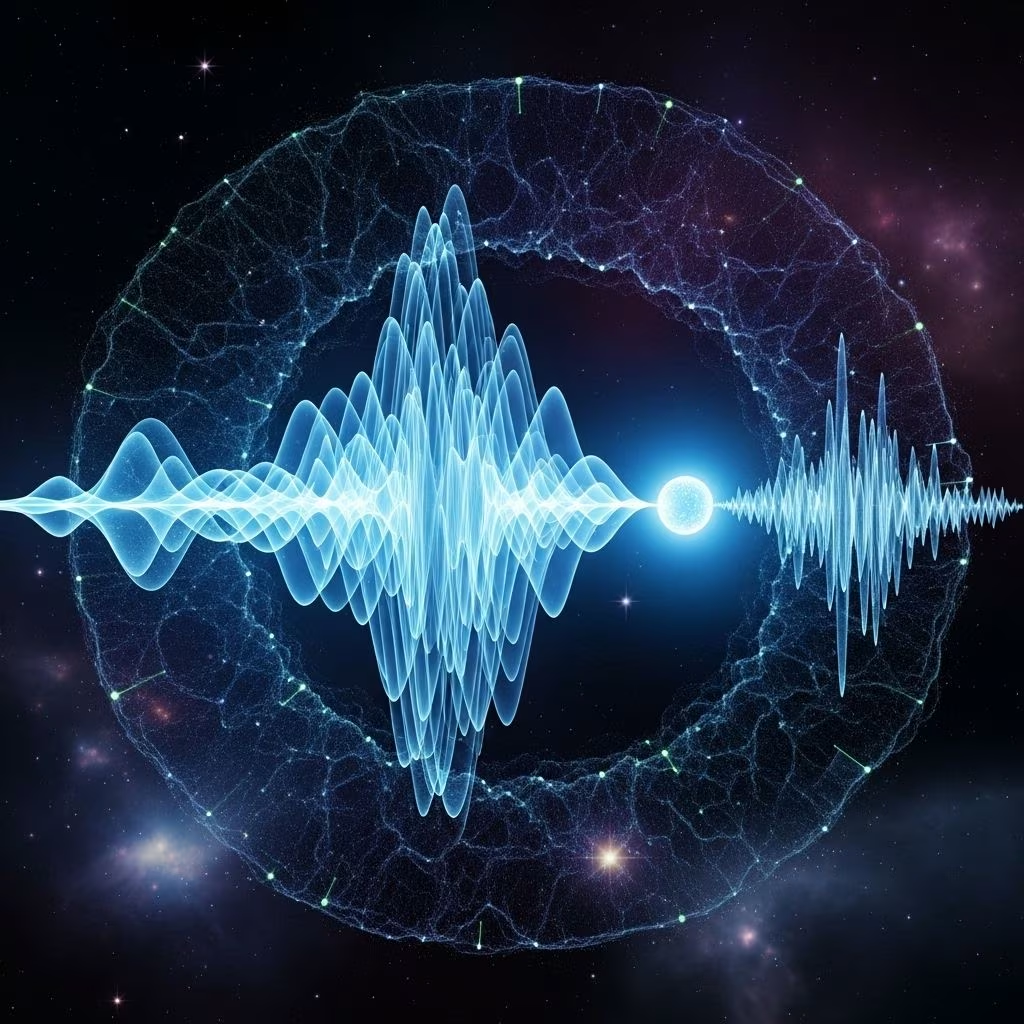
Modern physics is founded on some of the strangest—and most illuminating—ideas in science. Among them, none is more foundational or thought-provoking than wave-particle duality: the revelation that fundamental entities like photons and electrons display the properties of both waves and particles, depending on how you look at them. This counterintuitive fact, discovered over a century ago, continues to challenge and reshape our understanding of the universe.
The Classic Divide: Waves and Particles
Before the 20th century, physicists had clear-cut categories for nature’s ingredients. Waves—like water ripples and sound—spread out over space, showed interference and diffraction, and were governed by laws of continuity. Particles—like marbles, dust, or planets—followed clearly defined paths, interacting through individual collisions and existing at definite spots.
- Waves can overlap, creating constructive or destructive patterns (think of two water waves meeting).
- Particles are localized; two pebbles never “merge” to create a new pebble.
This distinction held firm until new experiments with light and, later, matter forced a radical rethink of reality’s rules.
Light: From Particle to Wave and Back Again
The Wave Theory Takes Center Stage
Isaac Newton famously argued in the 17th century that light was composed of particles, which he called corpuscles. However, by the early 1800s, evidence pointed strongly in the other direction. Thomas Young’s 1801 double-slit experiment showed that light, shone through two closely spaced slits, produced an intricate interference pattern of bright and dark bands on a screen—something unexplainable if light were simply a stream of particles.
The elegant mathematics of wave theory, developed by James Clerk Maxwell, unified electricity and magnetism and explained light as a self-propagating electromagnetic wave. For decades, the wave nature of light seemed settled science.
The Particle Theory Returns
At the dawn of the 20th century, puzzling discoveries began to challenge the purely wave-based view. The rivalling theory returned with Albert Einstein’s 1905 explanation of the photoelectric effect: when light strikes certain metals, it ejects electrons almost instantaneously—but only if the light’s frequency is above a specific threshold, regardless of intensity. Einstein proposed that light comes in discrete energy packets—photons—each carrying energy proportional to its frequency. This won him the Nobel Prize and reintroduced particles to the story of light.
Key Experiments: Where Wave Meets Particle
Today, we know that light and matter alike can behave as both wave and particle, depending on how they are observed. Here are some of the experiments that revealed this deep duality:
- Young’s Double-Slit Experiment (Light and Electrons):
- Light beamed through two slits forms interference fringes—proof of wave behavior.
- When performed one photon at a time, each makes a single spot, as you’d expect from a particle. But after many photons, an interference pattern emerges, showing each photon behaves like a wave until it’s measured.
- The same effect has been observed in electrons, atoms, and even some large molecules—solid objects displaying unmistakable wave traits.
- The Photoelectric Effect: Only photons above a certain frequency knock electrons out of metals, no matter how intense a dim beam is. This shows light’s energy is bundled in discrete quanta—particles.
- Compton Scattering: X-rays striking electrons bounce off in a way only explainable if both behave like particles, each conserving energy and momentum as in a billiard collision.
- Electron Diffraction: Beams of electrons shot through a thin crystal create an interference pattern characteristic of waves, not particles.
Matter’s Dual Personality
The realization that light can behave as a wave or a particle was profound. But the shock grew deeper when, in 1924, Louis de Broglie hypothesized that all matter—not just light—has a built-in duality. Every electron, atom, or molecule could be described by a wave with a wavelength inversely related to its momentum.
- This de Broglie wavelength is small for heavy, fast-moving objects (like a baseball), but measurable for tiny, slow particles (like electrons).
- Confirmed by experiments, this extended the strange quantum duality to everything in existence.
The Quantum Rulebook: Complementarity and Superposition
With the birth of quantum mechanics, it became clear that waves and particles were not mutually exclusive descriptions, but two complementary aspects of a deeper reality.
- Bohr’s Principle of Complementarity: Niels Bohr argued that the wave and particle views are both necessary, but mutually exclusive in a single experiment. Which aspect you observe depends on how you ask your experimental question.
- Superposition: Until observation, a quantum object exists in all possible states simultaneously, described by a mathematical wave function. Measurement “collapses” this wave function into a single outcome: a particle in a place, a photon with a certain energy, etc.
The Heisenberg Uncertainty Principle
The weirdness of wave-particle duality reaches a logical peak in the uncertainty principle, discovered by Werner Heisenberg. This law states:
It is impossible to know both the exact position and momentum of a quantum particle at the same time. The more precisely you know one, the less precisely you can know the other.
This isn’t due to technological imperfection, but to reality’s probabilistic quantum nature. Particles really lack definite positions and speeds until measured.
| Aspect | Wave Description | Particle Description |
|---|---|---|
| Position | Spread out | Localised |
| Momentum | Defined by wavelength | Defined by impulse |
| Energy emission | Continuous | In quanta |
| Interference | Yes | No |
Interpretations and Philosophical Implications
Wave-particle duality isn’t just a physics curiosity—it’s reshaped our philosophy of science and our view of what “reality” means.
- Measurement problem: Does observation itself cause the wave function to collapse? What role does the observer play?
- Quantum reality: Is an electron a wave, a particle, or something beyond human categories?
- Applications: Technologies like lasers, semiconductors, and quantum computing exist because of a mastery of dual quantum behaviors.
Why Duality Matters: Everyday Technology
Wave-particle duality isn’t just a deep abstraction. It underpins:
- The design of transistors and computer chips (quantum tunneling relies on wave-like behavior).
- Lasers (the stimulated emission of photons requires the understanding that light exists as both quantized particles and coherent waves).
- Magnetic resonance imaging (MRI) and other advanced imaging rely on the quantum properties of atomic nuclei.
- Emerging quantum computers manipulate information directly using wave functions and superposition.
Frequently Asked Questions (FAQs)
Q: Is light actually a wave or a particle?
A: Experiments show that light is neither strictly a wave nor strictly a particle; it exhibits characteristics of both depending on how it’s measured. Its true nature is best described by quantum field theory, which transcends the old categories.
Q: Do all particles have a wave nature?
A: Yes, according to quantum mechanics, every particle—from electrons and photons to even (in theory) large molecules—has an associated wave described by its wave function.
Q: Why don’t we see wave behavior in everyday objects?
A: Macroscopic objects have extremely short de Broglie wavelengths, making their wave characteristics undetectable at human scales. Quantum effects emerge only for the very small or at low energies.
Q: What is the double-slit experiment and why is it important?
A: The double-slit experiment reveals that light and even single particles can create an interference pattern only waves can make—if not observed directly. If you place detectors at the slits, the interference disappears, and particle-like behavior is revealed. It’s the canonical experiment of quantum duality.
Q: What technologies rely on wave-particle duality?
A: Technologies like lasers, transistors, electron microscopes, and quantum computers leverage quantum duality to manipulate and measure waves and particles on atomic scales.
Essential Takeaways
- Wave-particle duality is a cornerstone of quantum mechanics, showing that neither classical notion is complete by itself.
- Light and matter exhibit both wave and particle behaviors, as confirmed by centuries of experiments.
- Quantum theory reveals a universe where particles exist in many states at once, probabilities rule, and reality depends on observation.
For anyone curious about the nature of reality, wave-particle duality stands as one of the most profound discoveries in science—a continuing invitation to question what we know, and how deeply we can know it.
References
- https://en.wikipedia.org/wiki/Wave%E2%80%93particle_duality
- https://www.youtube.com/watch?v=DfQH3o6dKss
- https://www.ebsco.com/research-starters/physics/wave-particle-duality
- https://www.youtube.com/watch?v=ogmw55LGQrc
- https://byjus.com/physics/wave-particle-duality/
- https://www.britannica.com/science/wave-particle-duality
- https://quantumzeitgeist.com/wave-particle-duality-strange-physics-behaviour/
- https://www.wolframphysics.org/technical-introduction/potential-relation-to-physics/wave-particle-duality-uncertainty-relations-etc/
- https://vinodsblog.com/2022/09/15/wave-particle-duality-illuminating-the-intricate-dance-of-quantum-reality/
- https://chem.libretexts.org/Courses/Howard_University/General_Chemistry:_An_Atoms_First_Approach/Unit_1:Atomic_Structure/Chapter_2:_Atomic_Structure/Chapter_2.4:_Wave_-_Particle_Duality
- https://www.scribd.com/document/500516250/Wave-particle-duality
- https://scienceinfo.com/wave-particle-duality/
- https://chem.libretexts.org/Bookshelves/Physical_and_Theoretical_Chemistry_Textbook_Maps/Supplemental_Modules_(Physical_and_Theoretical_Chemistry)/Quantum_Mechanics/02._Fundamental_Concepts_of_Quantum_Mechanics/Wave-Particle_Duality
- https://study.com/academy/lesson/wave-particle-duality-concept-explanation-examples.html
- https://everdeepening.com/2024/10/18/explaining-wave-particle-duality/
- https://bigthink.com/starts-with-a-bang/surprising-origins-wave-particle-duality/