HD 189733b: Introduction to a Blue Alien World
Just 63 light-years from Earth in the constellation Vulpecula lies HD 189733b, an exoplanet as striking as it is hostile. Astronomers call it one of the most bizarre worlds ever found: a sapphire-blue ‘hot Jupiter’ whose winds whip sideways rains of molten glass across its scorching skies. The very same factors that inspire daydreams about distant blue worlds make HD 189733b completely inhospitable to life, and yet it continues to enthrall scientists with its wild, violent weather and unusual planetary characteristics.[10]
The Discovery of HD 189733b
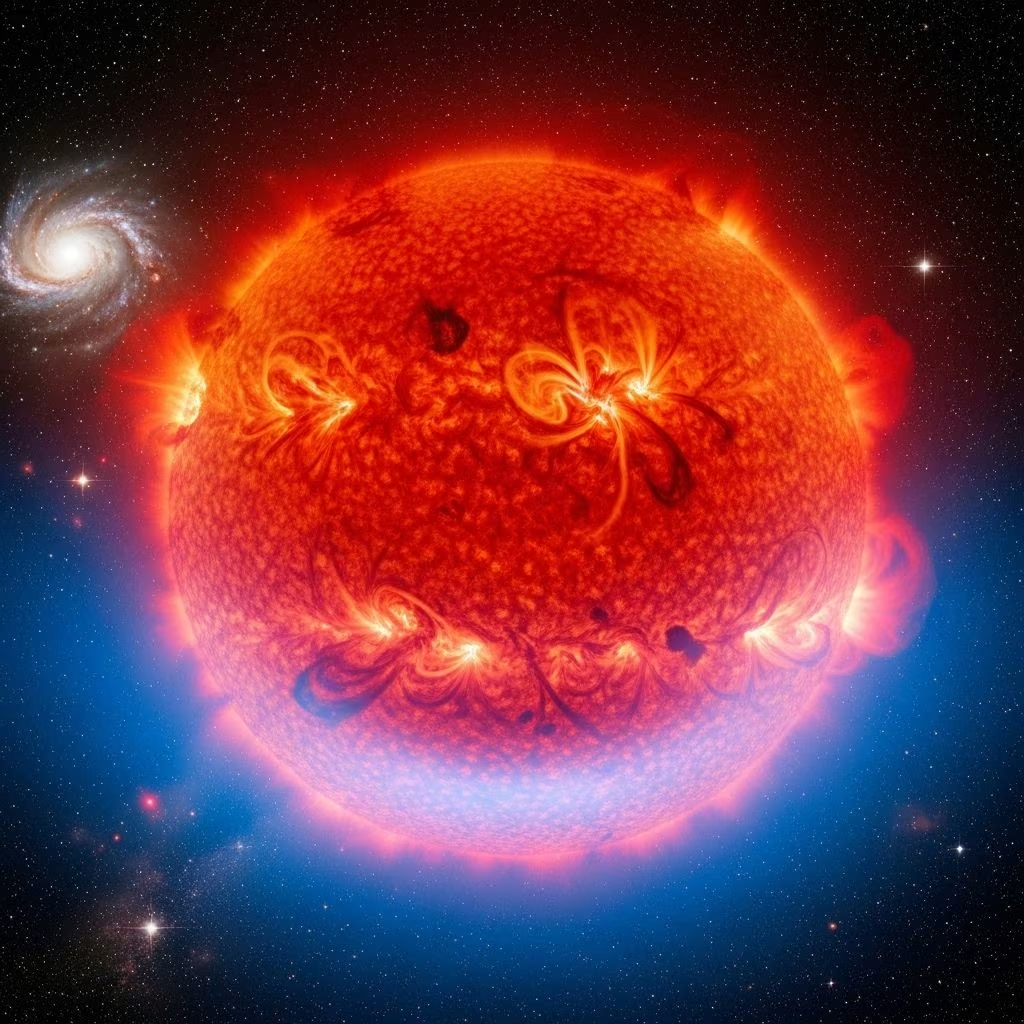
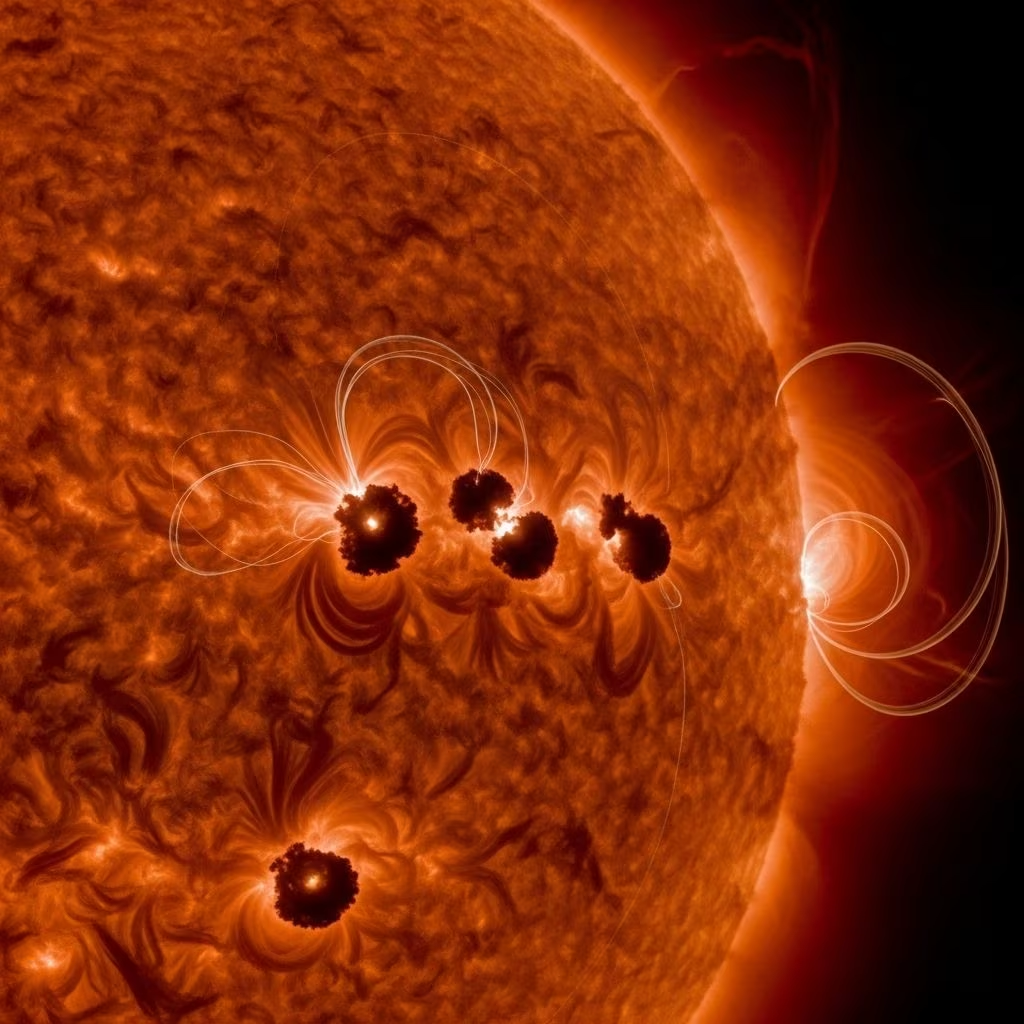
HD 189733b was discovered in 2005 by a team of astronomers using the transit method, which detects exoplanets when they pass in front of their host star and create a measurable dip in the star’s brightness[10]. The planet orbits a K-type main-sequence star slightly cooler than our sun. Its mass is approximately 1.13 times that of Jupiter and its radius is about 1.2 times larger. What truly distinguishes HD 189733b is its extreme proximity to its star: it completes an orbit in just 2.2 Earth days, tracing a path only 0.03 AU from its sun—a mere fraction of Earth’s own 1 AU orbital distance.
- Distance from Earth: 63 light-years
- Host Star: K-type, cooler than the Sun
- Planet Type: Hot Jupiter
- Mass & Radius: 1.13× Jupiter’s mass, 1.2× Jupiter’s radius
- Year Length: 2.2 Earth days
The short orbital period and close alignment make HD 189733b easier to observe and characterize, offering scientists a rare window into the nature of exoplanet atmospheres and climate.
The Extreme Climate of Hot Jupiters
Hot Jupiters are a class of gas giant exoplanets that orbit extremely close to their parent stars, resulting in fantastically high surface and atmospheric temperatures[10]. The case of HD 189733b perfectly exemplifies the “planetary daredevil” reputation these worlds have earned:
- Scorching Temperatures: On the dayside, HD 189733b reaches 1,700°F (930°C), creating an inhospitable furnace-like environment.
- Tidally Locked: The planet is tidally locked, so one hemisphere always faces the star, roasting under continuous daylight, while the other remains in perpetual darkness.
- Atmospheric Expansion: Observations in X-rays suggest HD 189733b’s outer atmosphere is much larger than previously expected, possibly due to intense heating and material loss.
These extremes challenge theories of planetary formation and survival, requiring scientists to rethink how gas giants can persist in such hostile orbits.
The Blue Appearance: Spectral and Atmospheric Mysteries
Among its most stunning features, HD 189733b’s striking blue color sets it apart from most other giant planets, which typically appear in muted browns, oranges, and reds. Unlike Earth’s oceans or Neptune’s methane-driven appearance, HD 189733b’s blue hue owes its existence to entirely different chemicals and atmospheric phenomena[10].
In 2013, astronomers used the Hubble Space Telescope to measure reflected blue light from HD 189733b’s atmosphere, confirming its sapphire-like color. Analyses revealed the blue comes from scattered light by tiny silicate particles—likely glass—present high in the planet’s atmosphere. These particles scatter blue light similar to the way Earth’s sky appears blue due to Rayleigh scattering, but, in this case, silicate glass rather than nitrogen and oxygen molecules are responsible[10].
- Blue Color Mechanism: Silicate particles scatter blue wavelengths of light
- No Water or Methane: The blue is NOT caused by water oceans or methane as in Solar System planets
- Unique Among Exoplanets: HD 189733b stands out as one of the very few exoplanets with a measured color
The Glass Rain Phenomenon
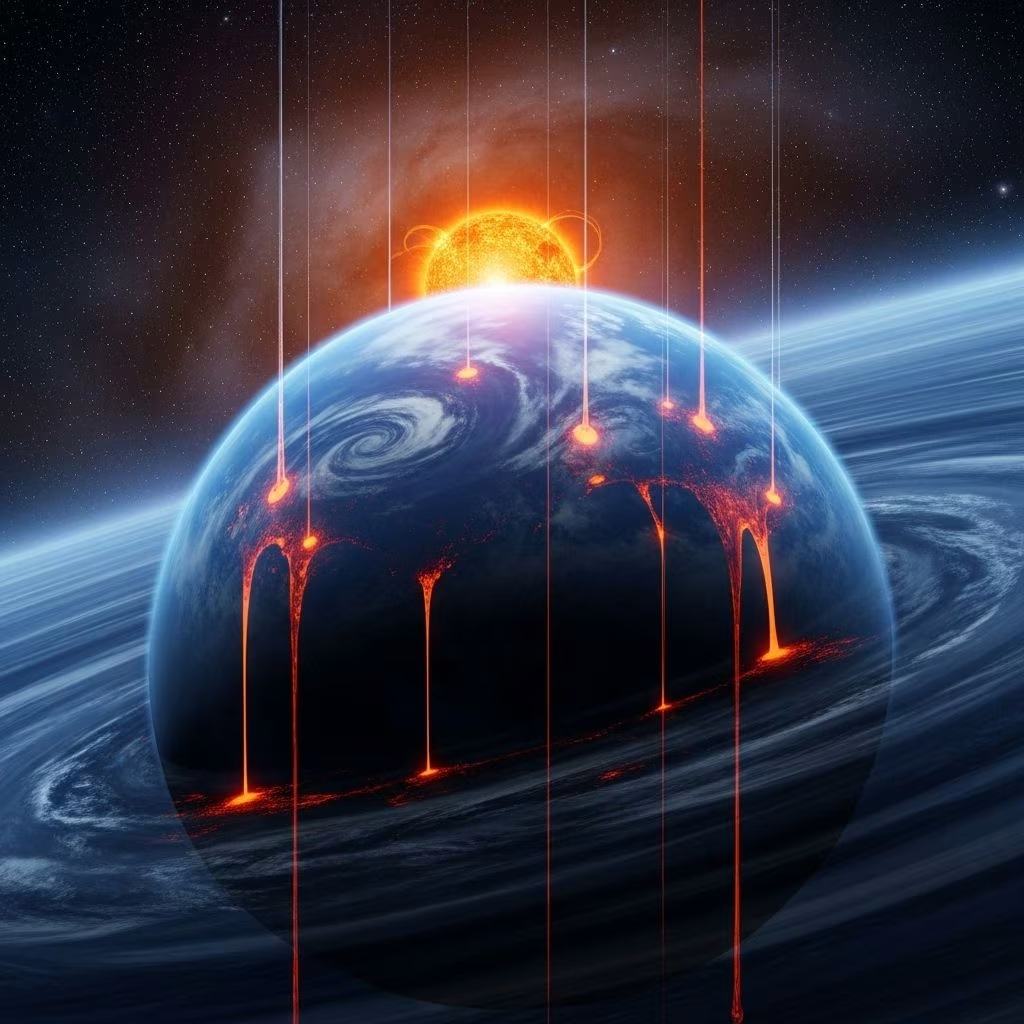
Perhaps most infamous of all HD 189733b’s features is its weather: sideways rain of molten glass. This terrifying climate is a consequence of the planet’s proximity to its star, high atmospheric temperatures, and extreme wind speeds.
Scientists confirmed the presence of glass rain through transmission spectroscopy techniques using the Hubble Space Telescope[10]. During planetary transits, starlight filters through the planet’s atmosphere, allowing scientists to analyze its composition. These studies revealed a haze of tiny silicate (glass) particles at high altitudes alongside evidence of wind velocities that exceed 5,400 mph (8,700 km/h). Such high-speed winds drive glass rain sideways across the planet, continuously churning its scorching skies.
- Glass Particles: Tiny silicates confirmed by spectral analysis
- Wind Speed: Up to 5,400 mph (8,700 km/h)
- Rain Direction: Sideways due to powerful equatorial jet streams
- Temperature: So high that glass remains molten as it forms raindrops
How Scientists Unlocked the Planet’s Secrets
The confirmation of glass rain and extreme weather on HD 189733b ranks among modern astronomy’s greatest achievements. Researchers combined several advanced techniques and instruments to decode the planet’s atmospheric mysteries:
- Transit and Transmission Spectroscopy: Captured spectral data during planet transits to reveal atmospheric components and temperature gradients[10].
- Infrared Mapping: The Spitzer Space Telescope provided infrared thermal maps, confirming drastic temperature variations across the planet’s surface.
- X-ray Observations: Unexpectedly large outer atmospheres were detected using X-ray telescopes, suggesting ongoing atmospheric loss.
Taking together results from Hubble, Spitzer, and ground-based observatories, scientists built a comprehensive model of HD 189733b’s brutal climate. These efforts marked the first time weather had been observed—and described—in detail on an extrasolar planet.
The Significance of Hot Jupiter Exoplanets
The study of HD 189733b sheds new light on the diversity and complexity of planets beyond the Solar System. Hot Jupiters, though initially thought to be rare oddities, have proven to be common, offering unique laboratories to study planetary evolution, atmospheric chemistry, and system dynamics.
- Easy Detection: Their large size and close orbital positions cause significant changes in starlight, simplifying the process of discovery.
- Wobble Effect: The gravitational tug of these giants makes their stars wobble—another detectable signature.
- Challenges to Theory: Their survival in close orbits challenges prevailing models of planetary formation, migration, and atmospheric loss.
- No Place for Life: Despite their beauty and intrigue, conditions on hot Jupiters like HD 189733b are universally hostile to Earth-like life.
Comparing HD 189733b to Other Blue Worlds
| Planet | Color Source | Main Atmospheric Constituents | Weather |
|---|---|---|---|
| HD 189733b | Silicate (glass) scattering | Hydrogen, helium, silicates | Molten glass rain, violent winds |
| Neptune | Methane absorption | Hydrogen, helium, methane | Methane ice clouds, extreme winds |
| Earth | Rayleigh scattering | Nitrogen, oxygen | Water rain, moderate winds |
- Only HD 189733b’s blue color is due to glass particles; Neptune’s is from methane, and Earth’s is from air molecules.
Rewriting Planetary Formation Models
The existence of gas giants so close to their stars—despite the risk of orbital decay and atmospheric stripping—forces astronomers to revise theories of planetary migration and survivability. HD 189733b, with its vast, volatile envelope and glass storms, serves as a test case for models of atmospheric retention, loss, and chemistry.
- Migration: Did HD 189733b form farther away and migrate inward, or is it a product of in-situ formation?
- Survivability: How resilient are these planets to intense stellar irradiation?
- Atmospheric Loss: Evidence from X-ray observations hints at ongoing atmospheric stripping.
Such studies not only further our understanding of HD 189733b, but also inform broader knowledge about exoplanet evolution throughout the galaxy.
Frequently Asked Questions (FAQs)
Q: Could life exist on HD 189733b?
A: No. With surface temperatures exceeding 1,700°F (930°C), high-speed winds, and rains of molten glass, HD 189733b is universally hostile to all known forms of life.
Q: What makes HD 189733b blue?
A: Its blue color is due to tiny silicate (glass) particles high in the atmosphere scattering blue wavelengths of light—not water or methane.[10]
Q: What is a ‘hot Jupiter’?
A: A ‘hot Jupiter’ is a gas giant planet similar in size to Jupiter but orbiting very close to its star, resulting in exceedingly high temperatures and unique atmospheric behaviors.
Q: How do scientists study weather on a distant planet?
A: By observing light that passes through or reflects off the planet’s atmosphere during transits. Spectral analysis lets scientists identify atmospheric components, map temperatures, and even detect storms.[10]
Q: What is unique about HD 189733b’s rain?
A: Unlike Earth, where rain is water, HD 189733b experiences rain of molten glass, driven sideways by winds over 5,400 mph.[10]
Key Scientific Insights from HD 189733b
- Hot Jupiters can have enormously extended and dynamic atmospheres.
- Atmospheric composition yields clues about planet formation and evolution.
- Weather systems, including exotic phenomena such as glass rain, exist on exoplanets.
- The planet’s blue appearance is a rare and measurable trait among exoplanets.
- Observational techniques such as transit spectroscopy and thermal mapping are key in decoding distant worlds.
Conclusion: Why HD 189733b Matters
Though inhospitable and alien in every respect, HD 189733b captivates astronomers and the public alike—not for its prospects of life, but for its demonstration of the wild diversity that exists within our galaxy. Its characteristic blue hue, sideways glass rain, and extreme climate are reminders that planetary systems can evolve in unexpected, dramatic ways. Each new observation of HD 189733b helps scientists refine theories of planetary formation, migration, and survival—questions fundamental to our understanding of the cosmos. Exploring such ‘rains of terror’ worlds not only satisfies scientific curiosity, but deepens our knowledge of what, where, and how planets live and die throughout the universe.
References
- https://www.space.com/34576-blue-alien-planet-glass-rain.html
- https://www.space.com/22614-blue-alien-planet-glass-rain.html
- https://www.nasa.gov/image-article/rains-of-terror-exoplanet-hd-189733b/
- https://www.livescience.com/38107-alien-planet-blue-color-revealed.html
- https://www.youtube.com/watch?v=4Dg-ZCMQSDY&vl=tr
- https://planetsave.com/articles/hd-189733b-blue-exoplanet-where-the-rains-is-made-of-molten-glass/
- https://www.youtube.com/watch?v=qynoIXk5azo
- https://time.com/archive/7219063/found-a-blue-planet-that-rains-glass/
- https://science.time.com/2013/07/12/found-a-blue-planet-that-rains-glass/
- https://www.animalsaroundtheglobe.com/this-planet-rains-liquid-glass-sideways-1-332996/
- https://www.ksl.com/article/51063328/scientists-find-a-molecule-never-before-found-outside-our-solar-system-on-a-planet-with-glass-rain
- https://www.upi.com/Science_News/2013/07/11/Deep-blue-planet-looks-like-Earth-rains-glass/3101373575772/
- https://www.theweather.com/news/science/new-findings-about-the-exoplanet-close-to-earth-where-molten-glass-rains-with-winds-of-800-km-h.html
- https://www.ndtv.com/world-news/astronomers-find-new-blue-planet-where-it-rains-glass-sideways-528082
- https://www.deccanherald.com/science/space/jupiter-like-planet-where-it-rains-glass-smells-like-rotten-eggs-james-webb-telescope-discovers-3098288
- https://www.sciencetimes.com/articles/51168/20240709/exoplanet-glass-rain-rotten-egg-hydrogen-sulfide-hd-189733-b.htm
- https://www.the-express.com/news/space-news/160955/alien-planet-that-rains-glass
- https://www.unilad.com/technology/nasa/nasa-hubble-telescope-rains-glass-planet-349703-20250625