


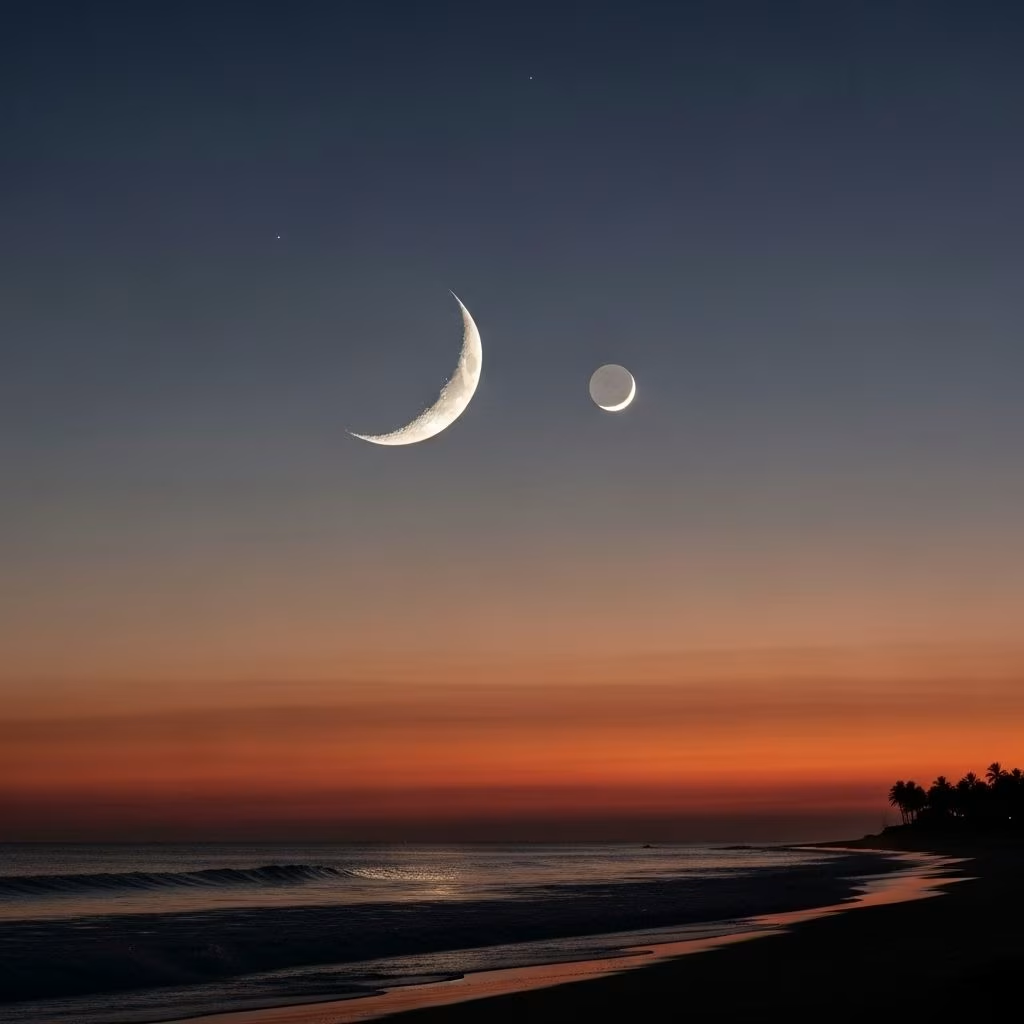
The Moon and Venus: A Spectacular Conjunction to Start Memorial Day Weekend
The dawn of May 23, 2025, promises a mesmerizing show for skywatchers as the crescent Moon and brilliant Venus glide closely together in the eastern sky. This celestial pairing, known as a conjunction, will mark the unofficial start of Memorial Day weekend with a display easily visible to the naked eye and unforgettable even for amateur astronomers. Whether you’re an early riser or a devoted stargazer, this event is an ideal occasion to connect with the cosmos before sunrise.
What Is a Moon-Venus Conjunction?
A conjunction in astronomy refers to two celestial bodies appearing close together in the sky, as observed from Earth. On the morning of May 23, 2025, the crescent Moon will align closely with Venus, the second planet from the Sun and the brightest natural object in the night sky after the Moon—earning Venus the moniker of ‘morning star.’
- Date: May 23, 2025
- Time: Approx. 1 hour before local sunrise (check local times for best viewing)
- Where to Look: Low in the eastern sky
- Crescent Moon: Only 17%–19% illuminated, producing a delicate, curved sliver
- Venus: Exceptionally bright, magnitude -4.2
- Field of View: Both objects fit within standard binoculars
Celestial Coordinates
- Right Ascension (RA): Both Moon and Venus at close celestial longitude
- Declination: Moon at +27°22′, Venus at +25°09′
- Constellation: Gemini
Best Times and Locations to View the Conjunction
Although visibility varies with location, the optimal viewing time is approximately one hour before sunrise, when Venus is about 10° above the eastern horizon and the sky is still dark enough for a clear view. Here are tips for observing from North America and beyond:
- In Chicago: Sunrise is at 5:23 a.m. CDT. Look eastward after 4:15 a.m. CDT.
- In New York City: Moon and Venus rise at 8:26 a.m. EDT, visible until almost midnight. Peak visibility is before dawn.
- General Advice: Find an unobstructed eastern horizon, away from city lights to best appreciate the subtle crescent and bright planet.
If the weather is uncooperative or your view is obstructed, several online astronomy projects offer livestreams so you can still witness the conjunction digitally.
What Will You See? The Science Behind the Beauty
This conjunction is especially beautiful for several reasons:
- Crescent Moon: The Moon, only 17–19% illuminated and four days past new phase, appears as a delicate sliver, glowing vividly in the morning darkness.
- Earthshine: The non-illuminated part of the Moon’s surface is softly lit by the light reflected from Earth itself, a phenomenon known as earthshine. This creates a complete, ghostly outline of the lunar disk.
- Brilliant Venus: Venus shines intensely at magnitude -4.2, easily overpowering nearby stars, and displays a waning crescent phase if viewed through a telescope. It is approximately halfway between new and half phase, about 45% illuminated.
- Other Celestial Guests: Saturn is also nearby, found over 17° to Venus’ upper right, adding to the planetary parade.
The apparent closeness of these two bodies is, of course, an optical illusion. The Moon orbits Earth at roughly 384,400 km, while Venus is about 42 million kilometers away at conjunction. Still, the geometry is perfect for a spectacular show from our perspective.
Can You See the Pair Together?
Venus and the Moon will be separated by about 6–7 degrees—too far for most telescopes but comfortably within the view of standard binoculars. Observers using small telescopes can enjoy detailed views of Venus’ crescent but must look separately at the Moon.
Safety Tips for Daytime Observing
- Never Point Optics at the Sun: As the Sun rises and brightens the sky, avoid pointing binoculars or telescopes toward the Sun, even if you’re still observing the Moon and Venus.
- Use a Tripod: For best results in photography or for extended viewing, stabilize your binoculars or camera on a tripod.
How to Photograph the Conjunction
Capturing the event is possible even with modest equipment. Consider these photography tips:
- Use a tripod to stabilize your camera or phone for longer exposure shots, revealing the full glory of both the crescent Moon and Venus.
- To catch earthshine, try exposures of a few seconds, but beware of overexposing the bright crescent.
- If shooting handheld, brace yourself or use a stable surface to prevent blurry images.
- Wide-angle photos also show scenery, city lights, or people admiring the dawn, enhancing the sense of occasion and scale.
Venus as a Morning Star: The Bigger Picture
Venus spends much of 2025 as a radiant morning star, having emerged from behind the Sun earlier in the spring. During conjunction, Venus is about 45% illuminated and will soon reach its greatest elongation from the Sun around June 1. At that point, it is furthest from the solar glare and sees maximum visibility in the morning sky.
- Venus’ Changing Phase: Like the Moon, Venus displays phases as seen from Earth; through a telescope, its disk appears as a thick crescent before full elongation, then becomes ‘half full.’
- Upcoming Highlights: In the following weeks, skywatchers will see Venus gradually brighten, then eventually shift to the evening sky later in the year.
Related Astronomical Events Around May 23, 2025
- Saturn in the Morning Sky: Saturn is visible over 17° from Venus, an excellent addition for dedicated observers.
- Occultation of Antares: On May 23 in 2024 (preceding year), the Moon occults Antares, a bright red star in Scorpius—a reminder of the many wonders appearing each spring.
Always check local almanacs and sky maps to find more events around the conjunction period.
Frequently Asked Questions About the Moon-Venus Conjunction
Q: How often do Moon-Venus conjunctions happen?
A: Conjunctions between the Moon and Venus occur several times a year, as the Moon cycles through the zodiac more quickly than any planet. Not all are equally striking; the May 23, 2025, event is noteworthy for its favorable timing and geometry.
Q: Can I see the conjunction with the naked eye?
A: Yes, both the crescent Moon and Venus are exceptionally bright and easily visible to the naked eye under dark skies—no equipment is required.
Q: Will I need a telescope or binoculars?
A: Binoculars enhance the view and allow you to see both objects together in the same field, but are not strictly necessary. A small telescope reveals Venus’ crescent phase and details on the Moon.
Q: What is earthshine on the Moon?
A: Earthshine is sunlight reflected off Earth’s oceans, clouds, and land, softly illuminating the Moon’s night side, making the full lunar disk faintly visible even when only a sliver is directly lit by the Sun.
Q: Is Venus safe to view at dawn?
A: Venus itself is always safe to view with the naked eye or binoculars, but avoid looking near the rising Sun with optics. Time your observations to keep well before sunrise for comfort and safety.
Q: Can I watch the event online?
A: Yes, many virtual astronomy projects stream live views of conjunctions and sky events, allowing anyone with internet access to join, regardless of local weather.
Table: Key Details for the May 23, 2025 Moon-Venus Conjunction
| Parameter | Detail |
|---|---|
| Date | May 23, 2025 |
| Best Viewing Time | 1 hour before sunrise, local time |
| Moon Phase | Crescent (17–19% illuminated) |
| Venus Magnitude | -4.2 |
| Angular Separation | ~6–7 degrees |
| Observing Aid | Visible to naked eye; binoculars recommended |
| Other Objects Visible | Saturn (over 17° away) |
| Constellation | Gemini |
Why Does the Moon Pair with Venus?
The Moon completes an orbit around the Earth every 27.3 days, cycling through its phases as it catches up and passes the planets along the zodiac. Venus, with its rapid eastward movement, is often near the Moon in our skies. These brief partnerships are not only visually delightful, but also serve as opportunities for amateur astronomers to practice navigation and learn the celestial sphere.
Tips for Enjoying the Experience
- Set an Early Alarm: The best views come in the dark or twilight before sunrise.
- Scout Your Eastern Horizon: Find a location with a clear, unobstructed view low to the horizon.
- Bring Binoculars and a Camera: Enhance the sight and save memories of the occasion.
- Invite Others: These events are fun to share with family or friends—introduce someone to the wonders of the cosmos!
- Check the Weather: Clear skies are essential for viewing; plan ahead for locations with the best forecast.
Further Resources and Livestreams
If local clouds or city lights obscure your view, consider tuning into a reputable online astronomy livestream run by organizations such as The Virtual Telescope Project. These resources often provide expert commentary along with high-quality images from dark-sky observatories.
Conclusion: A Celestial Gift for Skywatchers
This May 23, 2025, Moon-Venus conjunction is an accessible, awe-inspiring celestial event that requires little equipment and no special expertise—just a moment of quiet at dawn to connect with the universe. With the added atmospheric glow of earthshine, nearby Saturn, and the promise of spring in the air, this is a pre-dawn spectacle worthy of celebration. Set your alarm, gather your loved ones, and look to the east for one of the year’s most captivating sky shows.
References
- https://whenthecurveslineup.com/2025/05/10/2025-may-23-morning-venus-moon-conjunction/
- https://www.space.com/moon-venus-conjunction-livestream-may-2023
- https://www.astronomy.com/observing/the-sky-today-friday-may-23-2025/
- https://whenthecurveslineup.com/2024/05/06/2024-may-23-moon-antares-occultation-venus-jupiter-conjunction/
- https://www.foxnews.com/lifestyle/moon-venus-conjunction-space
- https://www.indastro.com/planet-conjuction/moon-venus-conjunction.html
- https://stardate.org/podcast/2025-05-23
- https://www.dailymotion.com/video/x9jzcgy
- https://www.astronomy.com/observing/the-sky-this-week-from-may-16-to-23-2025/
- https://www.yourtango.com/2025385177/zodiac-signs-powerful-new-era-may-23-2025
- https://creators.spotify.com/pod/profile/jeffrey-l-hunt/episodes/2024–May-23-Moon-Antares-Occultation–Venus-Jupiter-Conjunction-e2jv131
- https://www.celestron.com/blogs/news/moon-conjunctions-with-saturn-and-venus-in-2025
- https://www.yourtango.com/2025386436/zodiac-signs-major-abundance-may-23-2025
- https://www.dxpnet.com/astrology/aspects/conjunctions/moon-conjunct-venus/
- https://collective.world/horoscope-for-today-friday-may-23-2025/
- https://in-the-sky.org/news.php?id=20250103_20_100
- https://www.businesstoday.in/visualstories/news/moon-venus-saturn-align-the-celestial-trio-youll-only-catch-this-week-235475-21-05-2025
- https://www.youtube.com/watch?v=XW68SzoeMcg


