


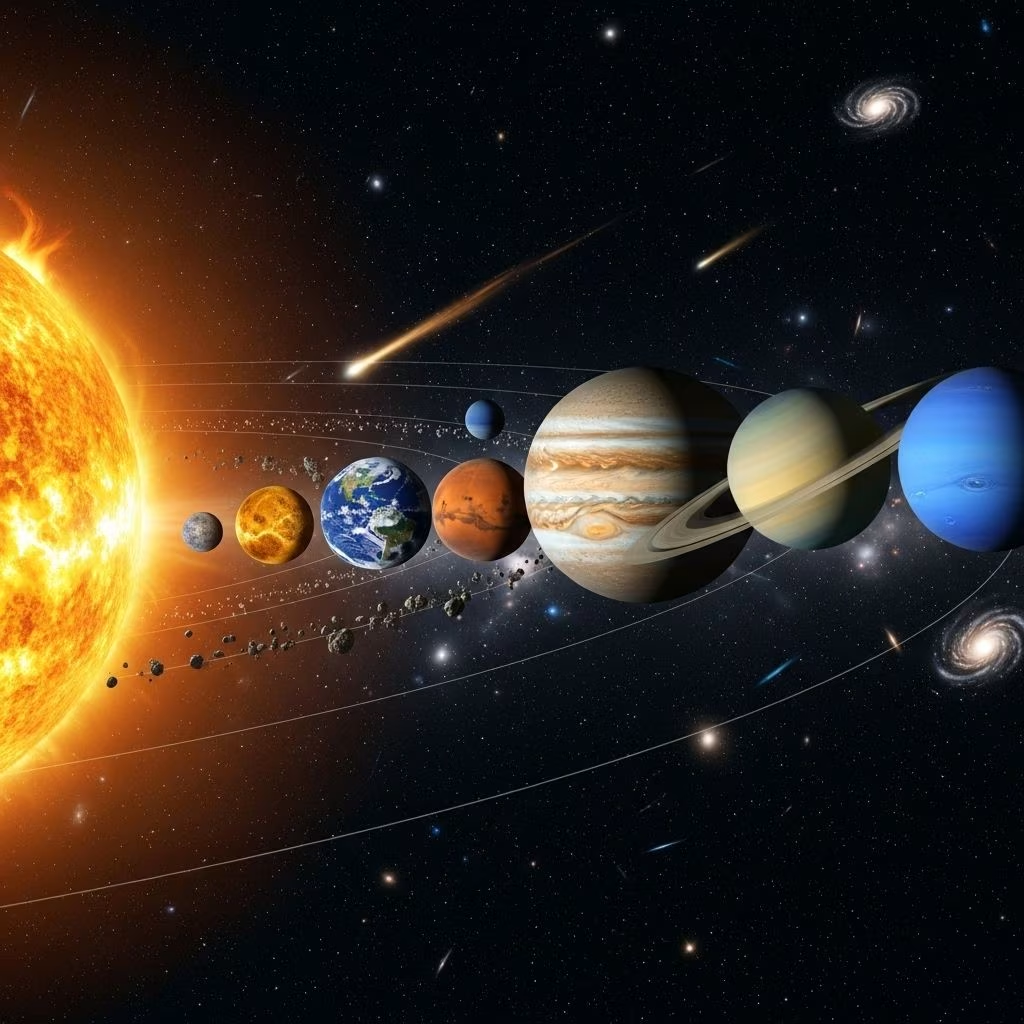
Our solar system is a vast, dynamic system anchored by the Sun and home to a diverse family of planets, dwarf planets, moons, and countless smaller objects. This comprehensive guide explores every planet in our solar neighborhood, unpacks the ongoing debate around planet definitions, and introduces the mysterious dwarf planets that orbit beyond Neptune.
What Is a Planet?
The term planet comes from the ancient Greek word planētēs, meaning “wanderer”—a reference to how these bodies move across the night sky, unlike the fixed stars. For centuries, the term applied to all bright objects that changed position; modern astronomy, however, uses a stricter classification based on physical and orbital characteristics.
- Classical Definition: Any large body orbiting the Sun.
- Modern (IAU) Definition (2006):
- Orbits the Sun.
- Has sufficient mass for self-gravity to form a nearly round shape.
- Has “cleared the neighborhood” around its orbit.
This modern definition led to the demotion of Pluto to a new class called dwarf planets and remains the authoritative standard for astronomical nomenclature.
An Overview of the Planets
There are eight recognized planets in our solar system, listed here in order from the Sun:
- Mercury
- Venus
- Earth
- Mars
- Jupiter
- Saturn
- Uranus
- Neptune
Beyond Neptune lies a population of smaller objects—dwarf planets and icy bodies—that challenge our definitions and expand our understanding of what a planet can be.
Types of Planets in the Solar System
- Terrestrial (Inner) Planets: Mercury, Venus, Earth, Mars
- Giant (Outer) Planets: Jupiter, Saturn (Gas Giants); Uranus, Neptune (Ice Giants)
- Dwarf Planets: Ceres, Pluto, Haumea, Makemake, Eris, and more
| Planet Type | Examples | Main Features |
|---|---|---|
| Terrestrial | Mercury, Venus, Earth, Mars | Rocky, dense, few to no moons, solid surface |
| Gas Giants | Jupiter, Saturn | Mostly hydrogen and helium, many moons, ring systems |
| Ice Giants | Uranus, Neptune | Composed of water, methane, ammonia; thick atmospheres |
| Dwarf Planets | Ceres, Pluto, Haumea, Makemake, Eris | Round, have not cleared orbits, mostly icy/rocky |
The Inner Planets: The Rocky Quartet
The four planets closest to the Sun—Mercury, Venus, Earth, and Mars—are known as terrestrial planets due to their rocky surfaces and compact size.
Mercury
- Position: Closest planet to the Sun, with an average distance of about 58 million km (36 million miles).
- Size: Smallest planet (slightly larger than Earth’s moon).
- Surface: Heavily cratered, resembling the Moon; no atmosphere to speak of.
- Day Length: 59 Earth days for one rotation.
- Year Length: 88 Earth days to orbit the Sun.
- Distinctive Feature: Extreme temperature swings from blazing hot to freezing cold.
Venus
- Position: Second planet from the Sun, about 108 million km (67 million miles) away.
- Size: Similar in size and mass to Earth—sometimes called “Earth’s twin.”
- Surface: Volcanically active, with mountains and vast plains. Hidden beneath a thick, toxic atmosphere.
- Atmosphere: Dense carbon dioxide with clouds of sulfuric acid; surface pressure 92 times that of Earth’s.
- Day Length: 243 Earth days—longer than its year!
- Temperature: Hottest planet in the solar system (average surface temp: 467°C / 872°F).
Earth
- Position: Third planet from the Sun, at an average of 150 million km (93 million miles).
- Atmosphere: Nitrogen-oxygen mix, perfect for supporting life.
- Surface: 71% water, unique geologic and climatic diversity.
- Only planet known to host life; home to one large moon.
Mars
- Position: Fourth from the Sun, known as the “Red Planet.”
- Surface: Rust-colored dust, ancient volcanoes (Olympus Mons is the tallest mountain in the solar system), canyons, and polar ice caps.
- Atmosphere: Thin, mostly carbon dioxide, with weak seasons.
- Moons: Two small moons, Phobos and Deimos.
The Outer Planets: Giants and Ice Worlds
Beyond the asteroid belt lie the four “giant planets.” The first two—Jupiter and Saturn—are known as gas giants, and the next two—Uranus and Neptune—are classified as ice giants due to their compositions.
Jupiter
- Position: Fifth planet from the Sun.
- Size: Largest planet—over 1,300 Earths could fit inside.
- Atmosphere: Hydrogen and helium; features giant storms including the iconic Great Red Spot.
- Moons: More than 75; largest four—the Galilean moons (Io, Europa, Ganymede, Callisto)—are worlds in their own right.
- Rings: Narrow, faint system.
Saturn
- Position: Sixth from the Sun, famous for its spectacular rings.
- Atmosphere: Similar to Jupiter; less dense than water.
- Rings: Composed mostly of ice and rock, the most extensive in the solar system.
- Moons: Over 80, including Titan—the second-largest moon in the solar system with dense atmosphere.
Uranus
- Position: Seventh planet from the Sun.
- Tilt: Uniquely tipped over on its side by about 98 degrees, leading to extreme seasons.
- Atmosphere: Hydrogen, helium, and methane (which gives it a pale blue-green color).
- Moons: 27 known, with dramatic orbits and surfaces.
- Rings: Narrow and dark, comparatively faint.
Neptune
- Position: Eighth and farthest known planet from the Sun.
- Atmosphere: Hydrogen, helium, and methane; famous for high-speed winds and dynamic storms.
- Moons: 14 known, with Triton being largest and geologically active.
- Rings: Faint, clumpy ring system.
Dwarf Planets: The Complex Outer Realms
Objects that orbit the Sun, are nearly round, but have not “cleared their neighborhoods” are classified as dwarf planets. They add fascinating diversity to our solar system’s inventory.
- Ceres: Largest object in the asteroid belt, between Mars and Jupiter.
- Pluto: Once the ninth planet, now a dwarf planet in the Kuiper Belt.
- Haumea, Makemake, Eris: Distant icy worlds beyond Neptune.
While smaller than Mercury, these objects raise essential questions about solar system evolution and the terminology of astronomy.
Criteria for Dwarf Planet Status
- Orbits the Sun
- Sufficient mass for a nearly round shape
- Has NOT cleared its orbital neighborhood
- Is not a satellite (moon)
Comparing Planets and Dwarf Planets
| Feature | Planet | Dwarf Planet |
|---|---|---|
| Orbits Sun | Yes | Yes |
| Nearly Round | Yes | Yes |
| Cleared Orbit | Yes | No |
| Types of Examples | Earth, Jupiter, Neptune | Pluto, Ceres, Eris |
| Typical Location | Inner/Outer Solar System | Asteroid Belt/Outer Solar System |
How Do Planets Form?
The most widely accepted model, the nebular hypothesis, suggests that planets formed from the swirling disk of gas and dust left over from the Sun’s formation. Through accretion and gravitational collapse, material clumped together to form planetesimals, which grew to planetary size over millions of years.
Frequently Asked Questions (FAQs)
Q: Why is Pluto no longer a planet?
A: The International Astronomical Union decided in 2006 that a planet must clear its orbital neighborhood. Pluto’s orbit overlaps with objects in the Kuiper Belt, so it became classified as a dwarf planet.
Q: How many dwarf planets are known?
A: There are five officially recognized dwarf planets: Ceres, Pluto, Haumea, Makemake, and Eris. More objects could be classified as dwarf planets as discoveries continue.
Q: What’s the difference between gas giants and ice giants?
A: Gas giants (Jupiter and Saturn) are mostly hydrogen and helium, while ice giants (Uranus and Neptune) have larger proportions of water, ammonia, and methane.
Q: Which planet has the most moons?
A: Saturn currently leads the solar system with over 80 confirmed moons, although Jupiter is a close competitor.
Q: Is there life elsewhere in the solar system?
A: While Earth is the only known planet with life, future exploration of Mars, Europa (moon of Jupiter), and Enceladus (moon of Saturn) may yield answers.
Key Facts at a Glance
- Number of planets: 8
- Number of recognized dwarf planets: 5 (with dozens more candidates)
- Largest planet: Jupiter
- Smallest planet: Mercury
- Only planet known to host life: Earth
Further Exploration
The solar system remains a dynamic field of research—new missions continually reveal surprising details about these worlds. From the intense heat of Venus, to Jupiter’s tumultuous weather, to the icy mysteries of the Kuiper Belt, our understanding of our planetary neighborhood continues to evolve. As our instruments and theoretical models improve, so too will our grasp of what it means to be a planet in our spectacular solar system.
References
- https://science.nasa.gov/solar-system/planets/
- https://en.wikipedia.org/wiki/Solar_System
- https://science.nasa.gov/solar-system/
- https://www.britannica.com/science/solar-system
- https://www.youtube.com/watch?v=e8YzKyot4Pc
- https://theskylive.com
- https://en.wikipedia.org/wiki/Planet
- https://nineplanets.org
- https://www.youtube.com/watch?v=libKVRa01L8
- https://www.britannica.com/topic/list-of-planets-2058004
- https://milwaukeeastro.org/beginners/planets.asp
- https://space-facts.com/planets/
- https://www.skyatnightmagazine.com/space-science/planets-solar-system-guide
- https://www.sciencefocus.com/space/planets-in-order-solar-system
- https://www.astronomy.com/science/planets-101-what-they-are-and-how-they-form/
- https://www.vedantu.com/physics/solar-system
- https://astrobackyard.com/planets-in-order/
- https://airandspace.si.edu/explore/stories/our-solar-system
- https://byjus.com/physics/solar-system/


