Sunspots: What Are They and Why Do They Occur?
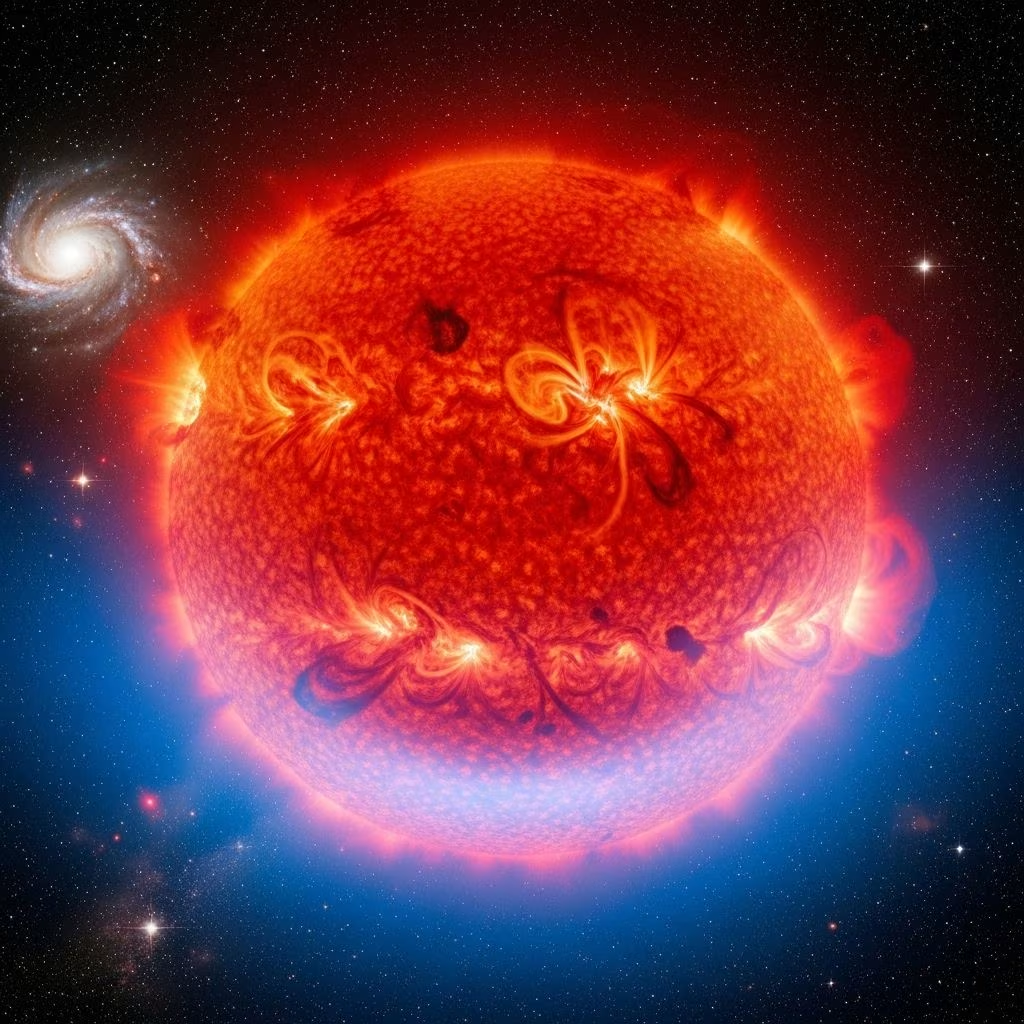
Sunspots have fascinated astronomers and laypeople alike for centuries. Appearing as dark, planet-sized patches on the sun’s surface, these features mark locations of intense magnetic activity and play essential roles in influencing solar and terrestrial phenomena. Their study is crucial for understanding the solar cycle, predicting space weather, and revealing the inner workings of our host star.
Definition and Characteristics
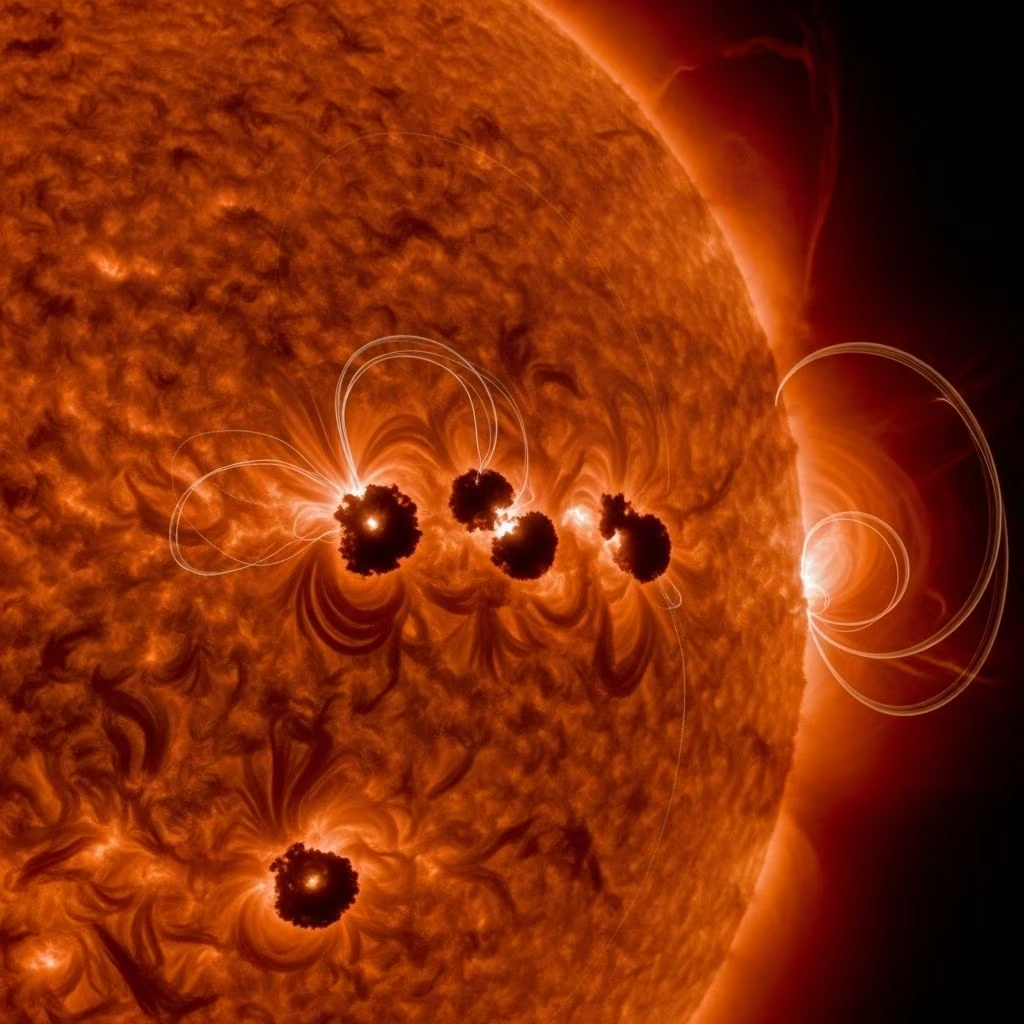
- Sunspots are cooler, darker regions on the sun’s photosphere caused by concentrations of magnetic field lines that suppress the flow of hot plasma.
- While most of the sun’s surface maintains temperatures of about 10,000°F (5,500°C), sunspots cool down to roughly 6,000°F (3,300°C). Their relative coolness makes them appear as dark blemishes when observed in visible light.
- Sunspots feature two distinct components:
- Umbra: The central, darkest core.
- Penumbra: The surrounding region, brighter and marked by intricate filaments of alternating light and dark.
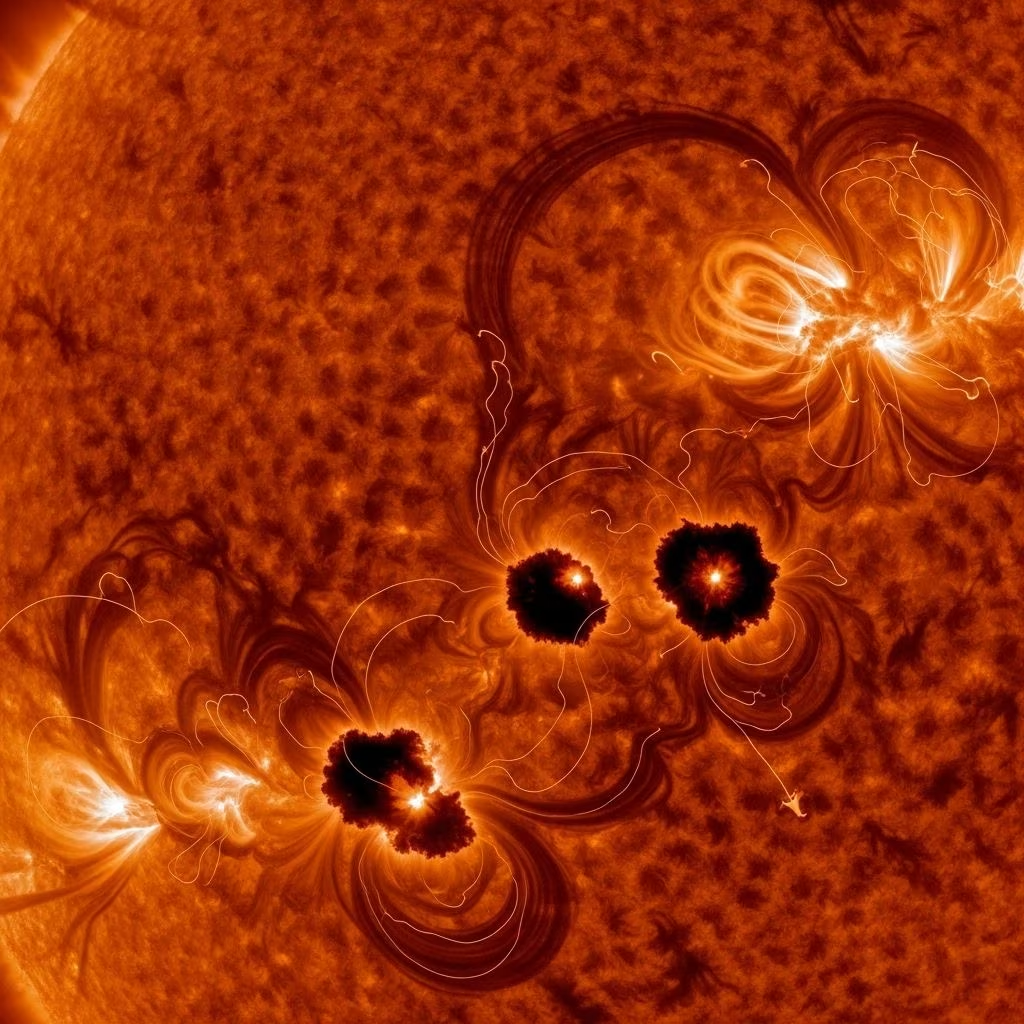
- Sunspots can range from hundreds to tens of thousands of miles across and often appear in groups called active regions.
Historical Observations
The history of sunspot observation spans back to the early 17th century when Galileo first pointed his telescope at the sun, initiating an era of continuous studies. Over time, astronomers have tracked and cataloged sunspots to unlock patterns governing solar activity, developing a detailed record of their behavior across hundreds of years.
How Do Sunspots Form?
The formation of sunspots is deeply entwined with the sun’s complex magnetic field. Yet despite decades of research, their origin remains among solar science’s enduring mysteries. Current theories and observational breakthroughs offer key insights:
Magnetic Fields and Differential Rotation
- The Babcock model, first proposed in 1961, likens the sun’s global magnetic field to loops of rubber bands. These loops, anchored at both poles, are stretched and wound due to the sun’s differential rotation—the equator spins faster than the poles.
- Over time, this differential rotation tangles and intensifies magnetic field lines, generating regions of concentrated magnetic stress.
- When magnetic field lines emerge and disrupt normal surface convection, they form pores in the photosphere. These pores can grow, merge, and coalesce into larger, planet-sized proto-spots. As they stabilize, they become sunspots.
Convective Flow and Spot Structure
- Sunspot edges reveal dynamic flows of gas, which help define their structure. Recent telescope observations confirm that the penumbra’s filamentary structure results from convective flows—columns of hot plasma rush upwards, cool as they spread out, then descend rapidly through the darkness of the umbra.
- Upflows in the penumbra can reach velocities of more than 6,600 miles per hour (10,800 km/h), while downflows in the umbra can exceed 2,200 miles per hour (3,600 km/h).
Precursors and Prediction
- Recent discoveries show that subtle magnetic field signals detectable at the sun’s surface can predict where sunspots may emerge, sometimes a full day before formation.
- Although these differences are not strong enough for single active region prediction, they offer new perspectives for understanding the initial formation processes of sunspots.
Sunspot Groups and Active Regions
Sunspots rarely appear in isolation. They tend to cluster in active regions—areas on the solar surface where magnetic fields are complex and robust.
- Active regions often give birth to dramatic solar events, including solar flares and coronal mass ejections (CMEs), which can impact satellites, astronauts, and even terrestrial technologies like power grids and airline navigation.
- The intricate interplay between plasma motion and magnetic structure ensures sunspots are reliable markers of broader solar activity.
Solar Cycles and the Role of Sunspots
Tracking sunspots has proven invaluable in monitoring the solar cycle. Solar activity waxes and wanes in roughly 11-year periods, marked by shifts in sunspot numbers, magnetic polarities, and overall solar output.
The Mechanics of the Solar Cycle
- During solar maximum, sunspots are abundant, solar storms are frequent, and magnetic field lines are highly tangled.
- At solar minimum, the sun is relatively quiet, with far fewer sunspots and reduced magnetic complexity.
- Each solar cycle concludes with the sun’s magnetic poles flipping, ushering in a new phase of activity.
Historical Solar Minima and Mysteries
The dynamics of sunspot production are not fully predictable. Notably, Solar Cycle 23 (peaking in 2001) ended with an unusually prolonged minimum, featuring many spotless days and an abnormally weak polar magnetic field—the longest drought in a century. Subsequent cycles, such as Solar Cycle 24 and the present Solar Cycle 25, have followed more typical patterns but still raise questions about the deep origins of these mysterious fluctuations.
| Characteristic | Solar Maximum | Solar Minimum |
|---|---|---|
| Number of Sunspots | High | Low or None |
| Solar Activity | Frequent flares, CMEs | Quiet, few eruptions |
| Magnetic Complexity | Highly tangled | Mostly stable |
| Impact on Earth | Storms, auroras, potential disruptions | Minimal impact |
| Polarity Flip | Occurs at cycle peak | N/A |
Why Do Sunspots Matter?
Sunspots offer a unique window into our changing star. Their frequency and behavior not only provide clues about the sun’s internal workings, but also influence conditions on Earth in a variety of ways:
- Space weather prediction: Tracking sunspot activity allows scientists to forecast solar storms that can endanger satellites, astronauts, and technology on the ground.
- Auroras: Solar storms spawned in active regions bathe Earth’s polar regions in breathtaking auroras.
- Power grid management: High solar activity can induce magnetic storms that affect electricity infrastructure.
- Air travel and communications: Solar flares and CMEs influence airline routes and can disrupt radio communication, especially at the poles.
Challenges and Ongoing Mysteries
Despite centuries of observation and advances in solar physics, many questions remain about sunspot formation, frequency, and long-term impacts:
- Why do sunspot cycles vary so dramatically? Some cycles feature extended minima, others erupt with vigorous activity.
- Can we reliably forecast sunspot emergence? Recent work identifying precursors and surface signals is promising but not yet able to predict specific spots with precision.
- How do convective flows and magnetic fields interact? The details of sunspot structure—from the umbra and penumbra to filaments—continue to be mapped and modeled, often using advanced telescopes and computer simulations.
- What is the full impact of sunspot-linked solar storms on modern life? The consequences of solar storms will likely grow as humans become more reliant on satellites and global networks.
Observing Sunspots: Tools and Techniques
Modern sunspot observation relies on a combination of ground-based and space technologies:
- Solar telescopes: Instruments such as the Swedish 1-meter Solar Telescope provide high-resolution imagery that has helped characterize dynamic flows in penumbral filaments and umbral darkness.
- Space observatories: NASA’s Solar Dynamics Observatory and similar missions monitor sunspots’ growth, movement, and their role in the solar cycle.
- Data networks: Projects like the Global Oscillations Network Group (GONG) aid in assembling comprehensive sunspot records, including the detection of precursors to sunspot formation.
Quick Facts: Sunspots at a Glance
- Sunspots indicate intense magnetic disturbance and cooler surface temperature on the sun.
- A sunspot’s diameter often matches or exceeds Earth’s—some measure tens of thousands of miles across.
- Sunspots are most common during solar maximum and nearly absent during solar minimum.
- The solar cycle lasts about 11 years, defining the ebb and flow of sunspot numbers and magnetic activity.
- Sunspot studies shed light on auroras, space weather risks, and changes impacting technology on Earth.
Frequently Asked Questions About Sunspots
What makes sunspots dark?
Sunspots are less bright than surrounding areas because their magnetic fields suppress convection, reducing the flow of hot plasma to the surface and lowering their temperature by roughly 4,000°F compared to the surrounding photosphere.
Can sunspots affect life on Earth?
Yes. Sunspots are linked to solar storms that can produce geomagnetic activity affecting satellites, power grids, and communication systems.
How are sunspots studied?
They are observed using specialized solar telescopes and satellites that record changes in brightness, structure, and magnetic activity.
What are solar cycles?
Solar cycles are roughly 11-year periods of rising and falling sunspot activity, marked by changes in the sun’s magnetic field and overall energy output.
Is it possible to predict sunspot formation?
Scientists can sometimes detect precursors to sunspot emergence days ahead, but precise prediction for individual sunspots remains elusive.
Conclusion: Sunspots and the Path Ahead
The study of sunspots continues to unlock new knowledge about the sun’s interior, magnetic fields, and effects on Earth. From their formation deep within the convection zone to their role as harbingers of solar storms and cycles, sunspots are more than fleeting blemishes—they are clues to the dynamic machinery powering our star. As technology and scientific understanding advance, ongoing observation of sunspots will remain a cornerstone of both solar physics and space weather forecasting, safeguarding life and infrastructure on our planet while illuminating the profound mysteries of the cosmos.
References
- https://nso.edu/press-release/scientists-discover-solar-precursors-of-where-when-sunspots-will-emerge/
- https://www.space.com/sunspots-formation-discovery-observations
- https://www.space.com/11858-dark-sunspots-origins-explained.html
- https://science.nasa.gov/sun/sunspots/
- https://www.space.com/11005-missing-sunspots-sun-mystery.html
- https://www.space.com/the-mysterious-sunspots
- https://www.space.com/19321-sun-formation.html
- https://www.space.com/58-the-sun-formation-facts-and-characteristics.html
- https://www.space.com/39021-200-year-old-journal-rare-sunspot-records.html
- https://www.space.com/solar-flares-effects-classification-formation