The Carrington Event: History’s Greatest Solar Storm
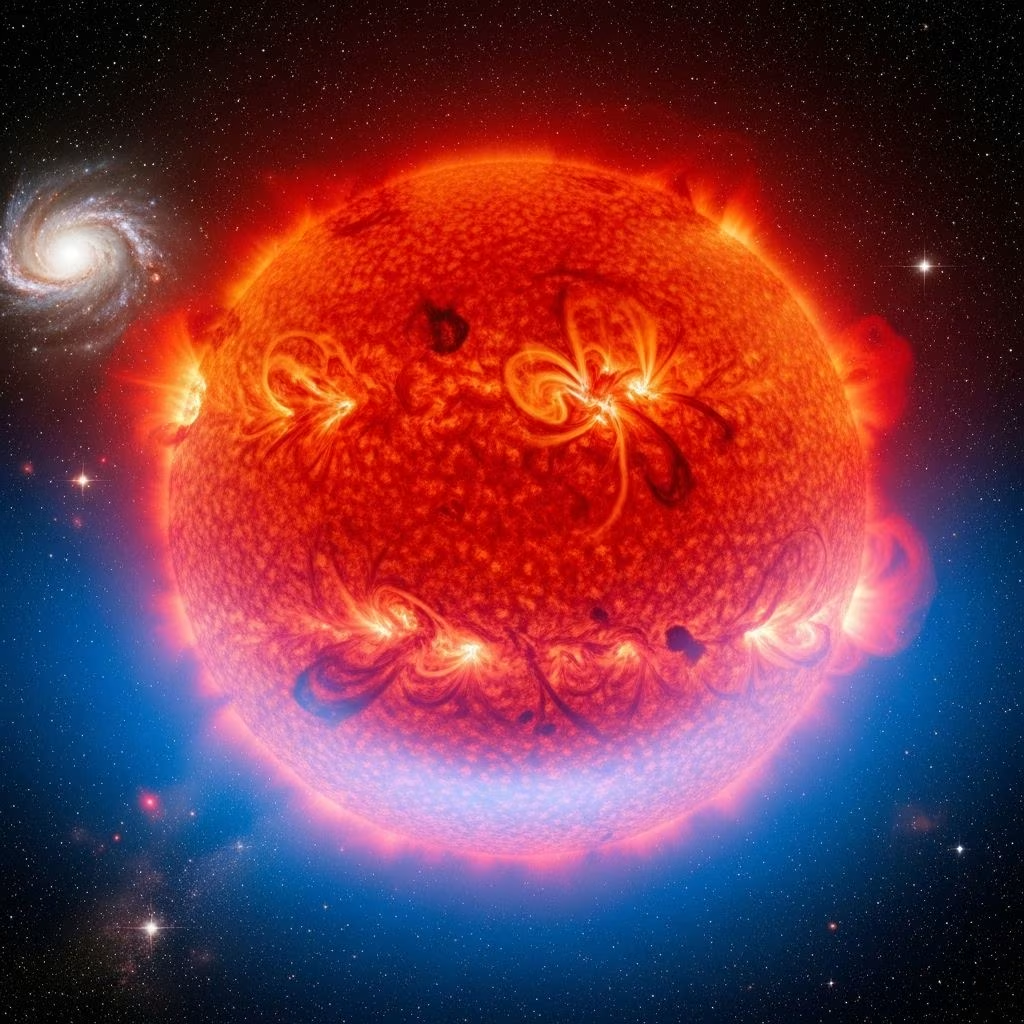
In early September 1859, the Earth was struck by an extraordinary natural phenomenon known as the Carrington Event, widely regarded as history’s most intense solar storm. Revealing the Sun’s hidden dangers, the event etched a permanent mark on human understanding of space weather. It not only disrupted the 19th-century world but also signaled persistent risks to our increasingly technological society.
Contents
- Origins and Discovery
- Timeline of Events
- Scientific Impact
- Societal Effects in 1859
- How Solar Storms Work
- A Carrington Event in Today’s World
- Preparedness & the Future Threat
- Frequently Asked Questions
Origins and Discovery of the Carrington Event
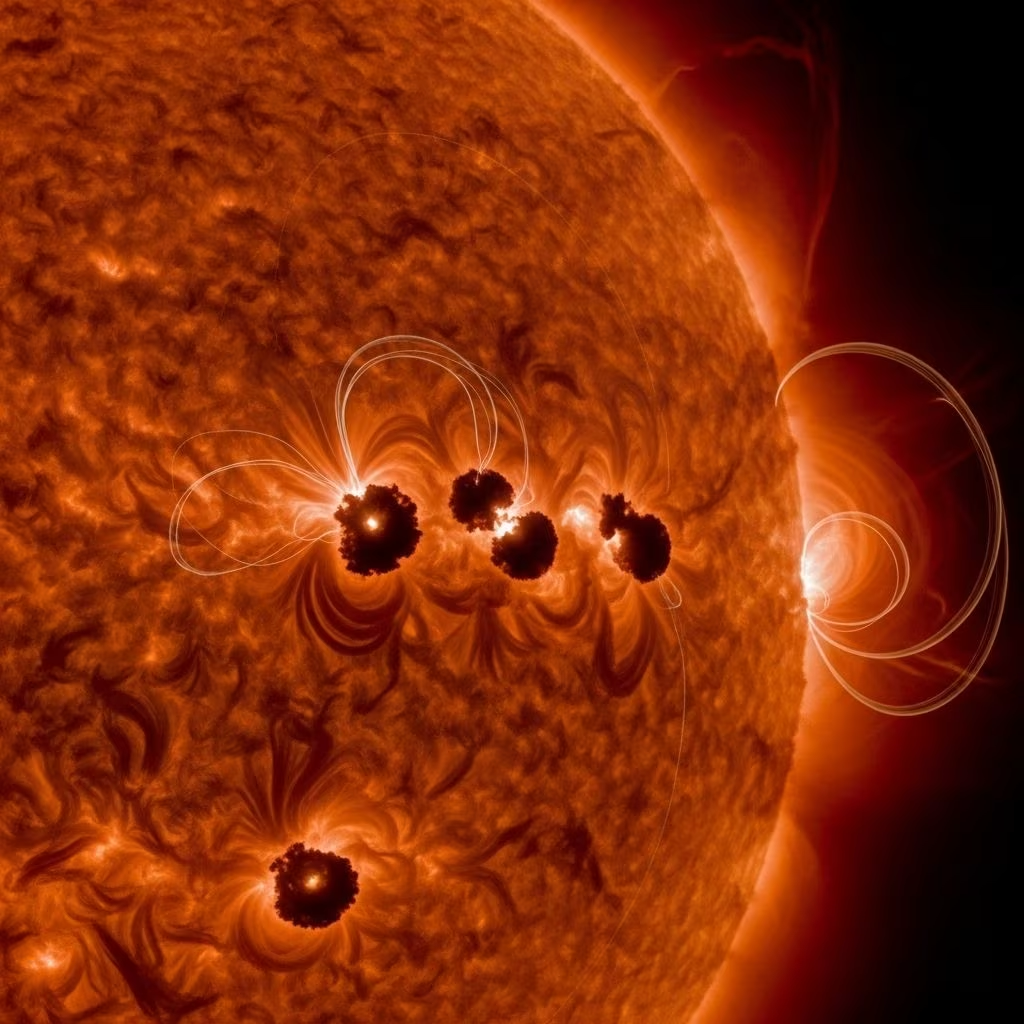
The Carrington Event derived its name from English astronomer Richard Carrington, who, alongside Richard Hodgson, independently observed a massive solar flare on September 1, 1859. Carrington was mapping sunspots from his observatory in Redhill, Surrey, when, just before noon local time, he witnessed an intense burst of white light originating from a region of sunspots. This bright flash would prove pivotal, marking the earliest ever recorded observation of a solar flare.
- Sunspots and Solar Activity: Carrington and contemporaries had noticed increased sunspot activity from August 28 onward.
- Solar Flare: The flash, or solar flare, erupted for five minutes; Carrington carefully documented its emergence and disappearance, which would later connect to geomagnetic and technological disruptions on Earth.
- Scientific Importance: This recognition laid the foundation for linking solar events to geomagnetic storms and broader space weather effects.
Timeline of the 1859 Carrington Event
| Date | Occurrence |
|---|---|
| Aug 28 | Sunspots begin to appear; magnetic fields on the Sun grow increasingly twisted. |
| Aug 29 | Auroras observed in unusual southern latitudes, including Queensland, Australia. |
| Sep 1 (morning) | Carrington and Hodgson observe the solar flare from England. |
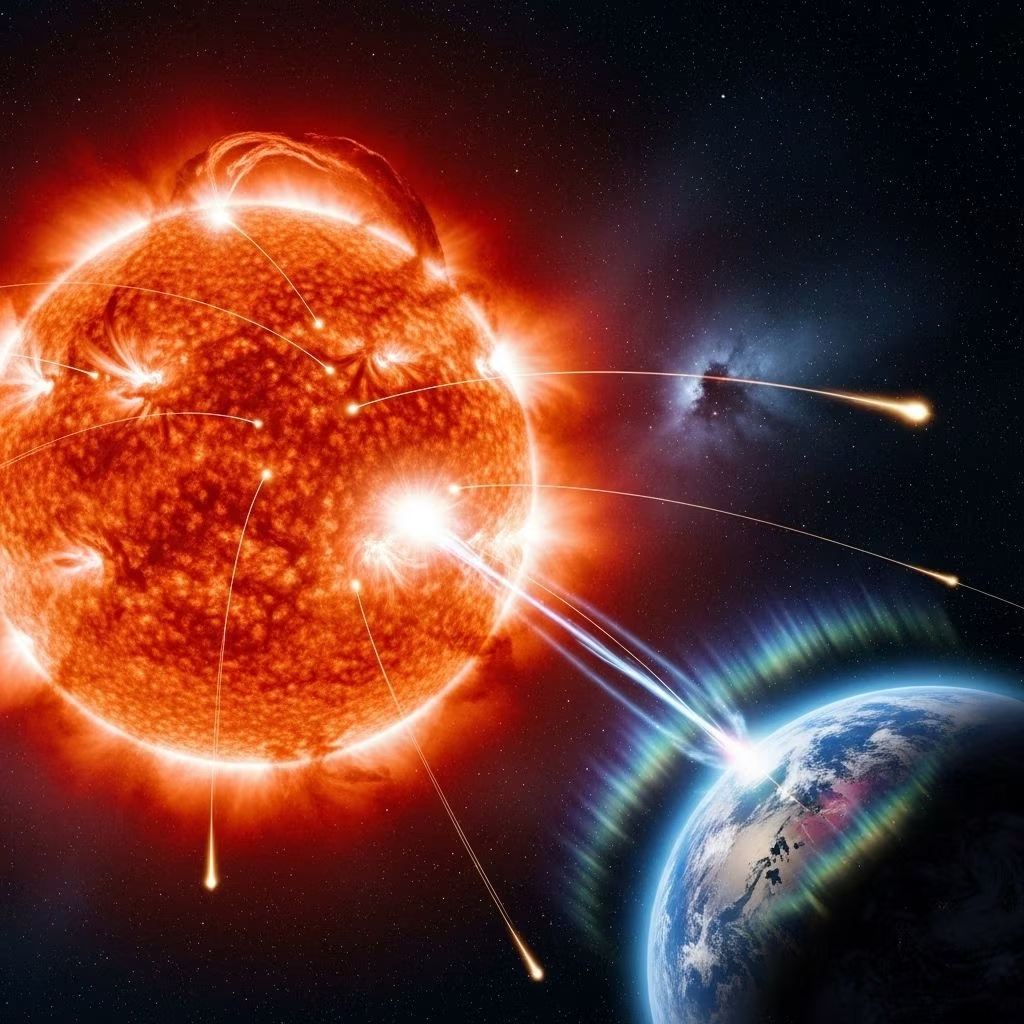
| Sep 2 (early hours) | Massive coronal mass ejection (CME) hits Earth after only 17.6 hours—a record transit time for solar material. |
| Sep 2-3 | Geomagnetic storm peaks; auroras seen worldwide as far south as the Caribbean and Hawaii. |
Scientific Impact: Carrington’s Legacy
Prior to 1859, the connection between solar activity and geomagnetic disturbances was poorly understood. The Carrington Event proved crucial in demonstrating that solar phenomena, especially solar flares and coronal mass ejections, directly affected Earth’s magnetic environment.
- The event led scientists to investigate the mechanisms behind auroras and electromagnetic storms.
- Observatories recorded magnetic fluctuations as far away as Scotland, highlighting the Earth-wide impact.
- Today, the Carrington Event marks the beginning of modern space weather science.
Societal Effects in 1859: Global Reach of the Storm
The technology of 1859, while primitive compared to today, was still vulnerable to the solar storm’s power. Telegraph systems—then the backbone of global communication—suffered dramatic, widespread disruptions:
- Telegraph Failures: Telegraph lines short-circuited, spark showers ignited fires in stations, and some operators reported telegraph systems worked without batteries thanks to the geomagnetically-induced currents.
- Auroras Worldwide: Vivid auroras illuminated the night sky in places where they are seldom seen, including southern Europe, the Caribbean, and parts of Central America.
- Unprecedented Magnetic Disturbance: Compasses and other navigation tools experienced sudden swings, confusing sailors and explorers.
- Public Reaction: For many, especially those living in lower latitudes, the appearance of vibrant, shimmering auroras sparked wonder and fear, as such displays were historically rare outside polar regions.
How Solar Storms Work: Space Weather Explained
Understanding the Carrington Event requires a primer on solar activity and space weather phenomena.
- Solar Cycle: The Sun follows an approximately 11-year cycle, marked by periods of high and low sunspot activity. Solar maximums bring increased likelihoods of large flares and CMEs.
- Sunspots: Dark blotches observed on the Sun’s surface, associated with intense magnetic fields.
- Solar Flares: Energetic bursts of radiation from the Sun’s surface, often near sunspot clusters.
- Coronal Mass Ejections (CMEs): Enormous bubbles of solar plasma and magnetic fields launched into space; these can trigger geomagnetic storms when they collide with Earth’s magnetosphere.
- Geomagnetic Storms: Disturbances in Earth’s magnetosphere caused by space weather, classified by the National Oceanic and Atmospheric Administration (NOAA) on a scale from G1 (minor) to G5 (extreme)—with Carrington-like events at the top.
While Earth’s magnetic field shields us from most solar fallout, intense space weather can breach defenses, creating hazards for power grids, satellites, and astronauts.
What Would a Carrington Event Do Today?
Modern life depends heavily on electrical, satellite, and digital infrastructure, making us far more vulnerable to a Carrington-class solar storm.
- Electrical Grids: Transformers and long-distance transmission lines could rapidly overheat and fail due to induced electric currents, causing blackouts and cascading failures of electrical infrastructure.
- Power Restoration: Widespread outages could range from several days in less-affected zones to potentially over a year in highly damaged regions (especially in densely populated areas).
- Global Communications: Disruption of satellite-based communications, GPS, radio, and television signals. Events in 2022 showed even a G2-class storm destroyed 40 SpaceX satellites.
- Financial Systems: Electronic payment and ATM systems dependent on grid power and internet connections could crash.
- Transportation: GPS navigation systems, critical for aviation and maritime activities, would be compromised, disrupting shipping and travel.
- Auroras: Skywatchers across latitudes could witness dramatic auroral displays similar to 1859.
Studies estimate a direct Carrington-like storm could cause $0.6 to $2.6 trillion in damages in the United States alone, with far-reaching global consequences.
Table: Comparison – 1859 vs. Today
| Aspect | 1859 Impact | Modern Impact |
|---|---|---|
| Communication | Telegraph malfunctioned, sparks flew, some systems ran without power | Mobile phones, satellite TV, internet, GPS disrupted; loss of global connectivity |
| Power Grids | No centralized grids; telegraph lines overloaded | Massive blackouts, transformer failures, possible long-term outages |
| Auroras | Seen far south, unprecedented visibility | Predicted worldwide, more intense and farther reaching due to stronger storm tracking |
| Navigation | Compass swings, confusion for traders/sailors | GPS failures; shipping, trains, planes interrupted worldwide |
Preparing for the Next Solar Superstorm
With space weather awareness growing, scientists and authorities urge serious global preparation for the next Carrington-class event.
- Monitoring & Prediction: NASA and NOAA maintain satellites and observatories to monitor solar activity and space weather, providing vital warnings.
- Infrastructure Hardening: Engineers recommend shielding transformers, updating grid systems, and planning for worst-case outages.
- Response Planning: Governments and agencies consider backup communication strategies, stockpiling grid components, and building redundancy into supply chains.
- Science Outreach: Dedicated organizations educate the public and policy makers on the tangible risks and necessary precautions.
The unpredictability of solar superstorms means preparation is key. Scientists estimate the chance of a massive solar storm is about 4% per year, with Carrington-class events at one every few centuries, but possibly higher.
Recent Near Misses and Ongoing Risks
- In July 2012, a powerful CME similar to the Carrington Event narrowly missed Earth by just nine days, serving as a stark warning.
- Modern society’s reliance on interconnected technology makes us increasingly exposed to solar-induced risk.
Frequently Asked Questions (FAQs)
Q: What causes a Carrington Event-class solar storm?
A: Huge sunspot groups form intense magnetic fields, which can unleash solar flares and CMEs. When these collide with Earth’s magnetosphere, they trigger geomagnetic storms.
Q: How often do such severe solar storms occur?
A: The average chance for a massive solar storm is about 4% per year. The last event of similar scale was in 1859, but near-misses and smaller storms are more frequent.
Q: Would a Carrington Event destroy electronics?
A: It would overwhelm power grids, cause blackouts, damage satellites and communications systems, but most consumer electronics are less directly affected unless plugged into the grid during surges.
Q: How can we protect vital infrastructure?
A: By upgrading transformer protections, installing fallback systems for grid management, having backup communications and robust scientific monitoring of the Sun’s behavior.
Q: What should the public do during solar storm alerts?
A: Consumers should prepare for potential short-term blackouts, keep emergency supplies ready, stay tuned to official warnings, and unplug sensitive electronics if instructed.
Related Reading
- Detecting the Perfect Solar Storm: How science attempts to forecast future events.
- The 2012 Near Miss: Lessons learned from almost experiencing another Carrington Event.
- Space Weather Preparedness: Actions governments and utilities take to minimize risk.
Final Thoughts: Bracing for the Next Carrington Event
The Carrington Event demonstrated the unpredictable force of our Sun and its ability to plunge the modern world into temporary chaos. As technology evolves and intertwines with daily life, it is increasingly critical to heed the warnings offered by space weather scientists and historical precedent. Understanding, monitoring, and preparing for these immense natural phenomena is a necessity—not just a scientific curiosity.
References
- https://en.wikipedia.org/wiki/Carrington_Event
- https://scijinks.gov/what-was-the-carrington-event/
- https://www.skyatnightmagazine.com/space-science/carrington-event-today
- https://www.astronomy.com/science/a-large-solar-storm-could-knock-out-the-internet-and-power-grid-an-electrical-engineer-explains-how/
- https://www.bu.edu/articles/2012/detecting-the-perfect-solar-storm/
- https://www.nasaspaceflight.com/2020/08/carrington-event-warning/
- https://www.techtimes.com/articles/275718/20220520/carrington-event-solar-storm-greatest-solar-storm-technology.htm
- https://en.wikipedia.org/wiki/September_1859_geomagnetic_storm
- https://www.itu.int/hub/2024/08/solar-storms-are-we-ready-for-another-carrington-event-2/
- https://www.sciencetimes.com/articles/44512/20230625/monstrous-sunspot-unleashed-carrington-event-historys-destructive-solar-storm.htm
- https://princetonastronomy.com/2019/02/02/the-carrington-event/
- https://pmc.ncbi.nlm.nih.gov/articles/PMC5215858/
- https://www.science.org/content/article/most-massive-space-storm-record-may-have-been-overhyped
- https://pmc.ncbi.nlm.nih.gov/articles/PMC4669545/
- https://astrobiology.com/2024/04/earth-life-records-its-local-stars-space-weather-carrington-event.html
- https://adventures.com/blog/carrington-event-biggest-solar-storm/
- https://forumias.com/blog/carrington-event/