Prague: Gateway to the Golden City of a Hundred Spires
Prague stands as the best-preserved Baroque city in Central Europe, a city of enchanting vistas, centuries-old towers, and a resilient spirit shaped by art, music, and political upheaval. Nicknamed the Golden City of a Hundred Spires, the Czech capital harmoniously blends ancient grandeur with modern buzz. From majestic castles and evocative bridges to the haunting remains of its Jewish Quarter, Prague’s layered past is palpable in every street and square.
The Historic Skyline: Prague’s Signature Views
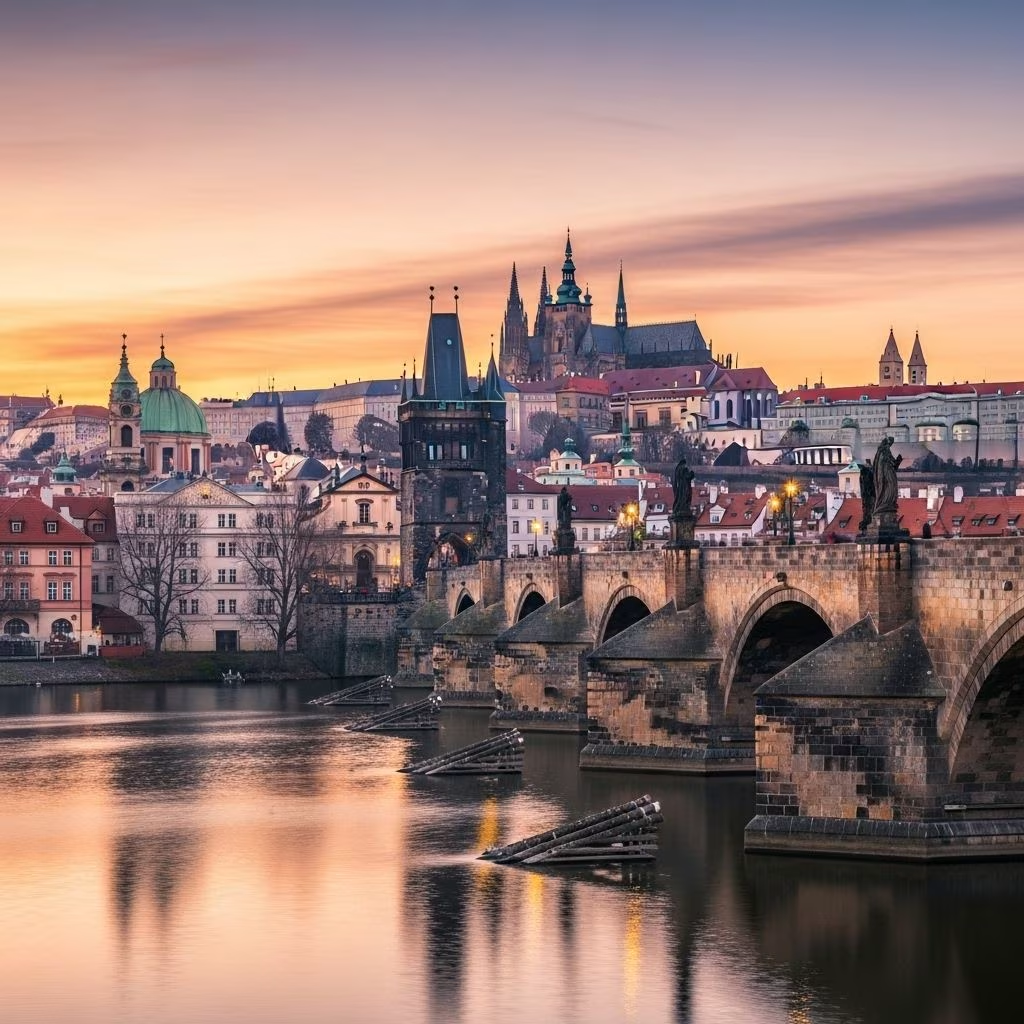
Prague’s historic core unfurls like a Baroque painting—where Gothic church spires pierce the sky and red-tiled rooftops tumble down rolling hills. The Vltava River slices through the city, reflecting the grandeur of Prague’s skyline in shimmering hues. Stone bridges, most famously the Charles Bridge, tie the city together, their statues and cobblestones whispering centuries of stories.
- Prague Castle: Dominating the cityscape from Hradčany Hill, this vast complex has stood witness to a millennium of Czech history.
- Charles Bridge: Adorned with dramatic Baroque statues, this pedestrian bridge is both a thoroughfare and an open-air gallery.
- Old Town (Staré Město): The city’s ornate heart, a dazzling maze of squares and alleys lined with architecture from every era.
Prague Castle: Heart of Czech Heritage
Your journey through Prague must begin at the Prague Castle—one of Europe’s largest and oldest castle complexes. The castle complex is a city within a city, sprawling over 70,000 square meters and packed with iconic sights.
- St. Vitus Cathedral: A soaring Gothic masterpiece whose spires are visible across the city; it houses the tombs of Czech kings and saints and the dazzling Crown Jewels.
- Old Royal Palace: Witness to historic royal events and the scene of the famous Defenestration of Prague.
- Golden Lane: Charming, pastel-colored cottages that once housed castle guards, goldsmiths, and even Franz Kafka.
- Changing of the Guard: A daily spectacle outside the castle gates, complete with fanfare and ceremonial uniforms.
Tips for Visiting Prague Castle
- Arrive early to beat the crowds—especially in peak season.
- Take in the panoramic view over the city from the castle’s ramparts.
Charles Bridge: Prague’s Open-Air Gallery
No visit is complete without a stroll across the legendary Charles Bridge. Built in the 14th century under the reign of Charles IV, the bridge arches gracefully over the Vltava, connecting the castle district to the Old Town. Thirty statues, mainly Baroque, line both sides of the bridge, each telling its own story.
- Street musicians and artists transform the bridge into a vibrant public stage.
- Go at dawn for magical solitude and misty river views, or in the evening for golden-lit vistas of the towers and city walls.
Old Town: Prague’s Timeless Core
The Old Town Square (Staroměstské náměstí) is Prague’s grandest stage, eternally bustling and framed by a riot of architectural styles—Gothic, Baroque, Renaissance, and Art Nouveau all intermingle. Here, the astronomical clock puts on its hourly show as bystanders gaze skyward, while horse-drawn carriages roll past the market stalls and outdoor cafés.
- Astronomical Clock (Orloj): Installed in 1410, it is the world’s oldest working astronomical clock. Watch for the procession of the Twelve Apostles every hour.
- Church of Our Lady before Týn: With its twin black Gothic spires, this church is an inescapable presence on the square’s skyline.
- Jan Hus Memorial: A dramatic sculpture honoring the Czech religious reformer, right at the heart of the square.
The Jewish Quarter: Shadows and Light in Josefov
Prague’s Jewish Quarter (Josefov) is one of Europe’s best preserved, offering both powerful testimony to centuries of Jewish life and painful reminders of the Holocaust. Today, the quarter draws visitors with its evocative synagogues, poignant cemetery, and stories of resilience.
- Old New Synagogue: The oldest active synagogue in Europe, dating back to the 13th century.
- Jewish Cemetery: Layered literally and figuratively, this haunting burial ground features thousands of crammed gravestones tilted by the passage of time.
- Jewish Museum: Spread over several synagogues, the museum displays centuries of culture, ritual objects, and personal stories.
- Learn about the legend of the Golem, the mystical protector allegedly fashioned from clay by Rabbi Judah Loew in the 16th century.
Music in Prague: A Storied Escape
Music is the heartbeat of Prague. For centuries, composers, musicians, and artists have found inspiration in its cobbled lanes and lavish halls. Mozart famously debuted works here, outshining even Vienna with the devotion of Prague’s music lovers.
- Rudolfinum: This grand concert hall is home to the Czech Philharmonic, renowned for its classical performances.
- Estates Theatre: The stage for the 1787 premiere of Mozart’s Don Giovanni, this is a must for opera lovers and history buffs alike.
- Catch a free or inexpensive concert in churches throughout the city, especially during festival season.
- Listen for street musicians echoing centuries-old folk tunes, jazz, and contemporary music in city squares.
Twentieth-Century Prague: A History of Turbulence and Triumph
Prague’s 20th-century history is a study in resilience—marked by world wars, occupation, totalitarian rule, and eventual liberation.
- Nazi Occupation and the Holocaust: The Jewish community suffered catastrophic losses during WWII, which today is commemorated in memorials and museums across the city.
- Communist Prague: For over forty years, the city lay behind the Iron Curtain. The Velvet Revolution of 1989, led by playwright-turned-president Václav Havel, peacefully dismantled communist rule.
- Wenceslas Square: The symbolic heart of modern Czech history; this wide boulevard has hosted revolutions, protests, and celebrations over the past century.
Czech Beer Culture: A Foamy Tradition
Prague claims some of Europe’s best beer—a boast that’s as historical as it is delicious. Czechs enjoy the highest beer consumption per capita in the world, and their brewing legacy is legendary.
- Pilsner, invented in nearby Plzeň, set the standard for golden lagers. A pint at a traditional Prague pub is an essential experience.
- Historic Beer Halls: Institutions like U Fleků and U Medvídků have been pouring pints since the Middle Ages.
- Order a “pivo” and pair it with hearty Czech fare (think roast pork, dumplings, and tangy sauerkraut).
The Lesser Town (Malá Strana): Elegance by the River
On the left bank of the Vltava, beneath the castle’s gaze, lies the Baroque splendor of Lesser Town. Meandering streets brim with embassies, charming gardens, hidden courtyards, and ornate churches.
- St. Nicholas Church: Its green dome and bell tower define the district’s skyline.
- Petrin Hill: A leafy escape with an Eiffel-style lookout tower and sweeping city views.
- Look for secret passageways and medieval alleyways linking larger boulevards.
Modern Prague: Youthful Pulse, Artistic Edge
While history is ever-present, today’s Prague is also creative, hip, and youthful. Murals, edgy galleries, sleek cafés, and innovative cuisine signal that the city is evolving while honoring its storied past.
- Find street art and modern sculpture scattered through neighborhoods old and new.
- Café culture thrives—follow in the footsteps of Kafka, Capek, and Kundera at the city’s historic and contemporary coffeehouses.
Essential Czech Phrases for Visitors
Connecting with locals is easier—and more memorable—if you learn a few simple Czech words:
- Ahoj – Hello / Goodbye
- Dobrý den – Good morning
- Prosím – Please
- Děkuji – Thank you
Planning a Visit: Practical Tips
- Best Time to Visit: Spring and early autumn offer mild weather and lighter crowds. Winter brings fairy-tale charm but chilly days.
- Getting Around: Prague’s historical core is compact and walkable; trams and metro easily connect outlying sights.
- Currency: Czech koruna (CZK).
- Safety: Prague is generally safe, with low crime rates in tourist areas. Watch for pickpockets in crowded spots.
- Language: Czech is the official language; English is widely spoken in tourist centers.
Frequently Asked Questions (FAQs)
Q: What is the best way to explore Prague’s major sights?
A: Walking is ideal in the compact city center. Public transport (trams, metro) is efficient for longer distances.
Q: Is Prague suitable for families?
A: Yes. Parks, puppet theaters, river cruises, and interactive museums make Prague appealing for children and families.
Q: Why is Prague called the “Golden City”?
A: The name refers to the gilded spires and rooftops that catch the sun, especially at sunset. Legend also attributes it to King Charles IV, who gilded the castle towers.
Q: Can I take guided tours in English?
A: English tours are widely available, especially at major attractions like Prague Castle, the Jewish Quarter, and Old Town.
Q: What local food should I try?
A: Sample dishes like svíčková (marinated beef with creamy sauce), goulash, and dumplings, accompanied by fresh Czech beer.
Quick Facts: Prague at a Glance
| Aspect | Detail |
|---|---|
| Country | Czech Republic |
| Population | ~1.3 million |
| Founded | 9th century |
| UNESCO Status | Historic Centre inscribed in 1992 |
| Currency | Czech koruna (CZK) |
Conclusion: Why Prague Endures
Prague’s beauty lies not only in its fairy-tale facades and grand historical sights but in a spirit forged through adversity—an ever-curious, ever-creative city. From the haunting quiet of the Jewish Cemetery to the lively swirl of a beer hall, from Baroque domes to Bohemian jazz, Prague is a city that rewards curiosity and lingers in memory. Whether you visit for a day or a week, every corner of Prague invites wonder.
References
- https://www.ricksteves.com/tv-programmers/season/eight
- https://www.imdb.com/title/tt1243815/episodes/?season=8
- https://www.imdb.com/title/tt7147710/
- https://www.pbssocal.org/shows/rick-steves-europe/episodes/rick-steves-europe-prague
- https://www.ricksteves.com/watch-read-listen/video/tv-show/season-8/prague
- https://www.youtube.com/playlist?list=PL1OajwstW05GTVkk609CBUy-AMuVnLSgR
- https://www.rottentomatoes.com/tv/rick_steves_europe/s08/e11
- https://en.wikipedia.org/wiki/Rick_Steves’_Europe