


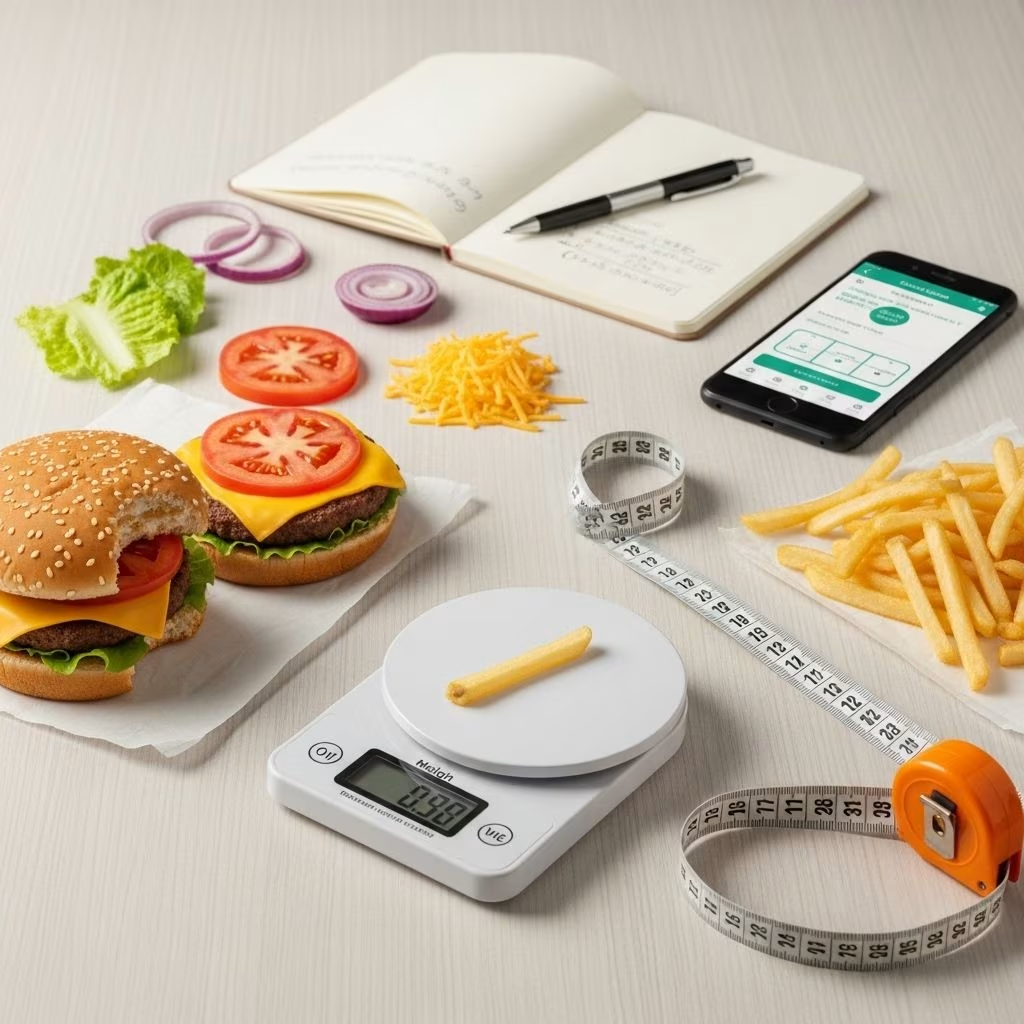
How to Accurately Estimate Fast-Food Calories: A Practical Guide
Understanding and accurately estimating the calories in fast-food meals is essential for anyone aiming to manage their weight, improve nutrition, or simply make better food choices while on the go. Fast food is convenient, but it can be deceptively high in calories, making it easy to misjudge how much you’re really consuming. This guide covers the pitfalls of underestimating fast-food calories, the reasons behind these errors, and offers strategies to help you make smarter, more informed decisions wherever you dine.
Why People Underestimate Fast-Food Calories
When eating out, people frequently underestimate the actual calorie content of their meals. Research shows that customers, particularly at fast-food restaurants, can guess as little as half the real calorie value of what they consume. This underestimation can happen for a variety of reasons:
- Portion Size Confusion: Fast-food servings are often larger than what we might choose at home.
- Hidden Ingredients: Added sauces, condiments, oils, and sugary drinks are easily overlooked.
- Lack of Labeling: Calorie labeling laws vary, and many fast-food chains only recently began displaying calorie information clearly.
- Perceived Healthiness: Seemingly healthy items (like salads or grilled sandwiches) may include high-calorie dressings or sides.
- Combination Meals: Combo deals can double or triple calorie intake compared to what one might anticipate.
The Research: How Off Are Our Estimates?
Studies consistently show that people underestimate the calorie content of fast-food items, sometimes by as much as 400 calories or more per meal. For example:
- In a large survey across multiple fast-food chains, adults underestimated their meal’s calorie content by a median of 175 calories. Adolescents were off by about 259 calories, and school-age children by roughly 175 calories.
- When asked to guess, participants usually gave lower figures for larger meals—a bias known as the portion size effect.
- The presence of calorie information at the point of purchase (e.g., on menu boards) improved accuracy but did not eliminate the tendency to underestimate.
The take-home message: Even well-informed consumers typically lowball fast-food calories, increasing the risk of unintended weight gain.
Common Pitfalls: Where Calorie Counts Go Wrong
Fast-food menus feature deceptively high-calorie options, many hiding excess calories in unexpected places. Beware of:
- Beverages: Sodas, milkshakes, and specialty coffees can add 200–600 calories per serving.
- Condiments and Sauces: A single packet of mayonnaise or salad dressing may add 100 calories or more.
- Fried Sides: French fries or onion rings can double a meal’s calorie tally.
- Extra Cheese and “Upsizes”: Larger portions or extra toppings quickly inflate calorie counts.
Calorie Estimates for Popular Fast-Food Meals
| Item | Estimated Calories | Common Pitfall |
|---|---|---|
| Cheeseburger | 300–500 | Extra cheese, larger buns, or multipacks add up fast. |
| Large Fries | 400–500 | Often underestimated, especially as sides. |
| Chicken Sandwich | 450–700 | Breaded options, mayo, and cheese. |
| Salad (with dressing) | 350–700 | Creamy dressings, cheese, and croutons. |
| Soft Drink (20 oz) | 250–300 | Refills and larger sizes go unnoticed. |
| Milkshake (Medium) | 500–700 | Dessert in disguise. |
Strategies to Improve Your Calorie Estimates
While it’s easy to make mistakes, you can train yourself to better estimate fast-food calories with these practical tips:
- Check posted nutrition facts: Many fast-food chains now display calorie counts on their menus. Take a few seconds to look before ordering.
- Use online calculators: Fast-food chains often have nutrition calculators on their websites or apps. Preview your options before heading out.
- Compare portions visually: Think of a deck of cards (3 oz of meat), a baseball (1 cup), or a poker chip (1 tbsp) to gauge serving sizes.
- Avoid combo meals: Ordering items à la carte allows for better calorie control.
- Request sauces and dressings on the side: This helps moderate the amount you actually eat.
- Downsize drinks and sides: Choose small or kid-sized beverages, and swap fries for fruit or salad when available.
Portion Control: Visual Cues to Estimate Calories
Learning how to recognize standard serving sizes is vital for estimating calories. Here are some handy visual comparisons commonly used by nutritionists:
- Meat (3 oz): Looks like a deck of cards
- Rice or pasta (1 cup): About the size of a baseball
- Cheese (1 oz): Resembles four stacked dice
- Dressing (2 tbsp): Fills a shot glass
Train yourself to use these mental images when assessing a restaurant portion to avoid estimating errors.
Smart Swaps: Lower-Calorie Fast-Food Choices
Fast food doesn’t always have to be a calorie bomb. Consider these lower-calorie swaps to satisfy cravings without sabotaging your goals:
- Skip fried for grilled: A grilled chicken sandwich is typically hundreds of calories less than a fried version.
- Choose water or unsweetened iced tea: Ditch sugary drinks to significantly cut calories.
- Order single burgers: Avoid doubles, triples, or loaded options.
- Opt for salads with vinaigrette: Use dressing sparingly, ask for it on the side, and skip croutons and extra cheese.
- Share sides or desserts: Splitting portions helps manage intake.
The Role of Technology in Calorie Estimation
Advancements in image-based calorie estimation are making it easier to gauge meal content. Mobile apps and smart devices now use:
- Photographic analysis: Snap a photo; AI estimates calories using food recognition and portion assessment.
- Online databases: Instantly access nutrition data for thousands of menu items.
- Barcode scanners: Quickly reveal package information for sides or drinks.
Nevertheless, even with technology, a critical eye on portion size and meal composition remains necessary for accuracy.
Understanding Nutrition Labels at Fast-Food Restaurants
With the implementation of menu labeling policies in many regions, calorie counts are increasingly available at the point of purchase. When reviewing these facts:
- Remember they reflect the prepared item as listed, but customizations (extra cheese, special sauces) often add unlisted calories.
- Beverage refills and impulse add-ons are easy to overlook.
- Nutritional details posted online may be more thorough than in-store menus.
When in Doubt: Estimate High, Not Low
If you have no nutrition information and must estimate, it’s safer to round up. Many nutrition experts recommend assuming that meals are larger and higher in calories than you might think, especially at fast-food chains known for generous portions.
- Aim to overestimate by at least 100–200 calories per entrée, especially if you’re unfamiliar with the restaurant’s sizing.
- Remember that extra ingredients—like bacon, special sauces, or double patties—can add calories rapidly.
Summary Table: Quick Calorie Reference for Common Fast-Food Items
| Food Item | Small/Regular | Large/Extra |
|---|---|---|
| Burger (Single) | 300–400 | 500–800 |
| Chicken Nuggets (6 pcs) | 250–300 | 500–750 (12 pcs) |
| Fries | 230–400 | 400–600 |
| Soda | 150–250 (12-16 oz) | 300–410 (32 oz) |
| Salad (with grilled protein) | 350–450 | 550–700 (with heavy dressing/cheese) |
Frequently Asked Questions (FAQs)
Q: Why do most people underestimate fast-food calories?
A: Common reasons include oversized portions, hidden calories in sides and drinks, deceptive “healthy” menu labels, and lack of visible nutrition information.
Q: Are salads at fast-food chains always lower in calories?
A: Not necessarily. Dressings, fried toppings, cheese, and croutons can quickly increase the calorie content—always check the nutrition facts and order toppings on the side when possible.
Q: What’s the most accurate way to estimate fast-food calories?
A: Check official menu labeling and use online calculators before ordering. When in doubt, compare portion size visually or use smartphone apps that reference restaurant nutrition databases.
Q: Should I completely avoid fast food when trying to lose weight?
A: No, occasional fast food can fit into a healthy weight-loss plan if you make mindful menu choices, control portions, and accurately estimate calorie intake.
Q: Do online calorie estimators and food recognition apps work well?
A: Recent technology using AI and food image recognition is improving, but visual and manual double-checking is still recommended for accuracy, especially for customized meals.
References
- https://consensus.app/questions/calorie-estimation-methods-for-food/
- https://cs229.stanford.edu/proj2015/151_report.pdf
- https://pmc.ncbi.nlm.nih.gov/articles/PMC3662831/
- https://pmc.ncbi.nlm.nih.gov/articles/PMC3719184/
- https://arxiv.org/html/2505.08747v1
- https://onlinelibrary.wiley.com/doi/10.1155/jfq/7044178
- https://www.semanticscholar.org/paper/Caloriemeter:-Food-Calorie-Estimation-using-Machine-Deshmukh-Metre/5c1cbe3234c266aa53042774f09c8ea020a43e5b


