Northern Lights: Facts, Science, and Magic of Earth’s Auroras
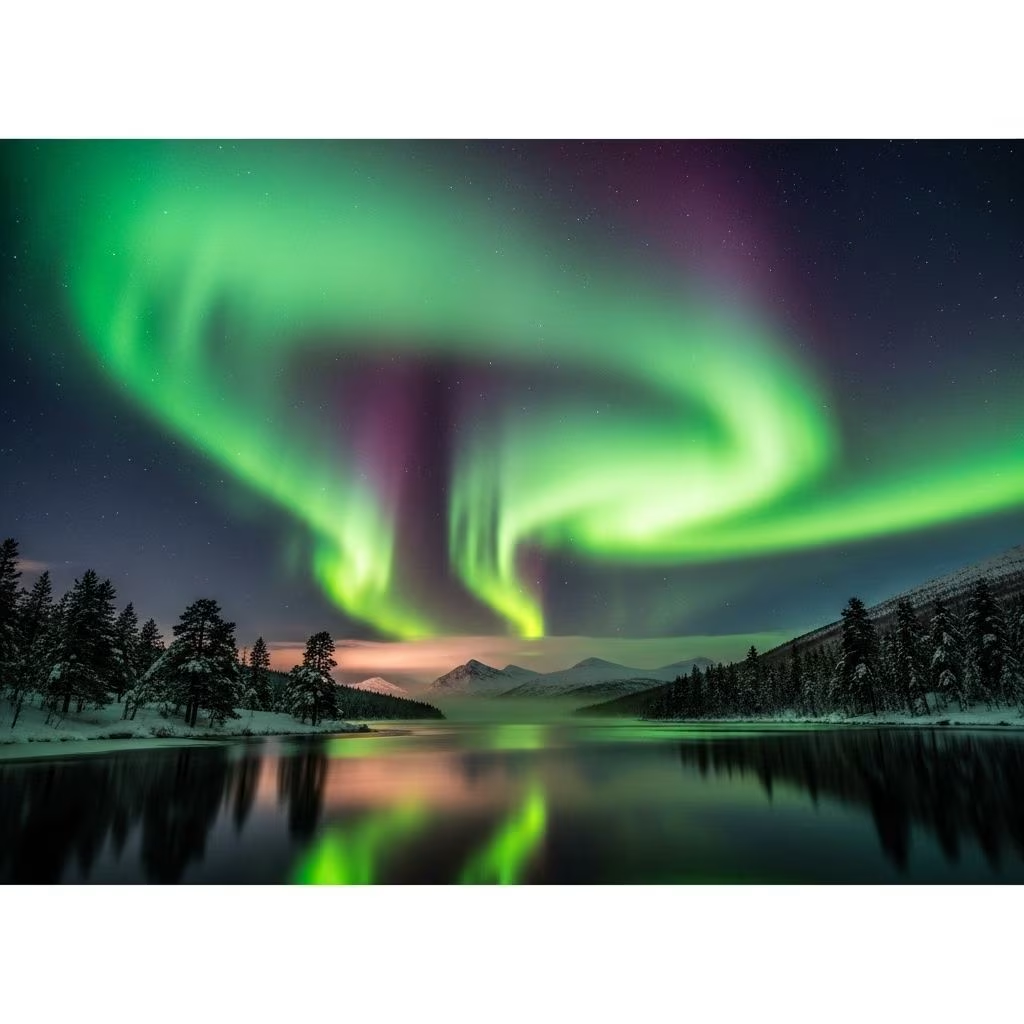
For centuries, the northern lights, known scientifically as aurora borealis, have fascinated, mystified, and inspired people across the world. These luminous displays captivate onlookers with their flowing green, red, and purple streams dancing across the night sky. But what causes these dazzling lights? Where and when are they best seen? And how have they influenced cultures and scientific exploration through the ages? This comprehensive guide explores the origins, science, history, myths, and global significance of auroras.
What is an Aurora?
Auroras are natural light displays, typically seen in the high-latitude regions near the Arctic and Antarctic Circles. In the Northern Hemisphere, they are called aurora borealis, or northern lights; in the Southern Hemisphere, they are known as aurora australis or southern lights. Both are caused by the same atmospheric and space processes, creating glowing curtains and ribbons of light across the sky.
The Science Behind the Northern Lights
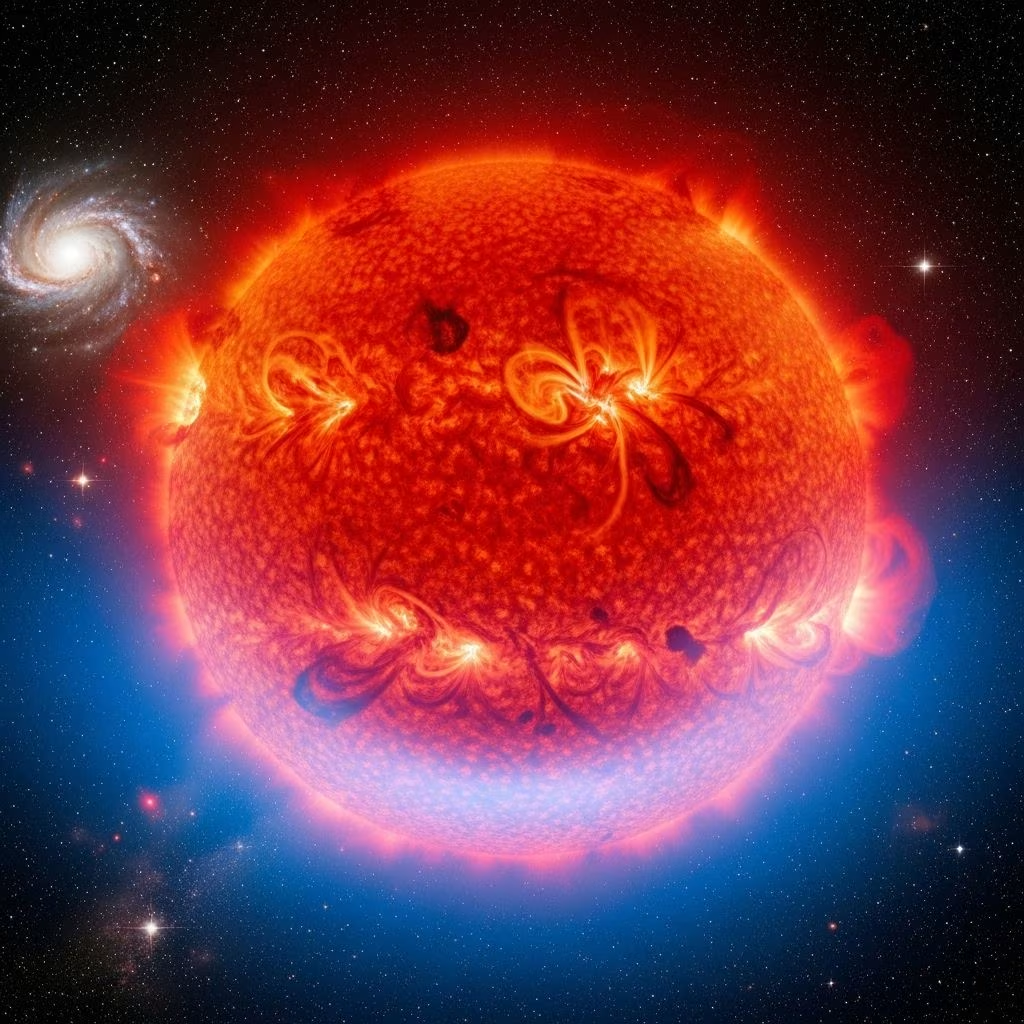
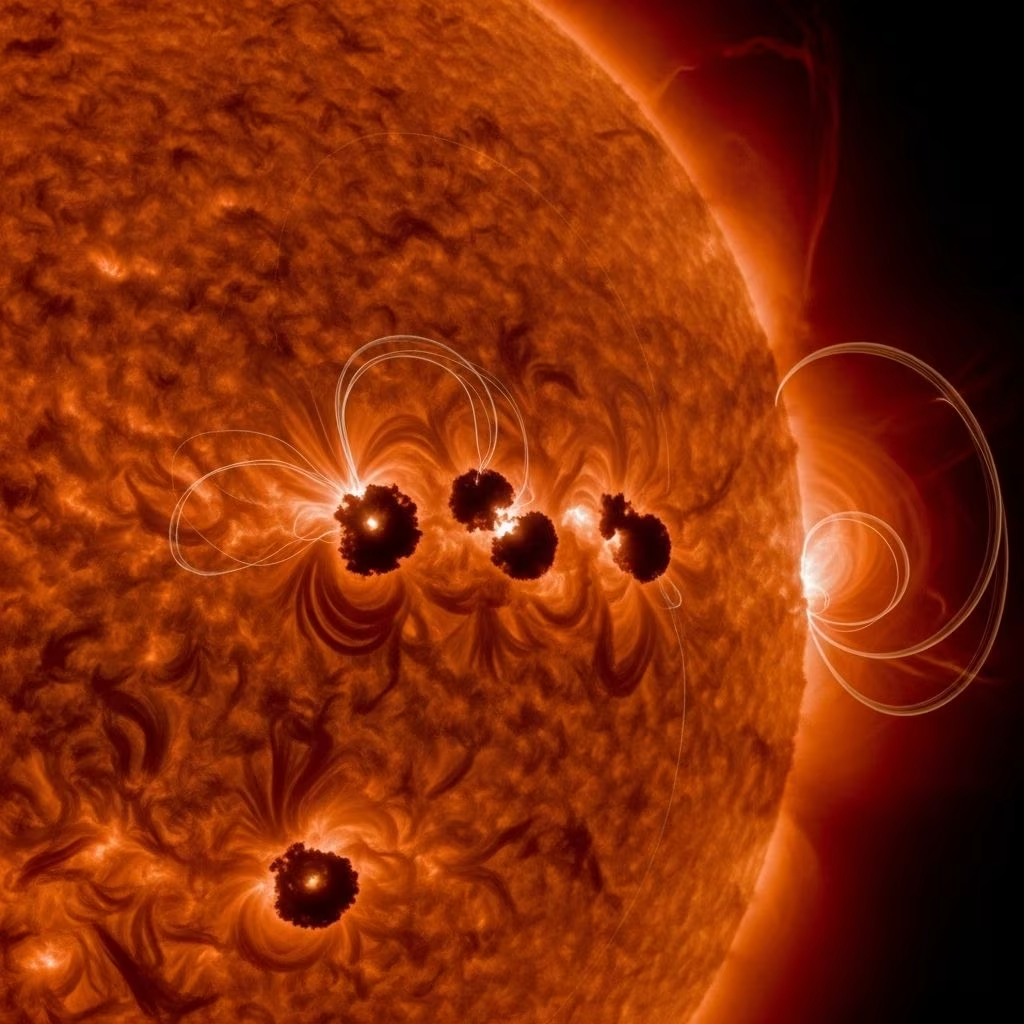
The driving force behind the aurora is the Sun. The Sun constantly emits a flow of charged particles known as the solar wind. During events like solar flares or coronal mass ejections—eruptions on the Sun’s surface—vast quantities of these particles are shot into space and sometimes directed toward Earth. When these particles reach Earth, they interact with the planet’s magnetic field—the magnetosphere—and are funneled toward the magnetic poles.
- Solar Wind: Stream of charged particles (protons and electrons) emitted from the Sun.
- Magnetosphere: Earth’s protective magnetic field, which guides the charged particles toward the poles.
- Atmospheric Collision: When the solar particles collide with molecules of oxygen and nitrogen in the upper atmosphere (80–500 km altitude), they transfer their energy to these molecules, “exciting” them.
- Release of Light: The excited molecules return to their original state by emitting photons, creating the shimmering lights seen from the ground.
The process can be summarized as:
| Step | Description |
|---|---|
| 1. Solar particles ejected | The Sun sends charged particles into space via solar wind and storms |
| 2. Magnetic field interaction | Particles are trapped and guided by Earth’s magnetosphere toward the poles |
| 3. Atmospheric collision | Particles smash into atmospheric gases, energizing them |
| 4. Light emission | Excited gases release photons, producing visible auroras |
Different Types: Borealis and Australis
The aurora appears in both hemispheres, forming two primary types:
- Aurora Borealis: Occurs in the Northern Hemisphere, above the Arctic Circle. Best known and most observed due to the greater human population in the north.
- Aurora Australis: Occurs in the Southern Hemisphere, around the Antarctic Circle. It is identical in cause and appearance but less commonly observed.
The regions around each pole where auroral activity is most intense are called auroral ovals. These ovals expand and contract depending on solar activity—stronger solar winds lead to larger auroral ovals, sometimes pushing the lights far from their usual polar homes and making them visible at much lower latitudes.
Aurora Colors and Patterns
The spectrum of aura colors and their wondrous visual patterns are determined by two main factors: the type of atmospheric gas being energized and the altitude at which the collisions occur.
- Green: The most common aurora color. Produced when charged particles collide with oxygen molecules at altitudes of 100–250 km (60–155 mi).
- Red: Less common, produced by high-altitude (above 250 km) collisions with oxygen atoms.
- Blue and Purple: Occur when particles interact with nitrogen. Blue is produced lower in the atmosphere (below 100 km), while purple and violet shades may appear at the highest and lowest altitude extremes.
Auroral patterns can vary from diffuse glows to rippling curtains, arcs, rays, and even corona-like bursts. These forms are shaped by Earth’s magnetic field lines and by constantly changing solar winds. Aurora displays may last from a few minutes to several hours and can cover vast swathes of the night sky.
Auroras in Mythology and Folklore
Before the science of auroras was understood, nearly every culture touched by the northern lights constructed myths and beliefs to explain their mysterious beauty and apparent power. Here are a few notable examples:
- Scandinavian and Finnish Legends: In Finnish folklore, the auroras were thought to be caused by the firefox (Revontulet) running so fast across the snow that its tail sent sparks up into the sky.
- North American Indigenous Beliefs: Many Inuit peoples saw the lights as the spirits of ancestors playing ball with a walrus skull. Some North American tribes viewed the lights as omens or messages from ancestors.
- Roman and Greek Observations: The ancient Greek and Roman scholars noted and described auroral displays, linking them to gods or warlike omens.
- Medieval Europe: Often seen as warnings or supernatural events, auroras were sometimes interpreted as harbingers of disaster or change.
How and Where to See the Northern Lights
Seeing the aurora borealis in person is a highlight for many. The quality and frequency of auroral displays depend on a combination of geography, time of year, solar activity, and weather.
Best Places to See the Aurora Borealis
- Norway (especially Tromsø, Svalbard, and the Lofoten Islands)
- Sweden (Abisko National Park)
- Finland (Lapland region)
- Iceland (entire country—dark, clear sky is key)
- Canada (Yukon, Northwest Territories, Nunavut, Manitoba)
- Alaska (Fairbanks and the Brooks Range)
- Greenland and parts of Russia
For the aurora australis, the southern lights, the top destinations include:
- Antarctica
- South Georgia Island
- Southern tip of New Zealand and Tasmania, Australia (rarely, on unusually active nights)
Best Time to Observe Auroras
- Late Autumn to Early Spring (October–March in northern latitudes) offers the longest nights and darkest skies.
- Solar Cycle Peaks: Auroral activity intensifies around the peak of the Sun’s roughly 11-year solar cycle, when solar storms are more frequent.
- Geomagnetic Storms: Major solar eruptions can spark auroras seen far beyond typical zones, including parts of northern Europe, the northern US, and even occasionally further south.
Tips for Seeing the Aurora
- Seek locations with low light pollution and unobstructed northern horizons.
- Be patient and dress warm; displays may last only a few minutes or extend for hours.
- Use aurora forecast tools and apps to track solar and geomagnetic activity.
Auroras and Space Weather
Auroras are not only beautiful—they are also a visible symptom of complex space weather conditions affecting Earth. Space weather encompasses various solar phenomena, including the flow of the solar wind, solar flares, and coronal mass ejections. These events can cause geomagnetic storms, leading to especially vibrant aurora displays but also affecting satellites, electrical grids, and communications.
- Major geomagnetic storms can knock out power lines and radio transmissions, particularly at higher latitudes.
- Satellites and astronauts in orbit are exposed to higher radiation during strong solar events.
Auroras Beyond Earth
Earth is not unique in experiencing auroras—other planets with magnetic fields and atmospheres can also light up. The most notable planetary auroras have been detected on:
- Jupiter: Features the largest and most powerful auroras in the solar system, driven by both the solar wind and the planet’s intense magnetic field.
- Saturn: Displays auroras detected by Earth telescopes and spacecraft; their colors and shapes differ due to varying atmospheric composition.
- Mars: Although it has a weak magnetic field, localized auroras have been discovered by orbiters.
- Uranus and Neptune: Both have faint, blue-green auroras observable by powerful telescopes.
Frequently Asked Questions (FAQs)
Q: Are the northern lights ever dangerous?
A: The aurora itself poses no danger to people viewing it from the ground. However, major solar storms that fuel bright auroras can disrupt power grids, communications, and satellite operations.
Q: Can auroras be seen with the naked eye?
A: Yes, auroras are best observed with the naked eye. Photographs can capture colors and forms that may be dimmer in person, but vibrant displays are visible without special equipment in dark, clear conditions.
Q: Why do auroras only appear near the poles?
A: Earth’s magnetic field guides incoming solar particles toward the magnetic poles, so auroral ovals are centered there. During strong magnetic storms, the ovals expand, allowing auroras to be seen at lower latitudes.
Q: What’s the difference between aurora borealis and aurora australis?
A: Both are caused by the same processes, but appear in opposite hemispheres—borealis in the north, australis in the south. Their forms and colors are often nearly identical.
Q: How high above Earth do auroras occur?
A: Most auroras form between 80 and 500 kilometers (50 to 310 miles) above the surface. The exact altitude affects their color and shape.
Q: Can the aurora make sounds?
A: While rare, observers occasionally report faint crackling or rustling sounds during intense auroras. Scientific evidence for these sounds is inconclusive, though some studies have explored possible sources.
Key Facts about the Northern Lights
- Auroras result from solar particles colliding with Earth’s atmosphere.
- Most visible in high-latitude regions (Arctic and Antarctic Circles).
- Their color depends on which atmospheric gases are energized and at what altitude.
- Solar activity, Earth’s magnetic field, and atmospheric conditions determine the frequency, intensity, and location of displays.
- Humans have observed and mythologized the northern lights for millennia.
- Similar auroras can be found elsewhere in the solar system.
The northern lights remain among nature’s greatest wonders, marrying art and science in a spectacle that has inspired awe and wonder since the dawn of humanity. Whether witnessing them firsthand or learning about their cosmic origins, studying auroras deepens our connection to both the universe and the mysteries of our own planet’s dynamic skies.
References
- https://en.wikipedia.org/wiki/Aurora
- https://science.nasa.gov/sun/auroras/
- https://www.hurtigruten.com/en-us/inspiration/northern-lights/science
- https://www.visitnorway.com/things-to-do/nature-attractions/northern-lights/facts-about-the-northern-lights/
- https://oceanwide-expeditions.com/blog/10-illuminating-facts-about-the-northern-lights
- https://www.rmg.co.uk/stories/space-astronomy/what-causes-northern-lights-aurora-borealis-explained
- https://spaceplace.nasa.gov/aurora/en/
- https://hollandamericahotels.com/blog/about-alaska/12-facts-about-the-aurora-borealis/
- https://www.mtu.edu/tour/copper-country/northern-lights/
- https://www.youtube.com/watch?v=paxenBrYJcQ
- https://www.asc-csa.gc.ca/eng/astronomy/northern-lights/what-are-northern-lights.asp
- https://www.nhm.ac.uk/discover/what-are-the-northern-lights-aurora-borealis-causes-explained.html
- https://www.youtube.com/watch?v=yuy4_x_WyWI
- https://www.swpc.noaa.gov/content/aurora-tutorial
- https://hello-aurora.com/blog/20-aurora-facts
- https://byjus.com/physics/aurora-borealis/
- https://www.icehotel.com/northern-lights
- https://www.funkidslive.com/learn/top-10-facts/top-10-facts-about-the-northern-lights/