How Cold Is Space? The Physics Behind the Universe’s Temperature
When people picture outer space, they often imagine an environment of absolute and infinite cold. But what does temperature mean in the void between planets and stars? How do scientists define and measure the chill of space, and why is it more complicated than simply saying, “space is cold”? This article explores the real science behind the temperature of space, from the heart of our solar system to the most remote reaches of the universe.
What Does ‘Temperature’ Mean in Space?
Temperature on Earth usually means how hot or cold a substance feels, a direct result of the movement (kinetic energy) of its molecules. In space, however, things work differently, mainly because of extremely low density — there are so few particles that, in most places, there aren’t enough of them to press against your skin or a thermometer.
- In space, temperature is defined as the average kinetic energy of particles.
- The fewer the particles, the less meaningful the concept of temperature—not because their energy is low, but because there’s little to transfer that energy to a physical object.
- For humans and spacecraft, feeling “cold” isn’t just about ambient temperature, but how quickly they lose heat through thermal radiation in the vacuum of space.
This means an object in space doesn’t cool down instantly. Instead, cooling is gradual, primarily via radiation, rather than by contact with colder material or fluid.
The Vacuum of Space: Is It Ever Truly Empty?
Though we think of space as “empty,” it is never truly a perfect vacuum. Even in the most desolate stretches between galaxies, there are:
- Atoms, usually hydrogen and helium, spread thin — sometimes fewer than one atom per cubic meter.
- Subatomic particles, dust, and cosmic rays.
- Photons, notably the cosmic microwave background (CMB), the afterglow radiation from the Big Bang.
These components mean there is always some energy, and thus some not-absolute-zero temperature, everywhere in space.
The Cosmic Microwave Background: The Universe’s Minimum Temperature
The coldest natural temperature in open space is set by the cosmic microwave background — electromagnetic radiation left over from the early universe, now cooled and stretched to microwaves by the expansion of space.
- The CMB bathes the entire observable universe.
- Temperature of the CMB: About 2.725 Kelvin (roughly -270.425 Celsius or -454.765 Fahrenheit).
- This makes it the effective “background temperature” throughout intergalactic space.
Objects left for billions of years in deep intergalactic space would eventually cool to match the CMB — unless acted upon by other forces or energy sources.
Absolute Zero: Theoretical Limit Versus Cosmic Reality
Absolute zero (0 Kelvin or -273.15°C) is the lowest temperature possible by the laws of physics — the point at which all molecular motion essentially stops. However, absolute zero is never actually reached in nature, not even in the deepest vacuum; the cosmic microwave background always provides a baseline above it.
- Laboratory experiments on Earth have created temperatures a tiny fraction of a degree above absolute zero.
- In natural outer space, the CMB sets a limit: 2.725 K.
Measuring Temperatures in Space
How do scientists know how cold the universe is? Measuring temperature in space isn’t as simple as using an ordinary thermometer. Several techniques are used, depending on what is being measured:
- Microwave detectors: Used to measure the cosmic microwave background.
- Infrared thermometers: Determine the heat radiated by astronomical objects.
- Thermal sensors on spacecraft: Measure the temperatures of planetary surfaces and atmospheres.
- Spectrometers: Analyze light from distant sources to determine the temperature of stars, gas clouds, and interstellar/intergalactic medium.
Instruments flown on satellites or telescopes must themselves be carefully shielded and calibrated, as even the faint warmth from surrounding equipment or the Sun can skew measurements.
The Coldest and Hottest Places in the Universe
| Location / Object | Reported Temperature | Explanation |
|---|---|---|
| Cosmic microwave background (general intergalactic space) | ~2.7 K (-270.45°C) | Set by the CMB; everywhere outside of gravitational or stellar influence. |
| Boomerang Nebula | ~1 K (-272°C) | Coldest known natural region; cooled below CMB by rapid expansion of gas. |
| Shadowed lunar craters | About 20 K (-253°C) | On the Moon, permanently shadowed craters can get very cold. |
| ISS exterior (in shadow) | -157°C | International Space Station surfaces facing away from the Sun. |
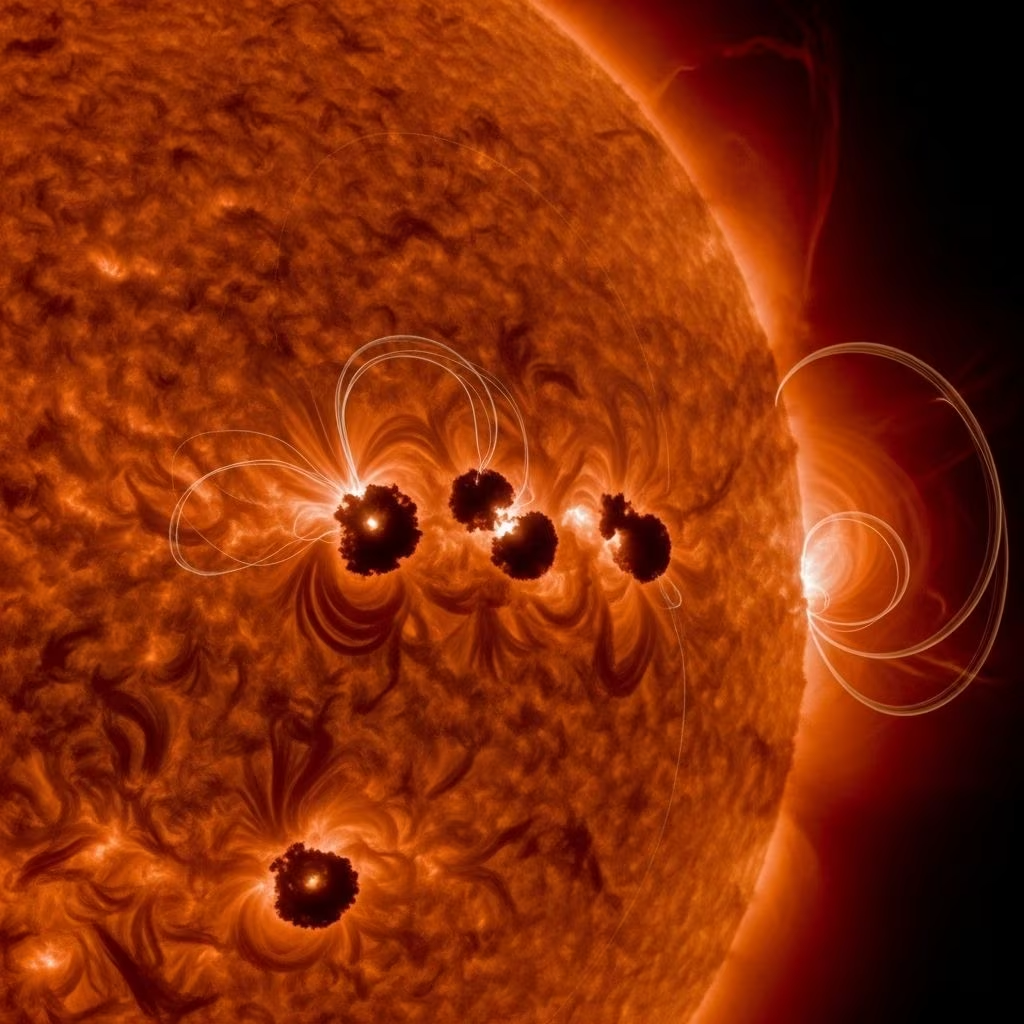
| Solar corona | ~1,000,000 K (726,850°C) | Sun’s outer atmosphere–hotter than the solar surface itself. |
| Core of a massive star | Up to 100 million K | Fusion processes drive temperatures to vast extremes. |
How Heat Transfers in Space: Radiation Rules the Vacuum
On Earth, heat travels by conduction (touch), convection (fluid motion, like air or water), and radiation (emitted as electromagnetic waves). In space, radiation is effectively the only way heat moves. Here’s why:
- No air or fluid exists to transport heat by conduction or convection.
- Any object (astronaut suit, satellite, moon rock) loses heat only by emitting infrared radiation.
- Objects exposed to intense sunlight also absorb radiant heat — making some locations extremely hot, while shadows remain frigid.
This is why spacecraft require careful thermal control — engineering solutions to both get rid of excess heat and prevent freezing.
Feeling Cold in Space: What Would Happen to a Human?
If you were suddenly ejected into deep space without a suit, you wouldn’t instantly freeze. Instead, your body would lose heat slowly through radiation. Simultaneously, the lack of atmospheric pressure brings other — more dangerous — hazards:
- Lack of pressure causes oxygen to leave the bloodstream, leading to unconsciousness in under 15 seconds.
- Other threatening effects: The vacuum causes ebulism (formation of bubbles in body fluids) and dehydration; freezing would occur more slowly than suffocation or decompression injury.
- Heat loss by radiation only: Compared to conduction/convection, radiative cooling is much slower.
Space Isn’t Uniform: Why Different Parts Have Different Temperatures
Space isn’t the same everywhere. Temperature varies dramatically depending on location and exposure:
- Near stars, heat from radiation dominates; surfaces may reach hundreds of degrees Celsius.
- In planetary shadows, such as the far side of the Moon or in deep craters, trapped surfaces remain very cold.
- Within galaxy clusters, the intergalactic medium can be millions of degrees, though sparse enough not to feel hot.
- The Boomerang Nebula is the coldest known natural location, even cooler than CMB, due to rapid gas expansion outpacing heating from background radiation.
Space probes and astronauts must be prepared for both freezing and scorching, often within a matter of minutes, as they pass in and out of sunlight or planetary shadow.
Technological Implications: Surviving and Measuring Space Temperatures
Space missions must account for temperature extremes. Consider some engineering and scientific consequences:
- Thermal management is crucial – spacecraft use insulation, heaters, radiators, and sometimes phase-change materials to maintain operational temperatures for electronics and instruments.
- Temperature calibration is critical for scientific measurements, including those of planets, moons, and the cosmic microwave background.
- Scientific advances have led to new types of thermometers, including quantum thermometers and radiometers, that allow for precise, contactless measurement in the harshest environments.
Summary Table: Typical Temperatures in Space Environments
| Location | Temperature Range |
|---|---|
| Intergalactic space (CMB) | ~2.7 K (-270.45°C) |
| Shadowed craters (Moon) | ~20 K (-253°C) |
| Low Earth orbit (in sunlight) | ~120°C |
| Low Earth orbit (in shadow) | ~-160°C |
| Kuiper Belt/Edge of solar system | ~50 K (-223°C) |
| Surface of the Sun | ~5,500°C |
| Core of neutron stars | Up to 1 trillion K |
Frequently Asked Questions (FAQs)
Q: If space is so cold, how can satellites or astronauts get hot?
A: In sunlight, there’s nothing to block or scatter radiant energy, so objects exposed to the Sun can heat up very quickly. Satellites and astronauts use shields and coats of reflective material to prevent overheating.
Q: Could anything ever reach absolute zero naturally?
A: No. Even with the cosmic microwave background as the universe’s cooling floor, and the quantum fluctuations of empty space, true absolute zero is never achieved anywhere naturally.
Q: Is it colder in the shadows on the Moon than in most of deep space?
A: In permanently shadowed polar craters on the Moon, temperatures can approach 20 K — extremely cold, but still much warmer than pure intergalactic space, primarily due to proximity to the Sun and the very thin lunar atmosphere not fully blocking all energy exchange.
Q: What is the coldest naturally occurring place observed in space?
A: The Boomerang Nebula holds the record at about 1 K, which is colder than the cosmic microwave background, due to rapid outflow and expansion of gas from the central star, resulting in intense cooling.
Fascinating Facts About the Universe’s Chill
- The temperature of space can never truly reach, nor drop below, the temperature of the cosmic microwave background, except in extraordinary circumstances (like the Boomerang Nebula).
- During the Apollo missions, temperature swings outside the lunar module could be over 300°C (from sun to shade), requiring advanced technology to protect astronauts.
- Laboratories on Earth have cooled atoms to less than one-billionth of a degree above absolute zero, far colder than anywhere found in nature.
- Heat doesn’t transfer quickly in a vacuum; radiative heat loss means that even without air, objects “cool off” more slowly than most people assume.
- Some dense interstellar clouds are warm (tens to hundreds of degrees Kelvin), while surrounding space is far colder, depending on the local energy sources and cosmic rays passing through.
Conclusion
Space isn’t just cold; it challenges our understanding of what ‘temperature’ means in the absence of air, water, or even solid ground. Defined by the cosmic microwave background, punctuated by mind-boggling extremes near stars, neutron stars, and nebulae, the temperature of space is not a single number but a complex, beautiful tapestry of physics and thermodynamics on the grandest scale. The next time you look up at the starry sky, remember: the chill of space is both colder—and more fascinating—than our everyday language can capture.
References
- https://science.nasa.gov/earth/measuring_global_temperature/
- https://www.nist.gov/news-events/news/2025/01/new-atom-based-thermometer-measures-temperature-more-accurately
- https://www.skyatnightmagazine.com/space-science/temperature-of-space
- https://en.wikipedia.org/wiki/Outer_space
- https://www.space.com/how-cold-is-space
- https://en.wikipedia.org/wiki/Satellite_temperature_measurements
- https://www.nasa.gov/directorates/armd/aetc/test-technology-temperature-measurement/
- https://www.vaia.com/en-us/explanations/engineering/aerospace-engineering/temperature-measurement/
- https://www.micro-epsilon.com/applications/search-by-measurement/temperature/
- https://citylabs.net/cold-outer-space/
- https://harfordastro.org/blog-4-1/temperature-in-space
- https://www.cryogenicsociety.org/index.php?option=com_dailyplanetblog&view=entry&category=industry-news&id=371%3Awhat-is-the-temperature-of-space-
- https://www.astronomy.com/science/how-cold-is-it-in-outer-space/
- https://www.livescience.com/coldest-place-in-solar-system
- https://www.youtube.com/watch?v=jT59v_TLm_Q
- https://theastrophysics.com/knowledgebase/how-is-temperature-measured-in-space