Moon Halos: Nature’s Circles and Humanity’s Lunar Gateways
Circular rings of light surrounding the moon have been observed for millennia, captivating skywatchers, inspiring legends, and sparking scientific curiosity. Known as moon halos or lunar halos, these optical phenomena are not only portents in folklore but also striking demonstrations of atmospheric physics. In the 21st century, the word “HALO” has also come to represent humanity’s ambitions in space, as NASA and other agencies develop advanced lunar orbits and habitats for a sustained presence on and around the moon. This article explores both the natural and engineered halos that circle our nearest neighbor in space.
What Is a Moon Halo?
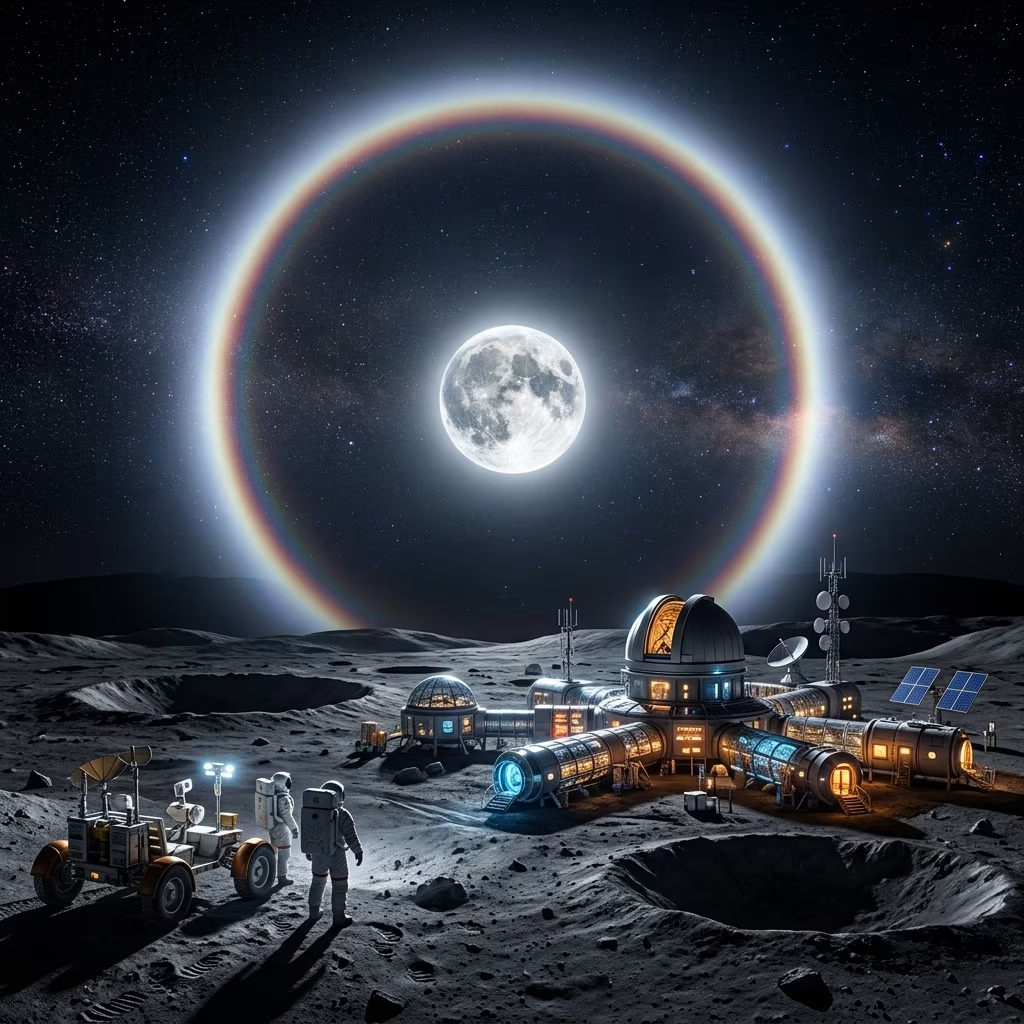
A moon halo is a luminous circle or ring that appears centered on the moon, usually visible when the moon shines brightly through high, thin clouds. The most familiar and dramatic is the 22-degree halo, named for its angular radius around the lunar disk. This halo appears as a wide, faintly colored ring, often with a reddish inner edge and bluish outer rim. The effect results from the passage of moonlight through millions of tiny ice crystals suspended in the upper troposphere.
- Most commonly observed during cold, clear winter nights with cirrostratus cloud cover.
- Not exclusive to the moon—sun halos (solar halos) occur via the same mechanisms, but are more striking due to the sun’s brightness.
- The 22-degree halo is the most frequent, but smaller or larger halos (e.g., the rare 46-degree halo) and related optical rings such as parhelia (“sun dogs”) are also possible.
The Optical Science Behind Moon Halos
Lunar halos are a type of halo (optical phenomenon), caused by the refraction and reflection of light—here, the moon’s reflected sunlight—by ice crystals floating high in the Earth’s atmosphere. Specifically:
- Moonlight passes through hexagonal ice crystals in cirrostratus clouds at altitudes of about 5–10 km (16,000–33,000 feet).
- The ideal crystal is shaped like a hexagonal prism. As light enters one face of the ice prism and exits through another at a 60-degree angle, it gets bent or refracted by a minimum angle of 22 degrees.
- The refraction (\(\theta = 22^\circ\)) angle is a result of Snell’s Law, determined by the difference in refractive index between air and ice.
- The cumulative effects of millions of such ice prisms, randomly oriented across the sky, generate a circular ring around the moon at a constant radius of 22 degrees. The ring’s width and intensity depend on the crystal sizes, concentrations, and cloud cover density.
| Feature | Description |
|---|---|
| Angular Radius | 22 degrees (typical) |
| Color Appearance | Faint colors—reddish inner edge, bluish outer edge; colors are muted compared to sunlight due to the relative dimness of moonlight. |
| Altitude of Clouds | 5–10 km (16,000–33,000 feet) |
| Crystal Shape | Hexagonal prisms |
| Frequency | Several times per year in temperate regions, more common in polar/sub-polar climates |
Other Types of Halos and Optical Phenomena
- 46-degree halo: Larger and much rarer, formed by more complex light paths through ice crystals.
- Sun dogs (parhelia): Side halos sometimes seen alongside the 22-degree halo, primarily with the sun but also possible with the moon.
- Lunar Coronas: Small, vividly colored rings much closer to the moon, caused by diffraction, not refraction, on tiny water droplets.
The History and Folklore of Moon Halos
Halos have stirred wonder and conjecture throughout human history. Many cultures have regarded the appearance of a moon halo as a cosmic omen or a portent of changing weather. Some core aspects include:
- Ancient and medieval skywatchers ascribed spiritual or meteorological meanings to halos, sometimes linking them to lunar deities or as forewarnings of major events.
- In Western folklore, a ring around the moon was frequently seen as a sign of approaching rain or snow—a belief validated in part by the science, as cirrostratus clouds often precede frontal systems and unsettled weather.
- Textual evidence goes back to Roman times and even earlier, noting rings or ‘crowns’ surrounding the moon preceding weather changes.
While the scientific explanation matured slowly with the rise of physics and meteorology, the moon halo’s beauty and mystery remain a part of the world’s observational folklore.
The Moon Halo and Weather Prediction
Moon halos do, in fact, sometimes foreshadow a change in weather. Here’s how:
- Cirrostratus clouds that create moon halos are often on the leading edge of large-scale, moist air masses associated with approaching warm fronts.
- Within 24–48 hours after sighting a halo, precipitation (rain or snow) often follows if the region’s weather patterns are conducive to frontal systems. This correlation is not universal but frequent enough to give rise to adages like, “Ring around the moon, rain or snow soon.”
Note: Not every moon halo means a storm is coming, but as a general rule, they can be considered as early meteorological indicators—an impressive convergence of folk wisdom and physical science.
Lunar Halo Orbital Science: From Natural Phenomena to Deep Space Outposts
The term halo takes on new significance in the context of lunar exploration. In the last decade, as astronauts and robotic probes return their focus to our moon, the concept of a halo orbit has become crucial for sustainable lunar activity.
Near-Rectilinear Halo Orbit (NRHO): What Is It?
As part of NASA’s Artemis program and the international push for returning humans to the lunar surface, space agencies are planning to construct a new lunar outpost—the Gateway station. This modular spacecraft will travel in a unique gravitationally stable path called a near-rectilinear halo orbit (NRHO). In this context:
- An NRHO is not an optical halo, but a mathematical solution to the three-body orbital problem involving the Earth, the moon, and a spacecraft.
- This special orbit brings the station as close as 3,000 km above the lunar surface at its nearest approach and up to 70,000 km at its farthest point. It is called “halo” due to its looping path around the moon (and relative to the Lagrange points in the Earth-moon system).
- The NRHO provides continuous communication with Earth and broad surface access for landers and science missions while minimizing fuel needs.
The Gateway and the HALO Module
The Gateway station, fundamental to Athena’s plans for long-term lunar exploration, features a core module named HALO—the Habitation and Logistics Outpost. This is an engineered “halo” that symbolizes humanity’s transition from moon observer to interplanetary explorer.
- HALO module will serve as a living and working space for astronauts, with life support, command, and research facilities.
- Outfitted to dock with NASA’s Orion capsule, lunar landers, and resupply vehicles.
- Functionality includes environmental controls, power distribution, radiation monitoring, and communication links.
- The Power and Propulsion Element (PPE) module, which will launch with HALO, uses high-efficiency solar electric propulsion to maintain the Gateway’s orbit.
Ultimately, the HALO module and Gateway will act as a stepping-stone for crewed missions to the lunar surface and, in the future, to Mars. Among key capabilities:
- Enables long-term lunar science experiments.
- Allows rapid surface access to various lunar regions, including the water-rich south pole.
- Acts as a testbed for deep-space living far from Earth.
Moon Halos in Art, Culture, and Modern Media
From ancient skywatchers drawing “rings around the moon” in petroglyphs or poems, to today’s astrophotographers capturing halos with smartphones, the moon halo continues to enchant. In the digital era, the phenomenon trends online each time a dramatic display is spotted:
- Social media rapidly spreads images and awe at especially bright or well-formed halos.
- Recent events—such as a spectacular lunar halo seen across Canada—ignite public curiosity about the science behind what they witnessed.
- The term halo is used increasingly in both natural and technical lunar contexts, further entwining science with imagination.
How to See and Photograph a Moon Halo
Spotting a moon halo is often a matter of chance—clear skies with high cirrostratus clouds and a bright moon. To maximize your chances:
- Look for thin, milky-looking clouds that cover most or all of the sky. Thick, opaque, or low-altitude clouds block the effect.
- A halo will be best seen around a full moon or gibbous phase, when the moon’s light is strongest.
- Get away from urban light pollution for best viewing, though bright halos may still be visible in cities.
- To photograph: Use a smartphone or DSLR with long exposures, set the moon slightly off-center to capture the entirety of the ring, and try bracketing exposures to balance the moon’s brightness with the dimmer ring.
Comparing Natural and Artificial Moon Halos
| Aspect | Natural Moon Halo | Lunar Gateway ‘HALO’ |
|---|---|---|
| Origin | Atmospheric refraction of moonlight by ice crystals | Human-made habitat module in lunar orbit |
| Visibility | Seen from Earth’s surface under specific cloud conditions | Visible to astronauts; represents a node for lunar operations |
| Significance | Weather prediction, folklore, natural beauty | Space exploration, international science collaboration |
| Physical Nature | Optical phenomenon, ephemeral, dependent on weather | Physical structure, engineered, permanent (planned) |
Frequently Asked Questions (FAQs)
Q: What exactly causes a moon halo to appear?
A: A moon halo is caused by moonlight passing through millions of ice crystals in cirrostratus clouds high in the atmosphere. These crystals bend (refract) the light into a circle with a radius of 22 degrees around the moon.
Q: Are moon halos rare?
A: Moon halos are not extremely rare, but they require specific atmospheric conditions. In temperate climates, you may see several in a year. They can be more frequent in polar or alpine regions due to persistent cold and ice clouds.
Q: Do moon halos always predict rain or snow?
A: Not always, but often cirrostratus clouds forming halos precede unstable or frontal weather. Therefore, a halo may suggest precipitation in the near future, but it is not a certainty.
Q: How are lunar “halo” orbits used in space exploration?
A: Near-rectilinear halo orbits (NRHO) are highly efficient paths for placing space stations like Gateway around the moon. They provide stable, continuous communication with Earth and easy access for landers and science missions.
Q: What is the difference between the moon halo in the sky and the Gateway HALO module?
A: The moon halo is a natural optical effect caused by atmospheric ice crystals. The Gateway HALO is a pressurized spacecraft module—Habitation and Logistics Outpost—for astronauts in lunar orbit.
Conclusion: Circling Back to the Moon
From mysterious ice-ringed apparitions in the night sky to the sophisticated orbits that will host humankind in deep space, the moon halo fuses science, wonder, and aspiration. As you gaze up at the next luminous ring encircling the moon, remember: its story spans from ancient folklore and atmospheric physics to the modern gateways carrying humanity’s dreams to the lunar frontier.
References
- https://www.space.com/moon-halo
- https://www.space.com/isro-chandrayaan-3-moon-dust-ejecta-halo
- https://www.adastraspace.com/p/what-is-a-lunar-halo
- https://www.livescience.com/space/space-exploration/spacex-rocket-punches-a-hole-in-the-clouds-birthing-an-ethereal-halo-around-full-moon
- https://www.skyatnightmagazine.com/space-science/moon-ring-halo
- https://en.wikipedia.org/wiki/22%C2%B0_halo
- https://eu.azcentral.com/story/entertainment/life/2023/11/27/ring-halo-around-moon/71717768007/
- https://www.sciencetimes.com/articles/47843/20231225/moon-halo-explained-moons-ring-real-optical-illusion.htm
- https://www.livescience.com/planet-earth/why-does-the-moon-sometimes-have-a-halo
- https://orbitaltoday.com/2024/02/19/a-rare-moon-halo-was-seen-over-canada-what-causes-moon-halos/
- https://www.youtube.com/watch?v=AEVTXr1nAts
- https://www.cbsnews.com/news/capstone-nasa-spacecraft-moon-halo-orbit-test-flight/
- https://en.wikipedia.org/wiki/Halo_(optical_phenomenon)
- https://scitechdaily.com/nasa-habitation-and-logistics-outpost-contract-finalized-for-moon-outpost-living-quarters/
- https://www.youtube.com/watch?v=TEUW10ntbkM
- https://www.leonardo.com/en/news-and-stories-detail/-/detail/halo-the-connecting-link-between-the-earth-and-the-moon
- https://astrobackyard.com/halo-around-the-moon/