August 2025 Black Moon: A Rare Astronomical Event
On August 23, 2025, skywatchers across the globe will experience a strikingly uncommon lunar event: the Black Moon. Adding to the astronomical drama, the New Moon will coincide with an exceptionally close alignment with Mars, making this a standout occasion for astronomers and enthusiasts alike.
The convergence of these phenomena brings heightened interest to this particular lunar phase, so let’s explore what makes this Black Moon—and its celestial companion, Mars—so remarkable.
What Is a Black Moon?
The term Black Moon, though not an official astronomical designation, broadly describes unusual timings of the New Moon phase. For August 2025, the event fits the seasonal Black Moon definition: the third New Moon in an astronomical season containing four New Moons instead of the usual three.
- Astronomical seasons divide the year based on solstices and equinoxes, typically spanning three months each.
- Every so often—roughly every 33 months—the lunar cycle shifts so that four New Moons fall within a single season; the third in that sequence earns the moniker “Black Moon”.
- Other Black Moon definitions exist (such as the second New Moon in a calendar month), but August 2025’s is strictly a seasonal type.
The last similar event was in May 2023, and the next won’t occur until August 2028—underlining its rarity.
When Is the Black Moon in August 2025?
The New Moon will officially reach its peak on:
- August 23, 2025: 2:06 a.m. EDT (06:06 GMT)
- August 22, 2025, for regions in the far west of the Americas due to time zone differences
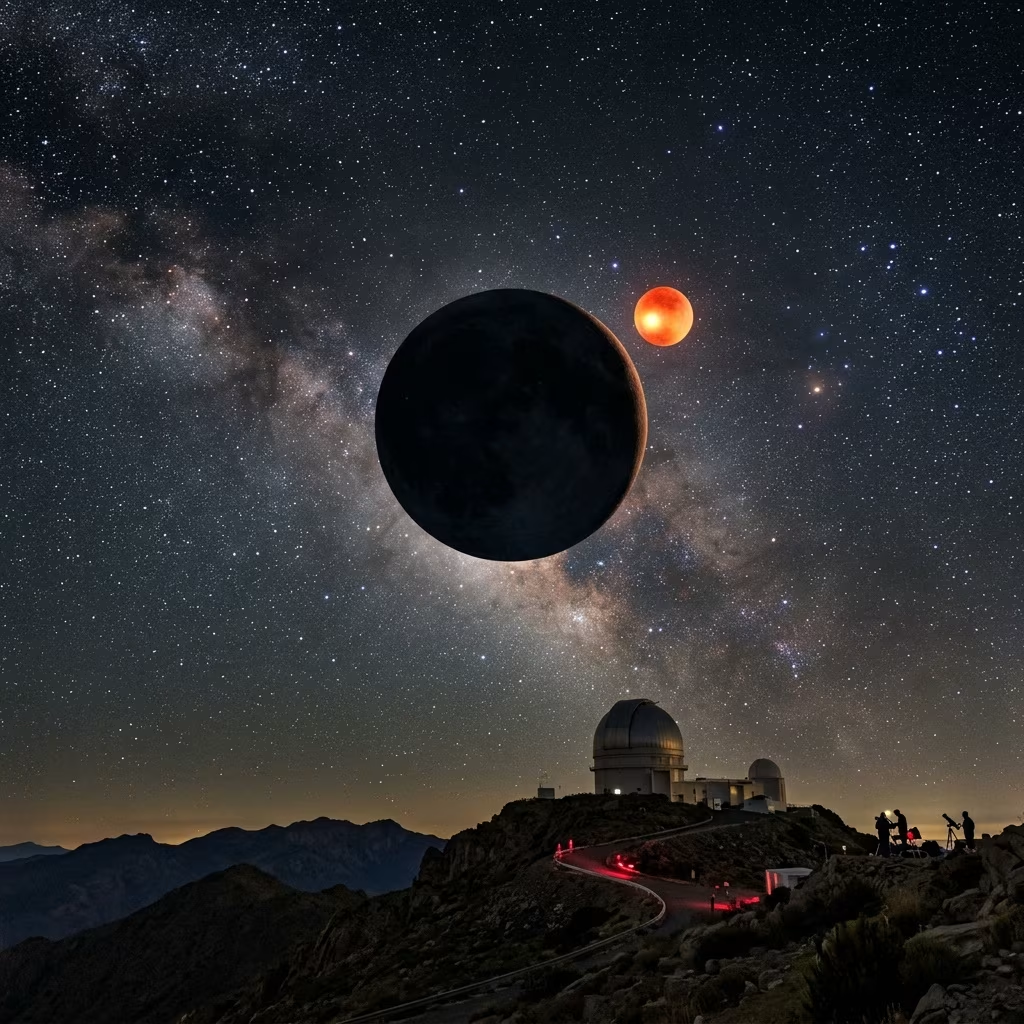
At the moment of the New Moon, the lunar disk lies in the constellation Leo, just 1 degree north of the Sun in the sky. The Moon will be impossible to see, as its sunlit side faces away from Earth and its orbit brings it so close to the Sun visually that it blends into the solar glare.
The Science of Seasonal Black Moons
Understanding the seasonal Black Moon requires delving into the lunar calendar:
- A typical astronomical season (bounded by solstice and equinox, or vice versa) contains three New Moons.
- The average lunar cycle—from one New Moon to the next—is about 29.5 days.
- Because Earth’s year isn’t an even multiple of lunar months, occasionally a season accommodates four New Moons.
- The third of these four is labeled as the seasonal Black Moon—a phenomenon that occurs roughly every 2.5 to 3 years.
This rare calendrical alignment distinguishes a Black Moon from a standard New Moon, highlighting the interplay between our lunar satellite and Earth’s orbit around the Sun.
Why Can’t You See the Black Moon?
Although the Black Moon sounds dramatic, in reality, the Moon will be invisible to the unaided eye. Here’s why:
- During a New Moon, the Moon is positioned between Earth and the Sun, meaning its illuminated half faces away from us.
- As a result, the Moon not only appears dark but also rises and sets nearly in tandem with the Sun, positioning it too close to be seen against the Sun’s glare.
The only time a New Moon can be visible is during a solar eclipse—when the Moon passes directly in front of the Sun, temporarily obscuring its light. Even then, eclipse glasses or proper solar filters are essential for safety.
Historical and Future Black Moons
The Black Moon is a relatively modern term, but similar rare events have captured public imagination in the past:
- The most recent visible Black Moon occurred during the solar eclipse of April 30, 2022, although that was a monthly Black Moon.
- A notable seasonal Black Moon coincided with the Great American Eclipse on August 21, 2017.
- Following August 2025, the next seasonal Black Moon arrives on August 20, 2028—which will also happen to be a Supermoon.
The Celestial Bonus: A Close Encounter with Mars
This August, the excitement is doubled: the Black Moon isn’t the only astronomical highlight. Mars will be closely aligned with the Moon, creating an exceptional conjunction for observers worldwide.
- At New Moon, both the Moon and Mars will reside in the constellation Leo—though only Mars will be visible in the predawn and early morn sky.
- This alignment offers an excellent opportunity for stargazers to spot the Red Planet at its brightest—especially visible during the Moon’s absence, allowing Mars to shine unimpeded.
- The proximity adds to the night’s spectacle and provides astronomers a chance to appreciate planetary and lunar motions in action.
Summary Table: Black Moon & Mars Alignment (August 2025)
| Event | Date / Time | Sky Location | Visibility |
|---|---|---|---|
| Black Moon (New Moon) | Aug. 23, 2025, 2:06 a.m. EDT (06:06 GMT) | Constellation Leo, 1° north of Sun | Invisible (too close to Sun) |
| Mars Alignment | All night (best before dawn) | Constellation Leo | Bright, visible in darkness |
Why Does the Black Moon Ignite Curiosity?
The rarity, coupled with modern media buzz, has amplified public intrigue in Black Moons. Key reasons include:
- Calendrical Anomaly: Not every season accommodates four New Moons, so each occurrence feels special.
- Occult Significance: For some, Black Moons symbolize transformation or rarity, inspiring legends and folklore.
- Astronomical Learning: Events like these provide opportunities to discuss lunar cycles, calendar design, and orbital dynamics.
- Coincidence with Other Events: The August 2025 Black Moon aligns closely with a Mars conjunction, stacking astronomical delights for enthusiasts.
What Are the Different Types of Black Moons?
While 2025 features a seasonal Black Moon, similar terms pop up periodically. Here are key variations:
- Monthly Black Moon: The second New Moon in a calendar month (analogous to a “Blue Moon,” which is the second Full Moon in one month).
- Seasonal Black Moon: The third New Moon in a four-new-moon season (as in August 2025).
- Unusual Black Moons: Sometimes, a calendar month may not contain any New Moons—this can be called a Black Moon, but this occurrence is exceedingly rare.
How to Prepare for the August 2025 Black Moon Event
Even though the Moon itself will be invisible, you can enhance your stargazing experience and enjoy the Mars encounter by preparing as follows:
- Find a dark sky location: Good viewing conditions away from city lights allow you to spot Mars easily.
- Binoculars or telescopes: For those wishing to examine Mars or surrounding stars in detail.
- Stay late or rise early: Mars’ brightness will be best visible in the hours before and after the New Moon phase, thanks to minimal lunar interference.
- Check weather forecasts: Clear skies are necessary since clouds will obscure all celestial activity.
Frequently Asked Questions (FAQs) About the Black Moon and Mars Encounter
Q: Will I be able to see the Black Moon with my eyes?
A: No. During the New Moon phase, the Moon is positioned too close to the Sun and the side facing Earth is unlit, making it completely invisible to even the most powerful telescopes.
Q: Why is this event called a “Black Moon”?
A: The name refers to the unusual occurrence of a third New Moon in a season with four (rather than the standard three), making it a relatively rare calendrical event.
Q: How often does a seasonal Black Moon happen?
A: Approximately every 33 months. After August 2025, the next is due in August 2028.
Q: What makes the August 2025 event significant beyond being a Black Moon?
A: This Black Moon coincides with a striking close approach of Mars, making for a special night where the Moon, Sun, and the Red Planet align in Leo.
Q: Can I observe anything special in the sky during the Black Moon?
A: While the Moon will not be visible, Mars will stand out brightly in the early morning or predawn hours, unobstructed by moonlight. It’s an excellent time to locate and observe Mars in the constellation Leo.
Key Facts and Tips for Skywatchers
- Date: Black Moon occurs on August 23, 2025, at 2:06 a.m. EDT (06:06 GMT).
- Type: Seasonal Black Moon (third New Moon in a season of four).
- Sky Visibility: The Moon itself is not visible, but Mars will appear bright in Leo.
- Viewing Tips:
- Look toward the eastern horizon before dawn to spot Mars.
- Utilize star charts or sky apps to locate Mars in Leo.
- Stay Safe: Never attempt to view the Sun directly with the naked eye or through binoculars/telescopes without appropriate solar filters.
Conclusion: Witnessing a Rare Night Sky Performance
August 2025’s Black Moon and close Mars encounter fuse calendar quirk and cosmic choreography for a truly special astronomical display. Whether you’re a seasoned astronomer or a curious first-timer, this night promises a window into the dynamic, ever-changing nature of our solar system.
Mark your calendars for August 22–23, 2025, and step outside to observe Mars at its finest, all under the shadowed, mystical presence of a Moon you can’t see but will remember.
References
- https://www.space.com/stargazing/new-moon-of-august-2025-brings-a-rare-black-moon-and-a-close-mars-encounter
- https://www.timeanddate.com/astronomy/moon/black-moon.html
- https://www.space.com/stargazing/a-rare-black-moon-rises-with-the-sun-on-aug-23-2025-heres-what-to-expect
- https://www.timeanddate.com/news/astronomy/black-moon-2025
- https://www.northjersey.com/story/news/2025/08/22/what-time-is-tonights-new-moon-when-is-august-black-moon-to-watch-tonight-see-rare-new-moon-today/85777942007/
- https://www.spaceweatherlive.com/en/moon-phases-calendar/2025/8.html
- https://www.thehoodwitch.com/blog/2025/8/20/the-black-moon-in-virgo
- https://griffithobservatory.org/explore/observing-the-sky/whats-in-the-sky/the-moon/2025-phases-of-the-moon/
- https://www.livescience.com/space/the-moon/a-rare-black-moon-rises-this-weekend-what-is-it-and-what-can-you-see
- https://nasaspacenews.com/2025/08/the-black-moon-of-august-23-2025-a-rare-cosmic-wonder/
- https://news.northeastern.edu/2025/08/20/black-moon-event-august-23-explained/
- https://www.youtube.com/watch?v=nsgvZvlY758
- https://www.youtube.com/watch?v=WrGBuf-l6qg
- https://parade.com/astrology/most-impacted-august-new-moon-zodiac-signs
- https://starwalk.space/en/news/what-is-black-moon
- https://www.moneycontrol.com/science/rare-black-moon-of-2025-to-rise-in-august-when-where-to-see-and-what-it-means-article-13471283.html