


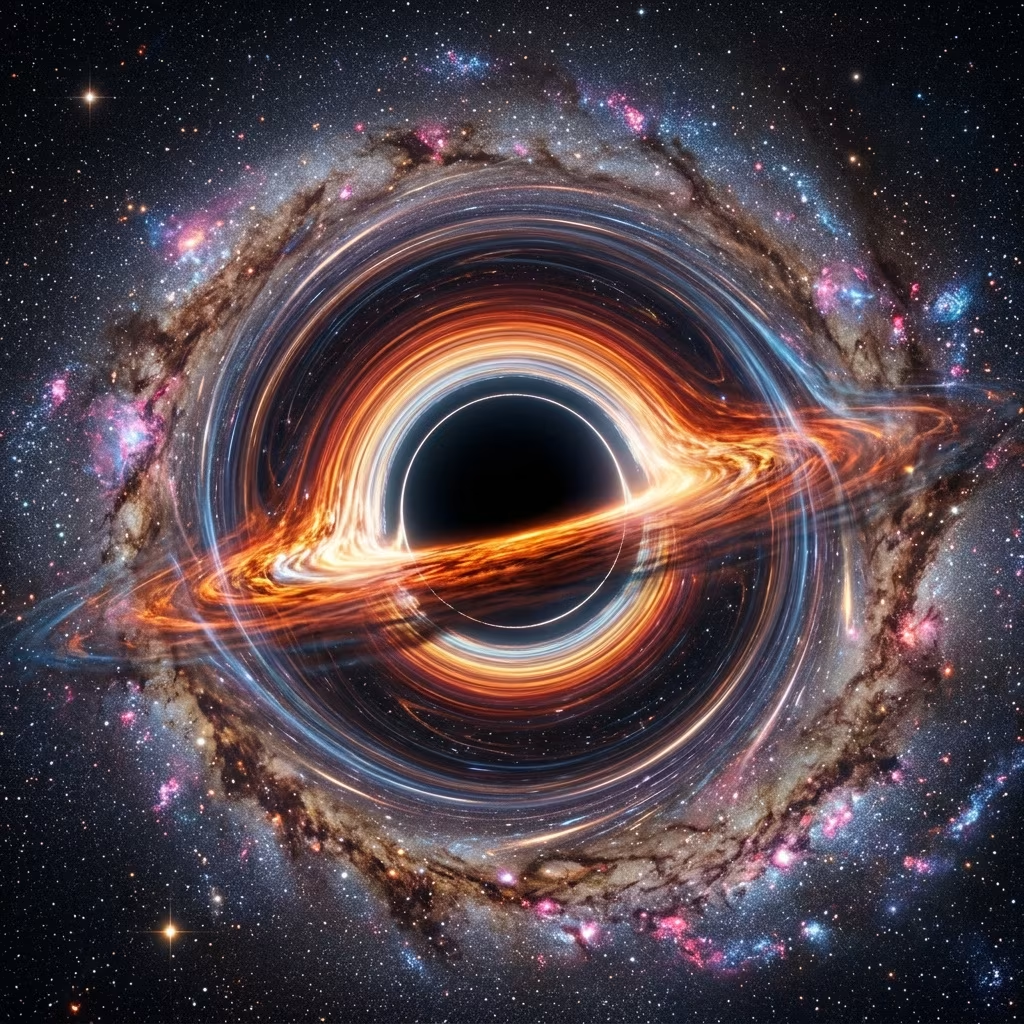
Black Holes & The Event Horizon: Boundary at the Edge of Spacetime
Black holes are among the most fascinating and mysterious objects in the universe. Their defining characteristic—the event horizon—marks a boundary beyond which nothing, not even light, can return. In this article, we explore the anatomy of black holes, the physics behind event horizons, and the mind-bending phenomena that occur at this cosmic edge.
What Is a Black Hole?
A black hole is an astronomical body with gravity so intense that nothing—not even electromagnetic radiation like light—can escape once it passes a certain point. This point of no return is known as the event horizon. Albert Einstein’s general relativity predicted that sufficiently concentrated mass would deform spacetime so significantly that escape becomes impossible. Early ideas about such entities trace back to John Michell and Pierre-Simon Laplace in the 18th century, but it was Karl Schwarzschild who first described the general relativistic solution that characterizes black holes in 1916.
- Core characteristics: Extreme density, immense gravity, and no escape beyond a certain boundary.
- Relativity’s role: General relativity explains how mass curves spacetime to create these objects.
- Discovery: The first known black hole, Cygnus X-1, was identified in 1971.
The Event Horizon Explained
The event horizon is more than just a simple boundary. It marks the dividing line where gravity’s pull becomes so overwhelming that all future paths, even those for light, inexorably lead deeper into the black hole. For an external observer, anything approaching the event horizon appears to slow indefinitely, never actually crossing the boundary from their perspective. This is a result of gravitational time dilation and redshift.
- Definition: The boundary in spacetime where outgoing paths for light curve inward, making escape impossible.
- Origin of the term: Coined by Wolfgang Rindler in the 1950s.
- Physical consequence: Beyond the event horizon, all future trajectories are compelled toward the black hole’s center.
Anatomy of the Event Horizon
| Region | Behavior of Matter & Light | Possible Paths |
|---|---|---|
| Far from Black Hole | Particles move in any direction, limited only by light speed | Escape possible |
| Near Event Horizon | Spacetime deforms; most paths curve inward | Escape increasingly difficult |
| Inside Event Horizon | All paths point to black hole center | Escape impossible |
General Relativity and the Fate of Matter
General relativity fundamentally changed our understanding of gravity, describing it as the warping of spacetime by mass and energy. Black holes are predicted by Einstein’s equations when matter collapses under its own gravity, continually shrinking until the escape velocity exceeds the speed of light. At that threshold, the event horizon forms.
- Black holes warp spacetime so intensely that every possible future path leads inward once crossed.
- Nothing locally detectable happens at the actual crossing—the event horizon itself is not a physical surface but a region of distorted spacetime.
The Experience: Crossing the Event Horizon
One of the strangest predictions in relativity is the subjective experience of crossing the event horizon. To a distant observer:
- An object approaching the event horizon appears to slow down endlessly, never quite crossing it.
- All light and information emitted from the object becomes dimmer and redder (gravitational redshift), until vanishing from view—typically in less than a second for stellar-mass black holes.
However, for a hypothetical observer falling into the black hole:
- Local experience remains unchanged—no unusual effects are observed at the crossing.
- The event horizon is unremarkable as crossed; only from outside does it appear as a singularity.
This discrepancy arises from Einstein’s equivalence principle: locally, physical laws remain consistent, whether in free-fall or crossing a cosmic boundary. The event horizon’s location cannot be determined by local means alone.
Shapes and Types of Event Horizons
- Shape at equilibrium: Always spherical topology for black holes at rest.
- Static black holes: Event horizon is a perfect sphere.
- Rotating black holes: The event horizon becomes oblate (flattened due to rotation).
- Other horizons: Cauchy, Killing, photon sphere, ergosphere, particle, cosmological horizons, isolated and dynamical horizons—each relevant in different contexts and theoretical frameworks.
Key Terms Glossary
- Apparent horizon: A surface defined by local properties, not necessarily coinciding with the event horizon.
- Photon sphere: Region where gravity bends light into closed orbits.
- Ergosphere: Area outside a rotating black hole where objects cannot remain stationary.
- Singularity: Theoretical point of infinite density at the black hole’s center.
Historical Perspectives and Theoretical Challenges
The concept of the event horizon evolved over centuries of grappling with the physics of gravity and light. John Michell’s 1784 hypothesis speculated that gravity could trap light. The Newtonian and corpuscular theory of light suggested that sufficiently massive bodies could prevent light from escaping, though the notion was not considered physically plausible until general relativity matured.
By the mid-20th century, David Finkelstein formally described the event horizon within relativity, revealing the profound implications of an invisible boundary, and prompting widespread re-examination. Stephen Hawking later suggested that apparent horizons, not strict event horizons, arise during gravitational collapse, with significant consequences for black hole information and the possibility of Hawking radiation.
Quantum Effects: Hawking Radiation
Quantum field theory adds richness to the classical view: near the event horizon, black holes emit a faint thermal glow known as Hawking radiation. This radiation mimics a black body with a temperature inversely proportional to the black hole’s mass—so low (billionths of a kelvin) for stellar black holes that it’s essentially undetectable.
- Hawking radiation: Quantum effect causing black holes to slowly lose mass over vast timescales.
Table: Hawking Radiation Properties
| Black Hole Mass | Predicted Temperature | Observability |
|---|---|---|
| Stellar (~10 solar masses) | ~billionths of a kelvin | Undetectable |
| Supermassive (>million solar masses) | Even lower | Impossible to detect |
Cosmic Event Horizons
Event horizons are not limited to black holes. In an expanding universe, regions can recede from us faster than light due to the expansion of spacetime itself. This creates a cosmic event horizon—a limit to the observable universe where even gravitational waves cannot reach.
- Defines the boundary between the observable and unobservable universe.
- Has implications for cosmology and the fate of signals as the universe accelerates.
Frequently Asked Questions (FAQs)
Q: What happens to time near the event horizon?
A: Due to gravitational time dilation, clocks near an event horizon appear to slow compared to those further away. To an external observer, an object falling into the black hole seems to freeze near the horizon, while to the infalling observer, time passes normally.
Q: Can anything escape once past the event horizon?
A: No. All future paths lead toward the center of the black hole; escape is impossible for matter or light beyond the event horizon.
Q: What would crossing an event horizon feel like?
A: For a sufficiently massive black hole, the event horizon is not a physical surface, so the crossing would feel no different than floating in space—no special effects or barriers would be perceptible.
Q: Is the event horizon a physical object?
A: No. The event horizon is not a solid surface, but a mathematical boundary in spacetime defined by escape velocity through Einstein’s equations.
Q: How is Hawking radiation related to the event horizon?
A: Hawking radiation is theorized to be emitted due to quantum fluctuations near the event horizon, causing black holes to slowly lose mass over unimaginable timescales.
Key Insights and Astrophysical Importance
- Black holes and their event horizons serve as laboratories for exploring gravity, quantum physics, and the fabric of spacetime.
- Event horizons challenge our notions of causality, observable reality, and the ultimate fate of information.
- Modern research pushes the boundaries of theory, seeking to reconcile quantum mechanics and gravity.
- Event Horizon Telescope: Directly images the region around supermassive black holes, providing unprecedented insight into the shape and physics of event horizons.
Summary Table: Essential Facts About Event Horizons
| Feature | Description |
|---|---|
| Definition | Boundary where escape velocity equals or exceeds light speed |
| Observable Effects | Gravitational time dilation, redshift, apparent freezing of objects |
| Local Experiments | No detectable event at horizon for infalling observer |
| Hawking Radiation | Quantum thermal radiation emitted near event horizon |
| Shape | Spherical for static; oblate for rotating black holes |
Conclusion
The event horizon is not just a conceptual boundary—it’s a gateway to the unknown, separating observable reality from a realm where physics as we know it is pushed to its limits. Understanding event horizons gives scientists crucial insight into the structure of space, time, and the universe itself. As technology improves and observations become more precise, humanity continues its pursuit to unravel the secrets lurking at the very edge of the spacetime continuum.
References
- https://science.nasa.gov/universe/black-holes/anatomy/
- https://www.space.com/black-hole-physics-universe-expansion-hubble-trouble
- https://en.wikipedia.org/wiki/Event_horizon
- https://www.space.com/black-hole-hunters-event-horizon-documentary.html
- https://www.nasa.gov/universe/what-are-black-holes/
- https://www.britannica.com/topic/event-horizon-black-hole
- https://en.wikipedia.org/wiki/Black_hole
- https://www.youtube.com/watch?v=OkaMIVGMpB0
- https://www.youtube.com/watch?v=a4vHwY0wMjs
- https://www.livescience.com/65185-what-is-black-hole-event-horizon.html
- https://astronomy.swin.edu.au/cosmos/e/Event+Horizon
- https://www.stsci.edu/~marel/black_holes/encyc_mod3_q3.html
- https://myspacemuseum.com/event-horizon-black-holes
- https://www.britannica.com/science/black-hole
- https://scopethegalaxy.com/what-is-the-event-horizon-of-a-black-hole/
- https://www.encyclopedia.com/science-and-technology/astronomy-and-space-exploration/astronomy-general/event-horizon


