


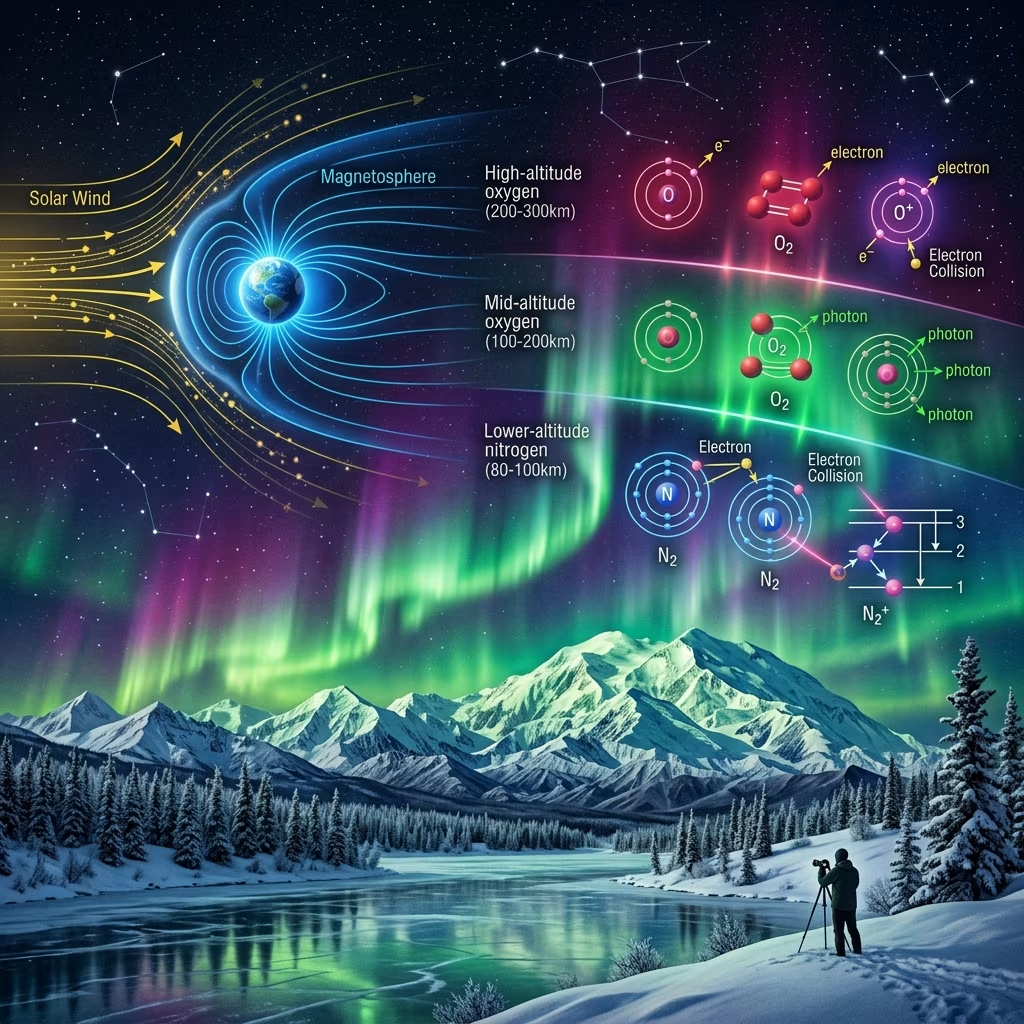
Aurora Colors Explained: The Science Behind the Northern Lights
The aurora, more commonly known as the Northern Lights or Southern Lights, is one of the most spectacular phenomena observable from Earth. The vibrant displays that dance across polar skies are the direct result of interactions between charged particles from the sun and gases in the upper atmosphere. But what determines the enchanting greens, haunting reds, ethereal purples, and rare blues of an auroral display? This article dives deep into the atomic processes, solar physics, and atmospheric chemistry that produce the wide palette of colors in Earth’s sky.
What Is an Aurora?
Auroras occur when electrons from space follow Earth’s magnetic field lines toward the poles, colliding with atmospheric atoms and molecules. This process excites the atmospheric constituents, causing them to emit light. The result is a majestic spectacle seen near the polar regions, known as Aurora Borealis in the north and Aurora Australis in the south.
- Aurora Borealis: Northern Lights (Latin ‘boreal’ means northern)
- Aurora Australis: Southern Lights (Latin ‘austral’ means southern)
- The name ‘Aurora’ comes from the Roman goddess of dawn, used by Galileo to describe the phenomenon.
The Physics Behind Auroral Formation
The root cause of auroras lies in the solar wind: streams of charged particles continually emanate from the sun. When these particles encounter Earth’s magnetosphere, they deform its field, funneling energetic electrons and protons into the upper atmosphere above both magnetic poles[10]. Collisions between these solar wind particles and atmospheric atoms (mainly oxygen and nitrogen) excite the atoms, which then release photons of specific colors as they return to their ground state.
Sequence of Events
- The sun emits the solar wind during periods of solar activity—especially during solar flares and coronal mass ejections.
- Earth’s magnetic field channels charged particles toward polar regions.
- Incoming electrons and protons collide with upper atmospheric atoms (mostly oxygen and nitrogen).
- Atmospheric atoms are energized and emit light at particular wavelengths (colors).
Colors of the Aurora: Atomic Origins
The most prominent feature of any aurora is its color. Each hue is linked to specific atoms and molecules and their excited states, as well as to the altitude where interactions occur[10].
| Color | Source Atom or Molecule | Altitude Range | Wavelength and Atomic State |
|---|---|---|---|
| Green | Atomic Oxygen | ~100–150 km (80–250 miles) | 557.7nm (1S state) |
| Red | Atomic Oxygen | Above ~200–300 km (180+ miles) | 630.0nm (1D state) |
| Purple & Pink | Molecular Nitrogen | ~120–200 km | Various prompt emissions |
| Blue & Violet | Molecular/Atomic Nitrogen | Lower altitudes, high energy events | Higher energy transitions |
| Yellow | Mix of green (oxygen) and red (oxygen) | Overlapping regions | Combination of emissions |
Why Do Colors Change with Altitude?
- Green: Caused by oxygen atoms excited to the 1S state; these emit quickly (lifetime ~1 second). Occurs at altitudes 120–400 km.
- Red: Caused by oxygen in the 1D state, with much longer lifetimes (>150 seconds). Only visible above 300 km, where thinning air lets the atom avoid being quenched by collisions.
- Purple: Prompt emissions by molecular nitrogen; occurs at 120–200 km and leads the green emissions in dynamic auroral events.
Other Colors and Their Origins
- Yellow: Sometimes appears as a blend where red and green overlap.
- Blue and Violet: These emissions arise mainly from nitrogen, more visible in high-energy solar events.
- Crimson pink: Hydrogen atoms contribute faint pink hues at lower altitudes, visible in energetic displays.
Factors Affecting Aurora Colors and Intensity
The intensity and distribution of colors in an aurora depend on several interrelated physical factors:
- Solar Wind Energy: Stronger geomagnetic storms (from increased solar wind speed and density) produce more active, expansive auroras with diverse colors.
- Altitude of Emission: Different excited atomic states persist depending on the density of the upper atmosphere, determining which colors persist at which levels.
- Atmospheric Composition: The ratio of oxygen and nitrogen, as well as trace gases, directly affects possible aurora hues.
- Geomagnetic Activity: Intense storms cause auroras to be seen farther from the poles and can reveal rare colors (deep reds, blues).
Shapes and Forms of the Aurora
Auroras do not only vary in color, but also manifest in a diverse range of shapes and structures:
- Arcs: Long, smooth bands stretching across the sky.
- Rays: Vertical streaks or pillars, often green or purple near the edges.
- Corona: Fan-like patterns radiating from a point above.
- Veils: Diffuse, sheet-like forms that fade gently into the night.
- Dynamic Curtains: Rapidly moving waves, twisting and folding in mesmerizing displays.
The shape and movement of auroras are determined by the distribution of charged particles funneled into the atmosphere by Earth’s magnetic field at any given moment. The interplay between shape and color creates a living tapestry that makes each auroral display unique.
Why Are Auroras More Frequent Near the Poles?
Earth’s magnetic field is strongest near the poles, channeling solar wind particles into oval rings known as auroral ovals. These are centered on the magnetic, not geographic, poles. Increased solar activity expands these ovals, making auroras visible at lower latitudes during intense geomagnetic storms.
Photography vs Human Vision: True Aurora Colors
Photographs of auroras often appear more vivid or dramatically colored than what is perceived by the naked eye. This is due to several factors:
- Camera Sensitivity: Digital cameras (and film) can accumulate light over time, picking up faint reds, blues, and purples invisible to human vision.
- Human Eye Response: Our eyes are less sensitive to weak light in low-light conditions, often registering auroral greens and whites, but not faint reds or blues.
Despite the differences, spectacular auroras occasionally reveal the full color spectrum to naked-eye observers during strong geomagnetic events.
Rare Auroral Colors and Phenomena
Most auroras show green and occasionally red. However, during rare events or powerful storms, unusual tints can dominate:
- Purple-pink curtains: Nitrogen emissions following energetic solar outbursts.
- Blue bands: Seen during major storms when deeper atmospheric regions are bombarded.
- Smooth Polar Rain Auroras: Unique phenomena captured only in recent years, revealing entire new physics in solar-terrestrial interactions.
Frequently Asked Questions (FAQs)
Q: What determines the green color in most auroras?
A: Green is caused by the emission of light from oxygen atoms at around 100–150 km altitude, when they return from an excited state to their ground state, emitting at a wavelength of 557.7nm[10].
Q: Why do auroras sometimes appear red?
A: Red auroras arise from oxygen atoms excited to the 1D state at higher altitudes (above 200–300 km), where the density is low enough for these atoms to emit light before being deactivated by collisions.
Q: What causes purple and blue hues?
A: These are produced by emissions from molecular and atomic nitrogen, which are excited by energetic electrons and emit light at higher energies, typically visible during strong geomagnetic storms[10].
Q: Can auroras be seen outside the polar regions?
A: During periods of intense solar activity (geomagnetic storms), auroras can be observed farther from the poles, sometimes reaching mid-latitudes.
Q: Are auroras unique to Earth?
A: No. Auroral phenomena occur on other planets with magnetic fields and atmospheres, such as Jupiter and Saturn.
Tips for Observing Auroras
- Seek out dark, clear nights away from light pollution in high latitudes (near the Arctic or Antarctic).
- Monitor space weather forecasts for strong solar activity (geomagnetic storms).
- Use a camera with manual exposure settings for vivid color captures.
- Dress warmly and bring patience—the aurora may be brief or last all night depending on geomagnetic activity.
Summary Table: Aurora Color Quick Reference
| Color | Atom/Molecule Responsible | Typical Altitude | Notes |
|---|---|---|---|
| Green | Oxygen | 100–150 km | Most common |
| Red | Oxygen | 200–300 km+ | Seen in intense displays |
| Purple/Violet | Nitrogen | 120–200 km | Follows energetic events |
| Blue | Nitrogen | Lower atmosphere | Rare |
| Yellow | Mixed (Oxygen/Nitrogen) | Overlapping emissions | Combination of colors |
Conclusion
Auroras are more than just dazzling beauty: they are nature’s most vivid demonstration of solar-terrestrial physics and atmospheric chemistry. The distinctive colors and shapes, from brilliant green arches to surprising purple-pink ribbons, are encoded in the atomic structure of the upper atmosphere and fueled by the energetic whims of our star. Next time you stand beneath an auroral sky or admire an aurora photo, you’ll know the atomic stories behind the spectacle.
References
- https://www.space.com/23707-only-photos-reveal-aurora-true-color.html
- https://www.space.com/rare-smooth-aurora-north-pole-explained
- https://science.nasa.gov/sun/auroras/
- https://www.swpc.noaa.gov/content/aurora-tutorial
- https://www.nps.gov/articles/-articles-aps-v8-i1-c9.htm
- https://www.skyatnightmagazine.com/space-science/what-causes-different-shapes-colours-aurora
- https://www.youtube.com/watch?v=1GFmuuKePpw
- https://www.youtube.com/watch?v=PgIKsuZ3RZU
- https://community.spaceweatherlive.com/topic/3513-different-colors-of-aurora/
- https://www.theaurorazone.com/about-the-aurora/the-science-of-the-northern-lights/the-northern-lights-colours/
- https://spacenessie.com/aurora-borealis
- https://en.wikipedia.org/wiki/Aurora
- https://www.auroraadmin.com/blog/aurora-borealis/colors-of-the-auroras/
- https://www.freeastroscience.com/2024/10/aurora-colors-explained-unveiling.html
- https://www.weather.gov/wrn/winter2017-space-sm
- https://spaceplace.nasa.gov/aurora/en/
- https://www.astronomy.com/science/what-is-an-aurora-and-why-do-they-come-in-different-shapes-and-colors/
- https://cloverchronicle.com/aurora-science-explained/


