


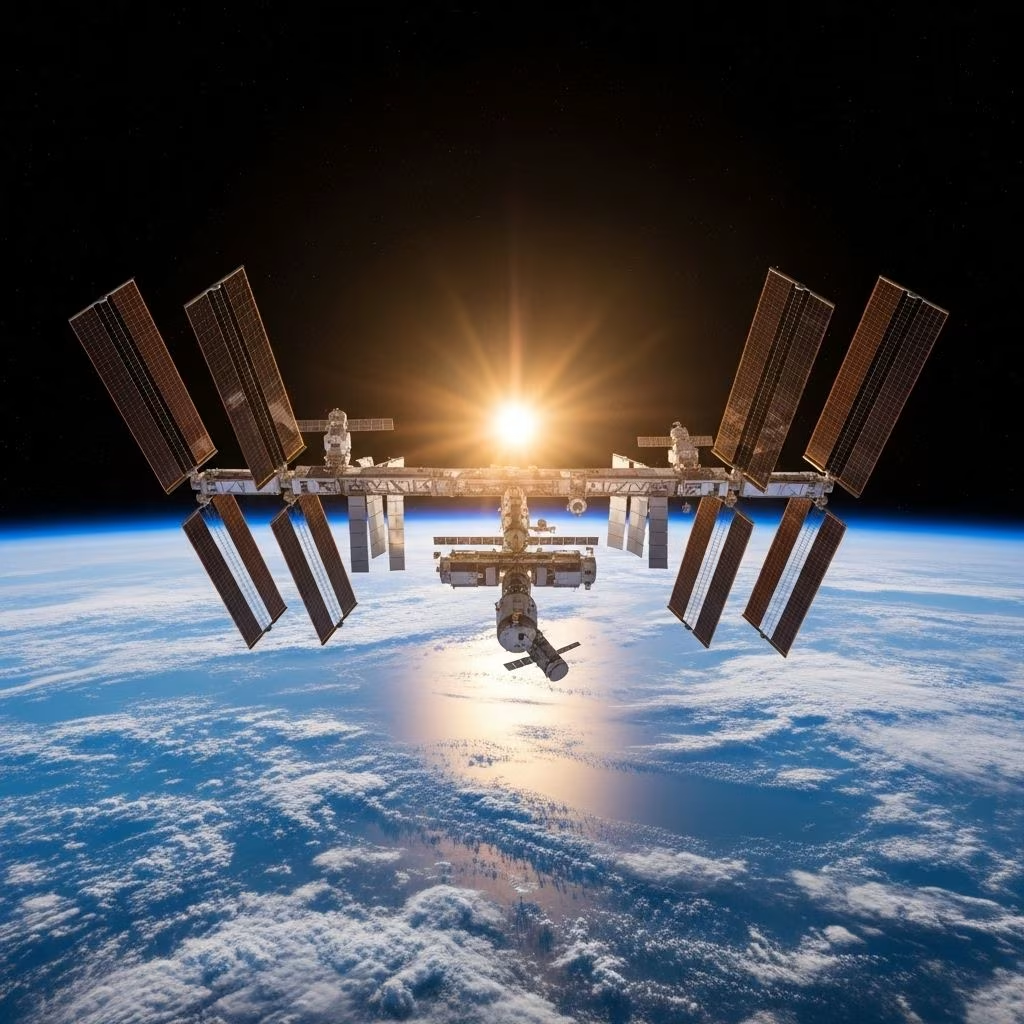
International Space Station: Humanity’s Outpost in Orbit
The International Space Station (ISS) stands as one of humanity’s greatest engineering achievements—a testament to global cooperation in space. Orbiting roughly 400 kilometers above Earth, the ISS serves as a multidisciplinary laboratory, observation post, and home to astronauts from around the world. It is the longest continually inhabited human outpost in space, and its scientific, technological, and diplomatic legacy will shape future space endeavors for generations to come.
What Is the International Space Station?
The International Space Station is a modular space station assembled in low Earth orbit through the collaboration of five key space agencies: NASA (United States), Roscosmos (Russia), ESA (European Space Agency), JAXA (Japan Aerospace Exploration Agency), and CSA (Canadian Space Agency). It is the largest man-made structure in space, designed primarily for scientific research in microgravity and as a demonstration platform for technologies critical to future planetary missions.
Why Build an Orbiting Station?
Conceiving an orbiting laboratory fulfilled several goals:
- International Collaboration: Pooling the resources and expertise of multiple nations fostered peaceful cooperation in space.
- Scientific Advancement: The microgravity environment allows experiments not possible on Earth, from studying biological processes to material science and physics.
- Technological Demonstration: The ISS tests life support, habitation, and spacecraft systems vital for future Moon and Mars missions.
- Education and Inspiration: The station captures the imagination, serving as a symbol of what humanity can accomplish together.
Since November 2000, the ISS has hosted continuous human presence, with international crews conducting thousands of experiments and sharing their experiences in real time with Earth.
Origins and Construction
The ISS program was launched from the convergence of two major projects:
- America’s Space Station Freedom was a planned U.S.-led outpost intended for low Earth orbit.
- Soviet Union’s Mir-2 program aimed to build a new modular space station as the successor to the iconic Mir.
After the Cold War, international partners chose collaboration over competition. The first ISS module, Zarya, launched from Kazakhstan in November 1998 aboard a Russian Proton rocket. Over the next decade, dozens of modules and components were delivered—mostly by the space shuttle or Russian vehicles.
| Year | Milestone | Agency |
|---|---|---|
| 1998 | Zarya (Functional Cargo Block) launched | Roscosmos |
| 1998 | Unity node (first U.S. module) | NASA |
| 2000 | First crew arrives (Expedition 1) | International |
| 2001–2011 | Major assembly and expansion, including laboratory and living modules | NASA, ESA, JAXA, CSA, Roscosmos |
Modular Design and Key Components
Designed for expandability, the ISS consists of two main segments:
- Russian Orbital Segment (ROS): Built by Roscosmos, it includes life support, propulsion and laboratory modules.
- US Orbital Segment (USOS): Built through NASA, ESA, JAXA, and CSA partnerships. Features multiple laboratories, living quarters, and storage modules.
Interconnecting these modules is the Integrated Truss Structure, supporting the station’s massive solar arrays and radiators.
- Pressurized modules: Scientific laboratories, living quarters, and airlocks.
- Solar arrays: Provide electrical power for all station operations.
- Robotic arms: Canada’s Canadarm2 is pivotal for cargo handling and assembly.
- Docking ports: Eight berthing and docking ports accept visiting spacecraft from NASA, Russia, private industry, and national programs.
Orbit and Operations
The ISS orbits Earth at an altitude of approximately 400 km (250 miles), circling the planet every 93 minutes and completing about 15.5 orbits per day. This rapid orbit means astronauts frequently experience sunrises and sunsets as the station hurtles through space at 28,000 km/h.
- Continuous Occupancy: The station has been inhabited since November 2, 2000.
- International Crew Rotation: Crews usually spend about six months aboard, with regular arrivals and departures coordinated by the partner agencies.
- Resupply Missions: Cargo ships from NASA, Roscosmos, SpaceX, Northrop Grumman, and other providers deliver food, water, equipment, and scientific payloads.
Who Has Visited the ISS?
As of August 2025, 290 astronauts from 26 countries have visited the station.
- NASA: The majority of visitors have come from the United States.
- Russia: Extensive experience with both Soyuz and Progress spacecraft.
- International Partners: European, Japanese, and Canadian astronauts regularly fly missions.
- Tourists: A handful of self-funded space tourists and private astronauts have made brief stays.
Daily Life and Research in Microgravity
Living and working on the ISS requires adaptation:
- Microgravity Effects: Crew members must exercise several hours daily to maintain muscle and bone health, and food, fluids, and personal hygiene are managed carefully.
- International Teams: English and Russian are the primary languages, and cultural exchange is part of daily routines.
- Science Laboratory: Experiments span biology, medicine, physics, astronomy, and even technology demonstrations for future exploration.
- Earth Observation: Crews document our planet’s weather, disasters, volcanism, and more for real-time analysis.
Scientific Achievements and Technology Testing
The ISS has supported more than 3,000 scientific investigations in its lifetime.Major achievements include:
- Protein crystal growth: Producing purer crystals than on Earth, aiding medicine and industrial engineering.
- Physiology and biomedical research: Studying bone, muscle loss, immunity, and human adaptation to space.
- Earth and space observation: Human-operated and automated instruments gather atmospheric, climate, and cosmic data.
- Technology demonstration: Wireless communication, advanced water purification, and station repairs offer insight for Moon and Mars missions.
International Partnerships and Global Cooperation
The ISS remains an unprecedented diplomatic venture, supported by treaties and bilateral agreements. Its governance is divided among NASA, Roscosmos, ESA, JAXA, and CSA, with roles fairly distributed.
- International Collaboration: Crew assignments, cargo delivery, experiment development, and technical support involve constant multinational coordination.
- Diplomatic Milestones: Cooperation survived political tensions, technological hurdles, and even crises in international relations.
Challenges: Keeping the Station Running
Operating the ISS involves surmounting technical, logistical, and safety challenges:
- Orbital debris: The station occasionally performs avoidance maneuvers to dodge space junk.
- Maintenance: Astronauts conduct regular spacewalks to repair, upgrade, and inspect station systems.
- Funding and politics: Budget negotiations, diplomatic shifts, and evolving priorities shape the station’s future.
- Aging hardware: Some modules have exceeded their planned lifespans, demanding ingenuity and resilience to keep them functional.
Commercialization: Moving Beyond Government
Recent years have seen increased involvement of private industry:
- Commercial Crew: Companies such as SpaceX and Boeing regularly launch astronauts and cargo.
- Private Research: Businesses conduct product testing, biomanufacturing, and pharmaceuticals aboard the ISS.
- Tourism and Outreach: The station welcomes commercial astronauts, student experiments, and Earth observation services.
The Future of the ISS: De-orbit and Successors
Looking ahead, plans are being finalized for the ISS’s retirement:
- Continued Operations through 2030: The ISS will host new modules, scientific missions, and commercial ventures, including Axiom Space’s Payload Power Thermal Module.
- De-orbit and End of Service: After 2030, a dedicated U.S. deorbit vehicle will guide the station safely into Earth’s atmosphere for disposal.
- Future Outposts: Multiple nations and private firms are planning successors—smaller, specialized stations for orbital research, tourism, and deep space exploration.
Summary Table: ISS Key Facts
| Feature | Detail |
|---|---|
| First Module Launch | November 1998 (Zarya) |
| Continuous Human Occupancy | Since November 2, 2000 |
| Altitude | ~400 km (250 miles) above Earth |
| Orbit Duration | 93 minutes per orbit, 15.5/day |
| International Visitors | 290 astronauts from 26 countries (as of Aug 2025) |
| Main Partners | NASA, Roscosmos, ESA, JAXA, CSA |
| Power Source | Solar arrays |
| Future Plans | Operation through 2030, planned deorbit after |
Frequently Asked Questions (FAQs)
Q: How big is the International Space Station?
A: The ISS spans more than 100 meters end-to-end, with a pressurized volume equivalent to a large five-bedroom house and enough living space for a crew of 6 to 7.
Q: Who owns the ISS?
A: The ISS is not owned by any one nation; it is operated under international agreements between the five partner space agencies, each managing specific segments and responsibilities.
Q: What kind of research is done on the ISS?
A: Experiments range from biology and medicine to materials science, technology demonstrations, and astronomy. Research benefits life on Earth and supports plans to explore the Moon and Mars.
Q: How do astronauts travel to and from the ISS?
A: Historically, Soyuz spacecraft ferried crews; today, flights are provided by Russia, NASA’s Commercial Crew partners (like SpaceX), and other international carriers.
Q: What will happen to the ISS after its retirement?
A: Current plans call for the station to be de-orbited safely by a specialized vehicle after 2030, with future research stations likely developed by governments and private firms.
References
- https://www.nasa.gov/international-space-station/
- https://www.nasa.gov/international-space-station/space-station-overview/
- https://en.wikipedia.org/wiki/International_Space_Station
- https://www.weforum.org/stories/2025/01/nasa-is-changing-how-it-uses-the-international-space-station-heres-why-that-matters/
- https://en.wikipedia.org/wiki/International_space_station
- https://whoisinspace.com
- https://www.britannica.com/topic/International-Space-Station
- https://issnationallab.org/spotlight/june-2025/
- https://www.space.com/news/live/international-space-station-live-updates
- https://www.space.com/space-exploration/international-space-station/the-ups-and-downs-of-life-in-space-on-the-iss-this-week-june-23-27-2025
- https://www.planetary.org/space-missions/international-space-station
- https://issnationallab.org
- https://www.astroviewer.net/iss/en/
- https://www.ariss.org/current-status-of-iss-stations.html
- https://www.wusf.org/science-space/2025-02-09/after-international-space-station-retires-what-comes-next
- https://www.nasaspaceflight.com/2024/12/iss-yearly-roundup/
- https://www.youtube.com/watch?v=i-GjYiiXOq4


