January 2025 Full Moon: Overview
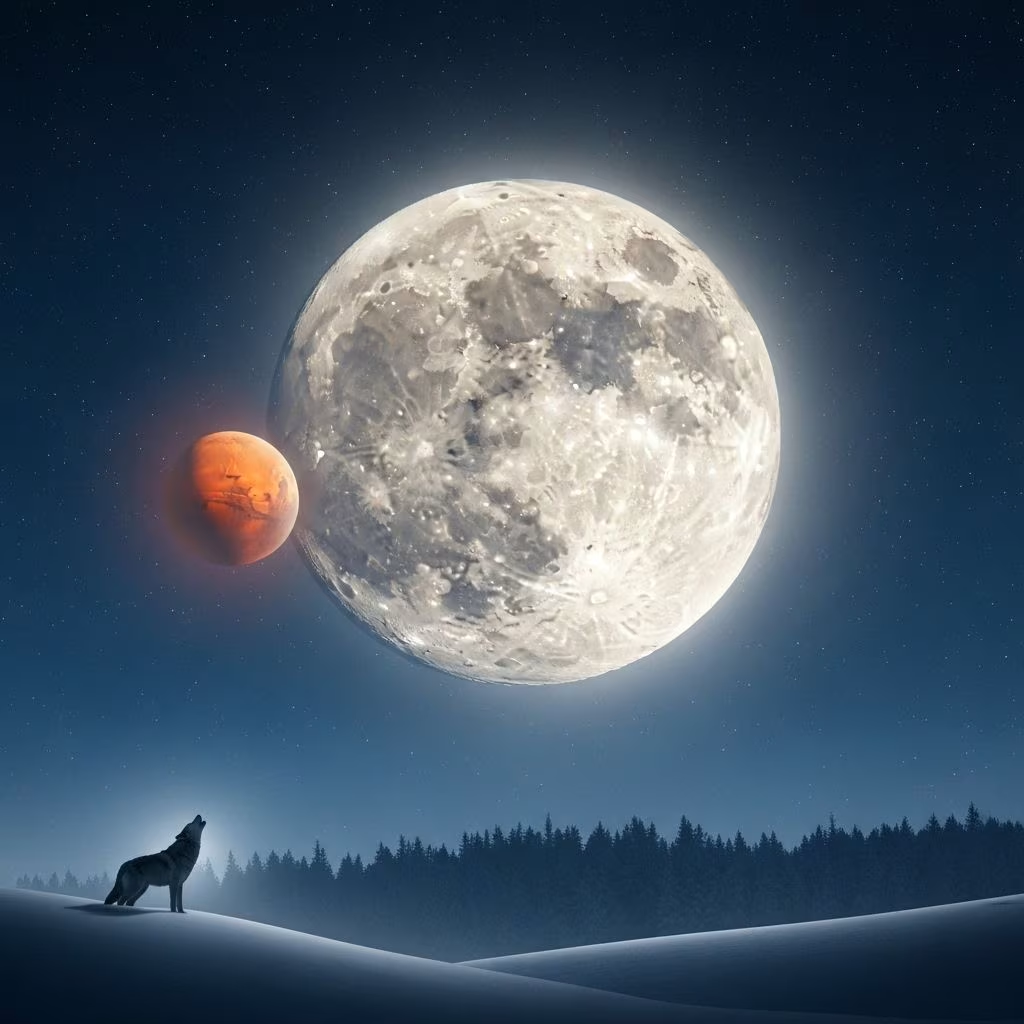
The January 2025 full moon, traditionally known as the Wolf Moon, presents not just the first lunar spectacle of the year but also a rare celestial alignment: the moon will pass directly in front of Mars, resulting in a dramatic occultation visible across the continental United States, Mexico, Canada, and western Africa.
This article explores the timing, significance, scientific characteristics, and unique cultural traditions associated with the January full moon, as well as tips for skywatchers and insights into the extraordinary Mars occultation.
When and Where to See the January 2025 Wolf Moon
- Date: January 13, 2025
- Time of Fullness: 5:22 p.m. EST (22:27 UTC)
- Visible Regions: Most prominent in the continental United States, Canada, Mexico, and western Africa
- Constellation: Gemini
Moonrise in New York City occurs at 4:28 p.m., just ahead of sunset at 4:51 p.m., making the full moon visible during twilight. The full phase occurs when the moon is directly opposite the sun as viewed from Earth, with its entire Earth-facing hemisphere illuminated.
Unique Celestial Event: The Mars Occultation
On January 13, 2025, observers across North America and nearby regions will witness an impressive cosmic coincidence as the full moon occults (passes in front of) Mars:
- Occultation Begins: 9:21 p.m. local time
- Mars Reappears: 10:37 p.m. local time
This alignment is relatively rare and a highlight for astronomers and skywatching enthusiasts. The moon will completely cover Mars, briefly dimming the Red Planet from view before it emerges on the Moon’s bright limb.
Understanding the Full Moon: Science and Illusions
The full moon occurs when the moon sits directly opposite the sun relative to Earth. At this point, the moon’s Earth-facing side appears fully illuminated, making it one of the brightest objects in the night sky.
Scientific Features
- Illumination: The entire near side is bathed in sunlight.
- Brightness: Full moons are bright enough to cast sharp shadows and light up the night even in rural areas.
- Apparent Size: The angular size stays nearly constant, but the moon can appear larger when near the horizon—a psychological effect known as the “moon illusion”.
Northern vs. Southern Hemisphere Views
| Hemisphere | Moon’s Altitude | Appearance | Color |
|---|---|---|---|
| Northern | Higher in the winter sky | Smaller illusion, brighter nights | Silvery/white |
| Southern | Lower in the winter sky | Larger illusion; foreground objects more visible | Yellowish due to longer atmospheric path |
The moon’s position changes with the seasons and hemisphere, leading to differences in brightness, color, and visual scale.
Cultural Names and Traditions of the January Moon
The January full moon has carried many names across cultures and centuries, reflecting local traditions, climate, and wildlife:
- Wolf Moon: Named by American and European cultures, reflecting the howling of hungry wolves on cold midwinter nights.
- Moon After Yule: A European name given to the first full moon after the winter solstice.
- Alternative Names:
- Chinese: Holiday Moon
- Celtic: Quiet Moon
- Cherokee: Cold Moon
- Southern Hemisphere: Hay Moon, Buck Moon, Thunder Moon, Mead Moon
Other Celestial Highlights Around the January 2025 Full Moon
Aside from the Mars occultation, the January full moon offers additional astronomical treats:
- From January 11-14, the moon traverses the Winter Hexagon, a prominent asterism made of six bright stars: Sirius, Procyon, Rigel, Aldebaran, Pollux, and Capella.
- On January 14, the moon passes near the Beehive star cluster (M44), another striking sight.
- Comet C/2024 G3 (ATLAS) may be close to its brightest, potentially reaching magnitude -2.0 around January 13 if conditions remain favorable.
How to Observe the Wolf Moon and Mars Occultation
- Find a location with a clear, unobstructed view of the sky. Open horizons are best for tracking the moon throughout the night.
- Use binoculars or a small telescope to capture details of both the lunar surface and the moment Mars disappears and reappears.
- Capture the event with photography: a tripod and a camera with manual exposure will allow for detailed images of the occultation and moon.
- Check local times for the occultation’s beginning and end, as they may differ slightly due to your exact location.
The Full Moon Calendar for 2025
The Wolf Moon leads an annual sequence of evocatively named full moons, each with unique lunar and astronomical phenomena. The table below summarizes the 2025 full moons with their traditional names:
| Month | Full Moon Name | Date | Special Events |
|---|---|---|---|
| January | Wolf Moon | 13 | Mars Occultation |
| February | Snow Moon | 12 | — |
| March | Worm Moon | 14 | Blood Moon, Micromoon |
| April | Pink Moon | 13 | Micromoon |
| May | Flower Moon | 12 | Micromoon |
| June | Strawberry Moon | 11 | — |
| July | Buck Moon | 10 | — |
| August | Sturgeon Moon | 9 | — |
| September | Corn Moon | 7 | Blood Moon |
| October | Harvest Moon | 7 | Supermoon |
| November | Hunter’s Moon | 5 | Supermoon |
| December | Cold Moon | 5 | Supermoon |
Some full moons in 2025 will coincide with astronomical events like micromoons, blood moons, and supermoons, making each month a unique opportunity for observation.
Why the January Full Moon Is Called the Wolf Moon
The origin of “Wolf Moon” is rooted in folklore, as indigenous peoples and early European settlers noticed wolves howling more frequently at this time of year. Although research indicates wolves are more active at night in winter, the name is a poetic reflection of the season’s starkness and the moon’s prominence during harsh, cold nights.
Alternative Native American names, like “Cold Moon” (Cherokee), and “Quiet Moon” (Celtic), reinforce the sense of quiet and dormancy in the landscape—a marked contrast to the brilliance of the full moon overhead.
Frequently Asked Questions (FAQs)
Q: What is a lunar occultation?
A: A lunar occultation occurs when the moon passes in front of another astronomical object, temporarily blocking it from sight. In January 2025, the moon will occult Mars, offering a rare view as the planet disappears behind the lunar disk and re-emerges an hour later.
Q: Why does the full moon look larger near the horizon?
A: The “moon illusion” is a psychological effect; the moon appears larger when close to the horizon because your brain compares it to foreground objects. Its actual angular size does not change.
Q: Why do different cultures have different names for the January full moon?
A: Traditional names reflect the local climate, natural phenomena, and folklore. For example, “Wolf Moon” relates to wolves’ winter behavior, while “Quiet Moon” and “Cold Moon” refer to seasonal characteristics.
Q: Will the Mars occultation be visible everywhere?
A: The occultation will be visible primarily in North America (including the US, Canada, Mexico) and western Africa. Viewers outside this region will see Mars near, but not blocked by, the full moon.
Q: How often does the moon occult Mars?
A: Lunar occultations of Mars are uncommon, especially during full moon, making the 2025 event notable for skywatchers in the affected regions.
Essential Skywatching Tips for the January 2025 Wolf Moon
- Check local weather forecasts and moonrise/set times to optimize your viewing session.
- Use star charts or mobile apps to pinpoint Mars and the moon’s route through the Winter Hexagon.
- Try taking photos at different phases of the evening to record the changing light and the moment of occultation.
- Remember that no special equipment is required to enjoy the full moon; the naked eye view is stunning on its own.
Further Reading and Resources
- U.S. Naval Observatory: Official full moon timing and astronomical data.
- Astronomical League: Event timing, occultation predictions, and skywatching advice.
- Skywatching Apps: Free or commercial star-gazing apps provide personalized alerts and visualizations for the 2025 lunar calendar.
Mark your calendars for the enchanting Wolf Moon of January 2025—a powerful symbol in folklore and the centerpiece of a rare celestial ballet as it passes before Mars. Whether you’re a casual skywatcher or a dedicated astronomer, this lunar event offers an inspiring start to the year’s night-sky wonders.
References
- https://www.space.com/35281-january-full-moon.html
- https://www.spaceweatherlive.com/en/moon-phases-calendar/2025/1.html
- https://www.astronomy.com/observing/full-moon-calendar-dates-times-types/
- https://griffithobservatory.org/explore/observing-the-sky/whats-in-the-sky/the-moon/2025-phases-of-the-moon/
- https://www.space.com/stargazing/dont-miss-these-15-spectacular-moon-events-in-2025&rut=c2a58aa8c1c40899d60aa126c443bc17da5d75c8c591a5ee1062d9a99b500706
- https://starwalk.space/en/news/full-moon-calendar-2025
- https://www.moongiant.com/calendar/january/2025/
- https://theskylive.com/moon-calendar?year=2025
- https://www.moongiant.com/phase/1/01/2025/
- https://www.calendar-12.com/moon_calendar/2025/january
- https://www.skyatnightmagazine.com/advice/next-full-moon
- https://dodecahedron-clementine-cc2m.squarespace.com/blog/2025/1/7/full-moon-calendar-2025-dates-names-and-astrology-zodiac-insights
- https://www.timeanddate.com/moon/phases/
- https://www.rmg.co.uk/stories/space-astronomy/full-moon-calendar-2025
- https://www.timeanddate.com/moon/phases/@2297536
- https://www.livescience.com/space/the-moon/full-moons-of-2025-names-dates-and-everything-you-need-to-know
- https://forrestertei.cloudblue.com/full-moon-jan-2025/
- https://www.marca.com/en/lifestyle/world-news/2025/01/13/67848a19268e3ed76b8b4584.html
- https://orbitaltoday.com/2024/11/24/full-moon-in-january-2025-revealing-the-magic-secrets-of-the-wolf-moon/
- https://lockhart.pep.org/post/when-is-the-full-moon-in-january-2025