Venus, the second planet from the Sun, is one of the most remarkable and studied worlds in our solar system. Often referred to as Earth’s “twin” due to its similar size and mass, its hostile atmosphere, extreme surface conditions, and unparalleled luminosity in the night sky make it unique in its own right. This article explores Venus in depth, covering its physical properties, atmospheric peculiarities, orbital mechanics, surface landscape, exploration history, and the role it plays in our understanding of planetary science.
The Unique Properties of Venus
- Second planet from the Sun, orbiting at a mean distance of about 108 million km.
- Brightest planet visible from Earth, often called the “morning star” or “evening star.”
- Similar in size and mass to Earth, earning the nickname “Earth’s twin.”
- Extreme surface conditions including a dense, toxic atmosphere and the hottest average surface temperature of any planet in the solar system.
Venus in the Night Sky
Venus shines brighter than any other planet or star (except the Sun and Moon) visible from Earth. Its intense brilliance stems from its thick, highly reflective cloud layers of sulfuric acid, which scatter sunlight efficiently. Venus is often visible shortly after sunset or before sunrise, gaining it the monikers “morning star” or “evening star.” At its brightest, Venus can cast faint shadows and is sometimes even visible in broad daylight to keen-eyed observers.
Venus’ Phases
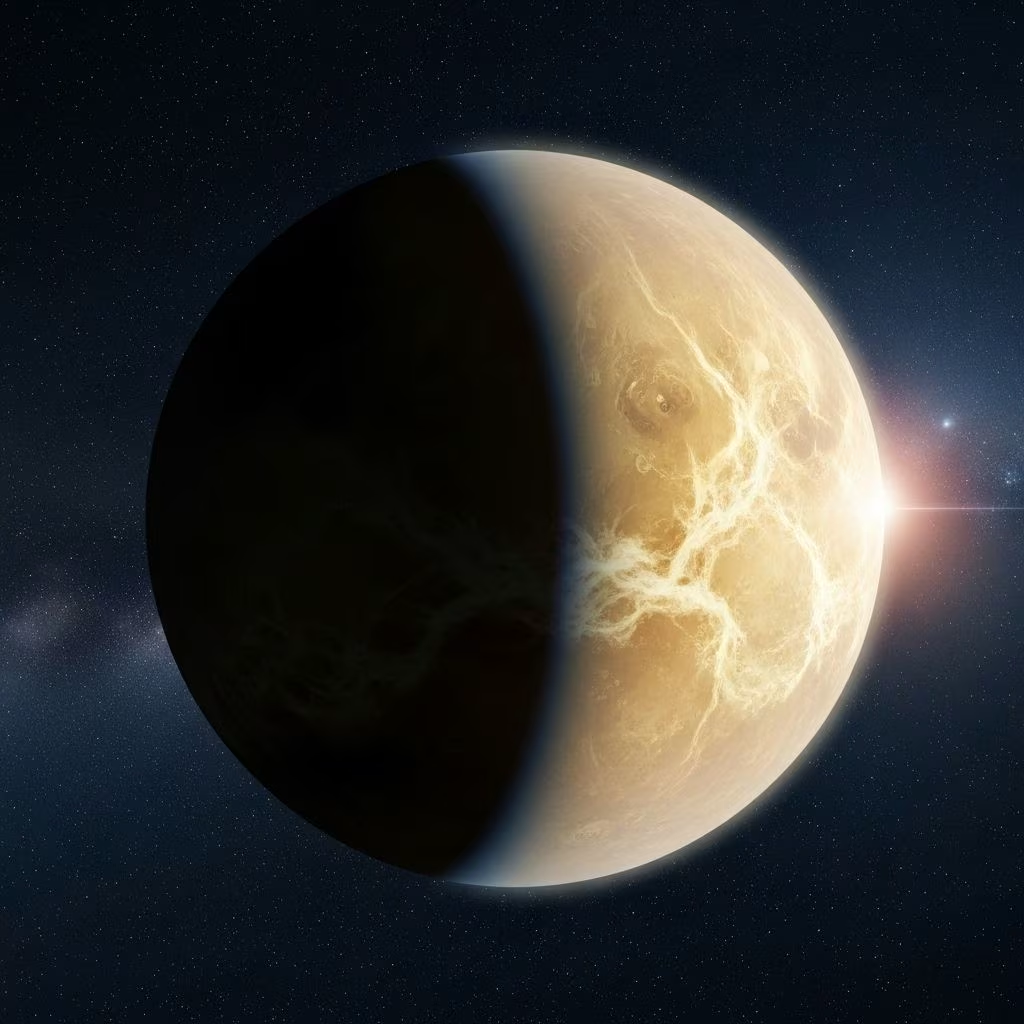
Like the Moon, Venus shows phases as it orbits the Sun, presenting a changing illuminated crescent or gibbous disk when observed through a telescope. These phases occur because Venus’ orbit lies inside Earth’s, making its different angles relative to the Sun and Earth possible to observe from our planet’s surface.
Basic Statistics and Physical Features
| Property | Value |
|---|---|
| Mean distance from Sun | 108.2 million km |
| Orbital period (year) | 224.7 Earth days |
| Diameter | 12,104 km |
| Mass | 4.867 × 1024 kg |
| Surface gravity | 8.87 m/s2 (about 90% of Earth) |
| Average surface temperature | 464°C (867°F) |
| Atmospheric pressure | ≈92 bar (over 90 times Earth’s pressure) |
| Rotation period | 243 Earth days (retrograde) |
| Number of moons | 0 |
The Atmosphere of Venus
Venus’ atmosphere is one of the most inhospitable in the solar system. It is 96.5% carbon dioxide, with most of the remainder being nitrogen. The dense atmosphere exerts a surface pressure over 90 times that of Earth, roughly equivalent to being almost 1 km underwater on Earth. A thick blanket of sulfuric acid clouds perpetually covers the planet, reflecting much of the sunlight and hiding the surface from optical telescopes.
- Greenhouse effect: The high concentration of carbon dioxide leads to a runaway greenhouse effect, trapping heat and causing surface temperatures hot enough to melt lead.
- Sulfuric acid clouds: These clouds cause Venus to be so bright and contribute to its toxic environment.
- Winds: Upper-level winds whip around the planet at speeds up to 360 km/h.
- Acid rain: Sulfuric acid rains down from the clouds but evaporates before reaching the surface because of the intense heat.
Venus versus Earth: Similarities and Differences
While Venus and Earth are sometimes called “twin planets” due to their similar sizes, masses, and rocky compositions, their surfaces and conditions differ drastically:
| Feature | Earth | Venus |
|---|---|---|
| Diameter | 12,742 km | 12,104 km |
| Surface pressure | 1 bar | ≈92 bar |
| Mean surface temperature | 15°C (59°F) | 464°C (867°F) |
| Atmosphere | 78% N2, 21% O2 | 96.5% CO2, 3.5% N2 |
| Surface water | Abundant | None |
| Clouds | Water vapor | Sulfuric acid |
| Rotation | Prograde (24 hours) | Retrograde (243 days) |
| Moons | 1 (Moon) | 0 |
Venus’s Orbit and Rotation
Venus orbits the Sun every 224.7 Earth days. Unusually, its rotation on its axis is retrograde—it spins in the opposite direction to most planets, including Earth. A day on Venus (one rotation) is longer than its year (one orbit around the Sun). Specifically:
- Rotation period (sidereal day): 243 Earth days.
- Orbital period (year): 224.7 Earth days.
- Solar day: 116.75 Earth days, due to both its rotation and orbital motion.
This slow retrograde rotation likely results from historical gravitational interactions and tidal forces. Venus’s axis is tilted only 3°, so it experiences almost no seasonal variations.
The Surface of Venus
Venus’s surface is a dramatic volcanic landscape shaped by immense geological forces. Although no active volcanoes have yet been observed directly, the entire planet is covered by vast lava plains, volcanic domes, and highland terrains. The surface is pockmarked with relatively few small impact craters, which suggests extensive surface “repaving” by lava flows within the last half-billion years.
- Major features: vast lava plains, shield volcanoes, mountains (like Maxwell Montes), tectonic structures called tesserae, and large circular impact structures.
- Volcanism: Volcanoes are thought to have played a huge role in Venus’s history, resurfacing most of the planet in catastrophic episodes.
- Highlands and lowlands: Most of the surface is made up of flat plains, but there are large highland areas such as Ishtar Terra and Aphrodite Terra.
Color and Visibility
Thick clouds shroud Venus in a bright yellowish-white hue when viewed through telescopes or in photographs. Surface color observations are only possible with radar technology due to the opaque cloud cover.
The Search for Water and the Fate of the Atmosphere
Venus currently has no liquid water on its surface. Water vapor in its upper atmosphere is extremely scarce, and the surface temperature and pressure would instantly vaporize or dissociate water molecules. However, planetary scientists suspect that ancient Venus may have once been wet, with oceans potentially present for up to two billion years, before a runaway greenhouse effect evaporated them and drove off hydrogen to space.
The Age and Formation of Venus
Like the other terrestrial planets, Venus formed about 4.5 billion years ago from the accretion of material in the proto-solar nebula. Its similar size and density to Earth indicate a comparable bulk composition and internal differentiation, but its geological development diverged due to its proximity to the Sun and resulting environmental conditions. The resurfacing events are believed to have occurred about 300-500 million years ago, erasing much of the planet’s earlier record.
Venus’s Lack of Moons
Unlike many other planets, Venus does not have any natural satellites. The reasons for this absence are likely tied to its proximity to the Sun—any captured or co-formed moon would have been gravitationally destabilized and lost—or to the collisional events in the planet’s early history.
Exploration of Venus
Venus has been a focus of planetary exploration for decades, with over 20 flybys, orbiters, atmospheric probes, and landers sent to study its mysteries. Some of the most significant missions include:
- Venera missions (Soviet Union, 1960s-1980s): First to transmit images and atmospheric readings from Venus’s surface, enduring surface conditions for up to two hours.
- Mariner 2 (NASA, 1962): First successful Venus flyby by a spacecraft.
- Magellan (NASA, 1990-1994): Used radar to map over 98% of Venus’s surface in detail through the thick clouds.
- Venus Express (ESA, 2006-2014): Studied Venus’s atmosphere and surface from orbit, providing crucial data about climate and weather patterns.
- Akatsuki (Japan, 2015–present): Continues to observe Venus’s weather and atmospheric dynamics.
Despite numerous missions, Venus’s hostile surface conditions have made lander lifespans short. Future plans include new orbiters, atmospheric probes, and potentially surface robots capable of withstanding the crushing pressure and heat for longer durations.
Fun and Unusual Facts About Venus
- Venus spins slower than any other planet and rotates in the opposite direction compared to most planets in the solar system.
- One “day” on Venus (one full rotation) is longer than its “year.”
- Its surface is hot enough to melt lead — hotter than Mercury, despite Mercury’s being closer to the Sun.
- Venus experiences hurricane-force winds in its upper atmosphere and has no moons or rings.
- Venus was named after the Roman goddess of love and beauty, and is the only planet named after a female figure in Greco-Roman mythology.
- Venus’s brightness has inspired countless myths and artistic representations across cultures worldwide.
Frequently Asked Questions (FAQs)
Q: Why is Venus called Earth’s “twin”?
A: Venus is called Earth’s “twin” because they are similar in size, mass, and density. However, their environments are radically different because of Venus’s runaway greenhouse effect and thick carbon dioxide atmosphere.
Q: Can you see Venus with the naked eye?
A: Yes. Venus is the brightest planet visible from Earth and often seen just before sunrise or just after sunset. It’s referred to as the morning star or evening star because of this brilliance.
Q: Why is Venus so hot?
A: Venus has an extremely dense atmosphere composed mostly of carbon dioxide. This creates a runaway greenhouse effect, trapping heat and raising surface temperatures higher than on Mercury—even though Mercury is closer to the Sun.
Q: Has life ever existed on Venus?
A: No evidence of life has been found on Venus. Surface conditions are considered too extreme for life as we know it. Some scientists speculate about the potential for life in the upper cloud layers, where conditions are less hostile, but this remains unproven.
Q: What future missions are planned for Venus?
A: Multiple space agencies, including NASA and ESA, are preparing new missions such as DAVINCI+, VERITAS, and EnVision to study Venus’s atmospheric composition, geology, and search for clues to its past habitability.
In Summary
Venus remains an enigmatic and captivating neighbor. Its dazzling brilliance in the sky has fascinated humanity since antiquity, and while superficially it may resemble Earth, its hellish surface and thick, toxic atmosphere are a stark reminder of the diverse evolutionary paths planets can take. Continued exploration and study of Venus not only illuminate the history of our own planet but also inform the search for habitable worlds elsewhere in the cosmos.
References
- https://www.space.com/15988-venus-planet-weird-facts.html
- https://science.nasa.gov/venus/venus-facts/
- https://space-facts.com/venus/
- https://www.space.com/3131-venus-data-sheet.html
- https://en.wikipedia.org/wiki/Venus
- https://www.britannica.com/place/Venus-planet
- https://www.skyatnightmagazine.com/space-science/facts-about-planet-venus
- https://spaceplace.nasa.gov/all-about-venus/en/
- https://starwalk.space/en/news/discover-the-amazing-planet-venus
- https://www.skyatnightmagazine.com/astrophotography/planets/venus
- https://www.livescience.com/facts-about-venus
- https://byjus.com/physics/venus/
- https://www.rmg.co.uk/stories/space-astronomy/interesting-facts-about-venus
- https://www.jameswebbdiscovery.com/universe/100-fascinating-facts-about-planet-venus
- https://spacecenter.org/meet-the-planets-venus/
- https://www.britannica.com/facts/Venus-planet
- https://www.popularmechanics.com/space/solar-system/a30299716/facts-about-venus/
- https://revolutionized.com/interesting-planet-venus-facts/
- https://www.funkidslive.com/learn/top-10-facts/top-10-facts-about-venus/