What Is the Gravitational Constant?
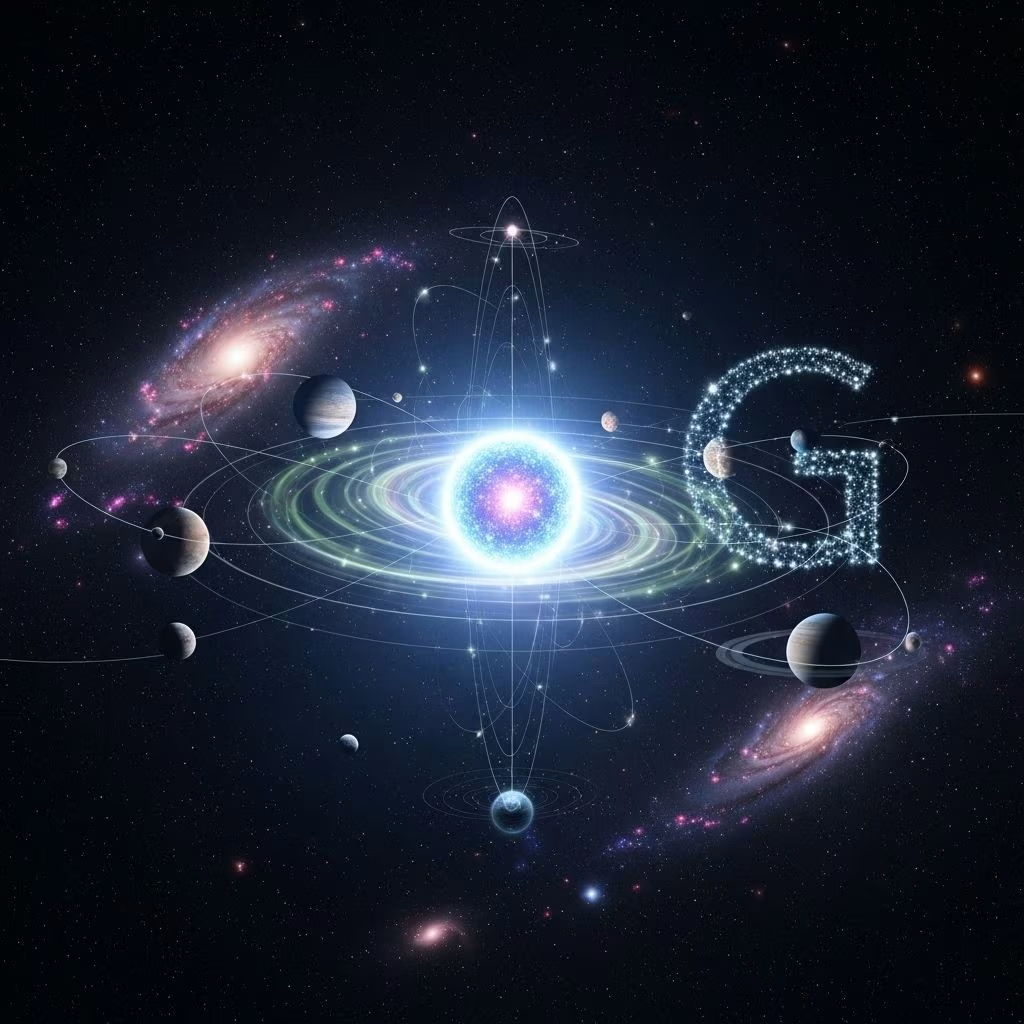
The gravitational constant, commonly denoted as G, is a fundamental constant in physics describing the strength of the gravitational force between two objects with mass. This constant is essential for quantifying gravity in the universe and is a cornerstone of Newton’s law of universal gravitation. G is known as the universal gravitational constant or Newton’s constant, distinguishing it from g, which is specific to the Earth’s surface gravity.
Understanding Gravity: Newton’s Law of Universal Gravitation
Gravity is the force that attracts all objects with mass toward one another. Newton formulated this as the Law of Universal Gravitation, which states:
Every mass in the universe attracts every other mass with a force that is directly proportional to the product of their masses and inversely proportional to the square of the distance between their centers.
This relationship is mathematically expressed as:
F = G × (m₁ × m₂) / r²- F: Gravitational force between the objects (in Newtons)
- m₁, m₂: Masses of the two objects (in kilograms)
- r: Distance between the centers of the two objects (in meters)
- G: Gravitational constant
Formula Table: Newton’s Law of Universal Gravitation
| Symbol | Meaning | Unit |
|---|---|---|
| F | Gravitational Force | Newtons (N) |
| m₁, m₂ | Masses of Objects | Kilograms (kg) |
| r | Distance between Objects | Meters (m) |
| G | Gravitational Constant | N·m²/kg² |
What Is the Value of the Gravitational Constant (G)?
The gravitational constant, G, is experimentally determined and has the approximate value:
- G = 6.674 × 10⁻¹¹ N·m²/kg²
This value is universal: it remains the same everywhere in the universe, unlike quantities such as Earth’s local gravity (g), which can vary by location and altitude.
G vs. g: What’s the Difference?
- G (gravitational constant): A universal constant expressing the strength of gravity throughout the universe. Used in formulas that calculate the force between any two masses anywhere.
- g (acceleration due to gravity): The acceleration experienced by an object due to Earth’s gravity at its surface, approximately 9.8 m/s². Varies depending on altitude and planetary body.
Discovery of the Gravitational Constant: A Historical Perspective
Although Newton established the law of universal gravitation in 1687, he did not experimentally measure the gravitational constant G itself. The first measurement came more than a century later, through the work of English physicist Henry Cavendish in 1798.
The Cavendish Experiment
Cavendish used a torsion balance—an apparatus featuring a suspended rod with lead spheres attached to each end— to detect minute changes in angle caused by gravitational attraction between the spheres. By carefully measuring the tiny twisting motion, he calculated the value that would later be recognized as G. Cavendish described his result as “weighing the Earth,” as the measurement made possible the first accurate calculation of the planet’s mass.
Significance of G: Why Is the Gravitational Constant Important?
The gravitational constant is a key ingredient in understanding the universe’s behavior. Its significance extends to multiple domains:
- Orbits: G helps determine planetary orbits, satellite trajectories, and the motion of stars and galaxies.
- Mass Calculations: By measuring the orbits of planets or moons and applying G, astronomers can calculate the mass of planets, stars, and galaxies.
- Cosmology: G is fundamental to equations describing the universe’s structure and expansion, such as General Relativity and cosmological models.
- Astrophysics: Understanding phenomena such as black holes, gravitational waves, and star formation depends crucially on G.
Challenges and Precision in Measuring G
The measurement of G is notoriously challenging—more uncertain than most other fundamental constants. Gravitational forces, even between massive laboratory objects, are exceedingly small compared to electromagnetic forces. Controlling for vibrations, air currents, and the tiniest environmental effects is critical for precision.
- Over the last two centuries, improved experimental designs have increased accuracy, but small discrepancies persist even into the 21st century.
- Current best measurements agree on G within about five parts per million, yet outliers and statistical noise remain problematic for experimenters.
This persistent uncertainty has intrigued and frustrated physicists, leading some to nickname G as one of nature’s more “mysterious” numbers.
G in Modern Physics and Cosmology
G’s role is central in countless equations and models, underpinning:
- Einstein’s General Theory of Relativity, explaining gravitational fields as curvature in spacetime.
- Cosmological calculations, such as the universe’s age, the expansion rate, and the formation of cosmic structures.
- Critical understanding of exotic phenomena—black holes, neutron stars, gravitational lensing, binary star systems.
- Calculations that enable precise space exploration, satellite navigation, and predictions of planet and moon orbits across the solar system.
Constants Table: Comparing G and Other Fundamental Physical Constants
| Constant | Symbol | Value | Unit | Field |
|---|---|---|---|---|
| Gravitational Constant | G | 6.674 × 10⁻¹¹ | N·m²/kg² | Gravity |
| Speed of Light | c | 2.9979 × 10⁸ | m/s | Electromagnetism |
| Planck Constant | h | 6.626 × 10⁻³⁴ | J·s | Quantum Mechanics |
| Elementary Charge | e | 1.602 × 10⁻¹⁹ | Coulombs (C) | Electromagnetism |
Why Does G Have Its Specific Value?
Perhaps the largest unanswered mystery is why G has its observed value. Unlike some other constants, G does not arise from deeper theory—its value appears to be an empirical fact of nature. Physicists speculate about possible links between G and the properties of the universe, but as yet, no underlying explanation has emerged. If G were even a tiny percentage different, the universe’s structure, star formation, and planetary orbits would be profoundly altered.
Fun Facts and Applications of the Gravitational Constant
- Universality: The value of G appears to be unchanging across the observable universe, making it truly universal.
- Foundation of Astrophysics: Essential to measurements ranging from weighing the Earth to calculating the mass of supermassive black holes.
- Spaceflight: All rocket launches, satellite insertions, and planetary missions depend on calculations using G.
- Cavendish’s Legacy: Henry Cavendish’s 1798 experiment marked the birth of precision physical science.
Frequently Asked Questions (FAQs)
Q: Is the gravitational constant the same everywhere in the universe?
A: Experimental evidence suggests that the gravitational constant, G, is the same everywhere in the observable universe and does not vary with location or over time.
Q: What is the precise value and unit of G?
A: The official value is approximately 6.674 × 10⁻¹¹ N·m²/kg². Units mean Newton times meter squared per kilogram squared.
Q: Why is G so difficult to measure precisely?
A: Because gravity is an incredibly weak fundamental force compared to others, even large masses exert only very tiny gravitational forces, making laboratory measurements extremely susceptible to interference from other forces and environmental factors.
Q: Who first measured G, and how?
A: Henry Cavendish first measured G in 1798 by observing the tiny deflections caused by gravitational forces between lead spheres using a torsion balance.
Q: What would happen if the value of G were different?
A: A different G would change the structure of the universe. For example, a higher G could lead to faster star formation and denser planets, while a lower G could result in a more diffuse cosmos with fewer or no stable galaxies or stars.
Q: What is the difference between G and g?
A: G is the universal gravitational constant; g is the local acceleration due to gravity at a planet’s surface (9.8 m/s² for Earth).
References for Further Reading
- Gravitational constant – Wikipedia
- Gravitational constant | Definition, Value, Units, & Facts – Britannica
- What Is the Gravitational Constant? – Universe Today
- Gravitational constant – BBC Sky at Night Magazine
References
- https://en.wikipedia.org/wiki/Gravitational_constant
- https://www.britannica.com/science/gravitational-constant
- https://www.youtube.com/watch?v=7ymoYwItyMw
- https://byjus.com/physics/value-of-gravitational-constant/
- https://library.fiveable.me/key-terms/ap-physics-1/gravitational-constant
- https://www.turito.com/blog/physics/gravitational-constant
- https://www.skyatnightmagazine.com/space-science/gravitational-constant
- https://library.fiveable.me/key-terms/principles-physics-i/gravitational-constant-g
- https://www.youtube.com/watch?v=gW1yz90xMrg
- https://byjus.com/physics/gravitational-constant/
- https://www.shaalaa.com/question-bank-solutions/define-gravitational-constant-g_90983
- https://www.universetoday.com/articles/gravitational-constant
- https://testbook.com/physics/what-is-gravitational-constant
- https://en.wikipedia.org/wiki/Gravitational_coupling_constant
- https://testbook.com/physics/gravitational-constant
- https://www.npl.washington.edu/eotwash/gravitational-constant
- https://pmc.ncbi.nlm.nih.gov/articles/PMC4173273/
- https://www.britannica.com/science/Newtons-law-of-gravitation