Venus’ Atmosphere: A Deep Dive into Its Composition and Structure
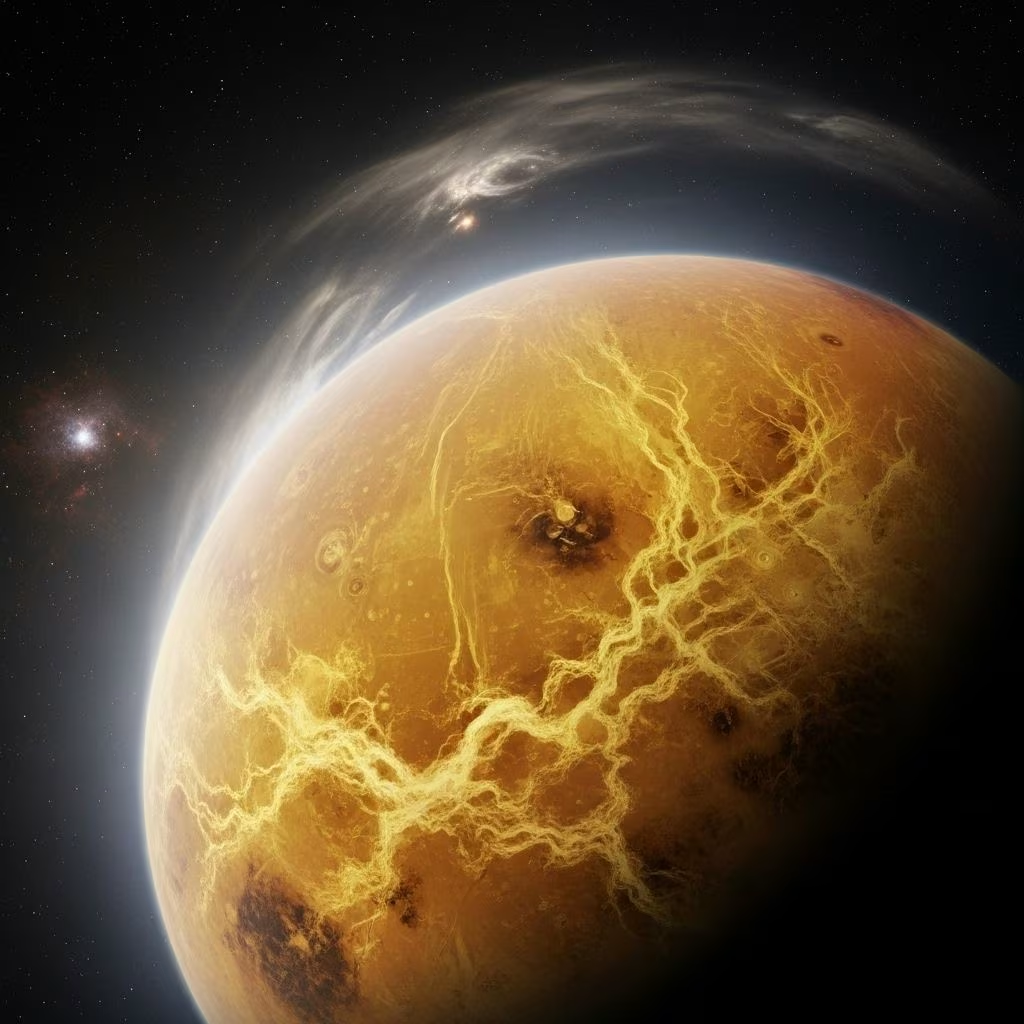
Venus, often called Earth’s twin due to its similar size and mass, possesses an atmosphere that is astonishingly different from any other planet in the solar system. Its thick, toxic clouds and extreme pressure create a world of intense heat and perpetual twilight, presenting planetary scientists with both challenges and fascinating mysteries.
Overview of Venus’ Atmosphere
The atmosphere of Venus is dominated by its density and heat, with temperatures soaring high enough to melt lead and air pressure at the surface that is analogous to that found nearly a kilometer under the Earth’s oceans. The thick clouds that enshroud the planet have kept its mysteries hidden for centuries, only recently revealing insights through radar mapping and space probes.
- Diameter: About 12,100 km (similar to Earth).
- Main atmospheric components: Carbon dioxide and nitrogen.
- Surface pressure: 92 to 93 bar—over 90 times Earth’s surface pressure.
- Average surface temperature: Approximately 467 °C (872 °F).
Atmospheric Composition
Venus’ atmosphere ranks as the densest of all terrestrial planets, containing more than 96% carbon dioxide and less than 3.5% nitrogen. A host of trace gases—including sulfur dioxide, water vapor, carbon monoxide, and various noble gases—paint a complex chemical picture.
Major and Minor Constituents
| Element or Molecule | Percentage (by volume) |
|---|---|
| Carbon dioxide (CO2) | 96.5% |
| Nitrogen (N2) | Less than 3.5% |
| Sulfur dioxide (SO2) | 0.015% |
| Argon (Ar) | 0.007% |
| Water vapor (H2O) | 0.002% |
| Carbon monoxide (CO) | 0.0017% |
| Helium (He) | 0.0012% |
| Oxygen (O2) | 0.001% |
| Neon (Ne) | 0.0007% |
- Water vapor is present in extremely low quantities—Venus is the driest planet in the solar system.
- Trace molecules like hydrogen, oxygen, krypton, hydrogen sulfide, and carbonyl sulfide have all been detected in tiny amounts.
Atmospheric Structure and Layers
The atmosphere is structured in several distinct layers, each with unique characteristics, composition, and functions. The following are the primary layers found on Venus:
- Troposphere: Extending up to 65-70 km above the surface, this layer contains most of the mass, temperature decreases with altitude, and weather phenomena occur here.
- Cloud decks: From 45-70 km, three main cloud layers are present, comprised mainly of sulfuric acid droplets.
- Mesosphere: Extending up to about 100 km. Temperatures stop dropping and start to rise again with altitude.
- Thermosphere: Above 100 km: gases are heated and partially ionized by solar radiation and migrate between the planet’s illuminated and dark hemispheres.
Unlike Earth’s atmosphere, which becomes gradually less dense with altitude, Venus’s atmosphere remains extremely thick up to a much higher elevation before thinning out.
Pressure, Temperature, and Surface Conditions
Venus’s surface conditions are among the most extreme in the solar system. The combination of heat-trapping and high pressure makes it inhospitable for any known life forms and most electronics.
- Pressure: Surface atmospheric pressure is approximately 92-93 times that of Earth, similar to the pressure found 900 meters below the surface of Earth’s oceans.
- Temperature: Average surface temperatures linger around 467 °C (872 °F), consistently hot enough to melt lead.
- Light: Only about 5% of sunlight reaches the surface due to thick cloud cover.
- Weather: Calm at the ground level, with only sluggish winds, but extremely violent and fast-moving at higher altitudes.
Cloud Layers and Sulfuric Acid Rain
Venus’s clouds are notorious, forming unbroken layers of yellowish horros that obscure its surface from view. Unlike Earth’s water clouds, Venus’s clouds primarily consist of corrosive sulfuric acid droplets mixed with tiny amounts of water and other chemicals.
- Cloud structure: Located between 45 and 70 km above the surface, divided into upper, middle, and lower decks.
- Acidity: Composed mostly of concentrated sulfuric acid (H2SO4).
- Lightning: Evidence suggests frequent lightning in the upper cloud layers, comparable in frequency to storms on Earth.
- Precipitation: Rain falls as sulfuric acid, but it evaporates long before it can reach the scorchingly hot surface—what scientists term “virga.”
Dynamic Weather and Winds
The Venusian weather system is dominated by powerful winds and dramatic atmospheric circulation. Unlike Earth, surface winds on Venus are slow (often less than 2 meters per second), but in the upper atmosphere, winds can reach speeds of over 360 km/h, circling the entire planet in just 4 Earth days—a phenomenon called super-rotation.
- Super-rotation: The entire atmosphere rotates up to 60 times faster than the planet rotates itself. Earth’s fastest winds reach only about 20% of the planet’s rotational speed.
- Polar vortices: At each pole, Venus displays vast, double-eyed vortex systems with striking S-shaped cloud patterns.
- Surface winds: Despite the massive pressure, ground-level winds are surprisingly gentle.
These features combine into a storm system that is perpetually in motion yet cloaked in thick clouds, pushing the boundaries of what we know about planetary atmospheres.
The Runaway Greenhouse Effect and Venus’s Climate
The runaway greenhouse effect is Venus’s signature atmospheric process. The thick carbon dioxide atmosphere traps infrared radiation very efficiently, driving surface temperatures to levels unmatched on any other planet (except perhaps in the core of gas giants).
- Solar energy penetrates the upper clouds, warming the planet’s surface, but the heat is blocked from escaping back into space.
- This process keeps Venus trapped in a perpetual, blazing heat—leading to an environment hotter than Mercury, despite Venus’s greater distance from the Sun.
Venus, Earth, and Mars: Atmospheric Contrasts
Venus, Earth, and Mars offer compelling case studies in planetary atmospheres. Each planet’s unique conditions arise from differences in composition, distance from the Sun, and atmospheric processes.
| Feature | Venus | Earth | Mars |
|---|---|---|---|
| Primary Gases | CO2 (96.5%), N2 (3.5%) | N2 (78%), O2 (21%) | CO2 (95.3%), N2 (2.7%) |
| Surface Pressure | 92-93 bar | 1 bar | 0.006 bar |
| Average Temperature | 467 °C | 15 °C | -60 °C |
| Water Vapor Content | Extremely low | Variable (up to 4%) | Trace |
| Clouds | Sulfuric acid | Water | Water-ice & CO2 ice |
| Greenhouse Effect | Runaway, extreme | Moderate, life-sustaining | Weak |
Key Differences:
- Only about 5% of sunlight penetrates to Venus’s surface compared to the much higher transparency of Earth’s and Mars’s atmospheres.
- Photochemical reactions play a minor role in Venus’s deep troposphere since ultraviolet light is absorbed by higher cloud layers.
Unsolved Mysteries and Ongoing Research
Despite several decades of space-based investigations, Venus’s atmosphere still holds secrets and poses scientific puzzles. Research is ongoing into its complex chemistry, dynamic weather, and the processes driving super-rotation and polar vortex formation.
- Origin of atmospheric super-rotation — Why does Venus’s upper atmosphere spin much faster than the surface?
- Complex cloud chemistry — What unidentified compounds or aerosols are responsible for certain cloud features and reflectivity?
- Ancient water — Did Venus once have oceans, and how did it lose what little water vapor remains?
- Lightning — How frequent and powerful are Venusian lightning strikes?
Recent missions and advances in spectroscopy, radar mapping, and atmospheric modeling continue to reveal new data. Still, some fundamental questions remain unanswered, fueling proposals for future robotic probes and even ambitions for high-altitude (balloon-based) exploration above the crushing lower layers.
Frequently Asked Questions (FAQs)
Q: Why is the surface of Venus so hot compared to other planets?
A: The extraordinarily high temperatures result from an extreme greenhouse effect, wherein thick clouds of carbon dioxide trap solar heat very efficiently, raising surface temperatures to above 460 °C.
Q: What are the clouds of Venus made of?
A: Unlike Earth’s water vapor clouds, Venus’s clouds are composed mainly of concentrated sulfuric acid droplets, making the atmosphere strongly acidic and opaque to visible light.
Q: Could any life exist in Venus’s atmosphere?
A: The surface is seemingly sterile due to crushing pressure and scorching heat, but some scientists speculate that life—even if only microbial—could potentially survive in the cooler, upper cloud layers, where temperatures and pressures are more Earth-like.
Q: How does Venus differ from Earth in receiving sunlight?
A: Only about 5% of sunlight manages to reach Venus’s surface, mostly as diffuse light, making it perpetually dim even during the day. Thick cloud layers absorb and reflect much of the Sun’s energy before it reaches the surface.
Q: Has any spacecraft landed on Venus?
A: Yes, several Soviet Venera landers and later Venus probes have touched down, briefly transmitting data before succumbing to extreme heat and pressure. Surface missions last from minutes to a couple of hours before systems fail.
Q: What makes Venus’s air pressure so different from Earth’s?
A: Venus’s atmosphere is composed almost entirely of dense carbon dioxide, accumulating in such enormous amounts that it produces surface pressures 90 times greater than Earth—akin to being deep beneath the ocean here.
Exploring Venus: Scientific Importance
Understanding Venus’s atmosphere helps planetary scientists:
- Investigate extreme climate and runaway greenhouse effects.
- Draw comparisons with early Earth and model the boundaries of planetary habitability.
- Advance technologies for exploring worlds with harsh environments.
The research conducted on Venus has already impacted Earth sciences, climate modeling, and astrobiology. Future missions, including potential atmospheric balloons and surface robots, promise to further reveal the secrets of our mysterious neighbor.
References
- https://en.wikipedia.org/wiki/Atmosphere_of_Venus
- https://www.britannica.com/place/Venus-planet/The-atmosphere
- https://www.aeronomie.be/en/encyclopedia/venus-atmosphere-mainly-composed-carbon-dioxide-and-nitrogen
- https://pubmed.ncbi.nlm.nih.gov/17778898/
- https://science.nasa.gov/venus/venus-facts/
- https://courses.lumenlearning.com/suny-astronomy/chapter/the-massive-atmosphere-of-venus/
- https://www.issibern.ch/teams/venusso2/multimedia/pdf/Krasnopolsky_06.pdf
- https://www.ebsco.com/research-starters/astronomy-and-astrophysics/venuss-atmosphere
- https://pmc.ncbi.nlm.nih.gov/articles/PMC6839549/
- https://en.wikipedia.org/wiki/Venus
- https://nssdc.gsfc.nasa.gov/planetary/factsheet/venusfact.html
- https://courses.lumenlearning.com/towson-astronomy/chapter/the-massive-atmosphere-of-venus/
- https://www.theexpertta.com/book-files/OpenStaxAstronomy/Astronomy_10.3.%C2%A0The%20Massive%20Atmosphere%20of%20Venus_pg347%20-%20349.pdf
- https://www.britannica.com/place/Venus-planet/Interior-structure-and-geologic-evolution
- https://www.liebertpub.com/doi/10.1089/ast.2022.0113
- https://openstax.org/books/astronomy-2e/pages/10-3-the-massive-atmosphere-of-venus
- https://openstax.org/books/astronomy/pages/10-3-the-massive-atmosphere-of-venus