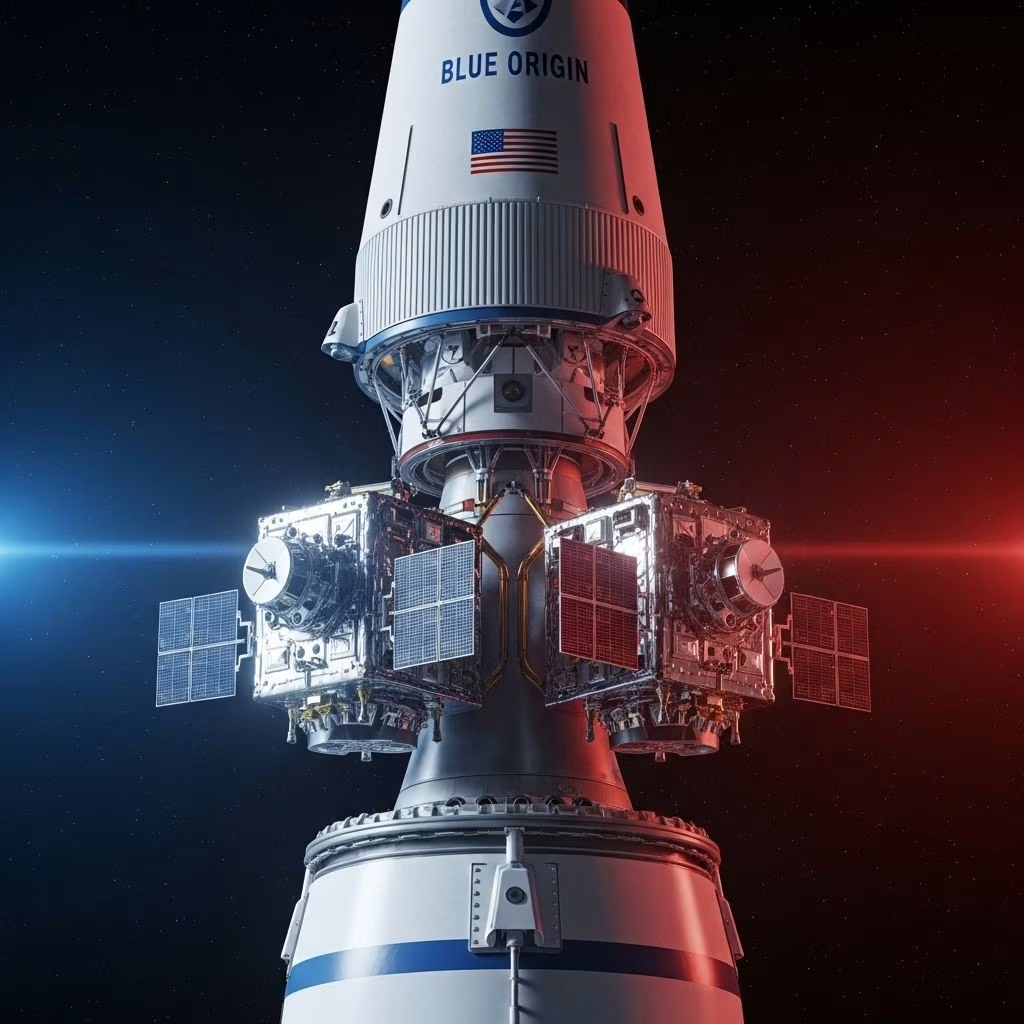
Twin NASA Mars Probes Will Fly on the Second-Ever Launch of Blue Origin’s New Glenn Rocket
NASA’s push for Mars exploration will reach a new milestone on the second launch of Blue Origin’s New Glenn—one of the world’s most ambitious heavy-lift rockets. The flight will carry two identical robotic probes toward the Red Planet, marking a critical test for Blue Origin’s next-generation launcher and NASA’s search for signs of life beyond Earth.
Overview: NASA, Blue Origin, and the Race to Mars
- NASA’s goal: Understand Mars’s atmosphere, climate, and potential for life through advanced robotic exploration.
- Blue Origin’s vision: Provide powerful, reusable launch systems for government and commercial customers.
- New Glenn’s achievement: Become a cornerstone in U.S. heavy-lift launch, challenging incumbent players like SpaceX and ULA.
Mission Profile: The Escape and Plasma Acceleration and Dynamics Explorers
On this landmark flight, two identical NASA spacecraft—the Escape and Plasma Acceleration and Dynamics Explorers—will embark on a journey to Mars. These twin probes are designed to study the mechanisms driving Mars’s loss of atmosphere, a focus that could offer clues about the planet’s past habitability and ongoing evolution.
- Primary scientific objective: Investigate the interaction between Mars’s magnetic field and solar winds.
- Impact: Their observations will fill major gaps left by prior missions, revealing how Mars’s climate changed over billions of years.
- Technology: Advanced spectrometers and plasma sensors to map atmospheric escape in real time.
New Glenn: Blue Origin’s Heavy-Lift Marvel
Developed by Blue Origin, New Glenn is a towering, 322-foot (98-meter) rocket that represents a new era for reusable, payload-rich launches. Standing taller than the Statue of Liberty, New Glenn’s debut has been years in the making and will soon support regular missions for NASA, the Department of Defense, and commercial customers.
| Feature | Specification | Benefit |
|---|---|---|
| Height | 98 meters (322 feet) | One of the tallest operational rockets, enabling larger payloads |
| Diameter | 7 meters (23 feet) | Broader fairing allows bulkier scientific equipment and satellites |
| First Stage Engines | 7 BE-4 (liquefied natural gas/LOX) | High thrust, reusability, and cost efficiency |
| Payload to LEO | 45,000 kg (99,000 lbs) | Can launch heavy interplanetary probes and stacked payloads |
- Launch site: Cape Canaveral Launch Complex 36.
- Stages: Two (with optional expendable third).
- Reusability: First stage designed to land vertically for up to 25 missions.
- Propellant choice: Methane and LOX for first stage; hydrogen and oxygen for second.
The Second New Glenn Flight: Strategic Stakes and Impacts
Blue Origin’s maiden launch of New Glenn was a demonstration; however, the rocket’s second flight—now with NASA’s Mars probes—signals a transition toward operational capability. This mission not only aims to boost payload to interplanetary trajectory but also to prove New Glenn’s commercial and government reliability.
- Maturity: Certification for National Security Space Launch program hinges on this and upcoming flights.
- Competition: New Glenn faces rivals like SpaceX’s Falcon Heavy and Starship, as well as ULA’s Vulcan rocket.
- Customer impact: Expanding launch options for science, defense, and industry.
- Long-term vision: Support for lunar cargo and future crewed missions.
Science Returns: Unlocking Mars’s Atmosphere
The two NASA spacecraft aboard New Glenn will focus on measuring how Mars’s atmosphere escapes into space—a process that has gradually stripped the planet of water and made it inhospitable. The mission uses advanced plasma detectors and magnetometers, building on discoveries from the MAVEN and Mars Express missions.
- Key questions:
- How quickly is Mars losing its atmosphere?
- What role do solar storms play in atmospheric escape?
- Could Mars’s ancient climate have supported life?
- Importance: These findings may inform future missions seeking evidence of ancient Martian life.
- Technological leap: Dual spacecraft can sample multiple regions simultaneously, offering more complete data.
New Glenn’s Launch Capabilities: Technical Specifications
| Parameter | Value |
|---|---|
| Total Height | 98 meters (322 feet) |
| Payload Fairing Diameter | 7 meters (23 feet) |
| LEO Payload | 45,000 kg (99,000 lbs) |
| GTO Payload | 13,000 kg (28,000 lbs) |
| Liftoff Thrust | 17,150 kN |
| First Stage Engines | 7 BE-4 |
| Second Stage Engine | 2 BE-3U |
| Stage Design | 2 (+ optional third) |
| First Stage Reusability | Expected up to 25 uses |
| Primary Launch Site | Cape Canaveral LC-36 |
The BE-4 engines use methane—a cheaper, cleaner propellant—distinguishing New Glenn from many older rocket families. The rocket’s broad fairing enables launch of payloads previously impossible on 5-meter class rockets, opening doors for larger probes, multi-spacecraft constellations, and future lunar landers.
New Glenn’s Market Impact and Future Prospects
Blue Origin’s New Glenn is poised to disrupt the launch market, competing for contracts beyond just NASA missions. Its reusability and powerful engines make it appealing for Earth-orbit satellites, interplanetary craft, and defense payloads.
- Commercial appeal: Lower launch costs, greater scheduling flexibility, and expanded payload volume.
- Government partnerships: NASA, U.S. Space Force, and foreign agencies increasingly interested in New Glenn’s capabilities.
- Technological innovation: Advanced manufacturing of engines, tanks, and software for rapid turnaround.
- Lunar and deep space potential: Future launches may support lunar cargo and deep space missions.
Timeline and Next Steps for New Glenn and NASA’s Mars Probes
- First New Glenn launch: Demonstration flight from Cape Canaveral, carrying the Blue Ring prototype, occurred in January 2025[10].
- Second flight: Twin NASA Mars probes scheduled for launch, aiming for Mars orbit entry.
- Certification track: Multiple launches planned to meet National Security Space Launch requirements.
- Mid-decade objectives: Expand capabilities for lunar missions and high-value science payloads.
Rocket Rivalry: New Glenn vs Falcon Heavy vs Vulcan
| Rocket | LEO Payload (kg) | Main Engines | Fairing Diameter | Major Missions |
|---|---|---|---|---|
| New Glenn | 45,000 | 7 BE-4 | 7m | NASA Mars, military, lunar |
| SpaceX Falcon Heavy | 63,800 | 27 Merlin | 5.2m | Telstar, Arabsat, USAF |
| ULA Vulcan | 27,200 | 2 BE-4 | 5.4m | Peregrine, Astrobotic |
While Falcon Heavy currently has higher payload capacity, New Glenn’s size and reusability are expected to bring competitive cost and schedule improvements as Blue Origin ramps up operations[12].
Frequently Asked Questions (FAQs)
What makes New Glenn’s second launch significant for NASA?
The second flight transitions New Glenn from a test platform to an operational launcher, supporting high-value Mars science and demonstrating U.S. leadership in heavy-lift, reusable rockets.
How are the twin Mars probes different from earlier missions?
These probes carry state-of-the-art plasma detectors and will operate in tandem, improving the spatial and temporal resolution of atmospheric escape measurements far beyond what previous single-craft missions achieved.
Will New Glenn’s first stage be reused after this mission?
Yes, the first stage is designed for vertical landing on a barge and is expected to be reused for up to 25 flights, although actual recovery depends on post-launch conditions and continued test success.
What are the long-term goals for New Glenn?
Beyond Mars, New Glenn’s development roadmap includes launches for lunar cargo delivery, high-volume deployment of satellites in mega-constellations, and support for future crewed deep space missions.
How does Blue Origin’s New Glenn compare to SpaceX’s Starship?
Starship is designed as a fully reusable super-heavy rocket aiming for much larger payloads and eventual Mars crewed missions, while New Glenn focuses on reusability for the first stage and carrying substantial robotic or satellite missions to orbit, with a proven supply chain and launch cadence.
Conclusion: New Glenn’s Second Flight and the Future of Mars Exploration
NASA’s twin Mars probes riding Blue Origin’s New Glenn signal a new era for both agency science and commercial rocket innovation. This flight fuses government demand with private ingenuity, promising deeper understanding of planetary evolution and a template for sustainable space transportation. As New Glenn expands its launch manifest, the boundaries of Mars, the Moon, and beyond grow increasingly accessible for science, industry, and human exploration.
References
- https://www.blueorigin.com/new-glenn
- https://en.wikipedia.org/wiki/New_Glenn
- https://www.space.com/40455-new-glenn-rocket.html
- https://www.blueorigin.com/missions/ng-1
- https://rocketlaunch.org/launch-providers/blue-origin/new-glenn
- https://phys.org/news/2025-01-glenn-blue-rocket.html
- https://www.simplerockets.com/c/ejc230/Blue-Origins-NEW-GLENN-rocket
- https://spaceexplored.com/2025/01/12/everything-you-need-to-know-about-blue-origins-first-new-glenn-launch/
- https://www.theweeklyspaceman.com/articles/new-glenn-all-about-blue-origins-next-rocket
- https://nextspaceflight.com/rockets/67/
- https://yellowdragonblog.com/wp-content/uploads/2019/01/new_glenn_payload_users_guide_rev_c.pdf
- https://newspaceeconomy.ca/2024/04/29/blue-origins-new-glenn-rocket-a-game-changer-in-the-space-industry/
- https://www.youtube.com/watch?v=s7IDPVp99Uc
- https://blog.joshuniverse.com/blue-origins-new-glenn-rocket-launch-milestone/
- https://newspaceeconomy.ca/2024/05/20/blue-origins-new-glenn-rocket-ushering-in-a-new-era-of-reusable-heavy-lift-launch-vehicles/
- https://www.youtube.com/watch?v=wwtoAt3qAA0
- https://www.ksgindia.com/study-material/news/blue-origins-new-glenn-rocket.html
- https://www.inverse.com/innovation/blue-origin-new-glenn-specs-power-launch-date-for-ambitious-rocket