How Long Does It Take to Get to Jupiter?
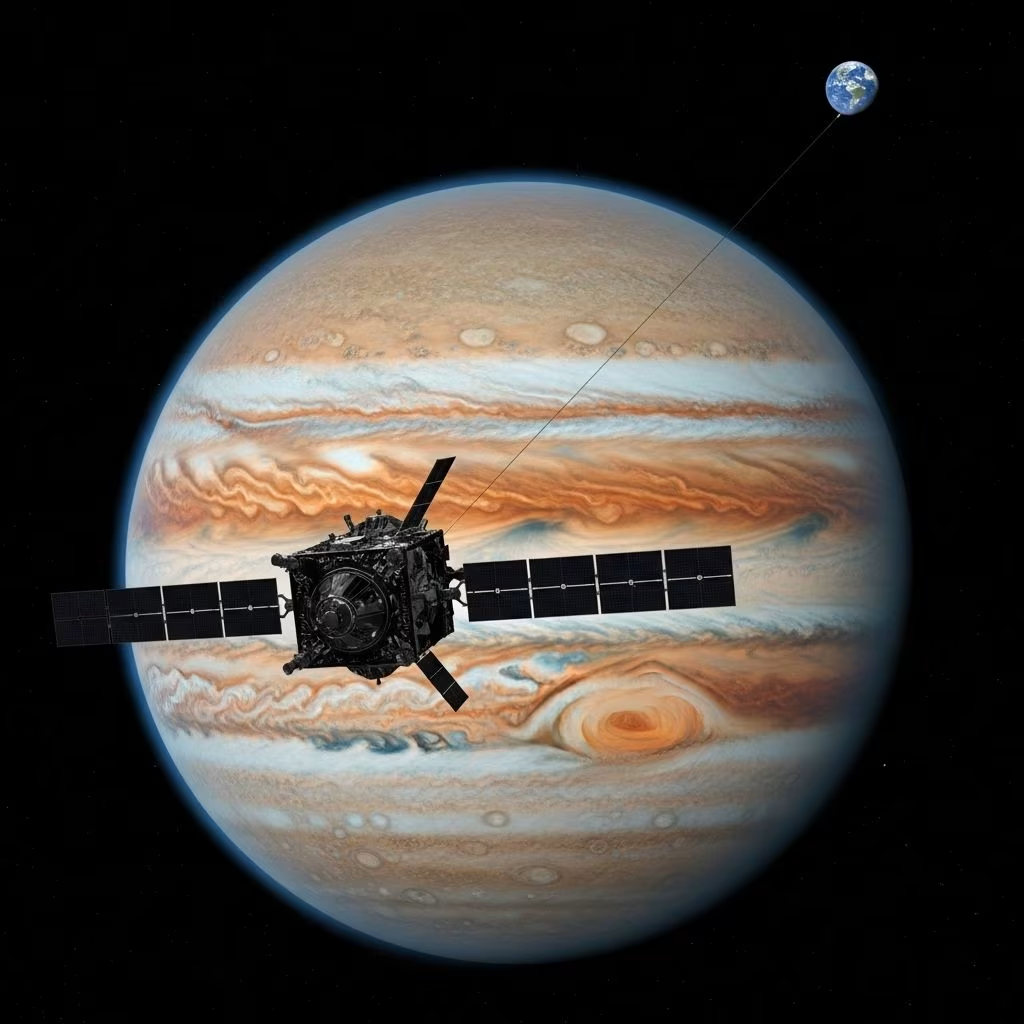
Jupiter, the largest planet in our solar system, has long fascinated scientists and the public alike. Understanding the journey times and the technology behind reaching this massive gas giant helps highlight both the challenges and triumphs of space exploration. The duration to reach Jupiter can differ significantly depending on the spacecraft, mission objectives, route, and alignment of planets.
Average Distance from Earth to Jupiter
The average distance between Earth and Jupiter is about 444 million miles (714 million kilometers), though this varies as both planets orbit the Sun. At certain points, the distance can range from about 365 million to over 600 million miles, impacting the time it takes to travel between the two worlds.
Factors Affecting Journey Time to Jupiter
- Planetary Alignment: The planets’ positions in their orbits determine the closest approach and possible launch windows. Proper alignment allows spacecraft to use gravitational assists, or slingshots, that can shorten the voyage.
- Spacecraft Speed: Different spacecraft have varying propulsion capabilities. Some utilize chemical rockets, while advanced missions may use ion propulsion or take advantage of gravitational boosts.
- Mission Objectives: Some missions are designed to fly by Jupiter rapidly, while others enter orbit or carry out complex maneuvers, affecting overall travel time.
- Technological Advancements: Next-generation propulsion systems and navigation techniques can further reduce journey times.
Historic Missions to Jupiter and Their Travel Times
Multiple unmanned missions have journeyed to Jupiter, each showcasing different technologies and strategies. The following table summarizes notable missions and how long each took to reach the gas giant:
| Mission | Launch Date | Arrival Date | Travel Time |
|---|---|---|---|
| NASA New Horizons | January 2006 | February 2007 | 405 days |
| Galileo spacecraft | October 1989 | December 1995 | 6 years |
| Juno spacecraft | August 2011 | July 2016 | 5 years |
| Pioneer 10 | March 1972 | December 1973 | 1 year 9 months |
| Voyager 1 | September 1977 | March 1979 | 1 year 6 months |
Quickest Mission
The fastest recorded journey was NASA’s New Horizons probe, which reached Jupiter in just 405 days as part of its flyby en route to Pluto[10]. This speedy transit was possible thanks to a rapid launch and trajectory that didn’t require slowing for orbital insertion.
Longest Mission
In contrast, missions like Galileo and Juno took five to six years, as their paths included multiple flybys to gather speed and the need to match Jupiter’s orbital velocity for successful orbit insertion.
Speed of Light vs. Spacecraft Speeds
If travel was not limited by current technology, and one could move at the speed of light (about 186,282 miles per second), it would take roughly 40 minutes to reach Jupiter from Earth at average spacing[10]. But with modern spacecraft, travel is much slower:
- Parker Solar Probe (the fastest human-made object) could reach Jupiter in approximately 42 days if it maintained its peak speed (though it isn’t designed for this route).
- Actual mission travel times range from just over 1 year (flyby) to 6 years (orbiters).
Calculating Travel Time to Jupiter
Estimating the duration for a trip to Jupiter involves several factors. The basic formula is:
For instance, at an average distance of 628.73 million kilometers, and at a speed of 24 km/s, the trip would take:
Travel Time = 628,730,000 km / 24 km/s = 26,197,083 seconds 26,197,083 / 86,400 seconds/day ≈ 303 daysIn reality, spacecraft need to carefully navigate complex gravity assists and orbital insertions, which increase this time considerably.
Gravity Assists and Their Role
A common method to reduce travel time is the use of gravity assists, where spacecraft gather speed by slingshotting around planets. This technique allows missions to change velocity without expending extra fuel:
- Galileo used Venus and Earth flybys, stretching its journey to 6 years but optimizing payload and energy.
- Juno used Earth flybys for acceleration, enabling its journey in 5 years.
- Voyager and Pioneer missions leveraged planetary alignments.
Upcoming and Future Missions to Jupiter
Interest in Jupiter exploration continues with advanced spacecraft and ambitious missions. Notable future missions include:
- NASA’s Europa Clipper: Scheduled for launch in the 2020s, it will study Europa, one of Jupiter’s major moons, with advanced instrumentation.
- ESA’s JUICE (JUpiter ICy moons Explorer): Launched in 2023, JUICE will take over eight years to reach Jupiter due to its trajectory and gravity assists required to enter orbit around its target moons.
These missions are expected to bring revolutionary science, revealing the nature of Jupiter’s atmosphere, magnetic fields, and its unique system of moons.
Why Do Travel Times Vary So Much?
- Flyby vs. Orbiter: Flyby missions use the planet’s gravity for speed without slowing down, resulting in quicker travel. Orbiters must reduce speed to allow for capture by the planet’s gravity, increasing trip duration.
- Mission Complexity: More complex missions, with multiple probes or orbital insertion maneuvers, require trajectories that take longer but allow for extended science operations.
Human Missions: Theoretical Possibilities
No human crewed missions to Jupiter have occurred yet. If a craft could reach speeds similar to robotic probes, a manned journey would still take years. Major challenges include radiation shielding, life support, fuel efficiency, and safe return strategies.
With current rocket technology, a hypothetical crewed trip would take at least as long as previous uncrewed probes — from over one year to half a decade — depending on trajectory and protective measures.
Comparing Mission Travel Times to Jupiter
| Mission/Probe | Type | Travel Time | Objective |
|---|---|---|---|
| New Horizons | Flyby | 405 days | Fast route to Pluto, quick Jupiter flyby |
| Galileo | Orbiter | 6 years | In-depth Jupiter exploration |
| Juno | Orbiter | 5 years | Magnetic & atmospheric study |
| JUICE (ESA) | Orbiter | 8 years (planned) | Moons and magnetosphere |
How Speed Affects Travel Time
The time needed to reach Jupiter changes dramatically based on velocity:
- At speed of light: 40 minutes
- At Parker Solar Probe speed: 42 days (theoretical)
- Most space probes: 1-6 years
Key Takeaways: Reaching Jupiter
- Jupiter lies, on average, 444 million miles from Earth, and trip times depend on speed, planetary alignment, and mission design.
- Historic missions have taken between 405 days and 6 years, with flybys taking less time than missions seeking to orbit.
- Advances in propulsion and gravity assists make future missions faster and more efficient.
Frequently Asked Questions (FAQs)
Q: What is the shortest time any spacecraft has taken to reach Jupiter?
A: NASA’s New Horizons completed the journey in just 405 days, thanks to a direct flyby trajectory[10].
Q: Why do missions like JUICE take eight years to reach Jupiter?
A: JUICE uses multiple gravity assists involving Earth and Venus, allowing it to efficiently reach Jupiter’s moons, which increases travel duration due to looping orbits and fuel-saving maneuvers.
Q: Is it possible to reach Jupiter faster in the future?
A: With new propulsion systems, advanced navigation, and better gravity assist planning, future journeys could be even quicker. However, mission objectives and safety requirements may demand longer, more complex routes.
Q: How far is Jupiter from Earth typically?
A: The average distance is about 444 million miles, but this varies considerably based on the planets’ positions in their orbits.
Q: What travel time would be needed at the speed of light?
A: At light speed, it would take just 40 minutes to reach Jupiter at its average distance from Earth.
Additional Resources
- NASA Solar System Exploration: Detailed mission profiles and data about Jupiter.
- Sten Astronomy Cafe: Comparisons of travel times to planets around the solar system.
- SpaceMath @ NASA: Problem sets and calculations for interplanetary travel.
References
- https://www.space.com/why-take-juice-spacecraft-eight-years-reach-jupiter
- https://www.youtube.com/watch?v=n5yuwTjdqQg
- https://www.space.com/35796-trappist-1-alien-planets-travel-time.html
- https://www.youtube.com/watch?v=4gDntIl2JSc
- https://spacemath.gsfc.nasa.gov/weekly/10Page3.pdf
- https://starlust.org/how-long-would-it-take-to-reach-jupiter/
- https://calculatorcorp.com/space-travel-calculator/
- https://sten.astronomycafe.net/how-long-does-it-take-to-get-to-each-of-the-planets/
- https://phys.org/news/2016-04-jupiter.html
- https://www.measuringknowhow.com/how-long-does-it-take-to-get-to-jupiter/
- https://theskylive.com/jupiter-info
- https://www.worldatlas.com/space/how-long-would-it-take-to-travel-to-each-planet.html
- https://www.calculatorultra.com/en/tool/earth-to-jupiter-speed-time-calculator.html
- https://www.nasa.gov/directorates/smd/how-long-does-it-take-to-get-to-the-moon-mars-jupiter-we-asked-a-nasa-expert-episode-51/
- https://travelpander.com/distance-between-earth-and-jupiter/