


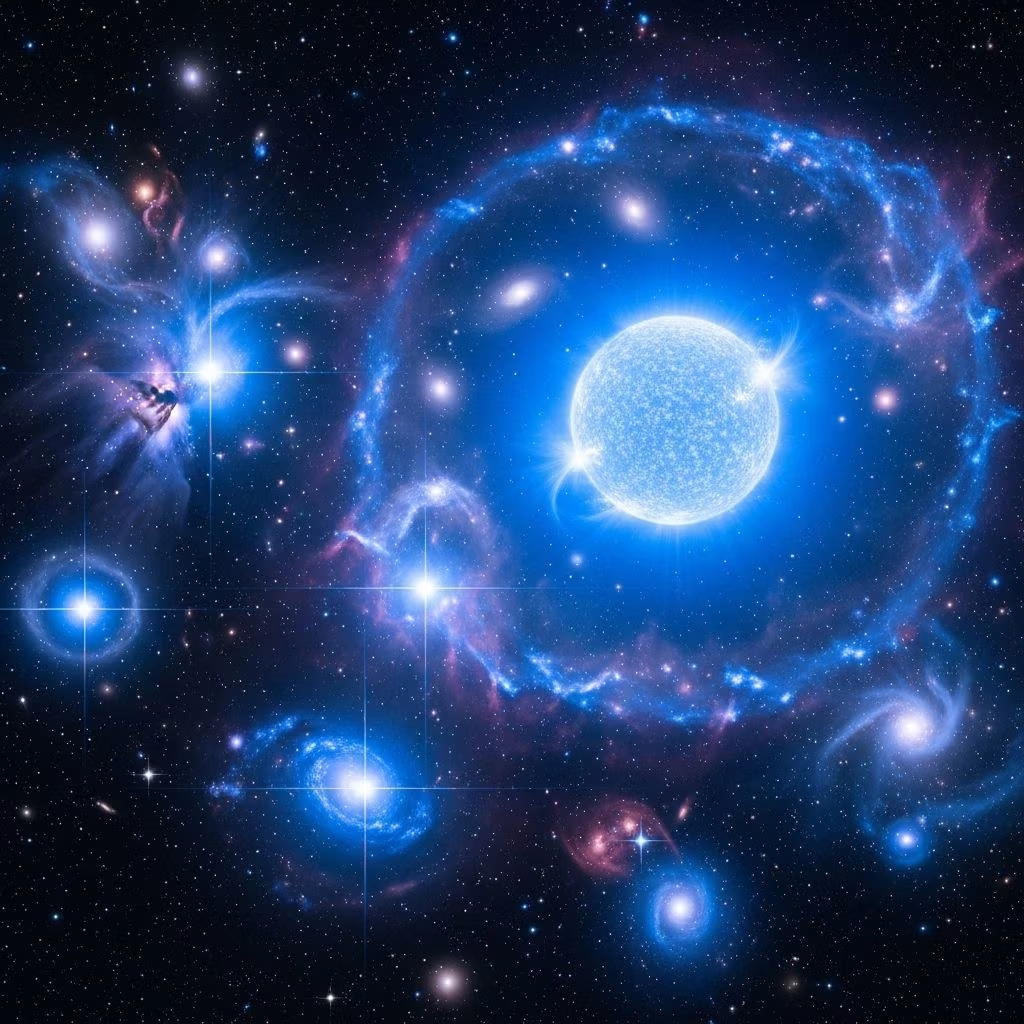
Introduction to Blue Stars
Across the cosmos, blue stars shine as some of the most brilliant, massive, and hottest objects detectable by astronomers. These stellar beacons serve not only as markers of galactic youth but also play a pivotal role in the evolution of galaxies themselves. From spectacular clusters captured by Hubble to the enigmatic formation processes of blue supergiants and the latest discoveries of mysterious blue blobs, blue stars represent both the cutting edge and classic questions of astrophysics.
What are Blue Stars?
Blue stars are defined by their high temperature, intense luminosity, and distinct blue hue, stemming from their surface temperatures which typically range between 10,000 and 50,000 Kelvin. The blue color arises because these stars emit the most light in the blue and ultraviolet wavelengths. Far larger and brighter than our Sun, blue stars have lifespans of just millions—rather than billions—of years, marking them as cosmically young, but also extraordinarily influential.
- Temperature: 10,000–50,000 K
- Mass: Usually 2 to over 40 times the mass of the Sun
- Luminosity: Up to hundreds of thousands times that of the Sun
- Color: Emits blue and ultraviolet light predominantly
- Lifetime: Several million years—much shorter than yellow or red stars
Types of Blue Stars
Not all blue stars are created equal. They span several stellar classes, including:
- O-type stars: The hottest and most massive, often found in young clusters.
- B-type stars: Slightly cooler and less massive than O-types, yet still incredibly luminous.
- Blue supergiants: Among the largest and brightest, representing an advanced phase in stellar evolution.
- Blue stragglers: Stars in older clusters that appear younger and hotter than their neighbors—sometimes due to mergers or mass transfer.
Comparison Table: Blue Star Types
| Type | Typical Mass (Solar Masses) | Temperature (K) | Main Characteristic |
|---|---|---|---|
| O-type | 16–100+ | 30,000–50,000 | Ultra-hot, brightest, earliest life stage |
| B-type | 2.1–16 | 10,000–30,000 | Very bright and blue, slightly longer lifespan |
| Blue Supergiant | 15–40 | 10,000–50,000 | Enormous, evolved, rapid fuel consumption |
| Blue Straggler | Varies | 10,000–20,000 | Anomalous youth in older cluster environments |
How Blue Stars Form
Blue stars originate in massive clouds of interstellar gas and dust, particularly within star-forming regions of galaxies. Their formation requires the collapse of substantial mass into a single protostar, which, under intense pressure and heat, quickly ignites nuclear fusion at a much higher rate than lower-mass stars.
- They are born quickly due to large mass concentrations, allowing for rapid and energetic star formation.
- Due to their high mass, they live short lives—burning through their hydrogen fuel rapidly and evolving through various phases at breakneck speed.
- Massive blue stars are typically found in stellar clusters, as these regions serve as cradles for high-mass star formation.
The Mystery of Blue Supergiant Origins
Among blue stars, blue supergiants are particularly enigmatic. These are stars that are at least 10,000 times brighter, two to five times hotter, and 16 to 40 times more massive than our Sun. Theoretically, this phase should be rare and brief, yet blue supergiants are seen frequently across galaxies.
Recent Research Breakthroughs
New research led by the Instituto de Astrofísica de Canarias (IAC) has revealed that blue supergiants are often the result of stellar mergers in binary systems. When two stars spiral together, they collide and combine, creating a single, more massive star that exhibits the properties of a blue supergiant.
- Unlike most massive stars, blue supergiants are usually found alone, lacking a gravitationally bound companion—suggesting a merged origin.
- Mergers explain why these stars appear in an evolutionary gap where standard models would not predict their existence.
- Simulations show that these merger-born stars match observed surface compositions, such as enhanced nitrogen and helium, better than conventional models.
These findings suggest binary mergers may be the dominant pathway for blue supergiant formation, reshaping our understanding of massive star evolution and even the processes that determine galaxy morphology.
Lifespan and Death: Blue Stars’ Dramatic Fate
Owing to their large masses and rapid fusion rates, blue stars burn out quickly. The end of their lives is marked by cataclysmic events:
- Most will explode as core-collapse supernovae, dispersing elements throughout the galaxy.
- Some leave behind compact remnants: neutron stars or even black holes.
- Blue supergiants’ deaths are particularly significant for enriching the galaxy with heavy elements, seeding future star and planet formation.
Clusters and Cosmic Landmarks
Blue stars tend to cluster together in regions of recent star formation. These clusters, such as those found in Messier 47, serve as dazzling markers in the night sky and as crucial laboratories for astronomers studying stellar evolution and galactic dynamics[11].
- Messier 47 cluster: Features hundreds of hot blue stars sparkling in deep space.
- Hubble observations: Reveal both the beauty and complexity of these clusters, helping astronomers map the structure and history of galaxies.
- Associated Nebulae: Massive nebulae often accompany blue star clusters, illuminated by their radiant light.
Strange Blue Blobs: The New Star System Mystery
A recent breakthrough in astronomy has revealed an unexpected new type of star system: the blue blobs[10]. Discovered using NASA’s Hubble Space Telescope, New Mexico’s Very Large Array, and Chile’s Very Large Telescope, these blue blobs are unlike traditional stars. They appear as compact, faintly glowing patches in space—resembling tiny dwarf galaxies—at distances of up to 300,000 light years from their parent galaxies.
- SECCO 1: The first blue blob system identified, leading to a new area of research.
- The discovery was accidental, arising as researchers searched for other objects, but found these unique blue patches instead.
- Follow-up observations aim to clarify whether these blobs represent star-forming regions ejected from galaxies or a new class of low-mass galaxy.
Blue blobs challenge existing models by blurring the lines between star clusters, galaxies, and intergalactic debris. Their study may shed light on how stars and galaxies interact, evolve, and recycle material across cosmic distances[10].
Blue Stars and Galactic Evolution
The impact of blue stars on the universe extends far beyond their own life cycles:
- Feedback Effects: Their intense radiation and stellar winds disperse gas, both triggering and inhibiting future star formation in their vicinity.
- Galactic Shape: Massive blue stars and supernovae influence the dynamics and chemical composition of galaxies, playing a critical role in shaping their future.
- Element Enrichment: The death throes of blue stars seed the interstellar medium with heavy elements necessary for planet and life formation.
- Cosmic Markers: The presence and distribution of blue star clusters inform us about the age, formation history, and activity in a given galaxy.
Observing Blue Stars: Modern Telescopes and Techniques
Contemporary astronomy relies on an array of powerful telescopes to study blue stars, their clusters, and related phenomena:
- Space Telescopes: NASA’s Hubble Space Telescope provides stunning images and vital data on blue star populations, clusters, and the mysterious blue blobs[10][11].
- Radio Arrays: The Very Large Array (VLA) uncovers energetic signatures and traces star-forming regions associated with massive blue stars.
- Ground-Based Observatories: Chile’s Very Large Telescope and others contribute crucial spectral information, helping determine star compositions, distances, and motions.
- Simulations: Advanced computer models allow researchers to test hypotheses about blue supergiant origins, including merger scenarios, and predict observable properties.
Key Scientific Discoveries
- Binary star mergers likely produce many blue supergiants, demystifying their unexpected abundance and solitary nature.
- Blue blobs may represent a new kind of star system—potentially giving clues about galaxy interactions, tidal debris, and star formation in intergalactic space[10].
- Observations reveal blue stars are pivotal in chemical enrichment and feedback in galactic environments.
Frequently Asked Questions (FAQs)
Q: What makes a star blue?
A: A star appears blue because its surface temperature is extremely high—often 10,000 Kelvin or greater—causing it to emit most of its light in the blue and ultraviolet part of the spectrum.
Q: Why are blue stars so massive and short-lived?
A: Blue stars have much more mass than stars like the Sun, which means their nuclear fusion processes are far more intense. This leads to greater brightness and higher temperature, but also a much shorter lifespan—often only a few million years.
Q: How do blue supergiants form?
A: Blue supergiants are often born from the merger of two stars in a binary system. This process creates a single, massive star with the properties observed in blue supergiants, such as enhanced helium and nitrogen on the surface.
Q: What are blue blobs and why are they important?
A: Blue blobs are compact, faint blue objects found far from any known galaxy, likely representing a new kind of star system or ejected star-forming region. They offer clues to interactions between galaxies and the recycling of matter across cosmic scales[10].
Q: What happens when a blue star dies?
A: Most massive blue stars end in spectacular supernova explosions, leaving behind neutron stars or black holes and dispersing heavy elements that are essential for the generation of new stars, planets, and even life.
Conclusion: The Significance of Blue Stars in the Cosmos
From the radiant clusters illuminating galaxies to the solitary supergiant mysteries and the latest discoveries of blue blobs, blue stars are central in advancing our understanding of the universe. They challenge our models, drive galactic evolution, and keep astronomers searching for answers to ever deeper mysteries. Blue stars are not just luminous objects—they’re cosmic signposts that reveal the dynamic, ongoing story of star formation, life cycles, and cosmic transformation.
References
- https://www.space.com/28032-blue-stars-messier-47-cluster-video.html
- https://www.space.com/blue-supergiant-stars-origin-mystery-solved
- https://newatlas.com/space/blue-blobs-stars-galaxy-belly-flop/
- https://cosmosmagazine.com/space/blue-blobs-star-system/
- https://www.sciencedaily.com/releases/2022/06/220616194716.htm
- https://www.sciencedaily.com/releases/2025/01/250113161124.htm
- https://cosmosmagazine.com/space/missing-a-large-and-unstable-blue-star/
- https://thingsofthestars.com/products/the-pale-blue-dot-poster
- https://www.universetoday.com/articles/blue-stars
- https://www.techtimes.com/articles/276956/20220620/mysterious-blue-blobs-present-new-star-system-data-hubble-vla.htm
- https://science.nasa.gov/missions/hubble/hubble-beholds-brilliant-blue-star-cluster/
- https://www.youtube.com/watch?v=V8-i3so5BmI
- https://www.youtube.com/watch?v=AvRMPTEVngo
- https://fooddrinklife.com/stars-in-space/
- https://4my3boyz.com/in-space-stars-in-the-galaxy-bright-starry-night-blue-cotton-fabric
- https://bssl.space
- https://spacewatchafrica.com/blue-skies-space-announces-new-satellite-to-monitor-how-energy-released-by-stars-can-affect-the-habitability-of-distant-planets/
- https://creators.spotify.com/pod/show/spaceinfo-club/episodes/BLUE-ORIGIN-completes-its-28th-New-Shepard-Flight-e2ro603
- https://en.wikipedia.org/wiki/Blue_supergiant


