Yuri Gagarin: The First Human in Space
On April 12, 1961, Yuri Alekseyevich Gagarin etched his name into history by becoming the first person to journey into outer space. His pioneering mission aboard Vostok 1 propelled humanity into a new era, making Gagarin a worldwide icon and forever changing our understanding of what was possible beyond the confines of our planet.
Early Life and Aspirations
Yuri Gagarin was born on March 9, 1934, in the village of Klushino, near the Russian city of Gziatsk (today renamed Gagarin in his honor). His early years were shaped by the backdrop of World War II, which displaced his family and introduced him to hardship from an early age. Despite these challenges, he excelled academically, particularly in mathematics and physics, and pursued a technical education in metalworking before following his passion for flight by joining a local flying club.
- Education: Attended technical schools and flying clubs, graduating from the Soviet Air Force Academy in 1957.
- Military Service: Served as a fighter pilot, displaying exceptional skill and discipline.
- Background: Raised during difficult times, Gagarin’s resilience and curiosity set him apart even in his youth.
The Path to Becoming a Cosmonaut
In 1960, during the height of the Cold War and the Space Race, the Soviet Union sought to place a human in space before the United States. Gagarin was selected as one of twenty pilots to undergo strenuous training and evaluation as potential cosmonauts.
- Intense Selection Process: Candidates faced medical, psychological, and physical tests even more demanding than those for military pilots.
- Final Six: Gagarin made the final cut, joining the elite group from which the first cosmonaut would be chosen.
- Personal Traits: His modesty, quick thinking, and calm under pressure marked him out as a top contender.
The Vostok 1 Mission: A Leap into the Unknown
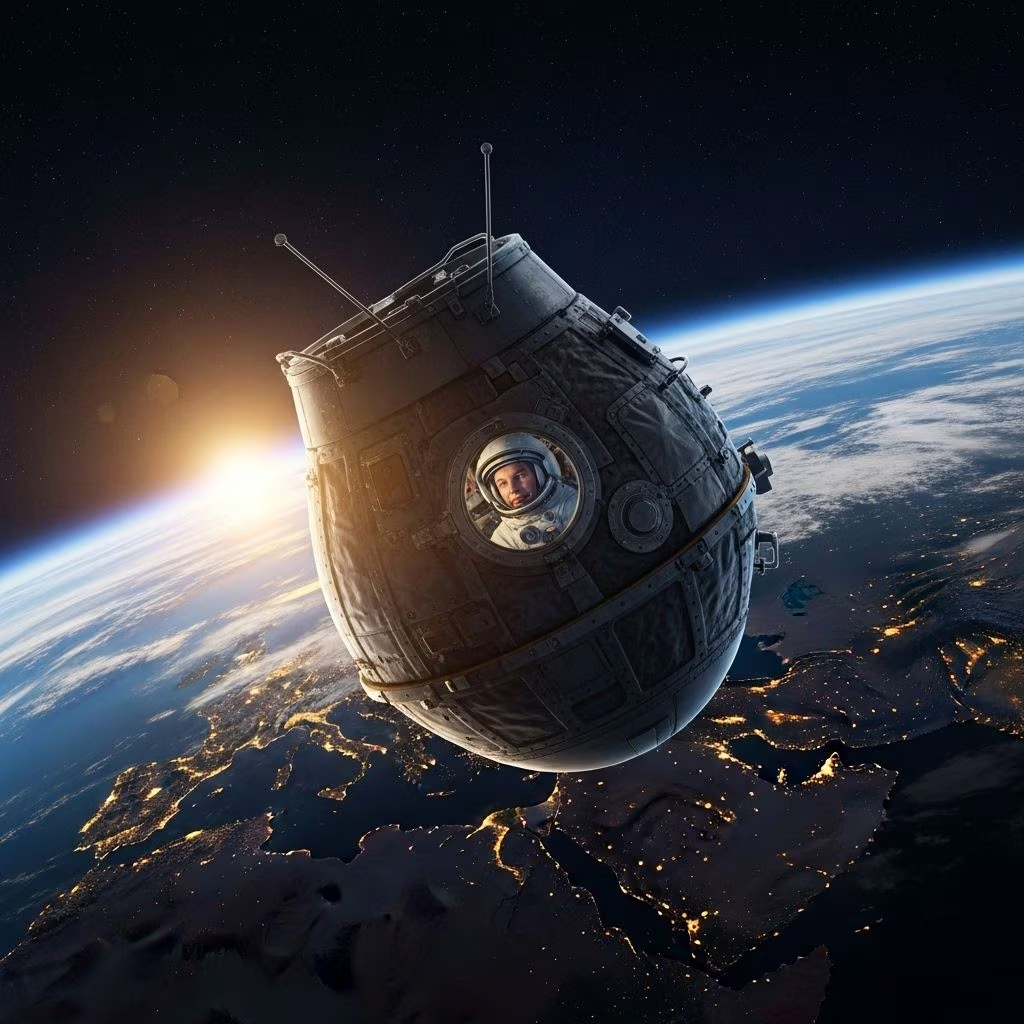
On the morning of April 12, 1961, under the codename KEDR (Siberian pine), Gagarin boarded Vostok 1 at the Baikonur Cosmodrome in Kazakhstan. While the mission would last just 108 minutes, its impact would echo for generations.
Launch and Ascent
- Launch Site: Baikonur Cosmodrome, the heart of the Soviet space program.
- Exact Time: 09:07 Moscow Time.
- Rocket: The Vostok 3KA-2, a modification of the R-7 intercontinental ballistic missile, supplied the thrust needed to break Earth’s gravitational bonds.
Gagarin’s famous radio call at liftoff, “Poyekhali!” (“Let’s go!”), captured the spirit of adventure and uncertainty that characterized the mission.
The Journey in Orbit
- Time in Space: 108 minutes (just under two hours).
- Maximum Altitude: 327 kilometers (203 miles) above Earth at apogee.
- Speed: Reached an orbital velocity of approximately 27,400 km/h (17,025 mph).
- Number of Orbits: One complete circuit of Earth.
- Weightlessness: Gagarin experienced the effects of microgravity for the first time—an unprecedented test of human physiology and psychological endurance.
- Control: The Vostok 1 was operated by an automated guidance system, though Gagarin was provided a sealed envelope containing a code that, if required, would allow him to take manual control in an emergency.
Descent and Landing
- Reentry: After successfully overflying the Soviet Union, retrorockets fired to begin descent.
- Separation: At 7 km altitude, Gagarin ejected from the Vostok capsule and parachuted safely to the ground—a necessity, as the capsule’s design could not ensure a cosmonaut’s survival if he remained inside until landing.
- Landing Site: Near the bank of the Volga River, close to the village of Smelovka in the Saratov region.
Upon landing, local villagers witnessed his descent. At first startled by the sudden appearance of a man in a bright orange suit, they soon welcomed Gagarin, who calmly identified himself as having come from space.
The Vostok Spacecraft: Engineering the Impossible
The Vostok 1 was a marvel of Soviet engineering, designed to carry a single crew member on a fully automated mission.
| Feature | Description |
|---|---|
| Crew Capacity | 1 (Yuri Gagarin) |
| Spacecraft Mass | 4,725 kg (10,417 lbs) |
| Length | 4.4 m (14 ft 5 in) |
| Diameter (Descent Module) | 2.3 m (7.5 ft) |
| Instrumentation | Automated guidance; radio; life support systems |
| Emergency Supplies | 10 days’ food & water |
| Flight Controls | Automated with sealed manual override |
| Landing System | Ejection and parachute descent |
The cabin was cramped and spherical, designed for survivability rather than comfort. Every aspect of the mission was meticulously planned, with contingency systems in place should the primary controls or reentry mechanisms fail.
The World Reacts: Gagarin’s Legacy Begins
Gagarin’s flight was an unqualified triumph for the Soviet Union, immediately making him an international hero and galvanizing world opinion. The mission led to widespread celebrations across the USSR and instant global fame for Gagarin. He later toured dozens of countries as an ambassador for Soviet science and peace.
- Titles and Awards: Gagarin received the highest national distinction, Hero of the Soviet Union, alongside numerous medals and honors from various countries.
- Public Image: His affable demeanor and humility made him a universally beloved figure and symbol of human possibility.
- Political Impact: The flight intensified the ongoing Space Race, prompting increased investment and urgency in the American space program, leading directly to President Kennedy’s call for a manned lunar landing by the decade’s end.
The Space Race: Gagarin and the Global Rivalry
Gagarin’s achievement was not only a scientific milestone but a pivotal moment in the Cold War rivalry between the Soviet Union and the United States.
- Soviet Prestige: The mission underscored the USSR’s technological prowess and led many to reassess the global balance of power.
- American Response: Just 23 days after Gagarin’s flight, Alan Shepard became the first American in space, but his suborbital mission highlighted the Soviets’ lead.
- Legacy Projects: Vostok 1 was a precursor to extensive Soviet and later international space exploration efforts, propelling the world toward the Moon, space stations, and beyond.
Yuri Gagarin After Vostok 1: A Life Changed Forever
After his historic flight, Gagarin never returned to space but played a prominent role in advancing Soviet space missions and training future cosmonauts.
- Leadership: Served as deputy training director of the Cosmonaut Training Centre (later renamed in his honor).
- Political Role: Appointed to both chambers of the Supreme Soviet, he became a figure of national significance beyond science and technology.
- Inspiration: Continually encouraged youth interest in science, engineering, and space exploration.
Tragically, Gagarin’s life was cut short in 1968 when he died in a jet training accident, but his legend endured, cemented not only in the monuments and cities that bear his name but in the unending curiosity of generations that followed.
Scientific and Cultural Impact of Gagarin’s Flight
- Space Medicine: Proved that humans could withstand the conditions of launch, weightlessness, and reentry.
- Public Imagination: Inspired new generations of scientists, explorers, and dreamers.
- Commemoration: April 12, the anniversary of Gagarin’s flight, is now celebrated as Cosmonautics Day in Russia and International Day of Human Space Flight globally.
- Culture and Media: Gagarin’s story has been told in countless books, films, and documentaries, his smiling face a symbol of hope and achievement.
Frequently Asked Questions (FAQs)
Q: How long did Yuri Gagarin’s Vostok 1 flight last?
A: The Vostok 1 mission lasted 108 minutes from launch to landing, during which Yuri Gagarin completed one full orbit of Earth.
Q: What was unique about Vostok 1’s landing system?
A: Because the Vostok capsule could not safely land with a cosmonaut inside, Gagarin ejected at about 7 km altitude and parachuted to the ground separately from the capsule.
Q: Was Gagarin able to control the spacecraft?
A: Vostok 1 was controlled by automated systems. In case of an emergency, Gagarin had access to a code in a sealed envelope that would have let him assume manual control, but this was not needed during the mission.
Q: Why was Yuri Gagarin chosen for the mission?
A: Gagarin was chosen for his outstanding performance during training, combined with his technical skills, composure, and charisma, making him an ideal candidate for the historic flight and its diplomatic aftermath.
Q: What is Gagarin’s legacy in space exploration?
A: Yuri Gagarin’s flight demonstrated that human spaceflight was possible and paved the way for major advances in orbital and lunar exploration. He remains a symbol of human courage and the spirit of discovery.
References
- https://en.wikipedia.org/wiki/Yuri_Gagarin
- https://www.planetary.org/space-missions/vostok-1
- https://www.britannica.com/biography/Yuri-Gagarin
- https://www.nasa.gov/image-article/april-1961-first-human-entered-space/
- https://en.wikipedia.org/wiki/Vostok_1
- https://www.youtube.com/watch?v=KANuFlelQ5k
- https://airandspace.si.edu/explore/stories/gagarin-vs-shepard
- https://www.fai.org/page/icare-history-pioneers
- https://www.youtube.com/watch?v=vkVAqNbX0Nw
- https://nmspacemuseum.org/inductee/yuri-a-gagarin/
- https://www.skyatnightmagazine.com/space-missions/yuri-gagarin-first-human-in-space
- https://spacecenter.org/this-day-in-history-yuri-gagarin-becomes-first-person-in-space/
- https://www.space.com/11351-yuri-gagarin-1st-human-spaceflight-facts-50-years.html
- https://aerospace.org/article/brief-history-space-exploration
- https://cosmo.org/april-12-in-space-history/
- https://www.space.com/11346-photos-yuri-gagarin-vostok1-human-spaceflight.html
- https://www.nmspacemuseum.org/inductee/yuri-a-gagarin/?doing_wp_cron=1706743662.9573359489440917968750
- http://www.spaceopedia.com/space-exploration/human-spaceflight/travellers/yuri-gagarin/
- https://www.susu.ru/en/news/2024/04/09/yuri-gagarin-global-scale-heroic-deed-first-man-space