The November 2025 Full Moon: A Guide to the Year’s Largest Supermoon
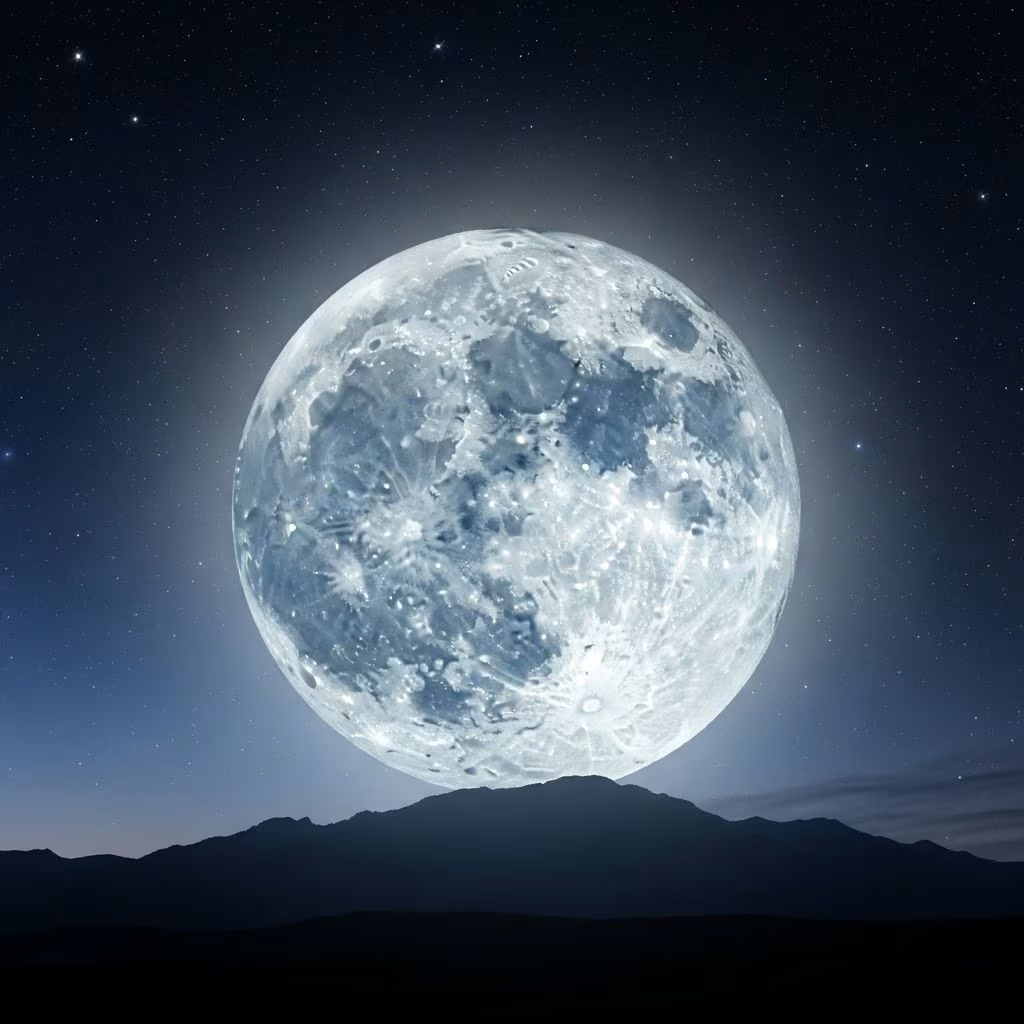
The November 2025 Full Moon is set to be an astronomical spectacle, coinciding with the biggest Supermoon of the year and offering a wealth of celestial events for stargazers. This comprehensive guide covers the exact timing of the Full Moon, its visibility, its placement in the night sky, what makes it a Supermoon, and how it ties into other notable November night sky events.
When is the Full Moon in November 2025?
The Full Moon in November 2025 reaches its peak illumination on November 5 at 13:19 GMT (8:19 a.m. EST). At this exact moment, the Sun, Earth, and Moon align, placing Earth directly between the Sun and the Moon—a positioning known in astronomy as “opposition.” While the exact moment of fullness occurs during daylight for some parts of the world, the Moon will appear nearly full both the night before and after, making it visible and striking throughout that period.
- Full Moon Date and Time: November 5, 2025, 13:19 GMT (8:19 a.m. EST)
To find out exactly when the Moon will rise or set in your location and its phase on any given night, astronomers recommend using online lunar calendars or astronomy apps.
Moon Phases and Calendar for November 2025
The lunar month brings with it a cycle of phases, each marked by distinctive illumination patterns and astronomical significance. In November 2025, the progression of the Moon’s phases is as follows:
- Full Moon: November 5, 2025
- Last Quarter: November 12, 2025
- New Moon: November 20, 2025
- First Quarter: November 28, 2025
There are eight commonly recognized Moon phases:
- New Moon
- Waxing Crescent
- First Quarter
- Waxing Gibbous
- Full Moon
- Waning Gibbous
- Last Quarter
- Waning Crescent
The four major phases—New, First Quarter, Full, and Last Quarter—mark specific, brief moments in the lunar cycle, while the minor phases span several days, with the Moon’s appearance gradually changing each night.
Waxing and Waning in November 2025
- Waxing Moon: November 1–4 and November 21–30 (the Moon’s illuminated portion grows from the New to Full phases)
- Waning Moon: November 6–19 (the illuminated portion diminishes from the Full to New phase)
This waxing and waning progression dictates the best times for different types of stargazing and astronomical observation throughout the month.
Special Note: The New Moon and Meteor Showers
The New Moon falls on November 20, creating ideal dark skies for observing fainter celestial phenomena. Notably, just days before, the Leonid meteor shower is expected to peak, promising up to 20 meteors per hour under moonless skies—an excellent opportunity to observe shooting stars without lunar glare.
The November Full Moon in Aries
While the November Full Moon typically appears in the constellation Taurus, it can also occasionally shine from Aries or, in rare cases, Cetus. In 2025, stargazers will see the Full Moon illuminate Aries. This location in the sky can affect what constellation and celestial features appear near the Full Moon on the night of its peak.
Astrological and Astronomical Context
- Constellation for November 2025 Full Moon: Aries
- Common alternative locations: Taurus (most common), Cetus (rare)
This alignment means the Full Moon will be framed by the stars of Aries, especially prominent during the early evening hours.
November’s Supermoon: Why It’s Special
The November 5 Full Moon isn’t just any Full Moon—it’s a Supermoon, and in 2025, it’s the biggest and brightest Supermoon of the year.
- Appears 7.9% larger and 16% brighter than a typical Full Moon
- Occurs near lunar perigee—the point where the Moon is closest to Earth in its orbit
| Supermoon | Regular Full Moon | |
|---|---|---|
| Distance from Earth | ~357,000 km (perigee) | ~384,000 km (average) |
| Apparent Size | Up to 8% larger | Standard |
| Brightness | Up to 16% brighter | Standard |
To the unaided eye, the difference between a Supermoon and a typical Full Moon is subtle, but it’s a notable treat for dedicated skywatchers and lunar photographers. The enhanced size and brightness make this Full Moon ideal for observation, photography, and lunar study.
Traditional Names for the November Full Moon
Historically, the November Full Moon has been called the Beaver Moon in many cultures, referencing the season when beavers complete their winter preparations and hunters set traps before winter ice freezes streams. In 2025, however, the November Full Moon is also called the Hunter’s Moon, which traditionally follows the Harvest Moon and supports hunting before the onset of winter.
- Beaver Moon: Named for beavers’ dam-building activities in late autumn
- Hunter’s Moon: Traditionally the Full Moon after the Harvest Moon—supports hunting and preparation
These cultural names arise not from astronomical occurrences but from seasonal events in the Northern Hemisphere, highlighting the Moon’s importance to ancient societies’ calendars.
Stargazing Highlights and Nearby Stars
The November 2025 Full Moon in Aries brings with it an array of nearby stars and celestial objects:
- The Pleiades star cluster (also known as the Seven Sisters) will be near the Moon the night after the Full Moon, on November 6—just 0°48′ apart.
- Because of the Moon’s brightness, the Pleiades may be difficult to spot with the naked eye; binoculars or a small telescope are recommended.
- Deep-sky observers can target the Andromeda Galaxy and Pleiades especially during the moonless nights around the New Moon (November 20).
- The Leonid meteor shower peaks on November 17–18, with optimal conditions just before the New Moon.
Moon Visibility Tips
- Check moonrise and moonset times for your precise location with astronomy apps or online lunar calendars.
- Use the moonless window around the New Moon to observe fainter objects.
- Binoculars enhance the clarity of lunar features and distant star clusters like the Pleiades.
Frequently Asked Questions (FAQs)
Q: What makes a Supermoon different from an ordinary Full Moon?
A: A Supermoon occurs when a Full Moon coincides with the Moon’s closest approach to Earth in its orbit (perigee), causing it to appear slightly larger and brighter than average—up to 7.9% larger and 16% brighter in 2025.
Q: When is the best time to view the November Full Moon in 2025?
A: The Full Moon will peak on November 5, but it will appear full to the naked eye on the nights before and after. Check your local moonrise times for the best viewing.
Q: Will the November Full Moon affect stargazing?
A: Yes, the Full Moon’s brightness can obscure faint objects. For deep-sky observations, plan around the New Moon (November 20) or during moonless windows in the month.
Q: What is the significance of the Beaver and Hunter’s Moon names?
A: The names are rooted in North American and European tradition, referencing key seasonal activities such as beaver trapping and hunting as winter approaches.
Q: What meteor shower coincides with the November 2025 New Moon?
A: The Leonid meteor shower peaks on November 17-18, just before the New Moon, offering prime meteor-watching conditions due to darker skies.
Additional Resources and Observing Tools
- Interactive sky maps and astronomy apps for tracking lunar phases
- Online moon calendars to mark key phases and plan observations
- Binocular guides and stargazing handbooks for identifying constellations near the Full Moon
Quick Reference: November 2025 Moon Phases
| Phase | Date & Time (GMT) |
|---|---|
| Full Moon | Nov 5 — 13:19 |
| Last Quarter | Nov 12 — 05:28 |
| New Moon | Nov 20 — 06:47 |
| First Quarter | Nov 28 — 06:59 |
Stargazing Recommendations for November
- Observe the November Full Moon early in the evening for dramatic moonrise photographs and to spot nearby star clusters.
- Take advantage of the New Moon for deep-sky targets like the Andromeda Galaxy and meteor showers.
- Use binoculars or telescopes for an enhanced view of lunar surface features and neighboring constellations.
Looking Forward: The Next Full Moon After November 2025
Once November’s Supermoon passes, lunar enthusiasts can mark their calendars for the December 2025 Full Moon. For detailed timings, stay updated using trusted moon phase calendars and online astronomy resources.
Useful Links and Further Reading
- Lunar phase calendars and observation guides
- Tutorials for photographing the Supermoon
- Deep-dive articles on the origin of Full Moon names
- Tips for viewing and recording meteor showers
References
- https://www.spaceweatherlive.com/en/moon-phases-calendar/2025/11.html
- https://www.calendar-12.com/moon_calendar/2025/november
- https://www.moongiant.com/calendar/november/2025/
- https://starwalk.space/en/news/full-moon-november
- https://theskylive.com/moon-calendar?year=2025&month=11
- https://www.space.com/34662-november-supermoon-full-beaver-moon.html
- https://www.space.com/38454-november-full-moon.html
- https://www.moongiant.com/moonphases/november/2025/
- https://starwalk.space/en/news/full-moon-calendar-2025
- https://griffithobservatory.org/explore/observing-the-sky/whats-in-the-sky/the-moon/2025-phases-of-the-moon/
- https://theskylive.com/moon/2025-11-05
- https://www.astronomy.com/observing/full-moon-calendar-dates-times-types/
- https://www.skyatnightmagazine.com/space-science/supermoon-what-when-next
- https://www.rmg.co.uk/stories/space-astronomy/full-moon-calendar-2025
- https://www.livescience.com/space/the-moon/full-moons-of-2025-names-dates-and-everything-you-need-to-know
- https://lunaf.com/lunar-calendar/2025/11/21/
- https://www.skyatnightmagazine.com/advice/next-full-moon
- https://www.timeanddate.com/moon/phases/@2297536
- https://zariaysheila.pages.dev/jofdycc-november-2025-full-moon-date-photos-evseerq/