


Does the Moon Rotate? Understanding the Lunar Dance
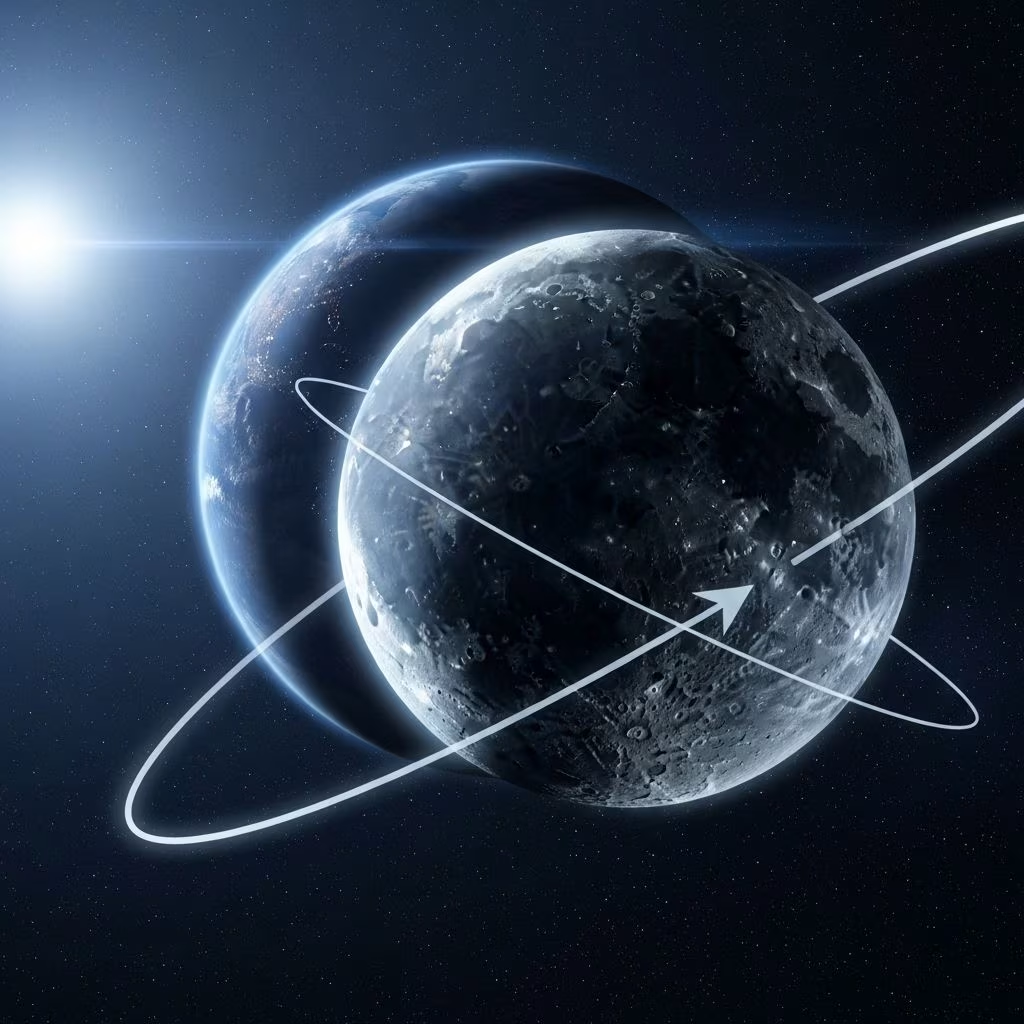
For most sky-watchers, the Moon seems to never spin. No matter where or when you look up, familiar features—like the Sea of Tranquility or Tycho crater—always gaze back from the lunar face. Why does the same side of the Moon face Earth? Does the Moon rotate at all? The answer is both simple and fascinating: yes, the Moon rotates, but in a uniquely synchronized way that shapes what we see on Earth.[11]
The Near Side and Far Side of the Moon
The near side of the Moon is the hemisphere we always see from Earth—etched with broad, dark lava plains called maria, streaked by lighter highlands, and punctuated by craters. The far side—sometimes misnamed the “dark side”—remains hidden from our direct gaze, only glimpsed through spacecraft and satellites.
- The Moon completes one orbit around Earth every 27.322 days, approximately.
- It also rotates once on its axis in nearly the same period, about 27.3 days.
- This phenomenon, known as synchronous rotation or tidal locking, keeps the same lunar face turned toward our planet at all times.[11]
Contrary to popular myth, the far side isn’t always perpetually dark. Lunar day and night cycle across both faces as the Moon orbits Earth. During the new moon phase, the near side is shrouded in darkness, while the far side is illuminated by the Sun.
Synchronous Rotation: The Mechanics of Tidal Locking
Why does the Moon spin exactly as fast as it orbits Earth? The answer lies in a gravitational process called tidal locking. When the Moon formed billions of years ago, it spun more rapidly. Over time, Earth’s gravity exerted frictional tidal forces on the Moon, slowing its rotation until it matched its orbital period. Now, this stable configuration means the Moon’s day (its rotation period) and month (its time to orbit Earth) are nearly identical.[11]
Here’s how it works:
- Rotational Period: The Moon spins once on its axis in about 27.3 days (a true lunar day).
- Orbital Period: It also completes one orbit around Earth in about 27.3 days.
- Result: The same side always faces Earth, much like if you walked in a circle around a campfire, always facing the flames.
The Elliptical Orbit and Lunar Libration
The Moon’s journey isn’t a perfect circle—it travels around Earth in a slightly elliptical orbit. This subtle stretch means the Moon sometimes speeds up or slows down in its orbital path:
- At perigee (closest approach), the Moon’s orbital speed is greatest and its rotation lags slightly, briefly revealing a little more of its eastern limb.
- At apogee (farthest distance), its rotation pulls ahead, and a small amount of the western edge becomes visible.
This effect, called libration, lets keen observers see up to about 59% of the Moon’s surface from Earth over time, rather than exactly 50%.
| Motion | Period (Days) | Description |
|---|---|---|
| Rotation | ~27.3 | Time to complete one spin on its axis |
| Orbit (Sidereal Month) | ~27.3 | Time to complete one full orbit around Earth |
| Synodic Month | ~29.5 | Time from one New Moon to the next, due to Earth-Moon-Sun alignment |
Contrasting Faces: Near Side vs. Far Side of the Moon
Beyond their orientation, the Moon’s two faces look strikingly different. Next time you gaze at the full Moon, remember:
- The near side is marked by large, dark maria—vast plains of solidified lava—mixed with lighter, cratered highlands.
- The far side is older, more heavily cratered, and largely lacks vast maria. It remained hidden from human view until the Space Age.
Apollo 8 astronauts were the first humans to witness the far side of the Moon directly. Today, orbiters and satellites, such as NASA’s Deep Space Climate Observatory, routinely capture views of its remote terrain.
The Brilliance of Earth from the Moon
NASA’s satellites have captured stunning images of the Moon crossing in front of Earth, revealing a surprising fact: Earth shines far brighter in the lunar sky than the Moon appears from our planet. According to Adam Szabo, a NASA scientist, “Our planet is a truly brilliant object in dark space compared to the lunar surface.”
The Moon’s Origin and Rotational History
So, why does the Moon rotate at all? Like many celestial bodies, the Moon’s spin is a leftover from its dramatic birth. The leading theory, called the giant-impact hypothesis, suggests:
- Roughly 4.5 billion years ago, a Mars-sized object (Theia) collided with the young Earth.
- Debris ejected from this impact coalesced, forming the Moon.
- The swirling, spinning material conserved angular momentum, giving the Moon its initial rotation.
Over eons, gravitational interaction with Earth gradually slowed the Moon’s spin until it achieved synchronous rotation—tidally locked forever.
Common Myths and Misunderstandings
It’s easy to misunderstand the Moon’s behavior because of how consistent its appearance is from Earth. Here’s what many get wrong—
- Myth: The Moon doesn’t rotate.
Reality: It rotates once every orbit, keeping the same face, like a figure skater constantly turning to face the audience while skating in a circle. - Myth: The far side is always dark.
Reality: Both faces receive sunlight during different phases of the lunar cycle. - Myth: Synchronous rotation happens instantly.
Reality: It took millions of years of tidal friction for the Moon’s rotation and orbit to align.
How Rotation Relates to Lunar Phases
The phases of the Moon—new, crescent, quarter, full, and the stages in between—result from the change in how much of the lunar surface is sunlit and visible from Earth during its monthly orbit. Even as the same side faces us, different portions of that face are illuminated by the Sun, depending on the Moon’s position relative to the Earth and Sun.
Lunar Libration: Seeing More than 50%
Because of the Moon’s elliptical orbit, variable speed, and slight axial tilt, observers can peek slightly around its edges—a phenomenon called libration. These gentle nods and wobbles come in three forms:
- Libration in longitude — Due to differences in the Moon’s orbital speed around Earth.
- Libration in latitude — Resulting from the tilt of the Moon’s axis, allowing us a view over its north and south poles.
- Diurnal libration — The result of viewing the Moon from different parts of the Earth’s surface at moonrise and moonset.
The combined effect lets us see about 59% of the lunar surface over time.
Table: Quick Summary of Lunar Motions
| Feature | Near Side | Far Side |
|---|---|---|
| Visibility from Earth | Always visible | Never directly visible |
| Main Geological Features | Maria, highlands, moderate cratering | Heavily cratered, few maria |
| Illumination | Cycles from day to night monthly | Same, alternates with near side |
| View by spacecraft | Since antiquity | Since 20th century |
Why the Moon’s Motions Matter on Earth
The Moon’s unique motion doesn’t just affect our view. Its gravitational effect is the driving force behind Earth’s tides. The mutual gravitational dance between Earth and Moon has locked the Moon’s rotation, but also gradually slows Earth’s spin by a fraction of a second each century.
Additionally, studying synchronous rotation helps astronomers understand many other moons and planets: for example, many satellites of other planets are tidally locked to their primaries, always keeping one face toward them—just like our Moon.
Frequently Asked Questions (FAQs)
Q: Does the Moon rotate on its axis?
A: Yes. The Moon rotates on its axis once every 27.3 days, the same time it takes to orbit Earth, creating synchronous rotation.
Q: Why do we always see the same side of the Moon?
A: Because the Moon’s period of rotation matches its orbital period around Earth, so the same hemisphere always faces us—a phenomenon called tidal locking.[11]
Q: Has anyone seen the far side of the Moon?
A: Yes. The far side was first glimpsed by spacecraft in 1959 (Luna 3) and later directly witnessed by Apollo 8 astronauts orbiting the Moon.
Q: Is the far side of the Moon always dark?
A: No. Both the near and far sides experience daylight and darkness as the Moon orbits Earth.
Q: What causes lunar libration?
A: Libration results from the Moon’s slightly tilted axis, elliptical orbit, and our changing vantage point, letting us see a bit around its edges.
Further Reading and Resources
- NASA’s Moon Overview: Extensive resources on lunar science and exploration.
- Lunar Phases and Motions: For more about moon phases and orbits, consult educational sites from space agencies or planetariums.
- Related Topics: Tidal forces, planetary satellites, and celestial mechanics.
Unraveling the Moon’s mysterious motion highlights not only the beauty of celestial mechanics, but also humanity’s ongoing quest to explore and understand the universe—one lunar view at a time.
References
- https://www.space.com/24871-does-the-moon-rotate.html
- https://en.wikipedia.org/wiki/Orbit_of_the_Moon
- https://www.iop.org/explore-physics/moon/phases-and-orbits-moon
- https://science.nasa.gov/moon/moon-phases/
- https://science.nasa.gov/resource/the-moons-rotation/
- https://en.wikipedia.org/wiki/Moon
- https://www.space.fm/astronomy/earthmoonsun/moonrotationorbit.html
- https://www.livescience.com/does-moon-rotate.html
- https://www.britannica.com/video/rotation-Moon/-207328
- https://www.amnh.org/learn-teach/curriculum-collections/young-naturalist-awards/afpectus-lunae-does-the-moon-rotate-on-its-axis
- https://www.worldatlas.com/space/does-the-moon-rotate.html
- https://www.youtube.com/watch?v=KBcxuM-qXec
- https://www.universetoday.com/articles/moon-rotation
- https://www.youtube.com/watch?v=0c-_Uzzqgkk
- https://space-facts.com/the-moon/
- https://www.space.com/19619-top-10-moon-facts.html
- https://www.universetoday.com/articles/does-the-moon-rotate
- https://astro.fmarion.edu/dooley/astronomy-lessons/moon


