The Moons of Uranus: Unlocking the Mysteries of an Icy Giant
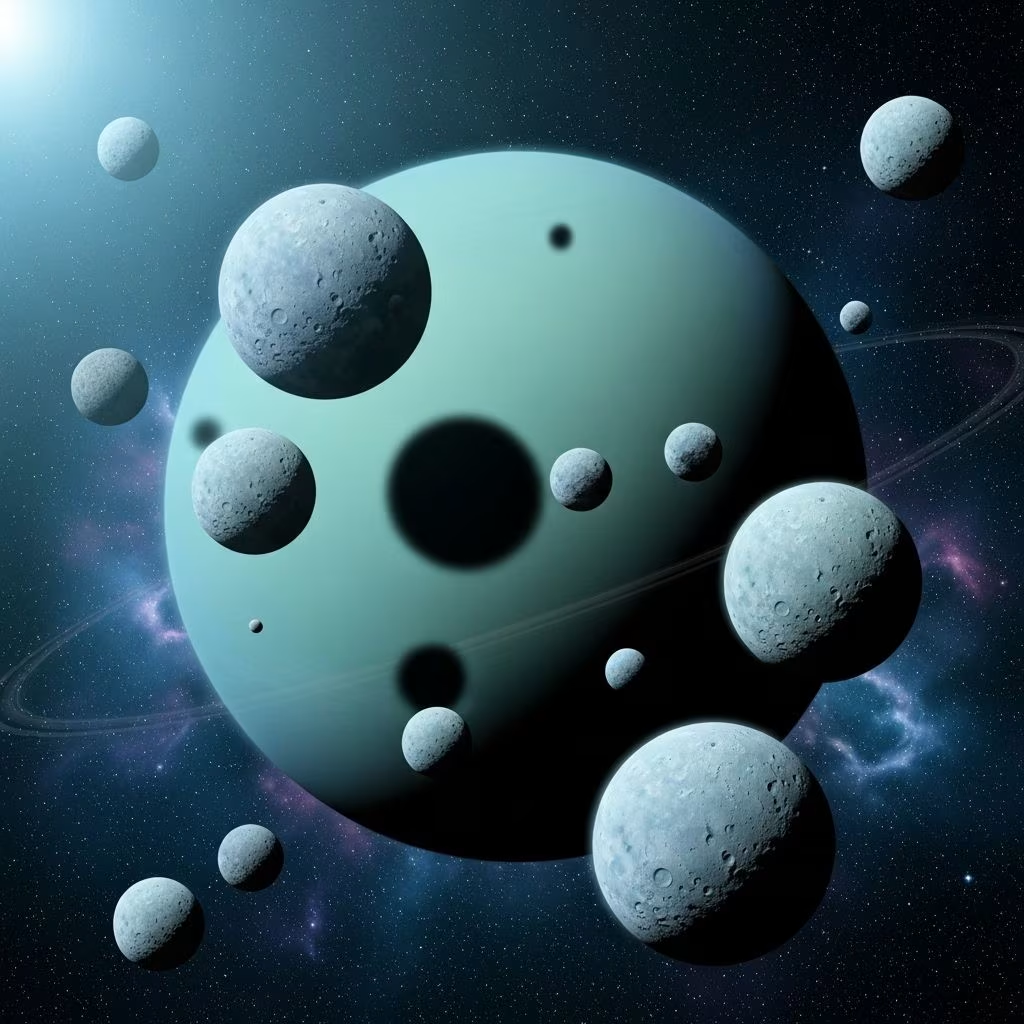
Uranus, the seventh planet from the Sun, is surrounded by a unique collection of natural satellites. Numbering at least 27 known moons, each is named after literary characters, and their physical features, origins, and orbital patterns have fascinated astronomers for centuries. This article explores the discovery, characteristics, groupings, and ongoing scientific intrigue surrounding Uranus’s moons, mirroring the latest findings and historic milestones in planetary science.
Overview: Uranus and Its Moons
Uranus’s moons represent one of the most diverse and enigmatic satellite systems in the solar system. These moons range in size from tiny rocks a few kilometers across, to Titania, which is nearly half the diameter of Earth’s Moon. Their orbits, composition, and even their names offer a window into the history and evolution of the outer solar system.
- The currently recognized moons of Uranus number at least 27.
- They are divided into three main groups: inner moons, major (classical) moons, and irregular moons.
- The five largest moons (Miranda, Ariel, Umbriel, Titania, Oberon) are considered the ‘major moons.’
- Most of Uranus’s moons are named after characters in works by William Shakespeare and Alexander Pope.
Naming the Moons: Shakespeare and Beyond
Uranus’s moons are distinctive among the solar system’s major satellites by their naming convention. Rather than mythological figures, as is common for other planetary satellites, Uranus’s moons draw their names from English literature:
- William Shakespeare: Most moons are named after characters from his plays, including A Midsummer Night’s Dream, The Tempest, and others.
- Alexander Pope: Some are named after characters in his poem The Rape of the Lock.
This tradition, set by 19th-century astronomers, continues as new moons are discovered.
A Brief History of Discovery
The history of Uranus’s moons spans more than two centuries:
- 1787: William Herschel discovers Titania and Oberon, the first Uranian moons to be identified.
- 1851: William Lassell discovers Ariel and Umbriel.
- 1948: Gerard Kuiper discovers Miranda
- 1986: Voyager 2 flyby leads to the discovery of 10 small inner moons.
- Subsequent discoveries come from Earth- and space-based telescopes, including the Hubble Space Telescope.
As observational technology advanced, the faint and distant satellites orbiting Uranus could be identified and studied in greater detail, with discoveries continuing through the early 21st century.
How Many Moons Does Uranus Have?
The exact number of Uranus’s moons varies in recent literature due to reclassification and new discoveries, but the International Astronomical Union recognizes at least 27 named moons. Some sources, based on newly detected candidates, list up to 29 or more, emphasizing the system’s dynamic nature.
Classifying Uranus’s Satellites
The moons of Uranus are grouped based on their size, orbit, and dynamical history:
- Inner Moons (Ring Shepherds): These 13-14 moons orbit close to the Uranian ring system. They’re small, dark, and irregularly shaped, with diameters typically less than 60 kilometers.
- Major (Classical) Moons: The five large moons—Miranda, Ariel, Umbriel, Titania, and Oberon—are the most massive and spherical due to their self-gravity. These dominate the Uranian sky and boast diverse surface features.
- Irregular Moons: There are 9-10 known irregular moons, which have highly tilted, eccentric, and often retrograde orbits. Many appear to be captured objects from the early solar system.
The Uranian Moon System at a Glance
| Name | Year Discovered | Diameter (km) | Notable Features |
|---|---|---|---|
| Titania | 1787 | 1578 | Largest Uranian moon; canyons, rifts, relatively bright |
| Oberon | 1787 | 1523 | Old, dark, cratered; bright impact features |
| Ariel | 1851 | 1157 | Brightest large moon; extensive canyons, signs of resurfacing |
| Umbriel | 1851 | 1172 | Darkest large moon; mysterious bright ring feature |
| Miranda | 1948 | 472 | ‘Frankenstein’ moon: varied, chaotic terrain, huge cliffs |
The Major Moons: Giants of the Uranian Sky
The five major moons of Uranus are its largest and most well-studied:
- Miranda: Famous for its bizarre, patchwork-like surface and the towering cliff Verona Rupes. Signs of tectonic and possibly cryovolcanic activity are evident.
- Ariel: The brightest and possibly youngest of the large moons, with surface features suggesting recent resurfacing by internal processes. Deep valleys and chasms scar its surface.
- Umbriel: The darkest major moon, known for its mysterious bright ring-shaped feature called “the fluorescent Cheerios.” Its surface is dominated by craters.
- Titania: The largest Uranian moon, marked by enormous rift valleys stretching for hundreds of kilometers. Some areas show relatively few craters, hinting at ancient geological activity.
- Oberon: Slightly smaller than Titania, this moon’s old, heavily cratered surface is interrupted by bright impact features and possible traces of frozen water volcanoes.
Scientists believe these major satellites formed either from an accretion disk surrounding Uranus soon after its formation, or perhaps in the aftermath of a giant collision. Their varied geologies provide clues to the history of the outer solar system.
The Inner Moons: Ring Shepherds and Rocky Relics
The inner moons are small, irregularly shaped, and closely nestled within Uranus’s faint ring system. Unlike the major moons, these satellites are difficult to study in detail due to their diminutive size and low reflectivity. Their discovery was largely a result of the Voyager 2 mission in 1986 and advanced ground-based telescopes in later years.
- Key examples: Juliet, Puck, Cordelia, Ophelia, Bianca, Desdemona, Portia, Rosalind, Cressida, Belinda.
- Diameters mostly between 20 to 50 kilometers.
- Likely comprised about 50% water ice and 50% rocky material.
- Several act as shepherd moons—their gravities help sculpt and maintain Uranus’s delicate rings.
The Outer (Irregular) Moons: Captured Wanderers
Perhaps the most mysterious members of Uranus’s moon family are its irregular moons. These typically:
- Orbit far from Uranus—sometimes tens of millions of kilometers away.
- Move on highly inclined, eccentric, and often retrograde (backward) paths, suggesting they were not formed in place, but rather captured from elsewhere—possibly from the Kuiper Belt or asteroid belt.
- Remain largely unseen except in sensitive telescope images, and little is known about their physical nature.
Formation and Evolution
The most widely accepted theory is that Uranus’s regular moons formed from a circumplanetary disk of material—much like a miniature solar system—early in Uranus’s history. The bizarre tilt of Uranus’s axis (nearly 98°) likely influenced the orbits and distribution of these moons. By contrast, the irregular moons are thought to be gravitational captures from the broader solar system.
Evidence for geological activity in the major moons, especially Miranda and Ariel, suggests they once had, or may even still have, subsurface oceans or warmth generated by tidal heating or radioactive decay. Yet, much about their inner structure and history is still unknown.
Surface and Composition: A Gallery of Contrasts
The surface properties of Uranus’s moons show significant variation:
- Albedo (surface reflectivity) varies: Ariel is the brightest, Umbriel the darkest.
- Composed largely of water ice mixed with darker rocky or organic material.
- Some, like Miranda, show enormous faults, cliffs, and mixed terrains, possibly the result of repeated internal melting and freezing cycles.
The composition beyond water ice—such as ammonia, carbon compounds, or silicates—remains an area of ongoing research.
Exploring Uranus’s Moons: Missions and Future Prospects
Most of what is known about these moons comes from a single spacecraft flyby:
- Voyager 2 (1986) provided the first—and so far only—close-up images and data of Uranus and its moons, revolutionizing our understanding of the system.
- Subsequent observations have used the Hubble Space Telescope and advanced ground-based observatories to probe their orbits and surfaces.
- No future missions currently planned, but scientists have proposed dedicated orbiter or flyby missions to further examine Uranus, its moons, and its rings.
Important scientific questions remain, such as the existence of subsurface oceans, the full story of the moons’ geological evolution, and the nature of the smallest, most distant satellites.
FAQs: Frequently Asked Questions about Uranus’s Moons
Q: Why are Uranus’s moons named after literary characters rather than mythological figures?
A: The tradition began with their 19th-century discoverers, wishing to set Uranus’s satellites apart from others. Shakespeare and Pope’s works were chosen as creative sources.
Q: Which is the largest moon of Uranus?
A: Titania is the largest Uranian moon, with a diameter of 1,578 km—about half that of Earth’s Moon.
Q: Do any of Uranus’s moons show signs of life or habitability?
A: No evidence for life has been found. However, Miranda and Ariel show signs of past geological activity, and scientists speculate about possible subsurface oceans in some moons.
Q: What makes Miranda’s surface so unusual?
A: Miranda’s patchwork appearance—grooved terrain, giant faults, and high cliffs—may result from repeated breaking-apart and reassembly or from tidal heating early in its history.
Q: Has any spacecraft orbited Uranus or landed on its moons?
A: Not yet. Voyager 2 conducted a quick flyby, but no probe has orbited Uranus or landed on a moon, making future missions a high priority for planetary scientists.
References and Further Reading
- NASA Science: Uranus Moons Facts
- Wikipedia: Moons of Uranus
- Britannica: Moons of Uranus
References
- https://science.nasa.gov/uranus/moons/facts/
- https://science.nasa.gov/uranus/moons/
- https://en.wikipedia.org/wiki/Moons_of_Uranus
- https://www.britannica.com/place/moons-of-Uranus-2237295
- https://en.wikipedia.org/wiki/Uranus’_natural_satellites
- https://www.skyatnightmagazine.com/space-science/uranus-moons
- https://www.britannica.com/place/Uranus-planet/Moons
- https://www.bobthealien.co.uk/uranus/moons.htm
- https://www.schoolsobservatory.org/learn/space/solar-system/planets/uranus
- https://study.com/academy/lesson/uranus-moons-rings-atmosphere-rotation.html
- https://www.go-astronomy.com/moons-of-uranus.htm
- https://www.bobthealien.co.uk/uranus/moons/index.htm
- https://esahubble.org/images/opo2518/
- https://study.com/academy/lesson/planet-uranus-facts-moons-temperature.html
- https://www.allthingspace.com/moons/a-comprehensive-guide-to-the-moons-of-uranus/
- https://object-cosmos.fandom.com/wiki/Major_Moons_of_Uranus
- https://www.slideshare.net/slideshow/moons-of-uranus/15014885
- http://www.spacetoday.org/SolSys/Uranus/UranusMoons.html
- https://myspacemuseum.com/moons-of-uranus