The Kármán Line: The Controversial Start of Space
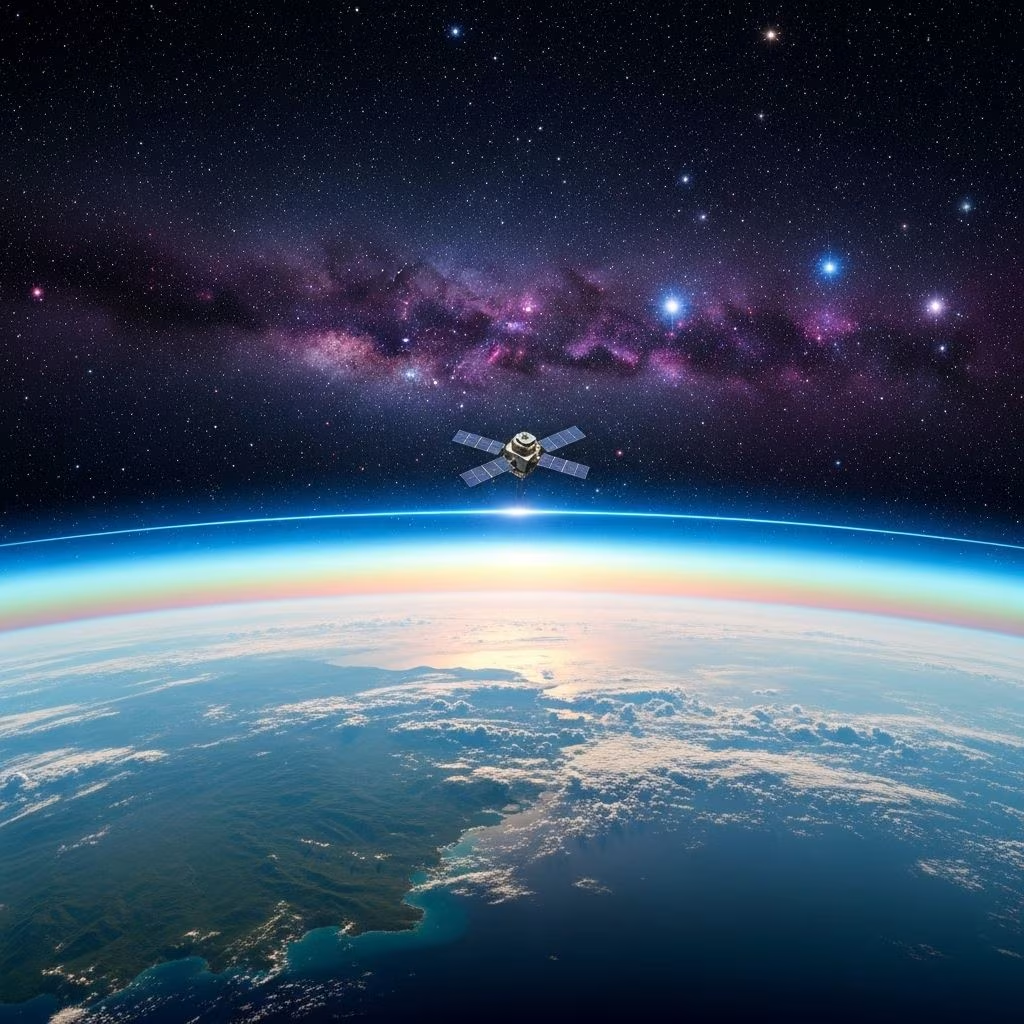
The question “Where does space begin?” has intrigued scientists, lawmakers, and the public for decades. The most widely recognized boundary is the Kármán line, conventionally set at 100 kilometers (62 miles) above Earth’s sea level. Yet, this line is not as clear-cut as it may first seem, with significant debate regarding its physical, legal, and cultural validity.
What Is the Kármán Line?
The Kármán line is the commonly accepted altitude at which Earth’s atmosphere becomes too thin to support conventional aircraft flight. Named after aerospace engineer Theodore von Kármán, this boundary represents the point where the principles of aeronautics give way to those of astronautics. Above this altitude, aerodynamic lift can no longer support flight, making rocket propulsion essential for continued ascent .
- Altitude: Defined at 100 kilometers (62 miles; 330,000 feet) above mean sea level.
- Establishing Body: Endorsed by the Fédération Aéronautique Internationale (FAI), the main international record-keeping body for aeronautics and astronautics.
- Historical Note: Theodore von Kármán calculated the theoretical limit for sustained aeronautical flight to be at approximately 83.8 km (52.1 mi), but the modern line was rounded to 100 km for practical and symbolic reasons .
Why Does the Kármán Line Matter?
Determining the boundary of space has far-reaching implications, affecting everything from aviation records to international law and the regulation of space activities. The line:
- Serves as a legal distinction between airspace (under national jurisdiction) and outer space (considered international territory).
- Defines eligibility for the coveted “astronaut” designation for pilots and travelers who cross it.
- Establishes the minimum altitude for the award of spaceflight-related records and medals.
The Science Behind the Boundary
Unlike a wall or fence, the boundary between Earth’s atmosphere and space is not physically defined. Instead, the transition is gradual—a thinning of gases over hundreds of kilometers. The essential scientific principles behind the Kármán line include:
- Atmospheric Density: At high altitudes, the air becomes too thin to generate enough lift for wings to function effectively.
- Orbital Mechanics: Above this region, satellites can achieve enough speed to maintain orbit for brief periods, although atmospheric drag remains significant below about 150 km.
- Spectrum of Gradual Change: There are no abrupt transitions in gas density or composition at 100 km; instead, it’s a reference point where practical flight ceases and orbital dynamics begin to matter .
Earth’s Atmospheric Layers
The Kármán line lies within the upper reaches of the mesosphere—one of five primary atmospheric layers:
- Troposphere: 0–12 km; weather occurs here.
- Stratosphere: 12–50 km; site of the ozone layer.
- Mesosphere: 50–85 km; where meteors often burn up.
- Thermosphere: 85–600 km; contains the International Space Station (ISS).
- Exosphere: >600 km; transitions into interplanetary space.
Why 100 Kilometers?
Theodore von Kármán proposed that 100 kilometers (approximately 62 miles) is the altitude where the air is so thin that a vehicle would have to travel faster than orbital velocity to produce sufficient lift from its wings to support itself. In other words, the minimum speed for lift equals or exceeds the speed to remain in orbit—making continued flight possible only by becoming a satellite .
This calculation makes 100 km a practical limit grounded in the interplay between aerodynamics and orbital mechanics, but it’s not a universally agreed-upon physical threshold.
Global Perspectives: Is the Kármán Line Universal?
Despite broad acceptance, not all countries or organizations agree on the 100 km definition. Here are some alternate perspectives and variations:
| Organization / Country | Boundary Definition | Notes |
|---|---|---|
| FAI | 100 km (62 mi) | Standard used for world records, majority of astronaut awards. |
| United States | 80.47 km (50 mi) | Used by the U.S. Air Force and NASA for astronaut wings qualifications. |
| Some researchers (e.g., Jonathan McDowell) | 80–90 km range | Argue for a lower boundary based on satellite reentry behavior. |
| Other National Definitions | Varies | Some nations make no official distinction and defer to international conventions. |
The Problems with Precise Definitions
There are strong arguments for and against choosing a single altitude as the start of space. Key points in the debate:
- Atmospheric Continuity: The thinning of the atmosphere is gradual, lacking a clear physical boundary.
- Legality vs. Physical Reality: The 100 km line is more a legal convenience than a reflection of abrupt natural change.
- Satellite Behavior: Some satellites can briefly dip below 100 km before complete orbital decay, suggesting space may begin at a somewhat lower altitude.
- Borderless Expanse: International law lacks a universally binding definition, allowing flexibility by jurisdiction.
Who Gets to be an Astronaut?
The definition of space’s boundary impacts who earns the honored title of “astronaut” or “cosmonaut”. The Fédération Aéronautique Internationale (FAI) and most global space authorities require a crossing of the 100 km Kármán line. However, NASA and the U.S. Air Force grant astronaut wings for anyone who exceeds 50 miles (80.47 km), a milestone reached by X-15 pilots and many commercial spaceflight participants .
This difference has practical effects:
- Virgin Galactic suborbital passengers have crossed 80 km but not always 100 km—qualifying as “astronauts” under U.S. law but not always under international convention.
- Blue Origin’s New Shepard flights routinely surpass both 80 km and 100 km, meeting all current criteria.
The History of the Kármán Line
Theodore von Kármán, a Hungarian-American mathematician and engineer, was pivotal in establishing the theoretical groundwork for modern aeronautics and astronautics. His calculations in the mid-20th century identified the region where atmospheric flight yields to orbital physics.
- 1960s: The FAI officially adopts the 100 km boundary.
- Ongoing Research: Scientific advances, balloon flights, and satellite observations have occasionally challenged the exact value since.
- Modern Discussions: Astrophysicists and atmospheric scientists sometimes propose boundaries as low as 80 km or as high as 120 km.
Why the Controversy Will Likely Continue
The dynamic nature of Earth’s atmosphere and advances in technology mean the position of the Kármán line may never reach complete consensus. As private spaceflight grows and new vehicles reach altitudes previously reserved for government missions, clear definitions gain new legal and commercial significance.
- Space Tourism: Passengers on suborbital flights will increasingly cross these debated boundaries, raising questions about criteria for astronaut status and space law protections.
- International Disputes: Jurisdiction over airspace, space traffic management, and liability for debris or accidents may depend on how “space” is defined.
Quick Facts: Kármán Line at a Glance
- Height: 100 km (62 mi) above sea level
- Named After: Theodore von Kármán
- Legal Standing: Adopted mainly by FAI; not universal in law or treaty
- Contenders: 50 miles (80.47 km) used by NASA and USAF; scientific debate ongoing
- Importance: Defines beginning of ‘space’ for astronaut awards, legal jurisdiction, spaceflight records, and more
Frequently Asked Questions (FAQs)
Q: Is the Kármán line visible or marked in any way?
A: No, there is no physical boundary at the Kármán line—it’s a legal and scientific convention, not an actual barrier in the sky.
Q: Why is there so much debate around where space begins?
A: Both the atmosphere and space form a continuous gradient rather than distinct layers, so any definition of the ‘start of space’ is somewhat arbitrary. Different organizations choose different boundaries to suit scientific or legal needs.
Q: Who supports raising or lowering the Kármán line?
A: Some scientists and agencies (notably U.S. authorities and astrophysicists like Jonathan McDowell) support using a lower boundary, like 80 km or 50 miles, as a more accurate or inclusive measure, particularly for astronaut status and satellite behavior.
Q: Does crossing the Kármán line make you an astronaut?
A: Generally, yes—crossing the Kármán line is accepted internationally as the threshold for astronaut status. However, some organizations award astronaut wings for crossing 80 km (50 miles) instead.
Q: Where is the International Space Station compared to the Kármán line?
A: The ISS orbits much higher, at roughly 400 km (about 250 miles)—well above the 100 km boundary set by the Kármán line.
Conclusion
While the Kármán line at 100 kilometers has become the practical and ceremonial threshold for where space begins, its definition is shaped as much by human needs as by nature’s gradients. The ongoing debate highlights both the complexity of our planet’s upper atmosphere and the changing demands of an era in which more people than ever are reaching for the stars.
References
- https://en.wikipedia.org/wiki/K%C3%A1rm%C3%A1n_line
- https://www.britannica.com/science/Karman-line
- https://www.astronomy.com/space-exploration/the-karman-line-where-does-space-begin/
- https://gbv.wilsoncenter.org/across-karman-faq
- https://www.popsci.com/science/karman-line/
- https://en.wikipedia.org/wiki/Karman_line
- https://www.ebsco.com/research-starters/astronomy-and-astrophysics/karman-line
- https://www.teachflight.com/blog/the-karman-line-the-theoretical-boundary-between-earth-and-space
- http://www.theskyscrapers.org/the-karman-line-defining-the-edge-of-space
- https://www.youtube.com/watch?v=vOYMWR8lUPo
- https://sciencenotes.org/where-does-space-begin/
- https://www.wilsoncenter.org/across-karman-faq
- https://planet4589.org/space/papers/Edge.pdf
- https://www.astronomy.com/wp/https:/the-karman-line-where-does-space-begin/
- https://www.livescience.com/63166-outer-space-border-karman-line.html
- https://alexsli.com/thespacebar/2019/2/4/the-edge-of-space-drawing-the-outer-space-boundary-line