Heliocentrism: A Sun-Centered Revolution in Astronomy
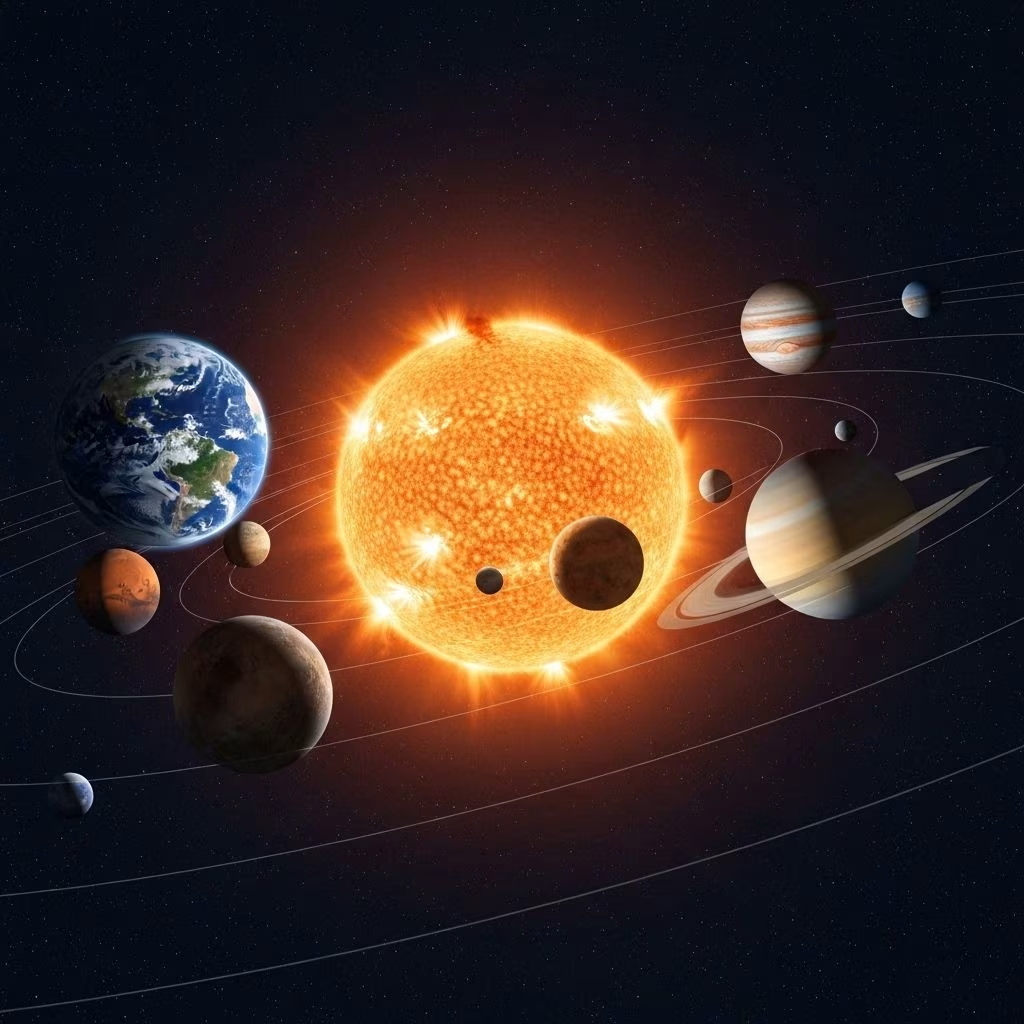
Heliocentrism, also known as the heliocentric model, is the astronomical concept that places the Sun near the center of our solar system, with Earth and the other planets revolving around it. This model replaced geocentrism—the belief that Earth was the fixed center of the universe—and dramatically transformed our understanding of the cosmos, science, and philosophy.
What Is Heliocentrism?
The heliocentric theory posits that the Sun is at (or near) the center of the solar system, with all planets, including Earth, orbiting it. This notion fundamentally shifted scientific thought and laid the groundwork for modern astronomy.
Before heliocentrism, the prevailing model was geocentrism, which argued that all celestial bodies revolved around Earth. This belief was strongly promoted by ancient Greek astronomers like Claudius Ptolemy in the second century AD, resulting in its dominance for nearly 1,400 years.
- Sun at the center: Earth and other planets orbit the Sun.
- Replaces geocentrism: Previously, the Earth was considered the center of all celestial motion.
The Birth of the Heliocentric Model
The roots of heliocentrism extend back to ancient Greece. Philosophers such as Philolaus and Hicetas speculated that Earth was spherical and revolved around a mystical “central fire.” The first known proposal that the Sun was the central object came from Aristarchus of Samos in the 3rd century BC.
- Philolaus & Hicetas (5th century BC): Speculated about central fire and orbital motion.
- Aristarchus of Samos: Proposed the Sun at the center, but his ideas were largely ignored.
- Ptolemaic geocentrism: Gained prominence due to its explanations for star positions.
The Ancient Struggle: Geocentrism vs. Early Heliocentric Thought
Despite early suggestions, heliocentrism failed to gain traction for centuries. Its proponents could not explain why the relative positions of stars remained unchanged as Earth supposedly moved around the Sun—an issue rooted in the limits of observational technology of the time.
Ptolemy’s geocentric system offered a model that better fit observed phenomena, sustaining its dominance until the Renaissance.
The Copernican Revolution: A Paradigm Shift
The turning point for heliocentrism arrived in the 16th century, thanks to the Polish astronomer Nicolaus Copernicus. In 1543, Copernicus published De revolutionibus orbium coelestium (“On the Revolutions of the Heavenly Orbs”), presenting a mathematical model of a heliocentric solar system.
- Nicolaus Copernicus: Founder of the mathematical heliocentric model.
- Copernican Revolution: Marked a dramatic shift in scientific and philosophical thought.
- Thomas Digges (1576): Expanded Copernican views; closer to modern understanding.
| Model | Center | Key Proponents | Main Arguments |
|---|---|---|---|
| Geocentrism | Earth | Ptolemy | Observed movements fit an Earth-centered model |
| Heliocentrism | Sun | Aristarchus, Copernicus, Galileo, Kepler | Planets orbit the Sun; explains planetary motion |
Key Figures and Contributions to Heliocentrism
- Aristarchus of Samos: First to propose the Sun-centered model (3rd century BC).
- Nicolaus Copernicus: Developed the full mathematical model in the 16th century.
- Thomas Digges: Expanded Copernicus’s system, bringing it closer to modern astronomy.
- Johannes Kepler: Introduced elliptical orbits, refining and supporting the heliocentric model.
- Galileo Galilei: Provided observational evidence using telescopes, championed heliocentrism despite fierce opposition.
Galileo and the Battle for Heliocentrism
Italian astronomer Galileo Galilei emerged as one of heliocentrism’s staunchest supporters. Through his telescopic observations—including the discovery of Jupiter’s moons and phases of Venus—Galileo provided concrete evidence against geocentrism.
His advocacy led to significant conflict with the Catholic Church, culminating in a famous trial before the Inquisition in 1633. Galileo was forced to recant his support for the model to avoid severe punishment, but his work left an indelible mark on science.
- Jupiter’s moons: Proved that not everything orbited Earth.
- Phases of Venus: Supported planetary orbits around the Sun.
- Galileo’s trial: Symbolized the clash between emerging science and religious orthodoxy.
Kepler and the Refinement of the Heliocentric Theory
Johannes Kepler, a German astronomer, revolutionized the heliocentric model by introducing elliptical orbits, correcting Copernicus’s earlier claims of circular planetary paths. Kepler’s laws of planetary motion made the heliocentric theory vastly more accurate and predictive.
- Elliptical orbits: Replaced circles, aligning theory with observations.
- Further support: Enhanced credibility and utility of heliocentrism.
- Kepler’s Laws:
- Planets move in ellipses with the Sun at one focus.
- Line joining planet and Sun sweeps out equal areas in equal times.
- Square of a planet’s orbital period is proportional to the cube of its average distance from the Sun.
The Scientific and Philosophical Impact
The acceptance of heliocentrism marked the beginning of the Scientific Revolution. It shifted humanity’s perspective—from believing in an Earth-centered universe to recognizing our planet as one among many orbiting the Sun.
- Transformation of cosmology: Fostered new ways of thinking about the universe.
- Stimulated discoveries: Inspired development in physics, astronomy, mathematics, and philosophy.
- End of anthropocentrism: Humans were no longer thought central to all existence.
Challenges to Heliocentrism
Even after Copernicus, Kepler, and Galileo, heliocentrism faced sustained resistance. The inability to detect stellar parallax (tiny shifts in star positions as Earth moves) fuelled doubts for centuries. Only with improved instruments and understanding did heliocentrism become widely accepted.
- Lack of stellar parallax: Questioned planetary motion; solved later as technology improved.
- Religious concerns: Contradicted scriptural interpretations, leading to heated debates.
The Modern Understanding: Beyond Heliocentrism
Further astronomical research revealed that the Sun is not the center of the universe—only of our solar system. Observations by Friedrich Bessel, William Herschel, and others demonstrated the Sun’s position within the galaxy.
Today, modern astronomy recognizes no universal center, but the heliocentric model remains foundational for understanding the solar system.
- Sun is not the universe center: It’s just one star in the Milky Way.
- No universal center: Modern cosmology has no absolute center point.
Frequently Asked Questions (FAQs) About Heliocentrism
Q: Who proposed the heliocentric model?
A: Aristarchus of Samos first proposed the idea, and Nicolaus Copernicus formulated the mathematical model in the 16th century.
Q: What was the main opposition to heliocentrism?
A: Religious orthodoxy and the inability to detect stellar parallax with early technology; geocentrism was more compatible with observations and doctrine at the time.
Q: How did Galileo support the heliocentric model?
A: Galileo’s telescopic discoveries, including Jupiter’s moons and the phases of Venus, demonstrated phenomena that couldn’t be explained by the geocentric model.
Q: Do scientists still use heliocentrism?
A: The heliocentric model is foundational in astronomy for describing our solar system, but modern cosmology recognizes the Sun as merely one star among billions in the galaxy.
Q: What replaced the geocentric model?
A: The heliocentric model replaced geocentrism as the dominant way of understanding planetary motion in the solar system.
Quick Recap: Key Points of Heliocentrism
- The Sun is at the center of the solar system; planets orbit around it.
- The Copernican Revolution was the turning point toward scientific acceptance of heliocentrism.
- Galileo and Kepler provided critical evidence and refinement.
- Heliocentrism revolutionized science, philosophy, and culture.
Further Exploration: Related Theories and Models
- Ptolemaic System: Geocentric theory based on complex cycles (epicycles).
- Tychonic System: Hybrid model; planets orbit the Sun, which orbits the Earth.
- Modern Astronomy: Expands on heliocentrism to situate the solar system within the galaxy and the universe.
Table: Chronology of Heliocentrism
| Year | Event | Contributor |
|---|---|---|
| 3rd century BC | Sun proposed as center | Aristarchus of Samos |
| 1543 | Mathematical heliocentrism | Nicolaus Copernicus |
| 1576 | Modified Copernican system | Thomas Digges |
| Early 1600s | Elliptical orbits | Johannes Kepler |
| 1633 | Galileo’s trial | Galileo Galilei |
Legacy of Heliocentrism
Heliocentrism is much more than a scientific model; it is a cornerstone of intellectual history. Its triumph over geocentrism paved the way for modern physics, celestial mechanics, and a broader scientific approach that continues to shape our quest for knowledge about the universe.
Sources and Further Reading
- Encyclopaedia Britannica: Heliocentrism
- Wikipedia: Heliocentrism, Copernican heliocentrism
- The Week: 52 ideas that changed the world—Heliocentrism
References
- https://en.wikipedia.org/wiki/Heliocentrism
- https://www.space.com/heliosphere-shape-remains-mystery-without-scientific-probe
- https://en.wikipedia.org/wiki/Copernican_heliocentrism
- https://www.britannica.com/science/heliocentrism
- https://theweek.com/52-ideas-that-changed-the-world/104487/what-is-heliocentrism
- https://study.com/learn/lesson/heliocentric-theory-model.html
- https://www.space.com
- https://gregorylessinggarrett.substack.com/p/just-a-spoonful-of-gravity-helps
- https://www.skyatnightmagazine.com/space-science/geocentrism-heliocentrism
- https://www.ebsco.com/research-starters/history/heliocentrism
- https://landsurvival.com/schools-wikipedia/wp/h/Heliocentrism.htm
- https://dc.cod.edu/cgi/viewcontent.cgi?article=1648&context=essai
- https://futurism.com/from-geocentrism-to-heliocentrism
- https://plato.stanford.edu/entries/copernicus/
- https://earthobservatory.nasa.gov/features/OrbitsHistory
- https://courses.ems.psu.edu/astro801/content/l2_p4.html
- https://intellectualmathematics.com/blog/heliocentrism-in-antiquity/
- https://truerestoration.org/pastoralia-episode-15-heliocentrism-geocentrism-and-flat-earth/