The Green Flash: Earth’s Rare Spectacle Explained
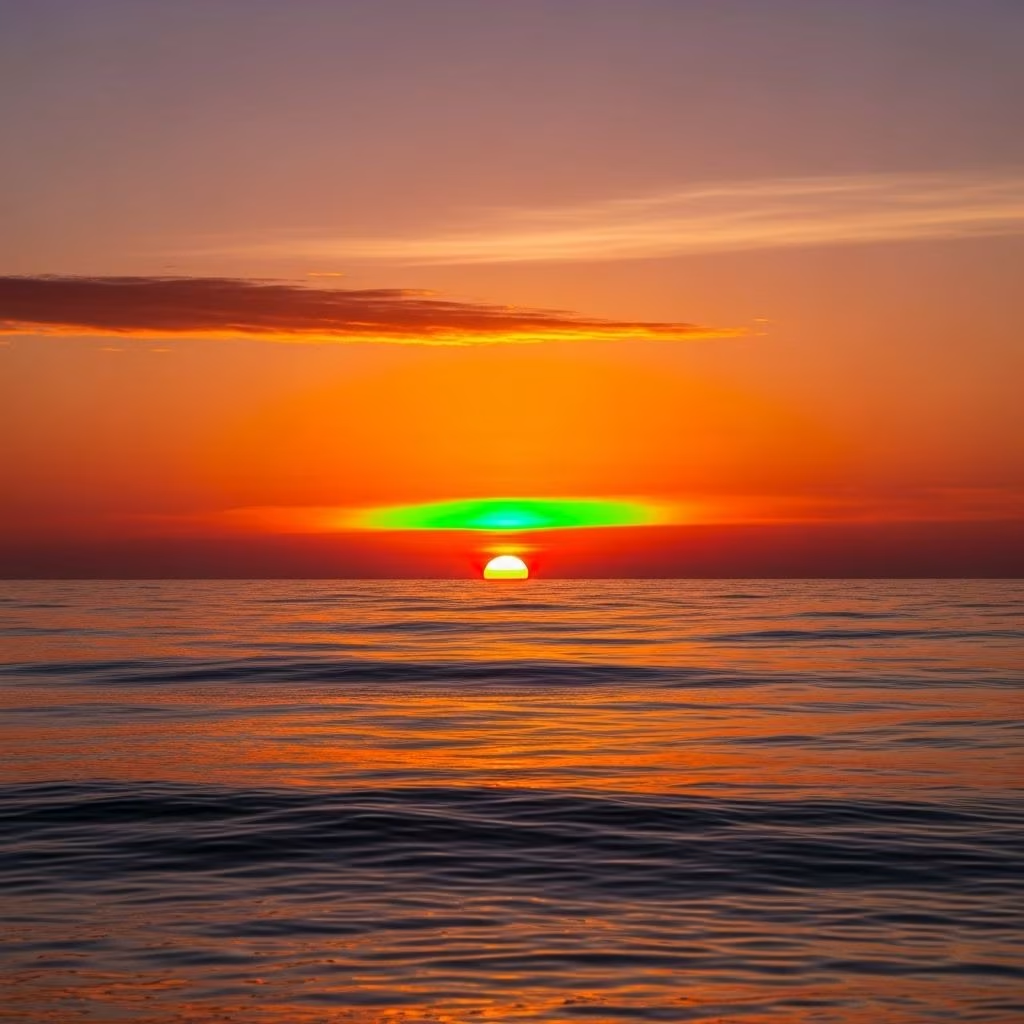
Among the atmospheric phenomena that enchant skywatchers, few are as alluring or elusive as the green flash. This rare event occurs at Earth’s horizons—sunrise or sunset—briefly coloring the top of the Sun’s disk a vivid green. Despite inspiring myths and scientific curiosity for centuries, the green flash remains a phenomenon that most people have only heard about or glimpsed on rare occasions. This article explores the science, observing tips, and cultural stories that define the green flash, while offering practical advice for those hoping to catch Earth’s fleeting burst of emerald light.
What Is the Green Flash?
The green flash is a meteorological and optical phenomenon most commonly observed at the moment of sunset or sunrise, when a distinct green spot or ray appears very briefly above the Sun’s upper rim as it sinks or rises past the horizon. The flash typically lasts less than two seconds, though under perfect conditions the display may persist for a bit longer.
If you’re lucky enough to witness it, the green flash appears when the atmosphere refracts sunlight, separating it into different colors akin to the effect produced by a prism.
Understanding the Science: Why Does the Sun Turn Green?
The Sun’s light is a blend of multiple colors, but when it approaches the horizon, our atmosphere acts as a massive prism. As sunlight passes through more dense air near the horizon, shorter wavelengths—such as blue and green—are bent more than longer wavelengths like red and orange.
- Refraction: Atmospheric refraction is stronger near the horizon, separating white sunlight into its component colors. Blue light is refracted most, followed by green, then red and orange.
- Scattering: At sunset or sunrise, air molecules and particles scatter blue light away, making green the next most visible hue.
- Mirages: Atmospheric layering and mirages can enhance this effect, occasionally magnifying the green appearance.
- Duration: The resulting green flash typically lasts for a fraction of a second up to a few seconds, depending on atmospheric stability and viewing conditions.
Where and When Can You See the Green Flash?
The green flash is best seen where the horizon is unobstructed and the air is clear and stable. Common locations include coastal areas with ocean views, mountain tops, and even from airplanes. Its rarity is attributed not only to atmospheric conditions but to the need for a clear sightline, free of terrain, trees, or pollution:
- Open seascapes or large lakes with unobstructed views westward or eastward
- Mountaintops above atmospheric haze
- Cloud tops, where airline pilots report seeing the green flash regularly while flying westward at sunset
Although more common at sunset, flashes have also been observed at sunrise. Extreme latitudes, such as near the equator, yield briefer flashes, as the Sun sets more quickly.
Varieties of the Green Flash
Not all green flashes are the same; several distinct types occur, influenced by atmospheric refraction, mirages, and other conditions:
- Inferior-mirage green flash: Occurs when the air near the surface is warmer than the air above, producing a mirage that magnifies and distorts the green edge.
- Mock-mirage green flash: Created by higher-altitude mirages, resulting in a flash above the real Sun image.
- Sub-duct green flash: Appears as a green ray shooting vertically, often under extreme atmospheric layering—an effect most commonly seen from ships, mountaintops, or on exceptionally clear days.
- Simple green rim: On most clear-day sunsets, slight magnification reveals a green rim atop the Sun, though this rarely develops into the full flash or ray effect.
Atmospheric Conditions: What Makes the Flash Possible?
Seeing the green flash depends on several atmospheric variables:
- Clean, dry air: Less haze and pollution allow more sunlight to reach the observer, increasing the chance for a visible flash.
- Stable temperature layers: Layering in the atmosphere enhances mirages, stretching and magnifying the separation between colors.
- Low solar angle: The effect is maximized when the Sun is close to the horizon, traveling through a longer path of dense atmosphere.
These conditions explain why the green flash is more likely to be seen at certain locations and during particular weather: think pristine ocean air after a cold front or atop high mountains.
Beyond the Sun: Green Flashes from the Moon and Planets
Although most widely associated with the Sun, the green flash phenomenon can sometimes be spotted with other bright celestial bodies at the horizon:
- Moon: A green flash may occur at moonrise or moonset if conditions are ideal.
- Bright planets: Venus and Jupiter, when aligned with the horizon, can also produce flashes due to atmospheric refraction.
These events are even rarer, requiring extraordinarily clean air, precise timing, and a sharp eye.
Green Flash Frequency: How Common Is It?
Many amateur astronomers and frequent travelers report seeing the green flash several times, particularly under favorable circumstances. However, less experienced observers or those situated inland often go a lifetime without seeing it, either due to lack of opportunity or awareness.
Observing Tips: How to Maximize Your Chances
- Choose your site carefully: Seek unobstructed horizons—beaches and oceanfronts are ideal.
- Monitor local weather: Wait for clear, stable air following cold fronts or during dry spells.
- Aim for the right time: Arrive before sunset or sunrise. Watch as the upper limb of the Sun approaches the horizon.
- Use safe optical aids: Binoculars or small telescopes can help, but never look directly at the Sun, particularly before it touches the horizon. Instead, filter or indirect viewing is advised.
- Record your observation: Quick cameras or video setups can capture the phenomenon if you miss it with the eye.
Patience and repeated attempts dramatically increase your odds of witnessing the flash. Remember that fleeting moments are easy to miss, so focused attention is key.
Legends, Myths, and Cultural Interpretations
The green flash has inspired an abundance of legends and folk tales. Some maritime cultures believed that those who see the green flash will never be deceived in matters of love, while others claim that the green flash signals impending changes in weather or luck.
- Literary references abound in adventure and romance novels, notably in Jules Verne’s “Le Rayon Vert.”
- Despite its mystique, science has demystified its origin, tracing the cause to familiar atmospheric physics.
Frequently Asked Questions (FAQs)
Q: Is the green flash really green and visible to the naked eye?
A: Yes, the color is truly green, but it only becomes visible under perfect atmospheric and environmental conditions, and usually for less than two seconds.
Q: Can I see the green flash anywhere?
A: While it can theoretically occur anywhere the horizon is visible, the best chances are at sea level over water or from high altitudes with clear air.
Q: Is the green flash linked only to the Sun?
A: No, though most common at the Sun’s horizon, the flash has occasionally been seen with the Moon and bright planets like Venus or Jupiter.
Q: Does pollution make the green flash harder to see?
A: Yes; particles in the atmosphere scatter green and blue light, making flashes less likely near urban or polluted regions.
Q: Are there risks to observing the green flash?
A: Only if you stare at the Sun while it is still fully above the horizon. Wait until the solar disk is nearly set, and never use optical aids without proper sun filters.
Table: Comparing Flash Types
| Type of Flash | Description | Typical Viewing Conditions |
|---|---|---|
| Inferior-mirage | Green coloration augmented by warm air mirages | Over hot surfaces, often at sea-level horizons |
| Mock-mirage | Green flash above Sun’s image, due to cold surface mirages | Cold weather, ocean or mountain view |
| Sub-duct flash | Vertical green ray, mirage-stretched | Mountains, ships, extreme atmospheric layering |
| Simple green rim | Thin green rim visible atop Sun without flash | Clear sunsets worldwide, especially with magnification |
Final Thoughts: Why the Green Flash Matters
Despite its brevity, the green flash is a reminder of the interplay between sunlight and our atmosphere, translating the mathematics of refraction and scattering into a dazzling natural spectacle. It invites us to look up, observe carefully, and appreciate the complexity and beauty present in what often seems like an ordinary sunset or sunrise. Whether you’re a scientist or a casual beachgoer, the green flash stands as proof that even our familiar world holds rare moments of wonder.
References
- https://en.wikipedia.org/wiki/Green_flash
- https://www.space.com/green-flash-earth-sunrise-sunset
- https://skybrary.aero/articles/green-flash
- https://www.youtube.com/watch?v=f7M-grhtU5Y
- https://ggweather.com/flash/
- https://physicsworld.com/a/the-green-flash/
- https://aty.sdsu.edu/explain/explain.html
- https://www.skyatnightmagazine.com/advice/skills/green-flash-venus-what-is-how-see
- https://www.farmersalmanac.com/what-green-flash
- https://skyandtelescope.org/observing/quest-for-the-green-flash/
- http://hyperphysics.phy-astr.gsu.edu/hbase/atmos/redsun.html
- https://skyandtelescope.org/observing/celestial-objects-to-watch/catch-the-green-flash/
- https://aty.sdsu.edu/observing/advice.html
- https://www.mtwilson.edu/old/vir/parkinglot/greenflash/index.html
- https://www.youtube.com/watch?v=axOmIu71pTo
- https://helio.astro.bas.bg/2024/03/10/the-green-flash-phenomenon/
- https://helio.astro.bas.bg/node/4
- https://www.livescience.com/planet-earth/why-is-there-sometimes-a-green-flash-at-sunset-and-sunrise