


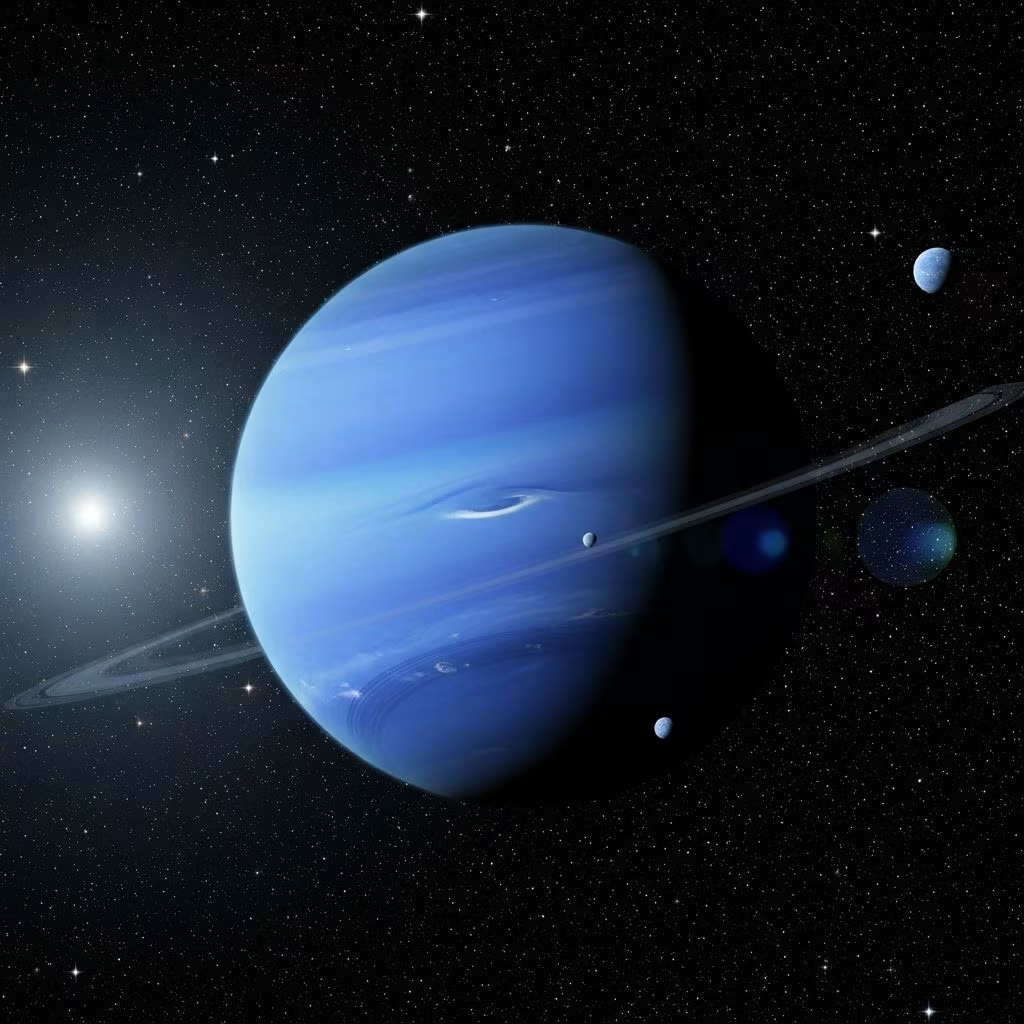
Neptune: The Other Blue Planet in Our Solar System
Neptune, the solar system’s eighth and most distant planet, remains one of astronomy’s greatest wonders—a frigid, blue world characterized by dynamic winds, storms, rings, and moons. More than 30 times farther from the Sun than Earth, Neptune fascinates scientists for its intense atmospheric phenomena, unique discovery story, and striking blue hue caused by methane. Let’s explore the history, structure, appearance, and mysteries of this icy giant.
Quick Neptune Facts
- Orbit Distance: 4.5 billion km (2.8 billion mi) from the Sun
- Diameter: Nearly 49,244 km (30,598 mi)
- Year Length: 165 Earth years
- Day Length: Roughly 16 Earth hours
- Moons: 14, including Triton
- Rings: At least five distinct rings
- Surface Gravity: Similar to Earth (1.14 g)
Discovery: Finding Neptune Through Mathematics
The journey to identifying Neptune sets it apart from other planets. Unlike those discovered through direct observation, Neptune was predicted using mathematical analysis. In the early 19th century, astronomers noticed Uranus’s orbit didn’t match predictions. French mathematician Urbain Le Verrier calculated that another planet’s gravity was disturbing Uranus, and sent his predictions to Johann Galle in Berlin, who confirmed Neptune’s position on September 23, 1846 . This remains the only case of a planet discovered through mathematical calculation rather than telescopic observation.
Historical Highlights
- Galileo observed Neptune in 1612 and 1613, but didn’t recognize it as a planet.
- The name “Neptune” was chosen for the Roman god of the sea, echoing its blue color—though the vibrant blue was only confirmed after the Voyager 2 mission in 1989.
- Seventeen days after discovery, Triton, Neptune’s largest moon, was identified.
Formation and Structure of an Ice Giant
Neptune formed approximately 4.5 billion years ago when gravity pulled together clouds of gas and dust. Along with Uranus, it’s classified as an ice giant, meaning its composition includes heavier “ices” like water, ammonia, and methane, rather than the predominantly hydrogen and helium cores of gas giants like Jupiter and Saturn .
Internal Composition
- A hot, dense fluid—mostly water, ammonia, and methane—forms the bulk, surrounding a rocky core roughly Earth’s mass.
- No solid surface exists; instead, gaseous layers gradually blend into superheated, pressurized liquids deep within.
- Scientists theorize about an ocean of superhot water beneath the outer atmosphere, trapped by high pressure so it does not boil away.
| Neptune | Uranus |
|---|---|
| Deeper blue color | Paler blue-green, hazy appearance |
| Higher wind speeds | Less extreme weather |
| Similar ice giant composition | Similar ice giant composition |
The Source of Neptune’s Blue Color
Neptune’s striking blue color is primarily due to methane in its upper atmosphere. Methane absorbs red wavelengths of sunlight, while blue light gets reflected back into space. This process, known as Rayleigh scattering, is responsible for the blue tint of both Neptune and Uranus, though Neptune appears brighter and more vivid .
- Recent studies reveal that processed Voyager 2 images exaggerated Neptune’s blue hues for clarity. In reality, Neptune and Uranus have similar colors, but Neptune’s active atmosphere and thinner haze layer make it appear more vibrant to observers.
- Earth is often called a blue planet because oceans reflect the sky’s blue color—not because of methane, but due to atmospheric scattering of sunlight.
- Scientists suspect other unknown chemicals may also contribute to Neptune’s blue color, but methane remains the main factor.
Neptune’s Atmosphere and Extreme Weather
Neptune’s atmosphere demonstrates some of the most dynamic weather in the solar system despite its great distance from the Sun and low energy input. The planet’s atmospheric layers consist mostly of hydrogen, helium, and methane, with swirling clouds and quick-moving storms manifesting across its sphere .
Wind and Storms
- Neptune holds the record for fastest planetary winds—up to 1,200 mph (2,000 kph), nine times faster than those on Earth.
- Storm systems, such as the Great Dark Spot observed by Voyager 2 in 1989, were large enough to encompass the Earth. This storm has since dispersed, but similar storms have repeatedly emerged at other locations on Neptune.
- These storms demonstrate extreme atmospheric activity: methane clouds, white frozen methane crystals, and pressure zones moving at phenomenal speeds.
Despite being cold and remote, Neptune’s atmospheric system is vibrant, with cloud features forming, disappearing, and occasionally yielding enormous vortices in both hemispheres.
Neptune’s Ring System
Although faint, Neptune possesses a system of rings—discovered in detail by Voyager 2. The planet’s five primary rings are composed mainly of dust, ice, and rock. Named after astronomers who contributed to Neptune’s study, these include:
- Galle
- Le Verrier
- Lassell
- Arago
- Adams
Neptune’s rings differ from Saturn’s iconic, highly visible rings, but their structure and composition have sparked continuing research into planetary ring formation and evolution. The Adams ring is especially notable for its distinct, bright arcs—strings of concentrated material instead of continuous bands .
Moons: Triton and Neptune’s Companions
Neptune is orbited by at least 14 moons, but the most remarkable by far is Triton, discovered only days after Neptune itself. Triton is unique in several respects:
- It is the only major moon in the solar system with retrograde orbit (moving opposite to Neptune’s rotation).
- Geological evidence suggests that Triton formed elsewhere in the solar system and was captured by Neptune’s gravity.
- Triton’s surface is icy and exhibits geysers that spew nitrogen gas, indicating a dynamic and potentially active geology.
- Its orbit is shrinking; in about 3.6 billion years, Triton may be torn apart, forming new rings around Neptune.
| Neptune Moons (Selected) | Key Features |
|---|---|
| Triton | Retrograde orbit, active surface, geysers, ice volcanoes |
| Nereid | Highly eccentric orbit |
| Proteus | Irregular, largest after Triton |
Voyager 2 Mission: Unveiling Neptune’s Secrets
Prior to 1989, Neptune was little more than a distant blue dot for Earthbound observers. NASA’s Voyager 2 spacecraft transformed our understanding by conducting the first—and so far only—flyby of Neptune:
- Date: August 1989
- Captured detailed images of Neptune’s atmosphere, rings, and moons, including the Great Dark Spot and Triton’s surface.
- Revealed five new moons and confirmed the presence of Neptune’s ring system.
- Observed dynamic cloud features and measured wind speeds at record-breaking velocities.
Voyager 2’s journey marked the culmination of a twelve-year Grand Tour of the outer solar system, having previously visited Jupiter, Saturn, and Uranus. Its data on Neptune remain the foundation for much of what astronomers know about the planet today .
How Neptune Compares to Other Blue Planets
Neptune shares its blue coloring with Uranus (another ice giant), as well as with Earth, though for differing reasons. Methane dictates Neptune’s vivid blue, while Earth’s color results from sunlight scattering in the atmosphere above its oceans. Despite both containing methane, Uranus is noticeably paler, which scientists attribute to thick atmospheric haze and less intense weather activity—Neptune’s thinner haze allows its blue to shine through more distinctly. Ongoing research is searching for additional chemicals that could intensify Neptune’s hue .
Frequently Asked Questions (FAQs)
Q: Why is Neptune blue?
A: Neptune’s atmosphere contains methane, which absorbs red light and reflects blue, giving the planet its vibrant hue .
Q: How was Neptune discovered?
A: Mathematician Urbain Le Verrier predicted its position after noticing disturbances in Uranus’s orbit. Johann Galle confirmed Neptune’s existence by telescope in 1846 .
Q: Does Neptune have rings?
A: Yes, Neptune has at least five distinct, faint rings, consisting mostly of dust and icy particles—discovered by Voyager 2 in 1989 .
Q: What are Neptune’s strongest winds?
A: Neptune’s winds can reach up to 1,200 miles per hour (2,000 kilometers per hour), the fastest sustained winds in the solar system .
Q: How does Triton differ from other moons?
A: Triton is unique for its retrograde orbit (opposite to Neptune’s spin). It’s geologically active and its shrinking orbit suggests it will eventually break apart to form new rings around Neptune .
Final Thoughts: Neptune’s Place in the Solar System
Despite its remote location and icy demeanor, Neptune is a planetary marvel—demonstrating extremes in weather, atmospheric chemistry, and moon dynamics. Ongoing studies using space telescopes and data from Voyager 2 continue to unravel the mysteries of the solar system’s windiest, bluest, and most enigmatic world. As technology advances, future missions may finally visit Neptune up close and illuminate its hidden depths for generations to come.
References
- https://science.nasa.gov/neptune/neptune-facts/
- https://www.nasa.gov/stem-content/neptune-the-blue-planet/
- https://airandspace.si.edu/explore/stories/neptune
- https://www.skyatnightmagazine.com/space-science/why-neptune-blue
- https://en.wikipedia.org/wiki/Neptune
- https://spacecenter.org/meet-our-solar-system-neptune/
- https://www.funkidslive.com/learn/top-10-facts/top-10-facts-about-neptune/
- https://www.worldatlas.com/space/why-is-neptune-blue.html
- https://dirleton.solar/neptune
- https://earthhow.com/planet-neptune-facts/
- https://www.zmescience.com/feature-post/space-astronomy/solar-system/planets/why-is-neptune-blue-00432/
- https://space-facts.com/neptune/
- https://byjus.com/physics/neptune/
- https://www.planetary.org/worlds/neptune
- https://blog.podiumpro.in/blue-planet-neptune/
- https://www.astrotourism.com/celestial-objects/neptune-curiosities-blue-planet/
- https://www.worldatlas.com/articles/10-fun-facts-about-neptune.html
- https://www.youtube.com/watch?v=gS5IO-MtCOM
- https://starwalk.space/en/news/planet-neptune-explore-the-farthest-planet-from-the-sun


