NASA’s Artemis Base Camp: The Blueprint for Living on the Moon
NASA’s Artemis program is not just about returning humans to the lunar surface—it’s about paving the way for continuous human presence on the Moon. With the Artemis Base Camp (ABC) concept and a vision for multiple lunar outposts, NASA is laying the groundwork for humanity’s next great frontier in space exploration.
The Artemis Program: A New Era in Lunar Exploration
The Artemis program, named after Apollo’s twin sister in Greek mythology, embodies NASA’s renewed commitment to lunar exploration. Its objectives go far beyond short-term missions; they include scientific research, resource discovery, and technological demonstration critical for future Mars missions.
- Artemis I: An uncrewed test flight that orbited and flew beyond the Moon, completed in late 2022.
- Artemis II: Will be the first crewed flight since Apollo, sending astronauts further into space than ever before.
- Artemis III: Planned as the first crewed Moon landing since 1972, aiming to land the first woman and the first person of color on the lunar south pole.
- Artemis IV–V: Will expand infrastructure with the Gateway lunar space station and additional crewed landings, advancing both lunar and deep-space exploration potential.
Beyond these initial steps, NASA’s ambitions are clear: establish a habitable lunar base and use the Moon as a staging ground for Mars and beyond.
Why a Lunar Base? The Case for Sustained Moon Presence
NASA’s approach reflects key lessons learned from decades of spaceflight, especially from continuous human habitation of the International Space Station (ISS). The Moon, with its proximity to Earth and scientific promise, provides a unique opportunity to:
- Perform extended studies in planetary geology and resources.
- Test life support, energy, and surface operations crucial for Mars missions.
- Harvest and utilize local resources, such as water ice, that can support human activities and generate fuel.
- Serve as a proving ground for autonomous robotic operations and construction techniques.
- Gather data critical to understanding the effects of long-term low-gravity environments on biology and technology.
Artemis Base Camp: Core Features and Purpose
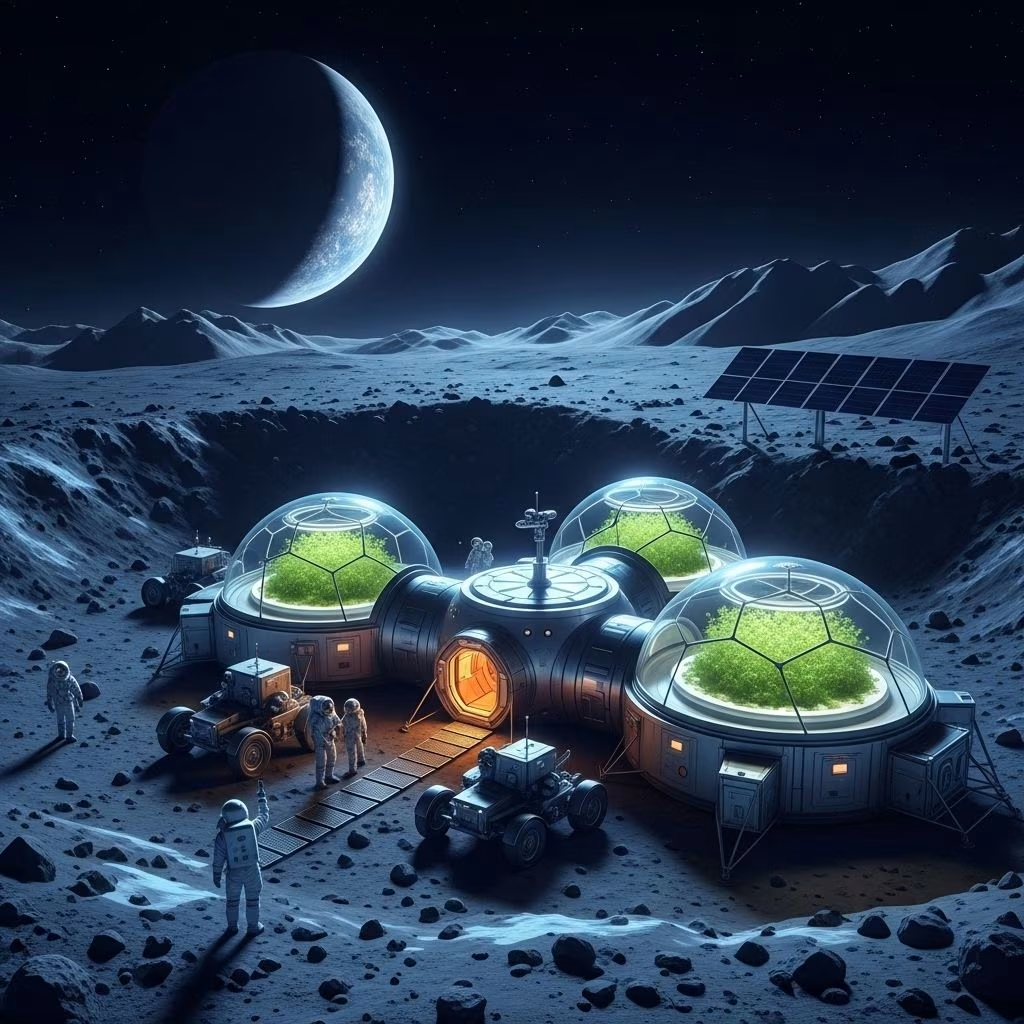
At the center of NASA’s lunar vision is Artemis Base Camp, a permanent, accessible outpost designed to enable Earth-independent living on the Moon. It will be strategically sited near the lunar south pole, where permanently shadowed craters harbor water ice—an invaluable resource for sustaining crews and generating rocket propellant.
Major elements of Artemis Base Camp include:
- Foundation Surface Habitat (FSH): A robust, long-duration habitat supporting crews for up to two months at a time.
- Habitat Infrastructure: Airlocks, power systems (primarily nuclear fission reactors), communications arrays, and waste recycling facilities.
- Pressurized and Unpressurized Rovers: Enabling deeper exploration and logistics over significant distances from the base.
- Power Generation: Nuclear reactors and solar arrays, coupled with advanced energy storage solutions.
- Cargo Landers and Logistics Modules: Providing re-supply, equipment, and redundancy for long-term occupancy.
Table: Artemis Base Camp Core Infrastructure
| Component | Function | Key Technologies |
|---|---|---|
| Foundation Surface Habitat | Living, research, and life support for crew | Advanced shielding, environmental controls, modular expandability |
| Rovers (Pressurized & Unpressurized) | Surface mobility and extended exploration | Radiation-hardened, long-duration energy systems, teleoperation |
| Power Units | Sustain habitat and operations | Nuclear fission reactors, high-efficiency solar arrays |
| Cargo and Logistics Landers | Supply delivery and redundancy | Reusable lunar landers, autonomous landing/navigation |
Living on the Moon: What Artemis Base Camp Will Enable
With Artemis Base Camp, NASA intends to create an environment where four astronauts can live and work for up to two months per mission cycle. The site is designed to:
- Provide a safe haven from radiation, temperature extremes, and micrometeorite impacts.
- Allow crews to explore the lunar environment systematically, including traverses to permanently shadowed regions.
- Facilitate scientific research in geology, geophysics, resource mapping, and astrobiology.
- Function as a launching pad for robotic missions to even more distant lunar locales.
Key operational activities will include assembling infrastructure, using in-situ resources (especially water ice), and conducting real-time science with laboratories on-site.
Multiple Moon Bases: Expanding the Artemis Vision
The long-term vision extends beyond a singular base. NASA is exploring the possibility of multiple outposts across the lunar surface to maximize scientific returns and build resilience in lunar exploration:
- Additional bases may be established at other sites rich in different resources, or that present unique scientific opportunities.
- Networked outposts would allow incremental construction, technology trials, and safe havens for exploration teams.
- International partners and commercial entities (driven by NASA’s open architecture approach) could contribute additional facilities or modules.
- Shared standards and interoperability will be crucial, ensuring that different national and private bases can function collectively.
The Role of Lunar Resources: Water, Power, and Autonomy
A critical driver for a permanent lunar footprint is utilization of local resources. The Moon’s south pole hosts deposits of water ice within shadowed craters, which can be mined and processed into drinking water, breathable oxygen, and hydrogen rocket fuel.
- Resource extraction reduces reliance on costly resupply missions from Earth.
- Processing water ice will demonstrate key technologies for Mars resource utilization (ISRU).
- Nuclear and solar energy systems will enable continuous operations, even during the two-week lunar night.
- Robotics and artificial intelligence are expected to support mining, construction, and daily maintenance with minimal human oversight.
International Collaboration and Commercial Partnerships
The Artemis program is designed as an open, collaborative architecture, echoing the global cooperation that made the International Space Station a reality. International and private collaboration will play several vital roles:
- Contributions of scientific instruments, crew modules, landers, and logistics by space agencies and companies.
- Setting universal interoperability standards so independent lunar assets work together seamlessly.
- Pooling resources and expertise to reduce costs and accelerate the construction of lunar infrastructure.
- Creating precedents for governance, resource-sharing, and peaceful co-existence on the Moon.
The Artemis Accords, already signed by more than two dozen nations, establish principles for safe, transparent, and responsible lunar activity.
From the Moon to Mars: Artemis as the Springboard for Humanity’s Next Steps
While the Moon is the immediate objective, Artemis is NASA’s crucial testbed for deep-space technologies and mission architectures that will ultimately send humans to Mars. Key lessons from Artemis Base Camp operations will inform:
- Long-term life support and surface operations needed for months-long Mars expeditions.
- Efficient use of local resources for air, water, construction, and propulsion.
- Remote autonomy and robotics for complex construction and science with less direct control from Earth.
- Resilient design strategies to handle harsh environments and operational uncertainty.
Success at Artemis Base Camp would validate crucial survival, science, and construction technologies required for planting the first human footprint on Martian soil.
Frequently Asked Questions (FAQs)
Q: Why is Artemis Base Camp located near the Moon’s south pole?
A: The lunar south pole region has areas in permanent shadow that are known to contain water ice—a critical resource for life support and fuel manufacturing, making it the most practical location for a sustainable, long-term lunar base.
Q: What is the Foundation Surface Habitat (FSH)?
A: The FSH is the main living and working structure at Artemis Base Camp designed to keep astronaus healthy and productive for missions of up to two months, equipped with advanced life support, shielding, and research capabilities.
Q: How will Artemis Base Camp get its power?
A: Main power sources will include advanced nuclear fission reactors for round-the-clock energy and high-efficiency solar arrays, ensuring constant support for habitat, science, and industrial operations—regardless of the lunar day-night cycle.
Q: Can Artemis Base Camp support more than four astronauts?
A: The initial plan centers on rotations of four astronauts for up to two months at a time, but the infrastructure is designed for modular growth so it can eventually support larger crews and even more complex missions.
Q: What comes after Artemis Base Camp on the Moon?
A: After the successful operation of Artemis Base Camp, NASA envisions deploying additional outposts, extending surface infrastructure, and using the Moon as a launchpad for crewed Mars missions and broader solar system exploration.
Conclusion: Artemis Base Camp—A New Dawn for Human Space Exploration
NASA’s Artemis Base Camp marks a decisive transition from short lunar visits to a vision of humanity as a truly spacefaring species. With proven technologies, global partnerships, and a clear strategy for living and working beyond Earth, Artemis stands as the herald of a new chapter in space—one that will return us to the Moon, sustain our presence, and inspire the next leap to Mars and beyond.
References
- https://en.wikipedia.org/wiki/Artemis_program
- https://www.nasa.gov/humans-in-space/artemis/
- https://www.funkystuff.org/artemis-base-camp/
- https://www.nasa.gov/wp-content/uploads/2020/12/artemis_plan-20200921.pdf
- https://futurism.com/the-byte/nasa-detailed-plan-2024-moon-base-camp
- https://www.kqed.org/science/1970873/nasas-artemis-missions-to-set-up-base-camp-on-the-moon
- https://www.cnet.com/science/space/nasa-completes-historic-trip-around-the-moon-whats-next-for-artemis/
- https://www.sciencelearn.org.nz/images/4939-artemis-base-camp
- https://www.americaspace.com/2024/01/13/living-on-the-moon-inside-artemis-foundation-habitat/
- https://www.rmg.co.uk/stories/space-astronomy/nasa-moon-mission-artemis-program-launch-date
- https://en.wikipedia.org/wiki/Artemis_3
- https://www.space.com/nasa-artemis-base-camp-more-moon-bases
- https://www.space.com/nasa-plans-artemis-moon-base-beyond-2024.html
- https://www.herox.com/blog/960-what-is-the-artemis-base-camp-and-how-does-this-ch
- https://www.youtube.com/watch?v=rU_LiVJp3xg
- https://www.youtube.com/watch?v=WoZTGfrMPqA
- https://www.studyiq.com/articles/nasa-artemis-mission/
- https://www.satnow.com/community/nasa-s-artemis-space-mission