Perseus Constellation: Facts, Location, and Myth
The Perseus constellation stands out in the northern sky, both for its prominent stars and its legendary ties to Greek mythology. Catalogued by the ancient astronomer Ptolemy and recognized today by the International Astronomical Union (IAU), Perseus is a celestial treasure for astronomers, mythology enthusiasts, and stargazers alike.
A Brief Overview
- Designation: Perseus (Abbreviation: Per)
- Size: 24th largest, covering 615 square degrees
- Location: Northern Hemisphere (between +90° and -35° latitude)
- Family: Perseus (includes Andromeda, Auriga, Cassiopeia, Cepheus, Cetus, Lacerta, Pegasus, Triangulum)
- Neighboring Constellations: Andromeda, Aries, Auriga, Camelopardalis, Cassiopeia, Taurus, Triangulum
Celestial Coordinates and Visibility
Coordinates: 03h 00m 00s, +45° 00′ 00″
Best viewing period: Fall and winter nights in the Northern Hemisphere
Mythological Origins
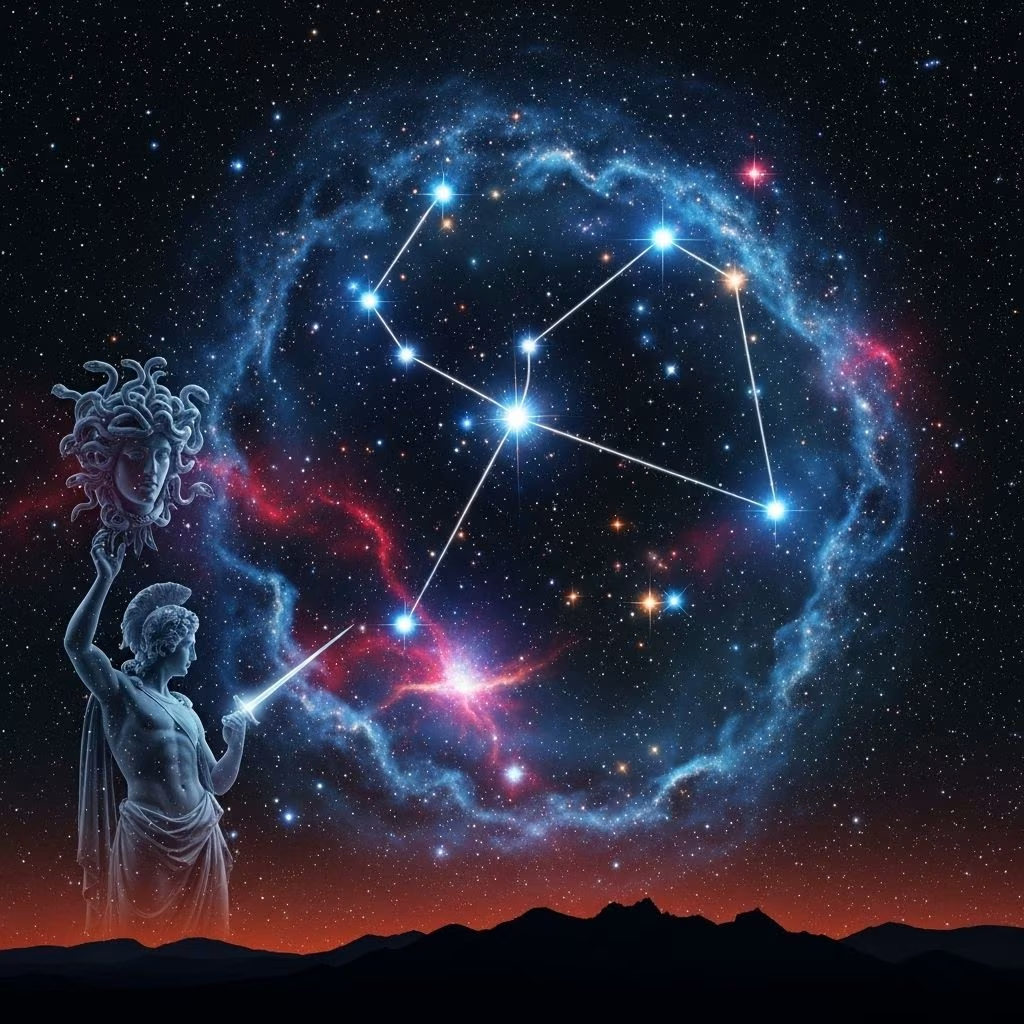
Perseus owes its name to the Greek hero Perseus, famed for slaying Medusa and rescuing Andromeda. The constellation sits among a cluster of stars and constellations directly related to this legend, including Andromeda, Cassiopeia, and the monstrous Cetus. Several 19th-century star atlases even depicted Perseus holding Medusa’s severed head, represented by an asterism Perseus et Caput Medusae.
Where is Perseus Located?
| Bordering Constellation | Direction |
|---|---|
| Andromeda | West |
| Cassiopeia | North |
| Camelopardalis | North |
| Auriga | East |
| Taurus | South |
| Aries | South |
| Triangulum | West |
The galactic plane passes through Perseus, making it rich in astronomical phenomena and deep-sky objects.
Main Stars in Perseus
Perseus houses several bright and notable stars, many with official names designated by the IAU. The brightest is Alpha Persei (Mirfak), while Beta Persei (Algol) is notorious among stargazers for its striking variability.
- Mirfak (Alpha Persei): Magnitude 1.79, a yellow-white supergiant, centerpiece of the Alpha Persei Cluster.
- Algol (Beta Persei): An eclipsing binary, also called the Demon Star, associated with ancient legends due to its changing brightness.
- Menkib (Xi Persei): Blue supergiant, part of the Alpha Persei Cluster.
- Other named stars: Atik, Berehinya, Dajiangjunbei, Miram, Muspelheim, Misam, each adding to Perseus’ celestial intrigue.
Astronomical Curiosities
- X Persei: Notable binary system containing a neutron star.
- GK Persei: Famous nova event in 1901, rising briefly to magnitude 0.2.
- Alpha Persei Cluster: A collection of young, hot stars spanning Mirfak and its neighbors.
Star Map and Appearance
Perseus appears as a winding chain of stars, arcing near the Milky Way, viewable on clear northern nights. Star maps often portray Perseus grasping Medusa’s head, with striking linear arrangements pointing towards neighboring constellations. The cluster-like nature of its central region makes it especially vivid under dark skies.
Deep Sky Objects in Perseus
Perseus is a treasure trove for deep-sky explorers, featuring open clusters, nebulae, and galaxies.
- Messier 34 (M34): Open cluster (NGC 1039), about 1,400 light-years away, containing dozens of stars visible through binoculars.
- Messier 76 (M76): Also called the Little Dumbbell Nebula (NGC 650 & NGC 651), a planetary nebula located about 2,500 light-years from Earth.
- Double Cluster: Two open clusters (NGC 869 & NGC 884) close together, known since antiquity and a favorite sight for stargazers.
- California Nebula (NGC 1499): A faint emission nebula stretching across the constellation, best photographed long-exposure.
- Perseus Cluster (Abell 426): A massive galaxy cluster about 250 million light-years from Earth, home to hundreds of galaxies and a focus of modern astronomical research.
The Perseid Meteor Shower
No other feature of Perseus is as celebrated among amateur astronomers as the Perseid Meteor Shower. Every summer, Earth passes through the debris trail left by the comet Swift-Tuttle, with meteors streaking across the sky at speeds of roughly 133,200 mph (214,400 km/h).
- Timing: Annually, July to August (peak mid-August)
- Radiant point: Within Perseus
- Origin: Debris from comet Swift-Tuttle
- Observation: One of the brightest and most reliable showers, visible to the naked eye in dark conditions
The Perseids have been recorded for over 2,000 years, gracing the night sky every summer and attracting observers worldwide.
How to Find Perseus
Spotting Perseus is relatively easy with a basic knowledge of the northern sky:
- First, locate Cassiopeia’s “W” asterism; Perseus appears just below it.
- Andromeda lies to the west, with Triangulum on its border.
- In autumn and early winter, look northward and search for a line of stars curving near the Milky Way—Mirfak marks Perseus’ heart.
- If using a star chart or mobile app, look for the arc spanning from Mirfak to Algol.
Cultural and Historical Significance
Perseus has been revered for centuries. Its inclusion in Ptolemy’s catalog reflects its importance in ancient times, while its mythological associations with heroism, monsters, and cosmic adventure have fueled artistic interpretations. Chinese astronomers recognized the Double Cluster, demonstrating the constellation’s global appreciation.
Quick Facts Table: Perseus Constellation
| Feature | Details |
|---|---|
| Brightest Star | Mirfak (Alpha Persei), Mag. 1.79 |
| Famous Variable Star | Algol (Beta Persei) |
| Meteor Showers | Perseids, September Perseids |
| Messier Objects | M34 (Open Cluster), M76 (Nebula) |
| Largest Deep-Sky Feature | Perseus Cluster (Abell 426) |
| Neighboring Constellations | Andromeda, Cassiopeia, Aries, Auriga, Camelopardalis, Taurus, Triangulum |
| IAU Abbreviation | Per |
| Star Names Approved by IAU | Algol, Atik, Berehinya, Dajiangjunbei, Menkib, Miram, Mirfak, Misam, Muspelheim |
Frequently Asked Questions (FAQs)
Q: What is the best time to see the Perseus constellation?
A: The best viewing period for Perseus is during autumn and winter in the Northern Hemisphere, particularly from November through February when it is high above the horizon during early evenings.
Q: What are the brightest stars in Perseus?
A: Mirfak (Alpha Persei) is the brightest star in the constellation, while Algol (Beta Persei) is best known for its striking variability.
Q: How is Algol, the Demon Star, unique?
A: Algol is an eclipsing binary star system whose brightness noticeably dims and brightens to observers, inspiring centuries of legends associating it with omens and the head of Medusa.
Q: What is the Perseid meteor shower, and why is it famous?
A: Originating from debris of comet Swift-Tuttle, the Perseid meteor shower radiates from Perseus each August and is among the year’s brightest and most consistent meteor displays worldwide.
Q: Which deep sky objects can be seen in Perseus with amateur equipment?
A: The Double Cluster, Messier 34 (open cluster), the California Nebula (best for astrophotography), and M76 (Little Dumbbell Nebula) are all discoverable with binoculars or modest telescopes under dark skies.
Final Words: A Heroic Beacon in the Sky
From its mythic tales to its astronomical wonders, Perseus continues to captivate observers and researchers. Whether you’re tracing the arc of its brightest stars, marveling at the Perseid meteors, or exploring its galaxy-rich deep-sky fields, Perseus offers a celestial journey worthy of its heroic namesake.
References
- https://www.space.com/perseus-constellation.html
- https://en.wikipedia.org/wiki/Perseus_(constellation)
- https://www.constellation-guide.com/constellation-list/perseus-constellation/
- https://theskylive.com/sky/constellations/perseus-constellation
- https://theplanets.org/constellations/perseus-constellation/
- https://astrobackyard.com/perseus-constellation/
- https://www.britannica.com/place/Perseus-constellation
- https://www.go-astronomy.com/constellations.php?Name=Perseus
- https://en.wikipedia.org/wiki/Perseus_constellation
- https://lovethenightsky.com/perseus-constellation-guide/
- https://www.star-registration.com/blogs/constellations-and-zodiac-signs/constellation-perseus
- https://www.solarsystemquick.com/universe/perseus-constellation
- https://www.underthenightsky.com/constellations/perseus/
- https://nineplanets.org/perseus/
- https://astro4edu.org/resources/diagram/SN20Ne16hj18/
- https://www.mesonstars.com/space/perseus-constellation-how-to-locate-stars-myth-and-data/
- https://www.constellationsofwords.com/perseus/
- http://www.seasky.org/constellations/constellation-perseus.html
- https://www.planetguide.net/perseus-constellation/
- https://www.starregistry.com/constellation-name/perseus/