


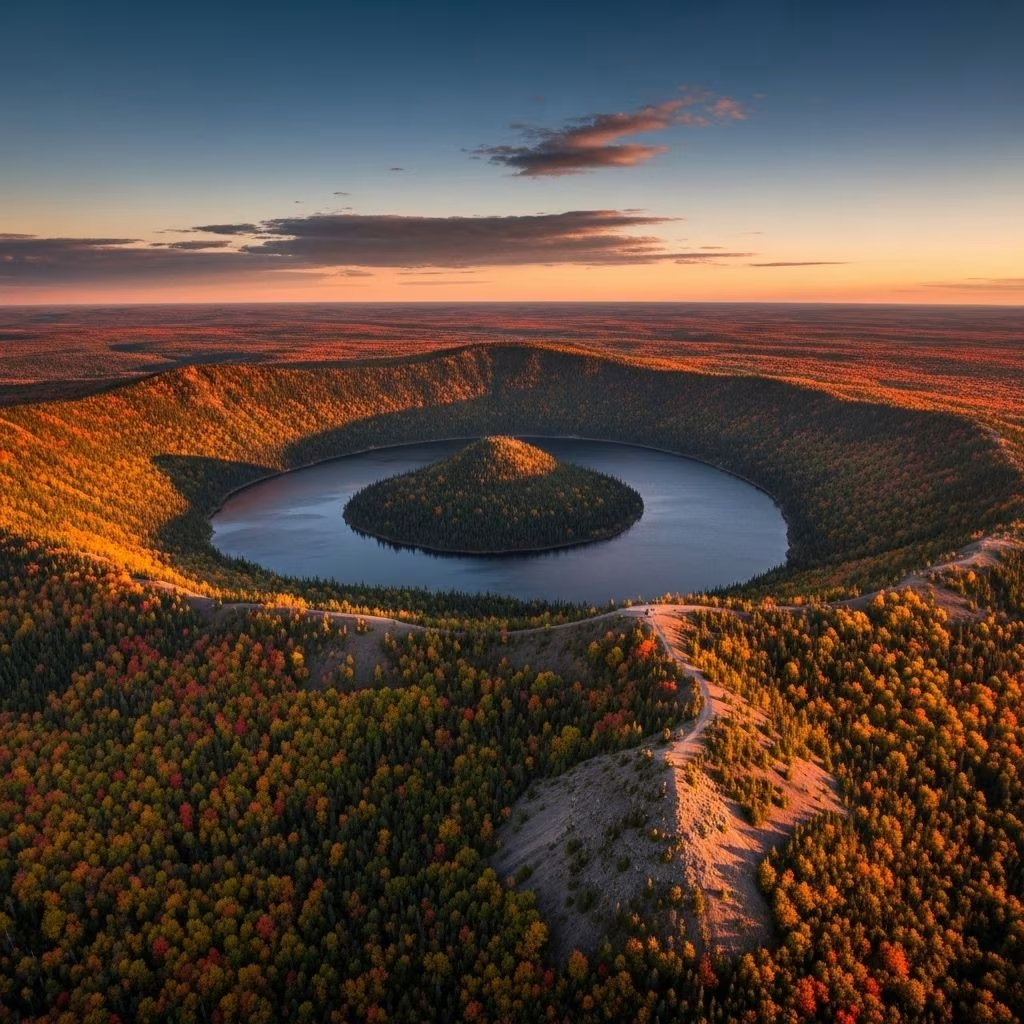
Earth carries the scars of dramatic encounters with space rocks—gigantic craters formed when asteroids or comets struck the surface with unimaginable energy. While most debris from space burns harmlessly in our atmosphere, some objects survive, carve out deep craters, and leave a lasting geological legacy. These impact sites offer a window into our planet’s past, revealing clues to ancient cataclysms that shaped both Earth and life itself.
What Is an Impact Crater?
Impact craters are typically large, circular depressions formed when a meteoroid, asteroid, or comet collides with a planetary surface at high speed. The energy released in these collisions can rival thousands or even millions of nuclear bombs, excavating vast amounts of material in an instant. Most craters on Earth get gradually erased by erosion, tectonic activity, and vegetation, but several spectacular examples remain clearly visible—even after millions or billions of years.
- Over 190 confirmed impact structures have been identified on Earth, according to the Planetary and Space Science Centre (PASSC).
- Impact crater studies help scientists reconstruct Earth’s ancient environment, past extinction events, and even model how our solar system evolved.
- Many craters are accessible for scientific study and adventure tourism, offering visitors an opportunity to witness these otherworldly landscapes first-hand.
The 10 Must-See Earth Impact Craters
Below, explore 10 of the most remarkable and accessible terrestrial impact craters—from gigantic multi-ring basins to perfectly preserved meteorite scars. Each entry includes a summary, location, estimated age, and visitor information.
1. Vredefort Crater (South Africa)
Vredefort Crater—also known as the Vredefort Dome—is the world’s largest and one of its oldest verified impact structures.
- Location: Free State, South Africa
- Diameter: Estimated between 180 and 300 kilometers (111–186 miles)
- Age: About 2.02 billion years
- Unique Features:
- Multi-ringed structure, visible from satellite imagery
- Central dome of uplifted rock, a result of the rebound after the colossal impact
- Visiting: The town of Vredefort sits within the crater and offers tours. The dome is a UNESCO World Heritage site, popular for hiking, geology tours, and river rafting.
2. Sudbury Basin (Canada)
The Sudbury Basin, one of the world’s oldest, largest, and richest impact structures, sits in Ontario’s mining heartland.
- Location: Ontario, Canada
- Diameter: Original diameter ~250 kilometers (155 miles); eroded to ~62 km (39 miles)
- Age: 1.85 billion years
- Unique Features:
- Heavily eroded, forms a large oval basin visible from space
- World-renowned source of nickel and other valuable metals
- Visiting: The city of Greater Sudbury lies inside the basin. Science centers and mining museums interpret the site’s history and geology.
3. Chicxulub Crater (Mexico)
The Chicxulub Crater marks the site of one of Earth’s most world-changing impacts—the event that likely drove the dinosaurs to extinction.
- Location: Northern Yucatán Peninsula, Mexico
- Diameter: ~180 kilometers (112 miles)
- Age: 66 million years
- Unique Features:
- Mostly buried; visible hints in the ring of cenotes (sinkholes) at the surface
- Linked to the Cretaceous–Paleogene extinction event
- Crucial for understanding mass extinctions
- Visiting: While most of the crater is not visible, the distinctive arc of cenotes can be toured. Educational centers in Mérida explain its significance.
4. Manicouagan Crater (Canada)
The stunning Manicouagan Crater forms a distinctive eye-shaped lake visible from space—a unique sight in remote Quebec.
- Location: Quebec, Canada
- Diameter: 70 kilometers (43 miles)
- Age: 214 million years
- Unique Features:
- Annular lake known as the “Eye of Quebec”
- Concentric ring structure well-preserved by water and geography
- Visiting: The reservoir is crossed by Highway 389; scenic views available, and various outfitters offer guided trips.
5. Popigai Crater (Russia)
Popigai Crater is one of the largest craters on Earth—remote, massive, and famous for its diamond reserves.
- Location: Siberia, Russia
- Diameter: 100 kilometers (62 miles)
- Age: 35 million years
- Unique Features:
- Impact transformed graphite in bedrock into diamonds
- Remote Arctic tundra setting; challenging to access
- Visiting: Accessible only via special expeditions; not a typical tourist site, but notable for scientific interest.
6. Acraman Crater (Australia)
The Acraman Crater lies buried beneath Lake Acraman. Its scale is best appreciated from satellite imagery, but its mysterious origins can be explored from the surface.
- Location: South Australia
- Diameter: 90 kilometers (56 miles)
- Age: 580 million years
- Unique Features:
- Visible only as a lake and deformed rock structures
- Key for understanding Precambrian impact history
- Visiting: The lake is remote but reachable by 4WD; best appreciated as an adventure in remote landscapes and geological exploration.
7. Morokweng Crater (South Africa)
The Morokweng Crater is a mostly buried impact site beneath the sands of the Kalahari Desert, containing fragments of the original asteroid deep underground.
- Location: Northwest Province, South Africa
- Diameter: 70 kilometers (43 miles)
- Age: 145 million years
- Unique Features:
- Asteroid fragments preserved under the desert surface
- Located beneath thick sediment, not obvious on the surface
- Visiting: The location is not readily accessible to tourists, but regional museums and research centers sometimes highlight its story.
8. Barringer (Meteor) Crater (United States)
Also called Meteor Crater, the Barringer Crater is probably Earth’s best-preserved—and most famous—impact crater. It offers an unforgettable tangible experience of a recent cosmic event.
- Location: Arizona, USA
- Diameter: 1.2 kilometers (0.75 miles)
- Depth: 170 meters (560 feet)
- Age: 50,000 years
- Unique Features:
- Rim and bowl clearly visible, easy to access
- Formed by an iron meteorite; first crater recognized as impact-created on Earth
- Visitor center and guided tours available
- Visiting: Open year-round; located east of Flagstaff, Arizona, with a world-class museum and observation platforms.
9. Gosses Bluff (Tnorala) Crater (Australia)
Gosses Bluff, known as Tnorala to its Indigenous custodians, is an iconic ring-shaped mountain in central Australia, regarded as a sacred site and a striking scenic landmark.
- Location: Northern Territory, Australia
- Diameter: The original crater ~22 kilometers (14 miles); the eroded central uplift is about 5 kilometers (3 miles) across
- Age: 142 million years
- Unique Features:
- Dramatic ring of cliffs rising from the Outback
- Sacred to Aboriginal people; features in Dreamtime stories
- Visiting: Open to the public; visit for geology, stunning views, and cultural heritage interpretation.
10. Lonar Crater (India)
The Lonar Crater is Earth’s only known hyper-velocity impact crater formed in basaltic rock, making it uniquely important both scientifically and culturally.
- Location: Maharashtra, India
- Diameter: 1.8 kilometers (1.1 miles)
- Age: ~52,000 ± 6,000 years
- Unique Features:
- Home to a saline lake, rare wildlife, and ancient temples on its rim
- Crater structure is largely intact, viewable from the air and the rim
- Visiting: Popular with tourists and pilgrims; accessible by road with guided walks and local lodging available.
The Science and Significance of Earth’s Craters
Impact craters are not just tourist destinations—they are vital scientific archives. By studying crater rocks, minerals, and sediments, researchers unravel:
- The composition of asteroids and comets that have collided with Earth
- The frequency, size, and effects of past impacts
- Clues to ancient mass extinctions and evolutionary leaps
- How impact events have shaped continents and their natural resources
How Craters Are Discovered and Studied
Many impact sites are subtle—eroded, buried, or altered over time. They are often discovered with a combination of techniques:
- Satellite imagery to reveal circular structures hidden in vegetation or beneath the ground
- Field geology, drilling, and seismic studies to confirm impact-related minerals and deformation
- Radiometric dating of impact-melted rocks to determine ages
Visiting Earth’s Impact Craters
Travelers can explore craters for science, adventure, photography, or a sense of connection to cosmic history. The largest and best-preserved sites often offer guided tours, museums, interpretive panels, and viewpoints. Respect protected environments and cultural heritage regulations, especially at sacred or remote sites.
Quick Comparison Table
| Crater | Country | Diameter (km) | Age (years) | Notable Feature |
|---|---|---|---|---|
| Vredefort | South Africa | 180–300 | ~2.02 billion | World’s largest, UNESCO site |
| Sudbury Basin | Canada | ~250 (original) | 1.85 billion | Major mining region |
| Chicxulub | Mexico | ~180 | 66 million | Dinosaur extinction link |
| Manicouagan | Canada | 70 | 214 million | Eye-shaped lake |
| Popigai | Russia | 100 | 35 million | Diamonds in impact rock |
| Acraman | Australia | 90 | 580 million | Under Lake Acraman |
| Morokweng | South Africa | 70 | 145 million | Asteroid fragments below |
| Barringer (Meteor) | USA | 1.2 | 50,000 | Best-preserved, accessible |
| Gosses Bluff (Tnorala) | Australia | 22 (original) | 142 million | Ring-shaped uplift, sacred |
| Lonar | India | 1.8 | ~52,000 | Basaltic rock, saline lake |
Frequently Asked Questions (FAQs)
Q: Why aren’t there more visible craters on Earth?
A: Erosion, sediment deposition, tectonic activity, and vegetation cover erase most evidence over time. New discoveries are often made using satellite data and deep drilling.
Q: How do scientists distinguish an impact crater from a volcanic crater?
A: Impact craters typically have signs of extreme shock, unique deformation patterns, and sometimes rare minerals like shocked quartz. Volcanic craters lack these features and are formed by internal activity.
Q: Can you visit every major crater on this list?
A: Most are accessible, but a few (such as Popigai and Morokweng) lie in remote, harsh environments. Some are covered by water or sediments but can still be studied via scientific expeditions.
Q: Do impact craters cause mass extinctions?
A: Some large impacts—such as Chicxulub—are linked to mass extinction events. Others have more localized environmental effects. The frequency of civilization-threatening impacts on human timescales is extremely low.
Q: Which crater is the youngest?
A: The Barringer (Meteor) Crater in Arizona is among the youngest large craters, formed just 50,000 years ago—a blink in geological terms.
Conclusion: Our Ongoing Connection to the Cosmos
Earth’s impact craters are more than scars; they are archives of planetary drama, survival, and change. Visiting these sites offers an extraordinary chance to touch deep time, witness nature’s power, and appreciate our planet’s continual interactions with the wider universe.
References
- https://www.space.com/10-earth-impact-craters-you-should-visit
- https://www.space.com/astronomy/earth/earths-oldest-impact-crater-is-much-younger-than-previously-thought-new-study
- https://www.youtube.com/watch?v=iTed69ef1ks
- https://en.wikipedia.org/wiki/List_of_impact_structures_on_Earth
- https://www.dailymotion.com/video/x9es9pu
- https://earthobservatory.nasa.gov/collection/1699/impact-craters
- https://en.wikipedia.org/wiki/Impact_crater
- https://www.lpi.usra.edu/education/explore/shaping_the_planets/impact-cratering/
- http://www.passc.net/EarthImpactDatabase/New%20website_05-2018/Index.html
- https://www.youtube.com/watch?v=ZWc24B6curY
- https://www.spacedaily.com/reports/The_craters_on_Earth_999.html
- https://airandspace.si.edu/stories/editorial/where-are-all-impact-craters-earth
- http://www.spaceopedia.com/astronomy/meteorites-meteors/craters/
- https://www.science.org/content/article/earths-colossal-crater-count-complete
- https://www.livescience.com/largest-asteroids-to-hit-earth
- https://bigthink.com/hard-science/earth-hidden-impact-craters/
- https://www.astronomy.com/science/these-5-impact-craters-highlight-earths-wild-history/
- https://www.worldatlas.com/space/how-many-asteroids-have-hit-earth.html


