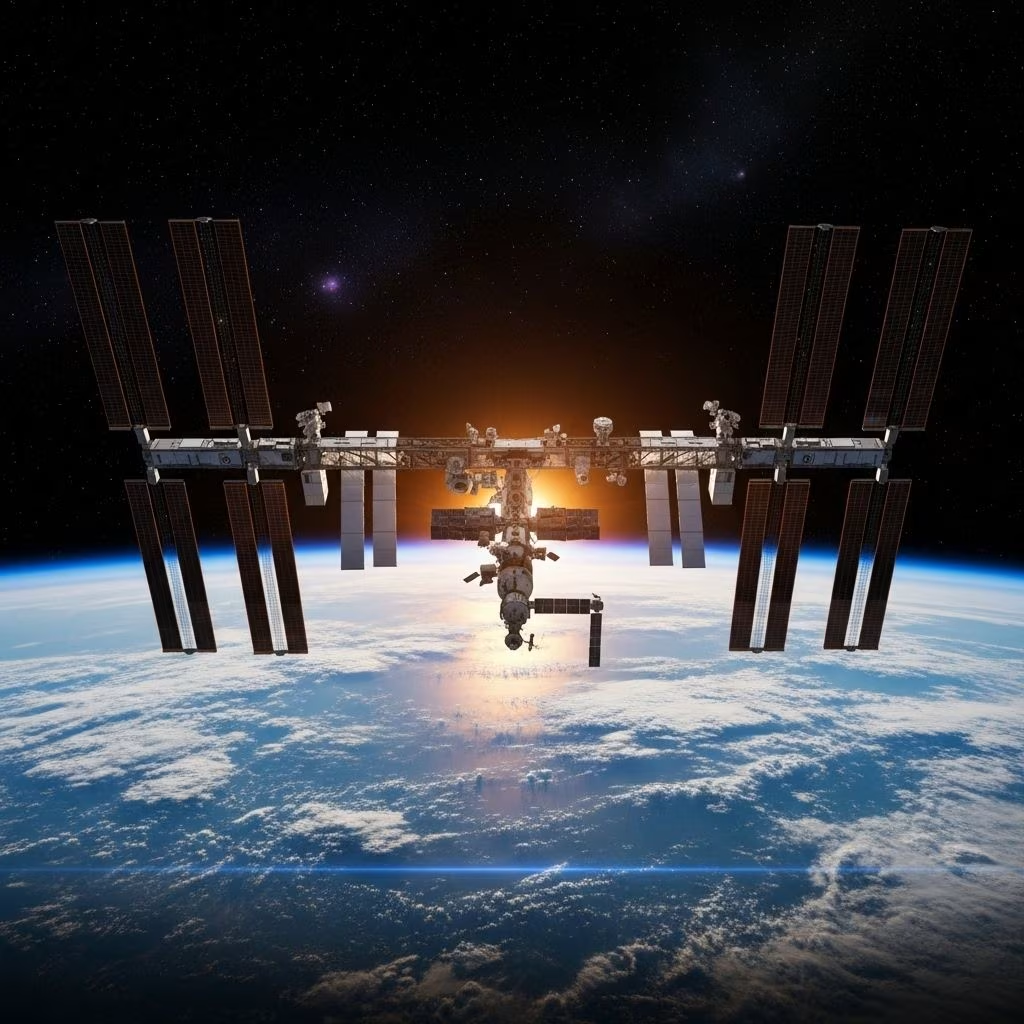
The International Space Station (ISS) is one of the most remarkable engineering feats of modern times. Orbiting our planet at an altitude of around 250 miles (400 kilometers), it serves as a laboratory, observatory, and home for astronauts from around the world. But how does this massive structure—larger than a football field and weighing over 900,000 pounds—remain aloft without simply plummeting back to Earth? To answer this, we delve into the science of orbital mechanics, the challenges of orbital decay, and the vital role of cooperative human ingenuity.
The Fundamentals of Orbital Mechanics
The ISS remains in orbit thanks to the delicate balance between two fundamental forces: Earth’s gravity and the station’s own velocity. An orbit is essentially a continuous state of freefall. To understand how, imagine throwing a ball: the faster you throw it, the farther it travels before hitting the ground. If you could throw it fast enough, its downward trajectory would match the curve of Earth, and it would keep circling—always falling, but never landing. This is what happens with the ISS, except the station is moving at an astonishing speed of approximately 17,500 miles per hour (28,000 kilometers per hour).
This velocity, precisely balanced with the pull of gravity, forms the basis for the ISS’s stable path around the globe. The concept is often illustrated by comparing it to the mythical idea of launching a cannonball fast enough to circle the Earth without falling—a thought experiment first proposed by Sir Isaac Newton.
- Earth’s Gravity: Constantly tugs the ISS toward the planet’s center.
- Orbital Velocity: The station’s fast sideways speed means it continuously “falls around” the Earth instead of straight down.
At the ISS’s altitude, gravity is about 90% as strong as on Earth’s surface. However, the combination of altitude and velocity results in persistent, controlled freefall—a condition we know as orbit.
Why Doesn’t the ISS Fall Back to Earth?
While the ISS is not entirely beyond the atmosphere, it is high enough that the remaining air is very thin. Still, there is some atmospheric drag. Over time, this drag would slowly lower the ISS’s altitude and eventually cause it to re-enter Earth’s atmosphere—unless something is done. How does the station avoid this fate?
- Atmospheric Drag: Molecules in the rarefied upper atmosphere create a continual, though small, resistive force, leading to what’s known as orbital decay.
- Orbital Decay: The gradual dropping of the ISS’s orbit due to atmospheric drag and minor gravitational perturbations.
To counteract this, mission controllers regularly schedule reboost maneuvers. These controlled burns increase the station’s speed and lift it back to its optimal altitude.
Reboost Maneuvers: Counteracting Orbital Decay
The ISS’s orbit is not permanent; it needs attention and adjustment. Atmospheric drag, although weak, robs the ISS of energy and gently tugs it toward Earth. Without intervention, the ISS would lose around 100 meters of altitude every day. Enter the reboost maneuver.
Reboosts typically use the following methods:
- Progress Resupply Vehicles: Russian Progress cargo spacecraft are commonly docked to the ISS and equipped with powerful thrusters. Periodically, controllers fire these thrusters to nudge the ISS back up.
- Zvezda Service Module: The Russian Zvezda module itself contains thrusters used for smaller orbital corrections and attitude adjustments.
- Other Visiting Vehicles: Occasionally, other spacecraft, such as the European Automated Transfer Vehicle (ATV), have performed reboosts.
The frequency and magnitude of reboosts depend on several factors:
- Current altitude of the ISS
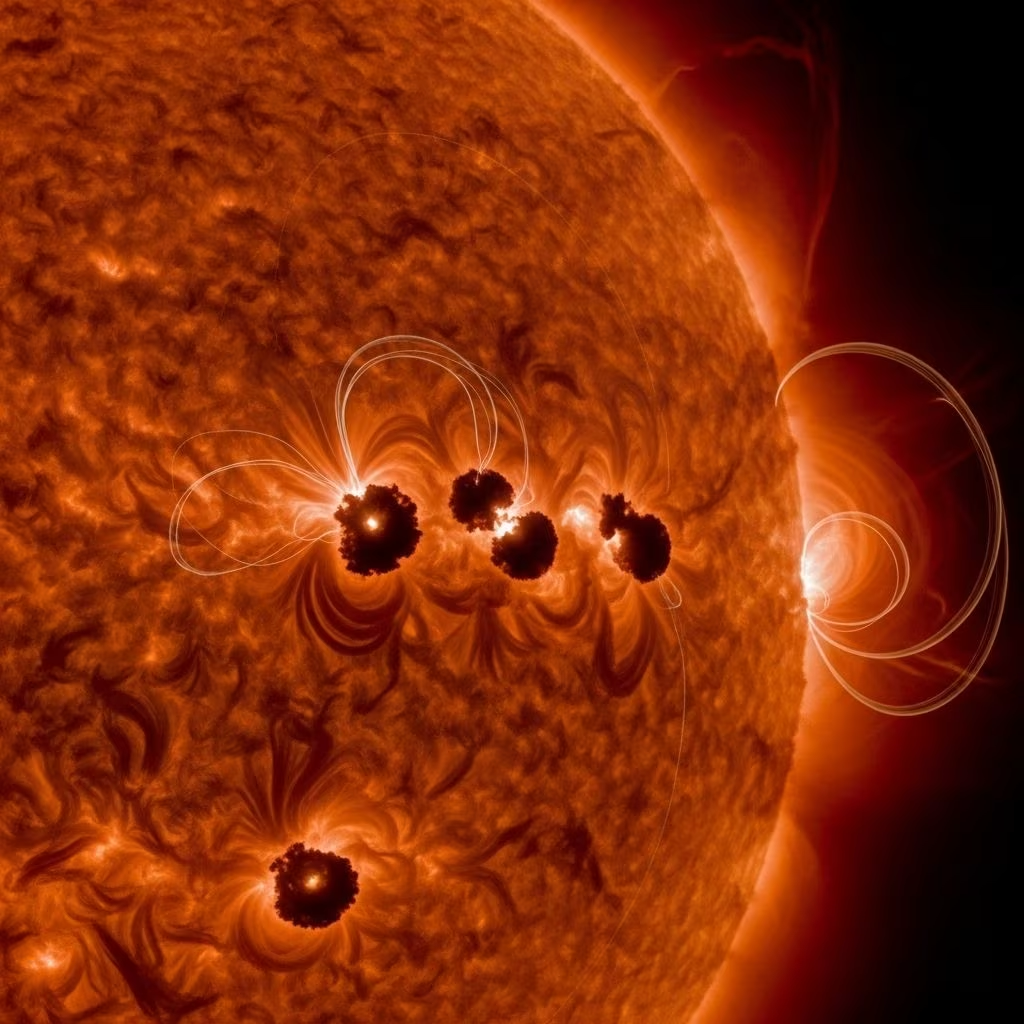
- Solar activity (which expands Earth’s atmosphere, increasing drag)
- Number and mass of docked spacecraft
During periods of intense solar activity, Earth’s atmosphere swells and drags more strongly on the ISS, necessitating more frequent reboosts. At times of quieter solar conditions, the schedule may be relaxed.
How a Reboost Works
During a reboost, the participating thrusters are ignited for several minutes. The ISS receives a slight push, incrementally raising its velocity and, as a result, its altitude. The boost is carefully calculated to avoid creating excessive vibration or subjecting the crew and experiments to unnecessary disturbance.
| Method | Purpose | Frequency |
|---|---|---|
| Progress Vehicle Thrusters | Major altitude reboosts, collision avoidance | Approx. every few months or as needed |
| Zvezda Service Module Thrusters | Minor course corrections | More frequently, for fine adjustments |
| Dragon/Cygnus (in rare cases) | Possible contributions if docked and equipped | Occasional, experimental use |
The Microgravity Environment Explained
The ISS is often described as a “zero-gravity” environment, but scientifically, the correct term is microgravity. In simple terms, objects and people on the ISS appear to float because everything is in freefall together—falling around the Earth at the same rate as the station itself.
- Freefall: The ISS, its crew, and onboard objects are all undergoing freefall due to gravity—yet their sideways velocity ensures they never touch down.
- Sensation of Weightlessness: Astronauts experience weightlessness not because gravity is absent, but because no support force counters their freefall.
While the ISS is only 250 miles above Earth—and gravity there is nearly as strong as on the surface—the continuous freefall creates the unique microgravity environment. This condition is critical for numerous scientific experiments in fields such as materials science, fluid physics, biology, and medicine. It allows researchers to study physical and chemical processes in ways impossible on Earth.
Imperfections in Microgravity
Microgravity on the ISS isn’t perfectly uniform. Subtle forces cause tiny accelerations and “jitter” called g-jitter—these may arise from:
- Air movement inside modules
- Crew activity (walking, exercising, operating equipment)
- Mechanical vibrations
Despite these small perturbations, the ISS maintains conditions stable enough for groundbreaking research.
The ISS’s Orbital Path: Altitude and Inclination
The ISS travels in an orbit inclined at 51.6 degrees to the equator. This inclination allows the station to:
- Pass over a majority of Earth’s surface
- Be accessible to international launch sites, especially those in Russia and the United States
- Enable a variety of Earth observation experiments and global communication links
At its altitude, the ISS completes one trip around Earth about every 90 minutes—roughly 16 orbits per day. This means astronauts onboard witness multiple sunrises and sunsets each day.
Collision Avoidance: Navigating a Crowded Space Environment
Earth’s orbit is increasingly congested with satellites, spent rocket stages, and debris. The ISS is equipped with advanced monitoring systems and receives continual updates about potential threats from ground-based radar networks. When a piece of debris is projected to approach dangerously close, the station may perform a Debris Avoidance Maneuver (DAM).
- Advance Notification: Ground control tracks thousands of objects and can warn the crew hours or days in advance.
- Safety Protocols: If a maneuver is not feasible in time, astronauts may take shelter in an attached spacecraft for quick evacuation.
International Cooperation: Keeping the ISS Flying
The ISS represents an unprecedented international partnership among five major space agencies:
- NASA (United States)
- Roscosmos (Russia)
- ESA (European Space Agency)
- JAXA (Japan Aerospace Exploration Agency)
- CSA (Canadian Space Agency)
This collaboration not only brings together the technical and financial resources needed to build and maintain such a complex station, but also fosters peaceful cooperation in space. Crew rotations, resupply missions, scientific experiments, and station upkeep are coordinated between these agencies.
What Happens If the ISS Loses Altitude?
If the ISS were to lose altitude without intervention, it would eventually encounter denser atmospheric regions, causing drag to increase rapidly. Over time, this would lead to uncontrolled re-entry and disintegration in Earth’s atmosphere. Reboost maneuvers and international coordination prevent this scenario and ensure the long-term habitability of the station.
End-of-Life Plans
When the ISS reaches the end of its operational lifespan, a series of controlled deorbit maneuvers will safely guide the station into the atmosphere, targeting a remote stretch of ocean for debris splashdown. Planning for this operation ensures that no large fragments threaten populated areas or active satellites.
Key Takeaways: What Keeps the ISS Aloft?
- Balance of Gravity and Velocity: The ISS stays in orbit by matching its high tangential velocity with the pull of Earth’s gravity, resulting in closed-loop freefall.
- Regular Reboosts: To counteract orbital decay, thrusters are periodically fired to restore lost altitude and maintain a safe path.
- Microgravity: The continuous freefall creates a near-weightless environment for science and daily life aboard.
- International Collaboration: The ISS’s existence is a testament to cooperation, shared investment, and technical prowess across borders.
Frequently Asked Questions (FAQs)
Q: How fast does the ISS travel around Earth?
A: The ISS orbits Earth at about 17,500 miles per hour (28,000 km/h), completing one revolution every 90 minutes.
Q: Why doesn’t the ISS fall to Earth if gravity is still strong at its altitude?
A: The ISS is in continuous freefall, moving forward fast enough that as it falls toward Earth, the planet curves away beneath it, keeping the station in stable orbit.
Q: What causes the ISS to lose altitude over time?
A: Thin atmospheric drag at its altitude slows the ISS slightly, causing orbital decay. Solar activity can increase atmospheric density, requiring more frequent reboost maneuvers.
Q: How is the ISS kept at the right height?
A: Thrusters on visiting cargo vehicles or the station’s own modules are used for periodic reboosts, raising its altitude to counter drag losses.
Q: What is microgravity, and how does it affect astronauts?
A: Microgravity describes the sensation of weightlessness the crew experiences because both they and the ISS are falling together around Earth. This allows research not possible on the ground but requires astronauts to adapt to new ways of moving and living.
Q: Who operates and maintains the ISS?
A: The ISS is a partnership between NASA, Roscosmos, ESA, JAXA, and CSA, with all agencies sharing responsibilities for maintenance, logistics, and operations.
Q: How long will the ISS remain in orbit?
A: Current agreements support station operations through at least 2030, after which a controlled deorbit and replacement strategies will be enacted.
Conclusion
The continued presence of the International Space Station above our planet is the result of intricate natural laws, advanced technology, and dedicated international teamwork. Its steady orbit provides humanity not just with scientific opportunities, but also a symbol of peaceful coexistence and shared ambition. As it circles Earth, the ISS reminds us what we can accomplish together, and how the laws of physics join forces with human purpose to keep our eyes—and our hopes—firmly trained on the stars.
References
- https://en.wikipedia.org/wiki/Maintenance_of_the_International_Space_Station
- https://ntrs.nasa.gov/api/citations/20100042525/downloads/20100042525.pdf
- https://www.asc-csa.gc.ca/eng/astronauts/about-the-job/maintenance-of-the-iss.asp
- https://en.wikipedia.org/wiki/International_Space_Station
- https://eol.jsc.nasa.gov/Tools/orbitTutorial.htm
- https://newspaceeconomy.ca/2024/09/04/how-does-iss-maintain-a-stable-orbit/
- https://aerospace.org/sites/default/files/2019-05/Davis-Mayberry-Penn_OOS_04242019.pdf
- https://www.planetary.org/articles/why-international-space-station-cant-operate-forever
- https://pubs.aip.org/aip/acp/article/552/1/139/572927/On-orbit-maintenance-operations-strategy-for-the
- https://www.youtube.com/watch?v=fDp8jbP_22c
- https://www.space.com/space-exploration/international-space-station/space-mysteries-how-does-the-iss-stay-in-orbit-without-falling-to-earth
- https://www.aeanet.org/how-does-a-space-station-stay-in-orbit/
- https://www.youtube.com/watch?v=NpHOlmNtFTQ
- https://news.gatech.edu/news/2024/12/16/how-does-international-space-station-orbit-earth-without-burning
- https://issfd.org/ISSFD_2012/ISSFD23_PS_5.pdf