


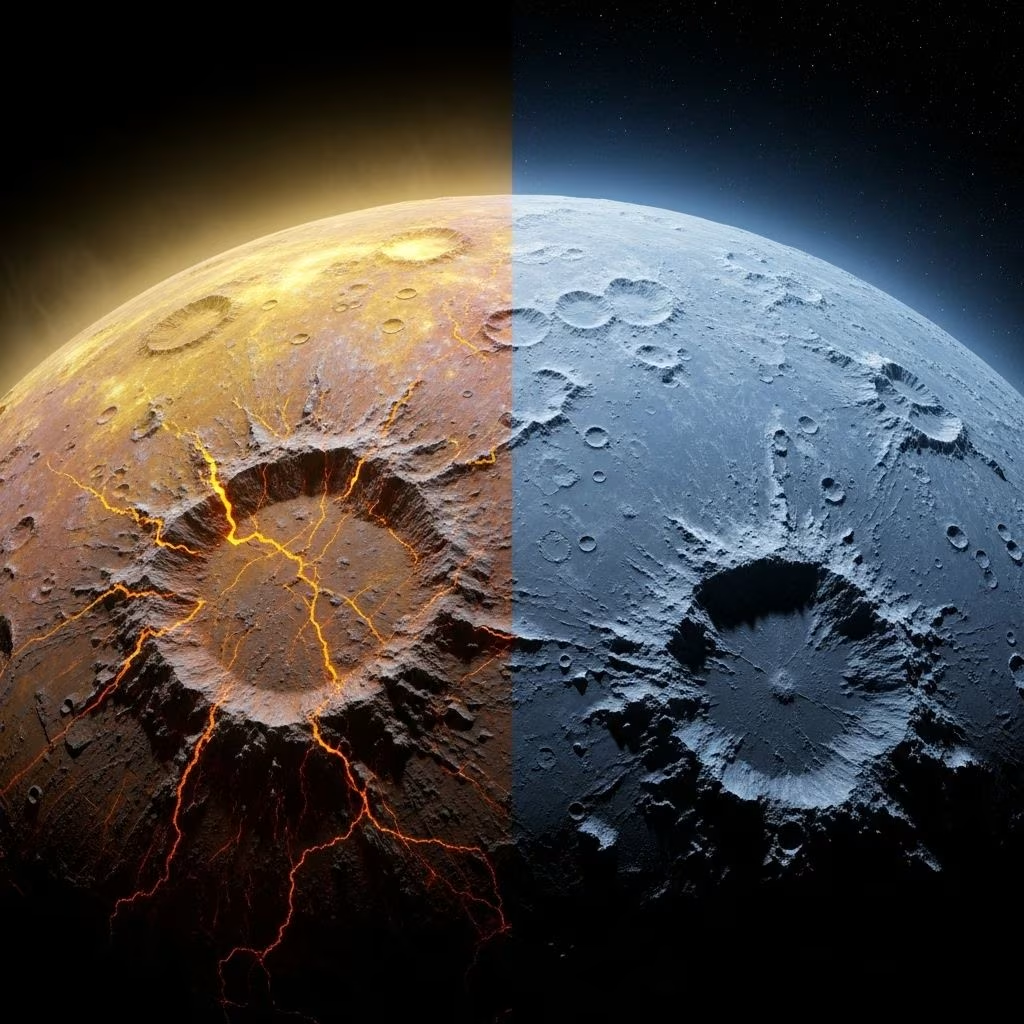
Mercury, the smallest and innermost planet of our solar system, is a land of breathtaking temperature contrasts. Its proximity to the Sun delivers blistering heat to its surface, yet the planet cools to some of the coldest temperatures in the solar system as night falls. Understanding the extremes of Mercury’s temperature reveals profound insights about planetary atmospheres, surface composition, and climate in the harshest environments imaginable.
Why Is Mercury So Hot—and So Cold?
Mercury’s fierce temperature variations stem from a unique confluence of factors:
- Proximity to the Sun: At just about 36 million miles (58 million kilometers) from the Sun, Mercury receives intense solar radiation far greater than any other planet in our solar system.
- Lack of Significant Atmosphere: Mercury’s thin exosphere—made of atoms blasted off its surface by solar wind—provides virtually no insulation. This means heat from the day is not retained at night, causing surface temperatures to plummet.
- Unique Rotation and Orbital Resonance: Mercury’s day (one sunrise to the next) lasts about 176 Earth days, and its 3:2 rotation-orbit resonance causes one side to face the Sun longer than the other, creating complex temperature zones.
Mercury’s Temperature Swing: By the Numbers
| Region/Time | Temperature Range (°C) | Temperature Range (°F) |
|---|---|---|
| Daytime Equator | up to 427°C | up to 800°F |
| Nighttime Equator | down to -173°C | down to -280°F |
| Pole Regions (permanent shadow) | below -171°C | below -275°F |
| Hot Longitudes at Noon | up to 700 K (~427°C) | up to 800°F |
| Warm Longitudes at Noon | up to 570 K (~297°C) | up to 566°F |
During the course of a single Mercurian “day,” the planet can swing from sizzling highs of about 800°F (427°C) to icy lows near -290°F (-180°C) as darkness settles in. These numbers mark Mercury as a planet of extremes: hotter than any other in daylight, colder than most at night.
What Drives Mercury’s Extreme Temperatures?
1. Proximity to the Sun
Mercury orbits much closer to the Sun than any other planet. This proximity means it endures intense solar energy. The Sun looks more than twice as big from Mercury’s surface as it does from Earth, and solar irradiance is up to 11 times stronger.
2. No Atmosphere to Trap Heat
Unlike Earth, which has an atmosphere that traps heat and moderates temperature, Mercury’s exosphere does not retain warmth. During the day, the surface heats rapidly under the Sun, but as the Sun sets, heat escapes directly into space, leading to dramatic cooling.
3. Elliptical Orbit and Orbital Resonance
- Mercury follows a highly elliptical (oval-shaped) orbit, which means its distance from the Sun varies by nearly 24 million kilometers between closest and farthest approach.
- This affects how much solar energy reaches the surface at different points in its orbit. When Mercury is at perihelion (closest to the Sun), areas at local noon receive maximum intensity.
- Its 3:2 spin-orbit resonance—rotating three times for every two orbits—creates “hot” and “warm” poles at the equator. Certain longitudes consistently experience higher temperatures at local noon than others, creating a complex thermal pattern across the surface.
4. The Long Mercurian Day
Mercury’s day (one sunrise to the next) lasts about 176 Earth days, due to the combination of its rotational and orbital speeds. This means that some parts of the planet bake in sunlight for months at a time, further amplifying the difference between day and night temperatures.
Mercury’s Equator vs. Poles: A Study in Contrast
Temperature extremes are not distributed evenly:
- Equator: Here, the temperature highs are the most dramatic, with scorching daytime temperatures that can melt lead.
- Pole Regions: With Mercury’s axis tilted only about 0.034 degrees (almost perfectly upright), there are areas at the poles, especially inside deep craters, that never see sunlight. These “permanently shadowed regions” stay below -170°C (-275°F), creating cold traps capable of preserving ice.
Mercury’s Cold Traps: The Surprising Presence of Ice
Despite being so close to the Sun, radar and spacecraft observations (notably NASA’s MESSENGER mission) have confirmed deposits of water ice at Mercury’s poles, sheltered within craters that never receive sunlight. The average temperature in these shadowed zones remains below -171°C (-275°F), cold enough to keep ice stable for billions of years. How can ice exist on a planet with such intense daytime heat?
- These permanently shadowed craters act as cosmic freezers, untouched by even the faintest Sun ray.
- Material impacting Mercury, such as comets, likely delivered water, which became trapped as ice in these unlit cold spots.
Mercury’s Surface and Exosphere: Interplay with Temperature
Mercury’s surface resembles Earth’s Moon: heavily cratered, lifeless, and with a variety of surface features including cliffs, ridges, and vast basins. The planet’s exosphere—composed mainly of oxygen, sodium, hydrogen, helium, and potassium—is formed as atoms are knocked loose from the surface by meteorite impacts and intense solar wind. However, it is too tenuous to behave like an atmosphere.
- Without atmospheric mixing, the heat gradient between lit and shadowed areas is abrupt.
- Mercury’s exosphere does not regulate temperature, resulting in intense gradients even over short distances.
Mercury Compared: A Table of Planetary Temperature Extremes
| Planet | Daytime High (°C) | Nighttime Low (°C) | Atmosphere? |
|---|---|---|---|
| Mercury | +427 | -173 | No (exosphere only) |
| Venus | +465 | +460 | Dense CO₂ atmosphere |
| Earth | +56.7 | -89.2 | Rich atmosphere |
| Mars | +20 | -125 | Thin CO₂ atmosphere |
| Moon | +127 | -173 | No |
Though Venus has a hotter average surface temperature due to its thick greenhouse atmosphere, Mercury claims the most extreme temperature swing between day and night in the solar system.
The Science Behind Mercury’s Temperature Distribution
Mercury’s temperature map is not uniform:
- “Hot poles” at the equator receive the brunt of sunlight during perihelion, reaching maximum temperatures.
- “Warm poles” at different longitudes during aphelion experience somewhat lower but still extreme temperatures.
- The rapid cooling at night is a result of the lack of atmospheric insulation and the planet’s slow rotation.
- Shadowed craters remain constant in their deep freeze, creating stable habitats for water ice to persist against all odds.
Exploring Mercury: The Challenges of Its Temperature Extremes
Mercury’s wild thermal environment presents severe challenges for spacecraft and scientific equipment. Any probe sent to the surface must withstand:
- Extreme heat during the long day.
- Severe cold at night.
- Intense solar and cosmic radiation.
NASA’s MESSENGER probe, which orbited Mercury from 2011 to 2015, was equipped with special shielding and relied on carefully calculated orbital paths to avoid overheating. The BepiColombo mission, a joint venture between ESA and JAXA, is currently en route and has likewise been engineered to cope with Mercury’s brutal thermal swings.
Frequently Asked Questions
Q: How hot does Mercury get during the day?
A: Mercury’s daytime temperatures at the equator can reach up to 800°F (427°C) during the local noon at its closest point to the Sun.
Q: Why are Mercury’s nights so cold?
A: Mercury has no thick atmosphere to retain heat, so once the sun sets, stored heat radiates quickly away into space, dropping surface temperatures to -290°F (-180°C) or lower.
Q: Can ice exist on Mercury despite the heat?
A: Yes, water ice has been detected in the permanently shadowed craters at Mercury’s poles, where temperatures never rise above -170°C (-275°F), making these “cold traps” stable for ice accumulation.
Q: How long is a day on Mercury?
A: One Mercurian solar day—sunrise to sunrise—lasts about 176 Earth days, the result of its 3:2 rotation-orbit resonance.
Q: How does Mercury’s temperature compare to Venus or the Moon?
A: Although Venus is hotter on average due to its thick CO₂ atmosphere, Mercury has a much higher range between its hottest and coldest temperatures. Mercury’s night and day extremes are even more dramatic than the Moon’s, thanks to its solar proximity.
Key Takeaways
- Mercury experiences the most significant temperature extremes in the solar system.
- No thick atmosphere exists to regulate the planet’s climate.
- Permanently shadowed polar regions contain deposits of water ice.
- Spacecraft visiting Mercury must be engineered for both searing heat and deep freeze.
- Mercury’s thermal environment offers vital clues about planetary formation and survival in extreme conditions.
Further Exploration
Learning about Mercury’s temperature extremes enriches our understanding not only of this small, battered world but also of the physical processes that shape all rocky planets. Mercury remains a laboratory for studying how planets handle extremes—and the tantalizing possibility of ice in the closest place to our Sun shows that surprises still await even in the harshest environments of the solar system.
References
- https://spacemesmerise.com/en-us/blogs/planets/exploring-mercurys-temperature-extremes-and-variations
- https://www.dlr.de/en/latest/news/2025/small-and-full-of-extremes-how-heat-and-cold-influence-mercury
- https://science.nasa.gov/mercury/facts/
- https://en.wikipedia.org/wiki/Mercury_(planet)
- https://www.space.com/18645-mercury-temperature.html
- https://sos.noaa.gov/catalog/datasets/mercury-topography/
- https://consensus.app/questions/temperature-variations-on-mercury/
- https://www.planetary.org/worlds/mercury
- https://sos.noaa.gov/catalog/datasets/mercury/
- https://www.nhm.ac.uk/discover/planet-mercury.html
- https://science.nasa.gov/resource/solar-system-temperatures/
- https://www.youtube.com/watch?v=yzym_2WPt6k
- https://www.youtube.com/watch?v=JCTwHElKij0
- https://hypertextbook.com/facts/2000/OlesyaNisanov.shtml
- https://www.studocu.com/en-ca/messages/question/4345143/what-is-the-primary-reason-for-mercurys-extreme-temperature-variations-reaching-as-high-as-4250c
- https://biologyinsights.com/why-does-mercury-have-extreme-temperatures/
- https://myspacemuseum.com/mercury-climate


