


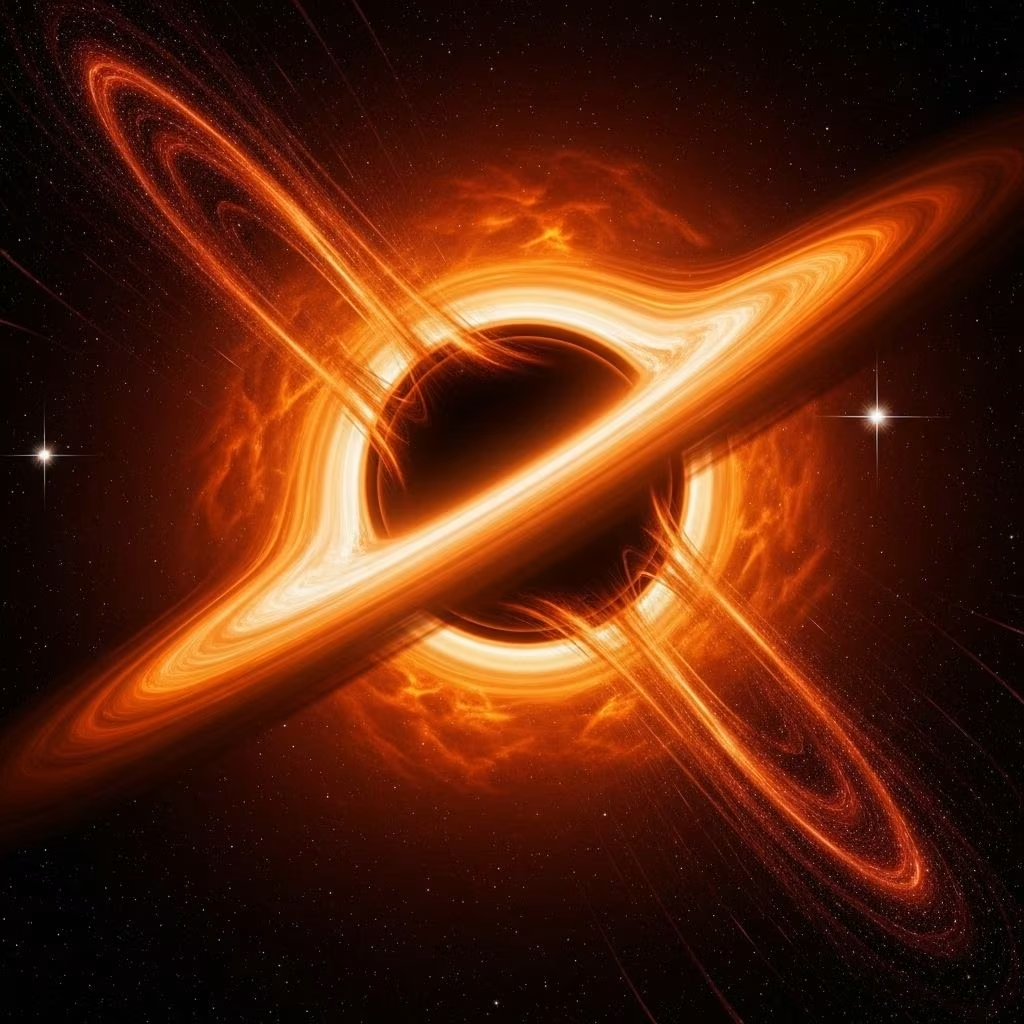
Milky Way’s Biggest Stellar-Mass Black Hole: Gaia BH3 Emerges
In a groundbreaking astronomical discovery, scientists have identified Gaia BH3 as the largest known stellar-mass black hole in our Milky Way galaxy. This cosmic “sleeping giant” lurks surprisingly close—only about 2,000 light-years from Earth in the constellation Aquila, making it one of the nearest significant black holes to our solar system.
The European Space Agency’s Gaia mission, designed to map the positions and movements of over a billion stars, led to this remarkable find. The discovery of Gaia BH3 fundamentally shifts scientists’ understanding of how stellar-mass black holes form and evolve in our galaxy.
What Are Stellar-Mass Black Holes?
Stellar-mass black holes are formed from the gravitational collapse of massive stars at the end of their lifetimes. These cosmic objects typically weigh about 10 times the mass of our Sun. Supermassive black holes, like those at galactic centers (e.g., Sagittarius A*), are far larger, but stellar-mass black holes can exist anywhere in a galaxy and are usually more elusive[10][11].
How Gaia BH3 Was Discovered: The Clues and the Methods
Astronomers made the record-breaking discovery using precise data from the ESA’s Gaia spacecraft. Gaia meticulously tracks the motion of billions of stars to create an unprecedented 3D map of the Milky Way, and its data have previously revealed two stellar-mass black holes (Gaia BH1 and Gaia BH2). Gaia BH3 stands out as the heftiest by far among them.
- Scientists spotted an unusual wobble in the movement of a companion star tied to Gaia BH3. This motion was a clear sign of an invisible, incredibly massive neighbor tugging on it.
- Further observations using ground-based telescopes, including the European Southern Observatory’s Very Large Telescope, confirmed the existence and mass of Gaia BH3[11].
Key Properties of Gaia BH3
| Black Hole | Mass (Solar) | Distance from Earth | Companion Star |
|---|---|---|---|
| Gaia BH3 | 33 | 2,000 light-years | Metal-poor star (aged) |
| Cygnus X-1 | 21 | 6,070 light-years | Massive star |
Compared to past record-holders like Cygnus X-1, Gaia BH3’s mass dwarfs them, highlighting its exceptional nature among known Milky Way stellar black holes[11].
Gaia BH3’s Surprising Origins: What Makes It Unique?
The orbit of Gaia BH3’s companion star revealed distinct clues about its formation. Remarkably, there was no evidence of a supernova explosion disrupting the star’s orbit. This insight suggests:
- Gaia BH3 was formed long ago—possibly in isolation—and only later acquired its stellar companion.
- The companion star is ancient and metal-poor, meaning it originated in the early universe, prior to stars becoming enriched with heavier elements.
- The undisturbed orbital relationship is unique for such a massive black hole, challenging current models that predict violent supernovae should impact companion stars.
Where Does Gaia BH3 Stand Among Black Holes?
To put Gaia BH3’s size in perspective:
- Most stellar-mass black holes in the Milky Way are 10-20 solar masses.
- Gaia BH3 is 33 solar masses, far exceeding previous known stellar black holes in the galaxy[11].
- Supermassive black holes, like Sagittarius A* at the galactic center, have millions of solar masses, but they are formed by the merging of smaller black holes and the accretion of matter over time[10].
This discovery underscores how much we still have to learn about the diversity of black hole formation and their distribution within galaxies.
Comparison of Notable Milky Way Black Holes
| Name | Type | Mass (Solar) | Distance from Earth |
|---|---|---|---|
| Sagittarius A* | Supermassive | 4.2 million | 26,000 light-years |
| Gaia BH3 | Stellar-mass | 33 | 2,000 light-years |
| Cygnus X-1 | Stellar-mass | 21 | 6,070 light-years |
Why the Discovery Matters: Scientific Impact
Finding such a massive, nearby black hole has significant scientific consequences:
- It challenges established theories about how black holes of stellar origin form; most should not reach this kind of mass through the collapse of a single star.
- The presence of an old, metal-poor companion around such a heavy black hole can provide new insights into the history and evolution of the Milky Way itself.
- The technique used—detecting gravitational disturbances in nearby stars—demonstrates the power of advanced space telescopes like Gaia for unveiling unseen cosmic phenomena.
Pasquale Panuzzo, astrophysicist at the National Centre for Scientific Research (CNRS), captured the excitement: “This is the kind of discovery you make once in your research life.”
Is Gaia BH3 a Threat to Earth?
Despite headlines calling it a “monster,” Gaia BH3 is completely harmless. At 2,000 light-years away, it’s much too distant to affect our solar system. Black holes, unless they are actively feeding or being approached, pose no danger to surrounding stars or planets beyond a certain zone[11].
How the Gaia Mission Delivers Stellar Science
The Gaia spacecraft was launched by ESA in 2013 to create the most accurate and comprehensive digital map of our galaxy ever constructed. Its highly precise measurements allow astronomers to:
- Track subtle movements and “wobbles” of stars.
- Identify gravitational influences that hint at hidden objects such as black holes.
- Assemble catalogues of star properties, ages, chemical composition, and locations.
Gaia’s legacy grows with each new dataset released, continually reshaping our picture of the Milky Way.
Frequently Asked Questions (FAQs)
What makes Gaia BH3 so unusual?
Gaia BH3 is unique because it is the most massive stellar-mass black hole yet detected in the Milky Way (33 solar masses), more than 50% heavier than previous record-holders like Cygnus X-1, and is located just 2,000 light-years from Earth[11].
How was Gaia BH3 detected?
Astronomers found Gaia BH3 by analyzing precise star motion data from the Gaia spacecraft. The abnormal movement of its companion star revealed the black hole’s existence, which was then verified by large ground-based telescopes.
What is the difference between stellar-mass and supermassive black holes?
Stellar-mass black holes are created by the collapse of a single massive star, usually weighing 5–20 solar masses. Supermassive black holes form at galaxy centers and can contain millions to billions of solar masses, mainly through mergers and accretion[10].
Does Gaia BH3 pose any danger to Earth?
No. Gaia BH3, at 2,000 light-years away, is far outside the range to threaten our solar system. Black holes only affect matter within their immediate vicinity unless actively feeding.
How does Gaia BH3 help scientists understand the Milky Way?
The discovery of Gaia BH3 offers new clues about black hole formation, the life cycles of massive stars, and the composition and evolution of ancient star populations in our galaxy.
Gaia BH3 and the Future: What’s Next?
Gaia BH3’s discovery urges astronomers to re-evaluate models of black hole formation, especially the processes leading to such large stellar remnants. Some scientists speculate that more hidden giants could be lurking, awaiting discovery within Gaia’s expanding troves of data.
- Continued observations of Gaia BH3 and its companion will help clarify how such massive black holes form and interact with their surroundings.
- Further study may reveal additional clues about the earliest epochs of our galaxy’s development.
- Gaia’s methodologies and data could soon uncover even broader populations of previously invisible stellar remnants.
Quick Facts: Gaia BH3—The Milky Way’s Largest Stellar-Mass Black Hole
- Name: Gaia BH3
- Type: Stellar-mass black hole
- Mass: 33 times the Sun’s mass
- Distance from Earth: 2,000 light-years (constellation Aquila)
- Discovery: ESA’s Gaia mission, ground-based telescope confirmation
- Significance: Challenges models of black hole formation and reveals hidden structures in the Milky Way
Conclusion: Gaia BH3’s Discovery—A New Era for Black Hole Science
The detection of Gaia BH3 marks a watershed moment in astrophysics. As one of the nearest and most massive stellar-mass black holes ever found, it redefines what scientists expect to find in the quiet outskirts of our galaxy. Its quiet “sleep” today may be a prelude to dramatic revelations yet to come, as astronomers strive to unlock the secrets of stellar death, galactic evolution, and the invisible skeleton of our universe[11].
References
- https://www.space.com/milky-way-biggest-stellar-mass-black-hole-gaia
- https://www.eso.org/public/news/eso2408/
- https://astrobites.org/2024/07/01/gaia-bh3/
- https://icc.ub.edu/news/gaia-mission-detects-most-massive-black-hole-stellar-origin-in-milky-way
- https://www.cosmos.esa.int/web/gaia/iow_20240416
- https://en.wikipedia.org/wiki/Sagittarius_A*
- https://www.youtube.com/watch?v=cYk1IOymyac
- https://www.youtube.com/watch?v=JHAxzG2dHM0
- https://www.universetoday.com/articles/the-milky-ways-most-massive-stellar-black-hole-is-only-2000-light-years-away
- https://www.eso.org/public/images/eso2408b/
- https://www.popsci.com/science/biggest-stellar-mass-black-hole/
- https://www.astronomy.com/science/astronomers-uncover-sleeping-giant-black-hole-gaia-bh3-the-largest-ever-found-in-the-milky-way/
- https://www.pcb.ub.edu/en/gaia-mission-detects-the-most-massive-black-hole-of-stellar-origin-in-the-milky-way/
- https://phys.org/news/2024-04-astronomers-largest-black-hole-milky.html
- https://timesofindia.indiatimes.com/world/europe/astronomers-find-biggest-stellar-black-hole-in-milky-way-galaxy-by-chance/articleshow/109359372.cms
- https://cosmosmagazine.com/space/astronomy/biggest-stellar-black-hole-milky-way/


