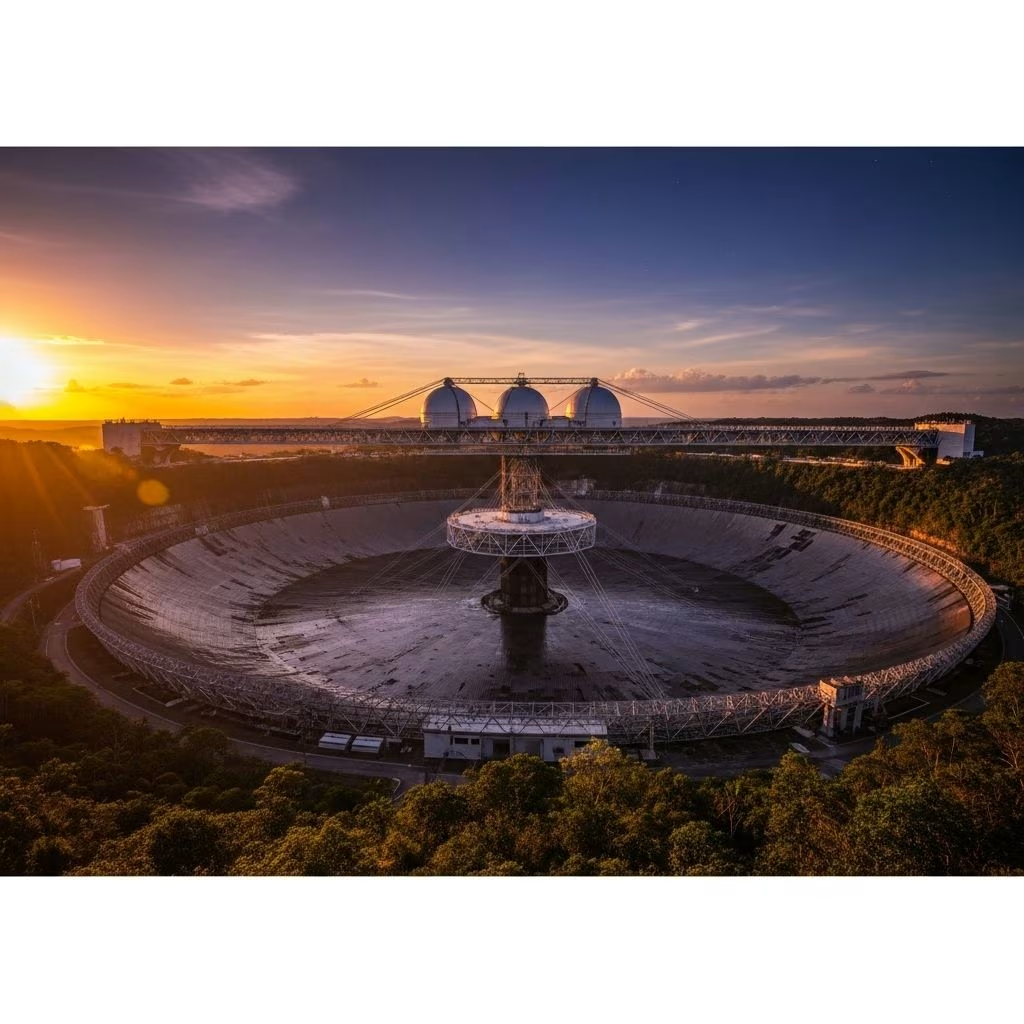
The Arecibo Observatory: A Monument to Science
The Arecibo Observatory, set within the lush landscape of Puerto Rico, was for decades the world’s largest and most recognizable radio telescope. From 1963 until its dramatic collapse in 2020, it stood as a giant in both physical scale and scientific output, transforming our understanding of space, the atmosphere, and even our place in the cosmos. Its legacy endures as a symbol of human curiosity, ingenuity, and cross-disciplinary research.
Location and Design
Located roughly 19 kilometers south of the city of Arecibo in northern Puerto Rico, the observatory was ingeniously nestled inside a natural limestone sinkhole 18°20′39″N 66°45′10″W. This unique geography provided both the vast space and the ideal environmental conditions needed to construct and operate one of the largest scientific instruments ever built .
- Main Instrument: 305-meter (1,000-foot) spherical radio/radar dish.
- Additional Facilities: Smaller radio telescopes, LIDAR (light detection and ranging) equipment, and a visitor center.
- Management: Owned by the U.S. National Science Foundation (NSF); managed for decades by Cornell University, later by SRI International and the University of Central Florida.
Genesis and Historical Development
The story of Arecibo began during the Cold War, rooted in the research priorities of the late 1950s. The United States Department of Defense, specifically the Advanced Research Projects Agency (ARPA, later DARPA), initiated the project as part of efforts to better understand the ionosphere—an electrically charged atmospheric layer that could impact missile detection and defense .
Timeline of Key Milestones
| Year | Event |
|---|---|
| 1959 | Cornell University contracts with ARPA to develop a large-scale ionospheric radar probe. |
| 1960 | Construction commences in Puerto Rico. |
| 1963 | Facility opens as the Arecibo Ionospheric Observatory. |
| 1969 | Transferred to the NSF and renamed National Astronomy and Ionosphere Center (NAIC). |
| 1974 | Upgrades for both ionospheric and radio astronomy studies. |
| 2011 | SRI International assumes management; consortium includes University of Puerto Rico and others. |
| 2018 | University of Central Florida leads a new management team. |
| 2020 | Collapse of main telescope following cable failures. |
| 2022 | NSF announces site will become an educational facility. |
Though initially meant for military purposes, the observatory quickly evolved into a general-purpose scientific instrument that contributed to myriad academic disciplines—including atmospheric science, planetary radar, and, of course, radio astronomy .
Engineering Marvel: Architecture and Features
The Arecibo Telescope’s design was revolutionary for its time. By making use of the island’s natural sinkhole, engineers overcame geographic and technological challenges associated with building such a giant reflector.
- The Dish: 305 meters in diameter, consisting of 38,778 perforated aluminum panels supported by a mesh of steel cables anchored at the edge of the sinkhole.
- The Platform: Suspended 150 meters above the dish by 18 steel cables strung from three reinforced concrete towers. The platform supported a movable receiver, instrumentation, and radar transmitters.
- Mobility: The receiver could be repositioned across the focal area, allowing observations across a limited section of the sky and fine control over beam direction.
- Improvements: The telescope underwent numerous upgrades, increasing its sensitivity, bandwidth, and versatility—most notably in 1974 and again in the 1990s.
Scientific Achievements and Discoveries
Arecibo Observatory’s greatest claim to fame is its wide range of major scientific breakthroughs—many of which fundamentally changed what we know about our solar system and universe.
Landmark Discoveries:
- Mercury’s Rotation (1964): Determined that Mercury’s day was 59 Earth days, not 88 as previously thought.
- First Solid Evidence of Neutron Stars (1968): Detection of periodicity in the Crab Pulsar, confirming the existence of neutron stars.
- The First Binary Pulsar (1974): Discovery of PSR B1913+16, later earning the Nobel Prize in Physics for Hulse and Taylor due to its role in confirming the existence of gravitational waves.
- First Millisecond Pulsar (1982): Discovery of PSR B1937+21, at the time the fastest-spinning pulsar known.
- First Radar Observation of a Comet (1980): Radar detection of Comet Encke.
- First Direct Imaging of an Asteroid (1989): Imaging of 4769 Castalia by radar.
- First Extrasolar Planets (1992): Discovery of three exoplanets orbiting PSR B1257+12.
- Mapping Icy Poles on Mercury (1994): Confirmed the presence of water ice in Mercury’s polar regions.
Other Areas of Contribution
- Near-Earth Object (NEO) Studies: Key contributions to the tracking and characterization of asteroids and comets that could threaten Earth.
- Atmospheric Research: Groundbreaking studies of Earth’s ionosphere and upper atmosphere.
- SETI (Search for Extraterrestrial Intelligence): Served as a primary facility for radio searches for extraterrestrial life.
- Solar System Exploration: Provided detailed surface maps of Venus and monitored planets, moons, and other solar system bodies.
The Arecibo Message: Communicating With the Cosmos
One of the most celebrated events in the Observatory’s history occurred in 1974 with the transmission of the Arecibo Message—a binary-encoded 1,679-bit pictogram broadcast toward the globular star cluster M13, 25,000 light-years away. Devised by Frank Drake and others as a demonstration of the facility’s prowess, it was humanity’s first deliberate interstellar radio message, describing DNA, a human figure, and our solar system.
- Purpose: To illustrate technological and communicative capacities rather than to make real contact (M13 will have moved by the time the message arrives).
- Structure: Consisted of elements representing numbers, atomic numbers, DNA, a human, the Solar System, and the telescope itself.
- Significance: Showcased mankind’s ability to reach beyond Earth, inspiring generations of astronomers and the public alike.
Cultural and Media Significance
Arecibo’s imposing dish and dramatic setting ensured it became an icon of popular culture, appearing in numerous films, TV shows, and media worldwide.
- Film: Featured in the climactic scenes of GoldenEye (1995 James Bond film), as well as Contact (1997), based on Carl Sagan’s novel.
- Television: Appeared in shows like The X-Files and various documentaries.
- Music: Served as an inspiration for album covers and lyrics, including the band Muse.
Through its role in SETI and planetary defense, the site also became a symbol for science “seeking answers” about humanity’s place in the cosmos.
Collapse and Aftermath
Despite its legacy, the telescope succumbed to structural fatigue in 2020. After two cables supporting the receiver platform failed within months, the NSF determined that repairs were too dangerous. On December 1st, 2020, the platform fell, destroying the dish below .
- Main Causes: Decades of tropical weather, hurricanes, and delayed maintenance placed immense strain on aging infrastructure.
- No Injuries: Fortunately, the collapse occurred while the site was evacuated.
- Response: Widespread global mourning and calls from the scientific community for future investment and a new, even more powerful instrument on site.
- Future Plans: The NSF has committed to transforming the site into an educational and outreach center; radio astronomy work continues with smaller facilities on location.
The Enduring Legacy of Arecibo Observatory
The collapse of the Arecibo Observatory marked the end of an era, but its spirit lives on:
- Scientific Influence: Its findings underpin modern astrophysics, atmospheric science, planetary defense, and search strategies for life in the universe.
- Human Capital: Served as a training ground for thousands of scientists, engineers, and students from Puerto Rico and around the world.
- Cultural Heritage: Continues to inspire interest in science, technology, and the universe on the island of Puerto Rico and worldwide.
- Legacy Honors: The asteroid 4337 Arecibo was named in its honor, and monuments, museum exhibits, and outreach activities preserve its memory and lessons for future generations.
Frequently Asked Questions
Q: What was the main scientific purpose of the Arecibo Observatory?
A: Originally designed to study Earth’s ionosphere for defense purposes, Arecibo became a multi-purpose tool for radio astronomy, planetary radar, and atmospheric science.
Q: How big was the dish at Arecibo?
A: The main reflector had a diameter of 305 meters (1,000 feet), covering about 18 acres of land.
Q: Why did the Arecibo telescope collapse?
A: After two main support cables failed in 2020, engineers determined that the structure was unsafe. The receiver platform ultimately fell onto the dish, fatally damaging the instrument.
Q: Can the site still be visited?
A: Yes, the visitor center and educational outreach facilities remain open, and the NSF plans to expand these resources for the public, students, and researchers.
Q: What are some of Arecibo’s most famous discoveries?
A: These include the first binary pulsar, the discovery of extrasolar planets, the mapping of Mercury’s icy poles, and the refinement of Mercury’s rotation period, among many others.
Q: Is there a replacement for the Arecibo telescope?
A: Engineers and scientists hope for a future large-scale facility on the Arecibo site, but as of now, China’s FAST telescope is the world’s largest single-dish radio telescope.
Q: Did Arecibo play a role in the search for extraterrestrial intelligence?
A: Yes, it was central to SETI projects and famously sent the Arecibo Message to space in 1974.
References
- Information based on public science sources and official records from the National Science Foundation, Cornell University, and NASA, as well as public encyclopedias and contemporary news releases.
References
- https://en.wikipedia.org/wiki/Arecibo_Observatory
- https://en.wikipedia.org/wiki/Arecibo_Telescope
- https://www.britannica.com/topic/Arecibo-Observatory
- https://www.nsf.gov/news/media-toolkits/arecibo
- https://nsf-gov-resources.nsf.gov/files/Arecibo-Fact-Sheet-11-20-r.pdf?VersionId=wFpMqLKclekSrtyzD4gP54nBxugvqc.Y
- https://www.britannica.com/summary/Arecibo-Observatory
- https://www.astronomy.com/science/the-rise-and-fall-of-arecibo-observatory-an-oral-history/
- https://blogs.iu.edu/sciu/2021/07/03/arecibos-50-years-of-discoveries/
- https://www.sciencenews.org/article/arecibo-telescope-collapse-astronomy-discoveries
- http://www.naic.edu
- https://www.space.com/the-universe/4-years-after-the-giant-arecibo-observatory-collapsed-we-finally-know-what-happened
- https://www.science.org/content/article/as-famed-arecibo-observatory-shuts-down-its-scientists-face-an-uncertain-future
- https://www.lpi.usra.edu/publications/newsletters/lpib/new/fall-of-an-icon-the-past-present-and-future-of-arecibo-observatory/
- https://pswscience.org/meeting/2450/
- https://www.aip.org/library/remembering-arecibo-observatory
- https://www.ornl.gov/news/neutrons-prove-bond-villain-did-not-cause-arecibo-telescope-collapse
- https://arecibo.space.swri.edu/REMNANTS/www.naic.edu/ao/blog/history-arecibo%E2%80%99s-legacy-telescope-impact-future-thanks-ao-salvage-survey-committee.html
- https://guides.library.cornell.edu/arecibo
- https://www.arecibo.pr/en/explora-el-legado-del-observatorio-de-arecibo-un-icono-cientifico-en-puerto-rico/