Van Allen Radiation Belts: Earth’s Invisible Shields
The Van Allen Radiation Belts are two vast, torus-shaped regions of charged particles trapped by Earth’s magnetic field. Discovered in 1958, these belts shield our planet from dangerous cosmic radiation while posing significant technical and biological challenges for satellites and astronauts. Ever since their discovery, the belts have been essential to understanding space weather, Earth’s magnetosphere, and the intricacies of exploring space safely.
What Are the Van Allen Radiation Belts?
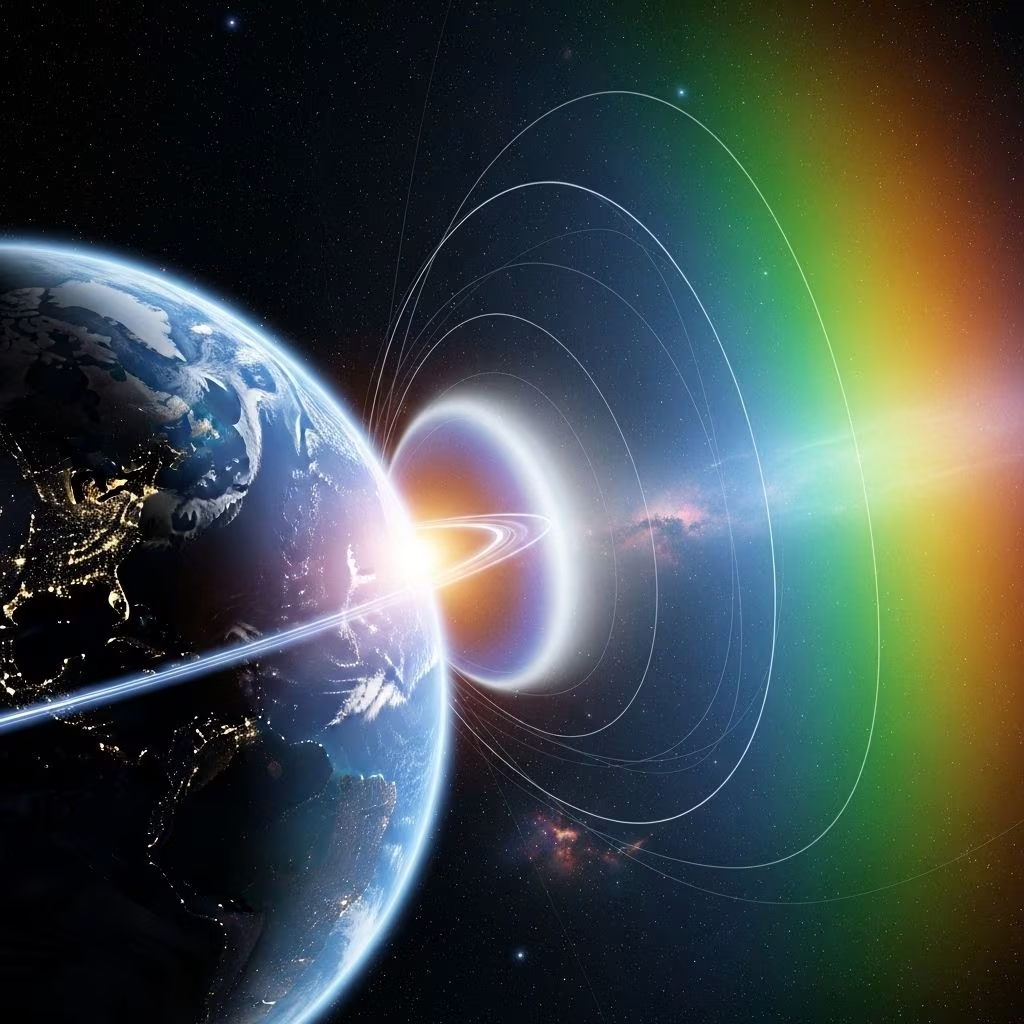
The Van Allen Radiation Belts are donut-shaped zones encircling Earth, filled with high-energy protons, electrons, and some heavier ions. These charged particles are trapped within the belts by Earth’s magnetic field, forming two primary regions: the inner belt and the outer belt. In 2012, a temporary third belt was detected during a period of intense solar activity, further underlining the complexity of these phenomena.
- Inner Belt: Closest to Earth, extending from about 1,000 km (600 miles) to 6,000 km (3,700 miles) above the surface, primarily containing energetic protons.
- Outer Belt: Ranging from roughly 15,000 km (9,300 miles) to 25,000 km (15,500 miles), dominated by high-energy electrons and variable due to solar activity.
- Third Belt: Discovered briefly in 2012, appearing between the inner and outer belts during strong geomagnetic storms and later dissipating.[10]
Physical Structure and Dynamics
These belts are far from static; they are shaped by the interaction of solar wind and Earth’s magnetic field. The belts’ intensity and breadth can vary according to processes like geomagnetic storms, which inject additional particles into the belts and cause their boundaries to fluctuate—sometimes forming sub-belts or even entirely new ones temporarily.[10]
Origins of the Trapped Particles
The energetic particles in the Van Allen belts originate mainly from:
- Solar Wind: Charged particles emitted in all directions by the Sun.
- Cosmic Rays: High-energy particles from outside our solar system that interact with Earth’s atmosphere and magnetic field.
- Residual Atomic Explosions: Artificial belts were temporarily formed in the late 1950s and early 1960s from high-altitude nuclear tests, but these dissipated with time.
Discovery and Exploration
The existence of the belts was revealed during America’s earliest ventures into space. James Van Allen and his team at the University of Iowa discovered unexpected high levels of radiation as Explorer 1, the first U.S. satellite, orbited the Earth in 1958. The data, confirmed by subsequent satellites, established the study of radiation belts as a cornerstone of space science.
- Explorer 1 & 3 Satellites: First detected powerful radiation bands around Earth.
- Van Allen Probes (2012-2019): Provided the most comprehensive data about the structure, composition, and variability of the belts.
The Role of Dr. James Van Allen
Dr. James Van Allen championed instrumentation capable of measuring high-radiation environments. In recognition, the belts were named in his honor, and his research paved the way for a deeper understanding of the space environment around Earth.[10]
The Structure of the Belts and Their Behavior
| Region | Altitude (Approx.) | Main Constituents | Behavior |
|---|---|---|---|
| Inner Belt | 1,000 – 6,000 km | Protons (energetic), some electrons | Stable, cosmic-ray origin, intense radiation |
| Outer Belt | 15,000 – 25,000 km | Electrons (highly energetic), lower-energy protons | Highly variable, influenced by solar storms |
| Temporary/Third Belt | Varies (between inner and outer belts) | Mix of high-energy particles | Forms and dissipates during intense geomagnetic activity |
The belts are not perfectly symmetrical due to the tilt and offset of Earth’s magnetic field, resulting in variations in thickness and intensity across different regions. Charged particles spiral along magnetic field lines, bouncing between the poles while drifting around the planet.
Hazards and Challenges
While the Van Allen belts are a natural shield against cosmic ray bombardment, they pose specific dangers to satellites, spacecraft, and astronauts passing through them.
- Radiation Damage: Electronics and solar panels aboard satellites can be damaged or degraded by energetic particles, leading to malfunctions.
- Health Risks for Astronauts: Human space travelers must transit the belts quickly or be adequately shielded to minimize radiation exposure.
- Communication Blackouts: Satellites in highly elliptical orbits may experience communication losses or data corruption as they traverse high-intensity regions.
The level of radiation is measured in units called “rads.” In the most intense regions, the belts can deliver a lethal dose within an hour in the absence of adequate shielding.
The Van Allen Belts and the Apollo Missions
Some have questioned how Apollo astronauts survived their journeys through the belts. NASA explains that the spacecraft traveled through the thinnest parts rapidly, and the cumulative radiation dose for each crew was measured at less than 2 rads for the entire lunar mission—well within safe limits for human exposure.
The Role of the Belts in Protecting Earth
The primary benefit of the Van Allen belts is their protection of life on Earth. The belts deflect and trap much of the high-energy solar and cosmic particle flux that would otherwise reach the planet’s surface, thus:
- Preserving the atmosphere by preventing atmospheric erosion by energetic particles.
- Shielding surface life from DNA-damaging cosmic rays and solar particles.
- Contributing to auroras by funnelling some particles toward the polar regions, where they interact with atmospheric gases to produce luminous displays.
Analogues Beyond Earth
Earth is not alone in possessing radiation belts. Several other planets with strong magnetic fields, such as Jupiter and Saturn, also have radiation belts, often many times more powerful than those surrounding Earth.
Understanding and Monitoring the Belts
Modern science employs specialized spacecraft and instruments to continually observe the Van Allen belts:
- Van Allen Probes: Launched in 2012 by NASA, these twin satellites revolutionized our knowledge of belt dynamics, particle acceleration and loss, and the response to solar storms.
- Ongoing Satellite Monitoring: Nearly all satellites bound for high orbits or interplanetary travel monitor space weather conditions to plan safe operations.
Continuing research aims to clarify how particles are accelerated to such high energies and what mechanisms control their losses from the belts. This knowledge is critical for forecasting the effects of solar storms and for the safety of future crewed missions beyond low Earth orbit.[10]
Key Facts About the Van Allen Radiation Belts
- The belts are not visible to the naked eye, as their emissions are in the form of radiation not detectable by human senses.
- The belts’ composition and structure can change rapidly in response to solar storms.
- Satellites are often placed in orbits that either avoid the most intense parts of the belts or are specially shielded to withstand the environment.
- The inner belt is populated predominantly by energetic protons, while the outer belt hosts energetic electrons.
- Earth’s magnetic field is key to both the existence and the variability of these belts.
Frequently Asked Questions (FAQs)
Q: Why are the Van Allen belts important for space exploration?
A: They pose radiation hazards that must be considered when designing spacecraft and planning astronaut journeys. Understanding the belts enables safe satellite operation and human spaceflight.
Q: Can the Van Allen belts be seen from Earth?
A: No, the belts emit radiation at energies invisible to human eyes, though their effects can be detected with specialized instruments.
Q: How do the belts affect satellites?
A: Prolonged exposure can damage electronics and solar panels and sometimes shorten satellite lifespans. Spacecraft are designed with shielding, and orbits are sometimes chosen to minimize exposure.
Q: Are similar belts found around other planets?
A: Yes, planets with strong magnetic fields like Jupiter and Saturn have their own, often larger, radiation belts composed of energetic particles.
Q: Did the Apollo astronauts pass through the belts safely?
A: Yes. NASA mission planners chose a trajectory that passed quickly through the thinnest parts of the belts, limiting exposure to below dangerous levels.
Conclusion: Why the Van Allen Belts Matter
The Van Allen Radiation Belts are both a challenge and a shield—posing obstacles to human technology and exploration, while protecting the Earth from cosmic radiation that could threaten the atmosphere and all life. Ongoing research helps safeguard our increasingly space-dependent society and propels humanity on its journey deeper into the cosmos.
References
- https://science.nasa.gov/biological-physical/stories/van-allen-belts/
- https://en.wikipedia.org/wiki/Van_Allen_radiation_belt
- https://spacecenter.org/what-are-the-van-allen-radiation-belts/
- https://www.britannica.com/science/Van-Allen-radiation-belt
- https://science.howstuffworks.com/dictionary/astronomy-terms/van-allen-radiation-belts-info.htm
- https://www.ebsco.com/research-starters/history/van-allen-radiation-belts
- https://www.youtube.com/watch?v=h9YN50xXFJY
- https://www.youtube.com/watch?v=FICprq_1u5Y
- https://farside.ph.utexas.edu/teaching/plasma/Plasmahtml/node24.html
- https://www.nasa.gov/solar-system/studying-the-van-allen-belts-60-years-after-americas-first-spacecraft/
- https://www.thesuntoday.org/heliosphere/van-allen-belts/
- https://en.wikipedia.org/wiki/Van_Allen_Radiation_Belt
- https://vanallenprobes.jhuapl.edu/Mission/index.php
- https://www.skyatnightmagazine.com/space-science/van-allen-belts
- https://www.merriam-webster.com/dictionary/Van%20Allen%20belt
- https://aerospace.org/article/van-allen-probes-reveal-hidden-radiation-belts
- https://www.vedantu.com/geography/van-allen-radiation-belt