


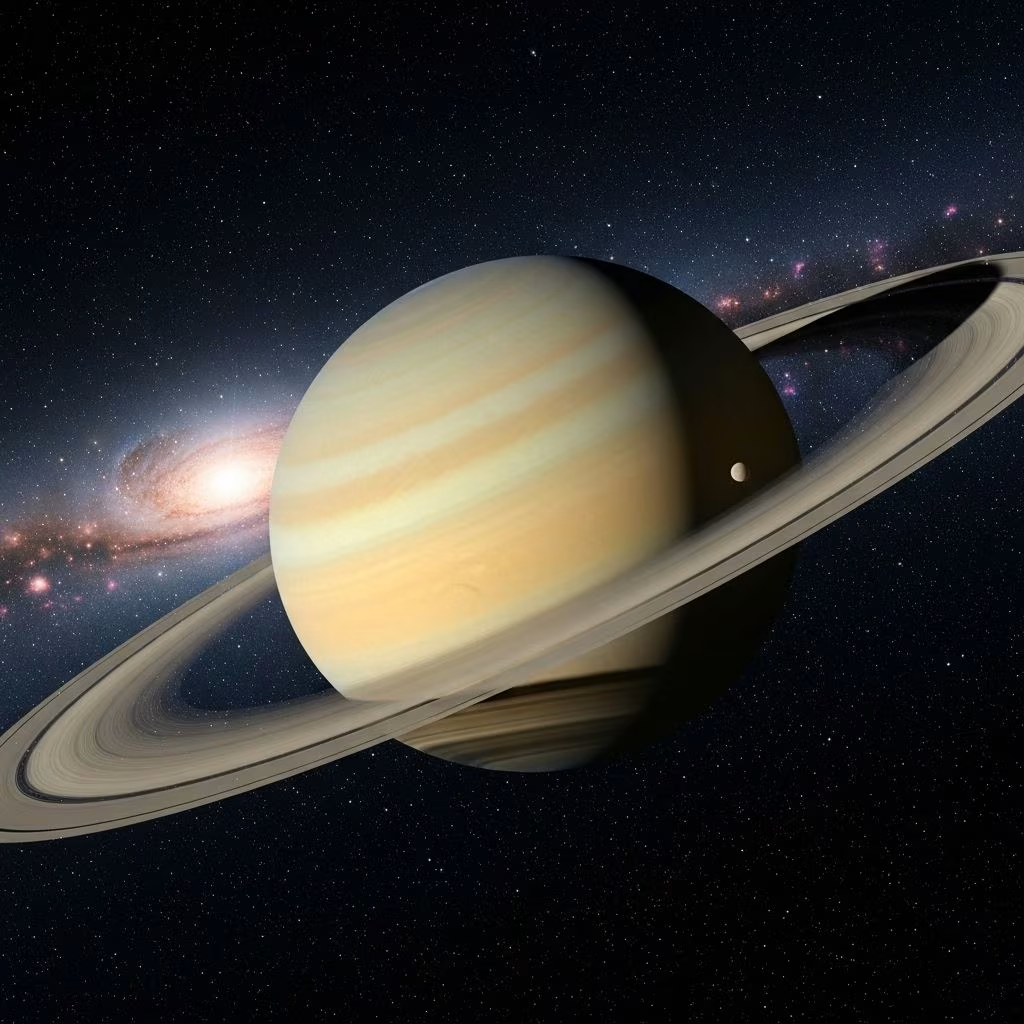
Saturn, the spectacular sixth planet from the Sun, is renowned for its stunning rings and large family of moons. But beyond its famous visual features lies a world composed mostly of light gases, extreme temperatures, intricate internal layers, and powerful weather systems. Discovered in antiquity and visited by several spacecraft, Saturn has inspired curiosity for centuries. Modern science allows us to penetrate its glowing clouds and decode the true nature of this giant planet.
Saturn at a Glance
- Sixth planet from the Sun in our Solar System
- Second-largest planet: Only Jupiter exceeds its volume
- Diameter: About nine times that of Earth
- Mass: 95 times that of Earth, but with much lower average density
- Orbital period: About 29.5 Earth years
- Famous for: Extensive and bright ring system, and at least 274 moons
Saturn’s Basic Composition
Like its fellow gas giant Jupiter, Saturn is dominated by hydrogen and helium, the most abundant elements in the universe. Saturn’s overall composition provides crucial clues to its formation and the evolution of the Solar System.
| Element | Approximate Proportion |
|---|---|
| Hydrogen (H2) | ~96% |
| Helium (He) | ~3% |
| Trace Elements (Methane, Ammonia, others) | ~1% |
These light gases, inherited from the primordial solar nebula, make Saturn the least dense planet: with an average density less than water. If you could place Saturn in a giant bathtub, it would float!
Internal Structure: A Layered Giant
Despite the evocative label “gas giant,” Saturn is more structurally complex than a simple ball of gas. Its mass is distributed through several distinct layers, each with unique chemistry and physical state. Understanding these layers helps explain the planet’s weather, magnetism, and even its dazzling rings.
Layers of Saturn’s Interior
- Outermost Layer: Gaseous hydrogen and helium atmosphere spanning about 1,000 km.
- Upper Clouds: Mostly ammonia ice crystals, responsible for Saturn’s faint yellow hue.
- Intermediate Layer: Liquid molecular hydrogen and helium; helium may form droplets that “rain” down, depleting helium content in outer regions.
- Metallic Hydrogen Layer: Under immense pressure, hydrogen behaves like an electrical conductor and becomes metallic, generating Saturn’s magnetic field.
- Core Region: Most models estimate a core of iron, rock, and ice-rich material, between 9–22 Earth masses, much denser than the gaseous layers above.
The distribution of these layers is inferred from gravitational measurements, models, and missions such as Cassini. Evidence suggests Saturn is more centrally condensed than Jupiter, with a greater proportion of dense materials near its center.
The Core: Rocky Heart or Fuzzy Boundary?
The nature of Saturn’s core remains a subject of active research. Based on measurements of gravity, ring behavior, and models of planetary formation, it is believed that Saturn harbors a core made of heavy elements—iron, nickel, silicates—possibly mixed with “ice” compounds like water, ammonia, and methane under intense pressures. This central region might be between 9 and 22 times the mass of Earth, with newer findings suggesting the boundary with the overlying metallic hydrogen could be diffuse or “blurry,” lacking a sharp transition. Estimates suggest the core could have a diameter of about 25,000 kilometers, up to 60% of the planet’s radius.
Atmosphere: Clouds, Winds, and Chemical Mysteries
Saturn’s atmosphere is a spectacular realm, dominated by hydrogen (over 90%) and helium (about 3%), with traces of methane, ammonia, and other volatile substances. Despite the simplicity of its base chemistry, Saturn’s clouds and weather phenomena are anything but dull.
Cloud Bands and Weather
- Pale Yellow Appearance: Due to ammonia ice crystals high in the clouds
- Belts and Zones: Saturn’s upper atmosphere is organized into wide alternating bands of lighter and darker clouds, though the contrasts are subtler than on Jupiter
- Superfast Winds: Wind velocities can exceed 1,800 km/h (1,100 mph)
- Giant Storms: Periodic massive storms—sometimes larger than Earth—appear, most notably the Great White Spots, with cycles lasting several decades
- Polar Hexagon: The north pole hosts a persistent, hexagonal jet stream feature, unique in the Solar System
The atmospheric composition leads to rapid rotation-driven dynamics, massive weather systems, and powerful auroras around the poles. The uppermost clouds are formed mainly of ammonia ice, with deeper levels containing ammonium hydrosulfide and water vapor clouds.
Energy Output and Internal Heat
Although Saturn receives sunlight like the other planets, it radiates nearly twice as much energy as it receives from the Sun. This excess internal heat arises from gravitational contraction—Kelvin-Helmholtz mechanism—and the “rainout” of helium droplets from the upper layers into the planet’s interior, which releases additional energy as the droplets fall.
Saturn’s Rings: The Icy Wonder
No discussion of Saturn is complete without mentioning its rings—the most famous in the Solar System.
- Composition: Mostly water ice (over 90%), with traces of rocky and dusty material
- Size and Structure: The rings span up to 282,000 km in diameter, but are extremely thin—sometimes only a few tens of meters thick
- Origin: Possibly remnants of shattered moons, comets, or other bodies torn apart by Saturn’s gravity
- Sections: Divided into several main components, labeled A, B, C, D, E, F, and G Rings, with complex structure and gaps maintained by gravitational interactions with moons (“shepherd moons”)
- Dynamics: The rings are not solid sheets; they are composed of countless individual particles, from tiny dust grains to chunks the size of mountains
The dazzling brightness and extensive scale of Saturn’s ring system continues to captivate astronomers and the public alike. They are distinct from the thin, faint ring systems of the other giant planets.
Magnetic Field: Saturn’s Invisible Shield
Saturn’s internal metallic hydrogen region enables the generation of a strong planetary magnetic field, though it is weaker than Jupiter’s. Saturn’s magnetic field is about 580 times stronger than that of Earth, yet its field is relatively symmetric around the planet’s axis. This field creates a magnetosphere that shields the planet from some solar wind and produces spectacular auroras at the poles, mimicking but not quite matching those of Earth or Jupiter.
Saturn’s Moons: A Host of Diversity
Saturn is orbited by more than 270 confirmed moons, ranging from the massive Titan—larger than Mercury and possessing a thick atmosphere—to countless small “moonlets” embedded in and around the rings. Each moon is a world unto itself, revealing different aspects of the Saturnian environment.
- Titan: Largest moon, has lakes and seas of liquid methane and ethane, dense nitrogen-rich atmosphere
- Enceladus: Active icy moon, with geysers venting water from a subsurface ocean
- Mimas, Tethys, Dione, Rhea, Iapetus: Smaller moons with icy surfaces, craters, and geological histories
Some moons, like Pan and Daphnis, orbit within the rings and help maintain the rings’ structure. These moons highlight the complexity and dynamism of the Saturnian system.
How Saturn Differs from Jupiter
Despite both being gas giants, Saturn stands apart from Jupiter in several ways:
- Lower Density: Saturn is less dense than water, while Jupiter is denser
- Smaller Core-to-Planet Ratio: Saturn’s core may be proportionally larger than Jupiter’s compared to the planet’s overall mass
- Rings: Saturn’s rings are vastly more massive and visible than Jupiter’s thin, dusty ones
- Atmosphere: Saturn’s cloud bands are more subtle in color and contrast
- Energy Budget: Both radiate excess heat, with Saturn’s additional energy coming from helium differentiation and ongoing contraction
Why Study Saturn’s Composition and Structure?
The study of Saturn’s chemistry and physical layers provides scientists with vital information on:
- Solar System Formation: The similar composition of Saturn and Jupiter with the Sun points to shared origins in the solar nebula.
- Planetary Evolution: Helium rain and internal heat flow help explain how massive planets evolve over billions of years.
- Exoplanets: Saturn’s structure serves as a model for interpreting data from distant gas giants orbiting other stars.
- Extreme Chemistry and Physics: The transition of hydrogen into metallic states under pressure cannot be replicated on Earth, but happens within Saturn.
Frequently Asked Questions (FAQs)
Q: Is Saturn made entirely of gas?
A: While Saturn is classified as a gas giant, it’s not purely gas all the way through; beneath the gaseous atmosphere and layers lies a dense core of heavier elements, much larger than Earth, surrounded by metallic and molecular hydrogen layers.
Q: Could a spacecraft land on Saturn’s surface?
A: Saturn does not have a solid surface like Earth or Mars. Any probe or hypothetical lander would descend into increasingly dense and hotter gases and eventually be crushed and vaporized by the immense pressure and temperature deep within the planet.
Q: Why are Saturn’s rings so prominent compared to Jupiter’s?
A: Saturn’s rings are much larger and brighter because they contain more ice, are more massive, and are less contaminated by dust than the faint, dark rings of Jupiter. The origin and maintenance of these rings involve unique interactions between Saturn’s moons and the planet’s gravity.
Q: What makes Saturn less dense than water?
A: Saturn’s overall composition is dominated by light elements, mostly hydrogen and helium, resulting in an average density of 0.687 g/cm³, less than that of liquid water.
Q: How does Saturn create its magnetic field?
A: Saturn’s magnetic field is generated by the movement of metallic hydrogen deep within the planet’s interior, though it is less intense than Jupiter’s and is remarkably symmetric about Saturn’s rotational axis.
Key Takeaways
- Saturn is a gas giant made mainly of hydrogen and helium, with a layered structure culminating in a dense core.
- The planet’s iconic rings are composed mostly of water ice and are the most brilliant and extensive in our Solar System.
- Huge storms, rapid winds, and persistent atmospheric patterns make Saturn a dynamic world.
- Moons such as Titan and Enceladus highlight the diversity and complexity of the Saturnian system.
- Understanding Saturn’s chemistry and structure helps unravel the mysteries of planetary formation and evolution throughout the universe.
References
- https://en.wikipedia.org/wiki/Saturn
- https://science.nasa.gov/saturn/facts/
- https://science.nasa.gov/saturn/
- https://www.britannica.com/place/Saturn-planet
- https://www.britannica.com/place/Saturn-planet/The-interior
- https://www.ebsco.com/research-starters/astronomy-and-astrophysics/saturns-interior
- https://coolcosmos.ipac.caltech.edu/ask/116-what-is-saturn-made-of-
- https://courses.lumenlearning.com/suny-astronomy/chapter/composition-and-structure-of-planets/
- https://planetfacts.org/what-is-saturn-made-of/
- https://www.asc-csa.gc.ca/eng/astronomy/solar-system/saturn.asp
- https://cseligman.com/text/planets/saturnstructure.htm
- https://www.lpi.usra.edu/education/IYPT/Saturn.pdf
- https://www.pas.rochester.edu/~blackman/ast104/sfeatures.html
- https://airandspace.si.edu/explore/stories/saturn
- https://www.letstalkstars.com/saturns-composition/
- https://lovethenightsky.com/what-is-saturn-made-of/
- https://study.com/learn/lesson/saturn-facts-rings-temperature-size.html


