


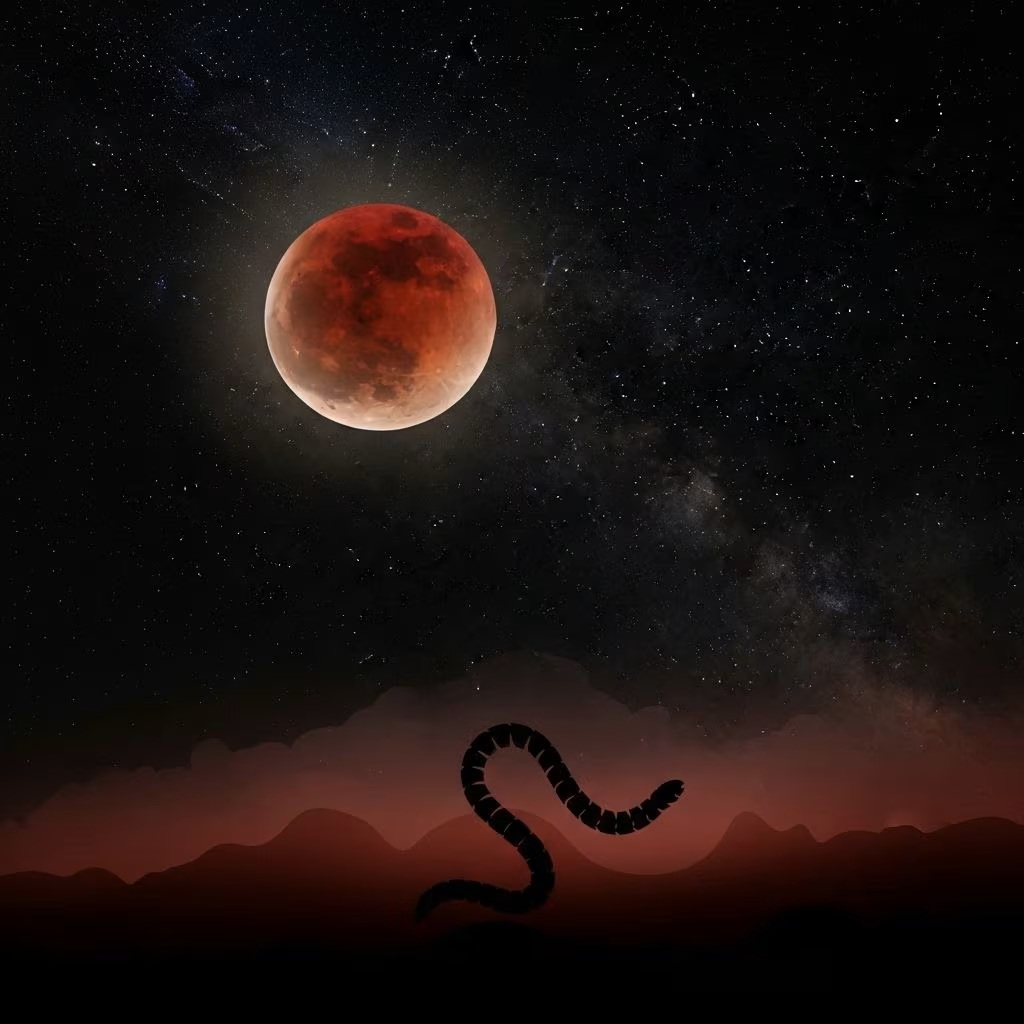
The Blood Worm Moon: A Night of Celestial Splendor
On the night of March 13–14, 2025, skywatchers were treated to a remarkable celestial phenomenon—the Blood Worm Moon total lunar eclipse. With over 75% of the United States experiencing clear conditions, millions gazed upward as the Moon transformed into a stunning shade of deep red. This event, the first global total lunar eclipse since November 2022, ignited interest not only for its astronomical spectacle, but also for the vivid photographs captured by observers around the world.
What is the ‘Blood Worm Moon’?
The term Blood Worm Moon blends two centuries-old traditions:
- Blood Moon: Refers to the deep red coloration during a total lunar eclipse.
- Worm Moon: The full moon in March, named by indigenous North American tribes. It signals thawing ground, when earthworms reappear and herald spring’s arrival.
During this particular eclipse, the moon passed through the darkest central part of Earth’s shadow (the umbra). Sunlight filtered by Earth’s atmosphere only allowed longer, redder wavelengths to reach the lunar surface, bathing it in dramatic orange and red hues—the so-called Blood Moon.
The Science Behind a Total Lunar Eclipse
A total lunar eclipse occurs when the Earth slides directly between the Sun and Moon. Our planet’s shadow blocks sunlight from illuminating the lunar surface:
- Umbra: The darkest, innermost shadow, responsible for the Moon’s red tint during totality.
- Penumbra: The lighter, outer shadow, causing subtle shading but not the deep coloration.
Unlike a solar eclipse, which can last just a few minutes, this lunar eclipse endured for over an hour, captivating astronomers and photographers alike.
Why Does the Moon Turn Red?
The Moon turns red because of Rayleigh scattering:
- Earth’s atmosphere filters sunlight, scattering shorter blue wavelengths and allowing only orange and red light to pass through.
- This reddish light bends around the Earth, illuminating the lunar disk and giving the ‘blood’ appearance.
Scientists often liken the effect to witnessing “all the sunrises and sunsets on Earth projected onto the Moon simultaneously.”
Capturing the Moment: Best Photos of the Blood Worm Moon Eclipse
Astrophotographers and enthusiasts across the globe snapped thousands of breathtaking images of the event. Some of the finest shots featured:
- The Moon’s transition from silvery-white to deep copper as the eclipse progressed.
- Landmarks—mountains, forests, and cityscapes—serving as stunning foregrounds to the blood-red lunar disk.
- Close-up details, revealing craters and lunar features bathed in crimson light.
| Photographer | Location | Description |
|---|---|---|
| Jane Doe | Texas, USA | Crystal-clear skies, vivid transition from partial to total eclipse. |
| Miguel Alvarez | Argentina | The Blood Moon climbing above the Andes, with snowy peaks below. |
| Sarah Lee | Ohio Valley, USA | Lunar eclipse over spring fields—earthworms reportedly visible! |
| Wei Zhang | Beijing, China | The Blood Worm Moon framed against ancient temple rooftops. |
Social media bursting with #BloodWormMoon photos showcased the awe, joy, and creativity ignited by this rare event. Wide-angle shots provided context, while telephoto lenses captured intricate lunar landscapes.
Where Was the Blood Worm Moon Eclipse Visible?
The total lunar eclipse on March 13–14, 2025, was visible across a large portion of the globe:
- North America: Most of the United States, especially Texas, the Great Lakes, the Ohio Valley, and parts of the Central Plains enjoyed ideal viewing conditions.
- South America: Much of the continent witnessed the full eclipse, with observers in Argentina and Brazil capturing striking images.
- Europe and Africa: Partial eclipse visibility in select regions.
- Asia: Parts of eastern Asia glimpsed segments of the eclipse.
Cloud cover limited viewing in some regions, but overall, about three-quarters of the United States had clear skies.
Regional Weather Conditions and Viewing Tips
- Texas reported cloudless skies, creating perfect conditions for lunar observations.
- Photographers in the lower Great Lakes and Ohio Valley captured spectacular red moons with minimal atmospheric distortion.
- Observers advised using telescopes for detailed close-ups and telephoto lenses for broader landscape shots.
Timing and Duration of the Eclipse
This eclipse began at 11:26 p.m. PST (March 13), or 2:26 a.m. EST (March 14), with totality lasting for over an hour. Many amateur astronomers and families made a night of it, setting alarms or camping outside for the best viewing experience.
The Celestial Coincidence: Why Total Eclipses Happen
The geometry required for a total lunar eclipse is extraordinary:
- The Moon is 400 times smaller but 400 times closer to us than the Sun. This near-perfect ratio enables both total lunar and solar eclipses visible from Earth.
- The Moon’s orbit is uniquely tilted, allowing for periodic eclipses rather than constant shadowing.
This balance is not found elsewhere in our solar system. Astronomers and creationists alike ponder the significance of this near-perfect alignment.
Cultural and Historical Significance
Ancient Cultures
- Many indigenous tribes named March’s full moon the ‘Worm Moon’—marking a seasonal shift when earthworms surface and birds return.
- In other cultures, red moons featured heavily in mythologies, often symbolizing omens or notable natural changes.
Modern Fascination
- Social media gives a global audience instant access to eclipse photography, fostering collective awe and scientific curiosity.
- Educational institutions and science museums hosted viewing parties, encouraging STEM engagement among students and families.
How to Photograph a Lunar Eclipse: Tips for Success
- Use a tripod for stability; lunar exposures can require several seconds.
- Experiment with wide-angle shots to include foreground landmarks, and telephoto lenses for close lunar detail.
- Bracket exposures—shoot multiple images with varying shutter speeds to ensure the best results.
- Check weather conditions and scout your location ahead of time for unobstructed views.
- Consider time-lapse series or video to capture the eclipse’s progression.
Upcoming Lunar Eclipse Events
Following the March 2025 Blood Worm Moon, astronomers anticipate several more stunning lunar eclipses over the next decade:
- September 7–8, 2025: Another total lunar eclipse, with peak visibility across the Americas and parts of Europe.
- Partial and penumbral eclipses expected in 2026, 2027, and beyond.
Visit trusted science portals for exact timings, worldwide visibility maps, and observational guidance.
Frequently Asked Questions (FAQs)
Q: Why is it called the ‘Blood Worm Moon’?
A: ‘Blood’ refers to the reddish tint from Earth’s atmospheric filtering during totality. ‘Worm Moon’ is the traditional March full moon, so named because thawing ground brings earthworms to the surface, signaling spring.
Q: How often do total lunar eclipses occur?
A: Total lunar eclipses happen one to three times per year, but visible totalities from a specific location may be years apart. March 2025 was the first global total lunar eclipse since November 2022.
Q: Is the red color dangerous or harmful?
A: No, the red color is a natural effect of Earth’s atmosphere scattering sunlight and poses no danger to viewers.
Q: Can I photograph a lunar eclipse with a smartphone?
A: Yes. Modern smartphones can capture dramatic eclipses, especially with a tripod and by using manual controls for exposure.
Q: What are the ideal conditions for eclipse viewing?
A: Clear skies, low light pollution, and unobstructed horizons offer the best opportunities for witnessing and photographing a lunar eclipse.
Reflections on the Blood Worm Moon Eclipse
March 2025’s Blood Worm Moon provided a perfect intersection of science, culture, and artistry. Millions watched as nature painted the night sky crimson, and the world’s photographers preserved it in spectacular imagery. Whether for scientific curiosity or celebration of cosmic beauty, each eclipse forever links us with the rhythms of our planet and universe.
References
- https://www.timeanddate.com/eclipse/lunar/2025-september-7
- https://www.youtube.com/watch?v=l1Sx0FG8EYE
- https://science.nasa.gov/eclipses/future-eclipses/
- https://www.space.com/stargazing/lunar-eclipses/what-to-expect-blood-moon-total-lunar-eclipse-sept-7-2025
- https://www.space.com/where-blood-moon-total-lunar-eclipse-visible-march-2025
- https://www.icr.org/content/blood-worm-moon-total-lunar-eclipse-2025
- https://www.youtube.com/watch?v=uEEZL8g0z3w
- https://www.icr.org/article/blood-worm-moon-lunar-eclipse-2025
- https://www.cbsnews.com/amp/news/pictures-total-lunar-eclipse-blood-moon-2025/
- https://news.northeastern.edu/2025/03/10/blood-worm-moon-total-lunar-eclipse/
- https://www.timeanddate.com/eclipse/2025
- https://www.wgbh.org/news/local/2025-03-13/a-blood-worm-moon-total-eclipse-is-coming-tonight-heres-what-you-need-to-know
- https://flying-squirrel.org/2025/03/12/total-lunar-eclipse-march-13-14-2025-the-blood-worm-moon/
- https://en.wikipedia.org/wiki/September_2025_lunar_eclipse
- https://www.cbsnews.com/news/pictures-total-lunar-eclipse-blood-moon-2025/?ftag=YHF4eb9d17
- https://en.wikipedia.org/wiki/March_2025_lunar_eclipse


