Io: Jupiter’s Volcanic Moon
Io is widely recognized as the most volcanically active world in the solar system. Orbiting Jupiter, this remarkable moon features extreme geological activity—ranging from towering volcanoes to mountains rising beyond the heights of Everest, and landscapes painted in vibrant hues of sulfur and ash.
From ancient discoveries to modern robotic observations, Io has continually surprised scientists, offering a window into planetary dynamics and the fundamental forces shaping the outer solar system.
Formation and Discovery
Io is the innermost of the four major Galilean moons of Jupiter, alongside Europa, Ganymede, and Callisto. Galileo Galilei first observed these moons in 1610, revolutionizing the understanding of our solar system and supporting the heliocentric model.
Io is thought to have formed about 4.5 billion years ago, not long after Jupiter itself, sharing the chaotic early history of the solar system.
Io stands out for its relatively small size (diameter about 3,642 km), yet its importance in planetary science is enormous. It has a mass and volume comparable to Earth’s Moon.
- Discovered: 1610 by Galileo Galilei
- Diameter: 3,642 km (slightly larger than Earth’s Moon)
- Orbital Period: 1.77 days around Jupiter[11]
Io Orbit and Physical Characteristics
Io orbits Jupiter at a mean distance of about 421,700 km. Its rapid orbital period (just under two Earth days) causes intense gravitational interactions with Jupiter and neighboring moons.
Such close proximity subjects Io to strong radiation and gravitational forces, both central to its unique volcanic properties.
| Characteristic | Value |
|---|---|
| Orbital Distance | ~421,700 km from Jupiter |
| Rotation/Orbit | 1.77 Earth days (locked synchronous rotation) |
| Gravity | ~1.8 m/s2 (about 0.18g Earth) |
| Surface area | Comparable to Moon |
Volcanic Activity
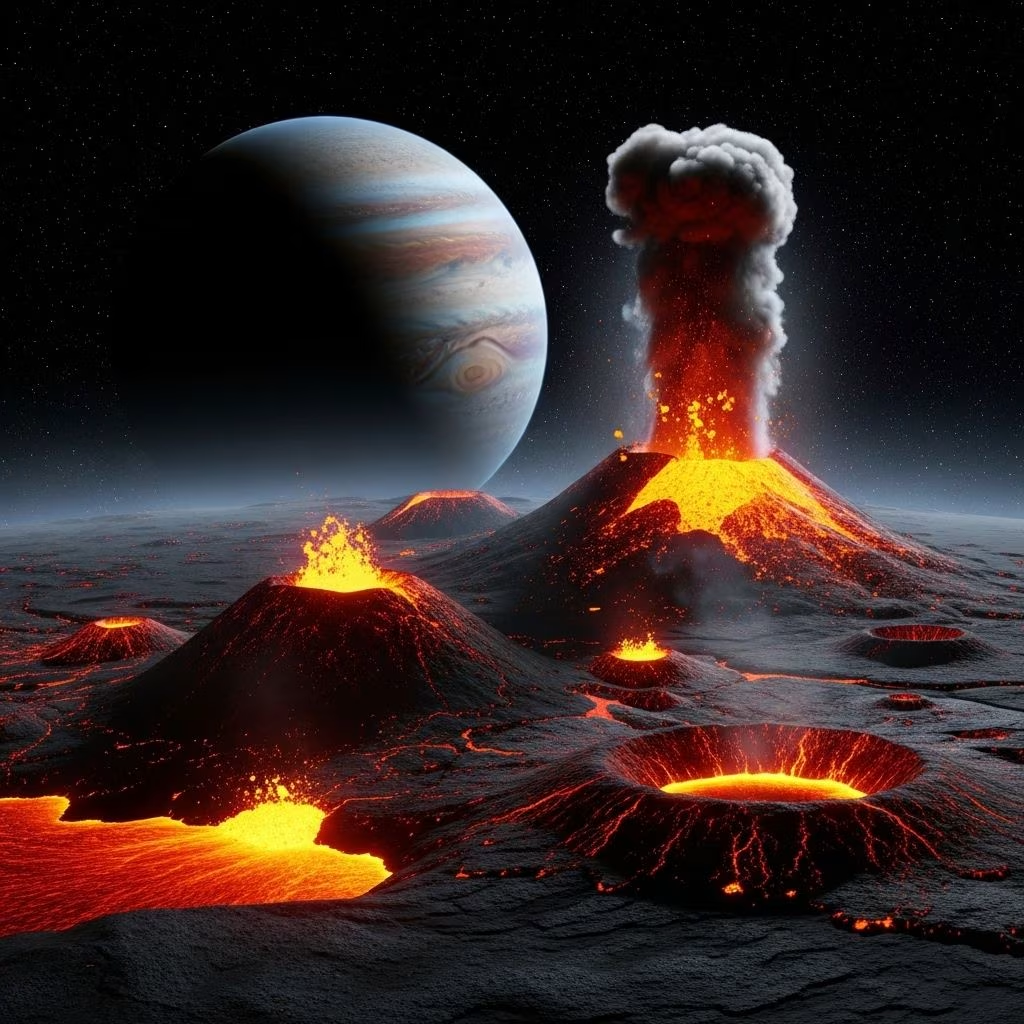
Io boasts over 400 active volcanoes, making it the most volcanically active body in our solar system. Its eruptions dwarf those found on Earth both in frequency and scale:
- Plumes of volcanic gas and dust shoot more than 200 kilometers above the surface.
- Lava lakes and flows cover immense tracts of the surface.
- More than 150 volcanoes have been directly observed; estimates suggest total counts exceed 400.
- Eruptions deposit bright yellow, orange, red, and white sulfur compounds across the moon’s terrain.
- Largest volcanic eruptions can eject up to 109 kg of material.
Volcanic activity on Io is so intense that some volcanic plumes may be visible through telescopes from Earth during major eruptions. The first confirmation of Io’s volcanism came from Voyager 1 in 1979, a discovery that forever changed astronomers’ view of planetary geology.
Tidal Heating and Geological Processes
The energy source fueling Io’s volcanoes is unique: tidal heating.
Unlike Earth, whose internal heat comes mainly from radioactive decay, Io is heated by tidal forces. Its eccentric orbit around Jupiter causes the planet’s immense gravity to alternately stretch and compress Io, generating internal friction and immense amounts of heat[11].
- Io’s orbital resonance with Europa and Ganymede maintains eccentricity, preventing the moon’s orbit from settling into a perfect circle[11].
- This continual flexing and squeezing melts the moon’s interior, sustaining volcanic activity over billions of years[13].
- Without this mechanism, Io would be geologically dead and pockmarked by impact craters, like Earth’s Moon.
Comparison: Tidal Heating vs. Radioactive Heating
| Heating Mechanism | Primary on | Source | Geological Effect |
|---|---|---|---|
| Tidal Heating | Io | Gravitational flexing from Jupiter & neighboring moons | Extreme volcanism, constant surface renewal |
| Radioactive Decay | Earth, Moon | Decay of radioactive isotopes in the mantle | Moderate volcanism/tectonics, gradual cooling |
Atmosphere and Surface Composition
Io’s atmosphere is exceedingly thin and composed predominantly of sulfur dioxide (SO2) volcanic emissions. The environment is toxic and unbreathable, with constant outgassing sustaining a tenuous atmospheric envelope.
- Atmospheric gases escape into space at a rate of about one ton per second.
- Some material forms a ring of charged particles (the Io plasma torus) around Jupiter.
- Layers of sulfur frost cover broad regions, with atmospheric gases condensing and precipitating on the surface.
This surface is primarily silicate rock, streaked and veiled by sulfur particles and compounds ejected from volcanoes. The variety of sulfur compounds creates Io’s distinctive bright yellow, white, orange, and red landscapes.
Landscape Features
Io’s surface is a dramatic patchwork of volcanoes, mountains, pits, and lava lakes. The moon features some of the tallest peaks in the solar system:
- Mountains: Io has mountains that exceed the height of Earth’s Mount Everest (average peaks reach 6 km high).
- Lava flows: Rivers of hot, liquid rock crisscross the terrain, often more extensive than those seen on Earth or elsewhere.
- Calderas and depressions: Volcanic pits and plateau regions mark sites of past and present eruptions.
- Coloration: Io’s palette changes depending on volcanic activity and chemical deposition, with constantly shifting splotches and streaks.
The lack of substantial craters, despite Io’s ancient age, demonstrates rapid resurfacing thanks to unceasing volcanism.
Robotic Exploration and Missions
Robotic spacecraft have revolutionized our understanding of Io since the late 20th century:
- Voyager 1 & 2: First captured Io’s volcanic plumes in 1979, confirming active volcanism.
- Galileo Orbiter: Detailed studies of Io’s surface, volcanic activity, and atmosphere during multiple flybys (1990s–early 2000s).
- Juno Mission: Continues to observe Io’s volcanic eruptions and environment during Jupiter system flybys.
To date, no human missions are planned for Io, mainly due to the extreme radiation from Jupiter’s magnetosphere and the hazardous sulfur-rich environment. Robotic probes are likely to continue leading exploration.
Frequently Asked Questions (FAQs)
Q: Why is Io so volcanically active?
A: Io’s activity is caused by tidal heating—a result of Jupiter’s powerful gravity and orbital resonances with other moons, which knead and stretch Io and heat its interior.
Q: How dangerous is Io’s environment?
A: Io’s surface is highly toxic due to sulfur compounds, and intense radiation from Jupiter makes it hazardous for humans. Any mission would require robust shielding and unmanned probes.
Q: What are the colors seen on Io’s surface?
A: The surface colors arise from various forms of sulfur—yellow, orange, red, and white compounds—deposited by volcanic eruptions and surface frosts.
Q: How large are Io’s volcanoes compared to Earth?
A: Io’s plumes reach over 200 km high, vastly exceeding Earth’s largest volcanic eruptions, and its mountains rival or surpass Mount Everest in height.
Q: Has Io always been volcanically active?
A: Recent studies suggest Io’s volcanism has persisted for over 4 billion years, likely since the moon’s formation[13].
Q: Could life exist on Io?
A: Io’s toxic, highly radioactive surface is considered inhospitable to known life forms, though its presence deepens our insight into planetary processes and environments beyond Earth.
Key Takeaways
- Io is the most volcanically active body in the solar system, with hundreds of active volcanoes and continuous lava eruptions.
- Tidal forces from Jupiter and neighboring moons power Io’s internal heat, setting it apart geologically[11].
- Its landscape is shaped by recurrent volcanic activity, sulfur deposits, and massive mountains.
- The moon’s thin, sulfur-dioxide-rich atmosphere constantly escapes to space, contributing to Jupiter’s plasma torus.
- Io’s extreme environment provides a unique laboratory for understanding planetary science and volcanism.
References
- https://science.nasa.gov/jupiter/jupiter-moons/io/
- https://science.nasa.gov/jupiter/jupiter-moons/io/facts/
- https://www.planetary.org/worlds/io
- https://en.wikipedia.org/wiki/Volcanism_on_Io
- https://en.wikipedia.org/wiki/Io_(moon)
- https://www.caltech.edu/about/news/jupiters-moon-io-has-been-volcanically-active-for-billions-of-years
- https://space-facts.com/moons/io/
- https://www.space.com/space-exploration/juno/what-causes-volcanic-eruptions-on-jupiters-moon-io-scientists-arent-so-sure-anymore
- https://www.britannica.com/place/Io-satellite-of-Jupiter
- https://www.quantamagazine.org/whats-going-on-inside-io-jupiters-volcanic-moon-20250425/
- https://theplanets.org/io/
- https://online.kidsdiscover.com/quickread/jupiters-moon-io-solar-systems-most-volcanically-active-body
- https://nasaspacenews.com/2024/04/jupiters-moon-io-a-fiery-world-with-a-volcanic-history-spanning-billions-of-years/
- https://www.volcanocafe.org/a-quick-tour-of-volcanism-on-io/
- https://www.space.com/11647-jupiter-volcanic-moon-io-magma-ocean.html
- https://www.livescience.com/space/planets/jupiters-tormented-moon-io-just-unleashed-the-most-powerful-volcanic-event-ever-seen
- https://www.skyatnightmagazine.com/space-science/io-jupiter-volcanic-moon
- https://www.worldatlas.com/space/io-the-volcanic-moon-of-jupiter.html