


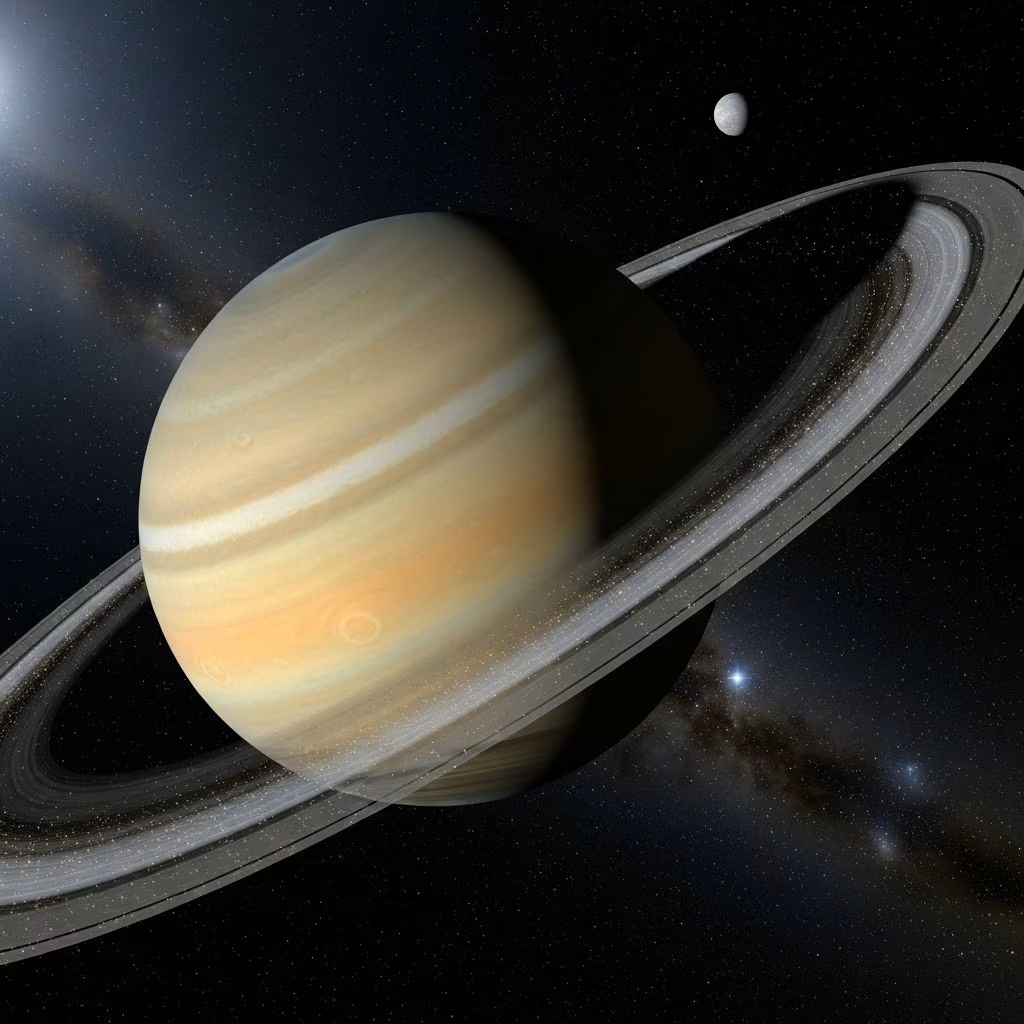
What Is Saturn Made Of?
Saturn, the sixth planet from the Sun, stands out in our solar system for its spectacular rings and massive size. As the second largest planet after Jupiter, Saturn’s composition and internal structure reveal much about the formation of giant planets and the evolution of our solar system. Understanding Saturn’s makeup involves investigating its atmospheric layers, core, and the mysterious materials that compose its famed rings.
Overview: The Gas Giant with Iconic Rings
Saturn is classified as a gas giant, sharing characteristics with Jupiter but possessing some unique features of its own. It is nearly nine times as large in radius compared to Earth, yet its average density is astonishingly low — roughly one-eighth that of our planet. In fact, Saturn is so light that it would float in water if a body large enough existed.
- Distance from Sun: ~1.43 billion km (9.59 AU)
- Mass: ~95 times Earth
- Orbital Period: ~29.45 years
- Moons: At least 274 known, with Titan the largest
- Rings: Made of ice, rock, and dust
Saturn’s Atmospheric Composition
The outermost layer of Saturn visible through telescopes and spacecraft is its atmosphere. The composition of Saturn’s atmosphere is dominated by two elements: hydrogen (H2) and helium (He). Trace amounts of other molecules give Saturn its distinct hues and contribute to cloud formation and storms.
| Component | Approximate Percentage |
|---|---|
| Hydrogen | ~96% |
| Helium | ~3% |
| Methane, Ammonia, Water Vapor | <1% |
| Other trace gases (e.g., ethane, phosphine) | Trace amounts |
Saturn’s pale yellow hue is largely due to the presence of ammonia crystals in its upper atmosphere. The planet’s atmosphere also features faint bands, storms, and occasional long-lived patterns. About every 30 years, powerful storms — including the spectacular “Great White Spot” — erupt, revealing dynamic weather and internal atmospheric processes.
Saturn’s Internal Structure
Beneath Saturn’s thick gaseous atmosphere lies a complex internal structure. Although Saturn is called a gas giant, most of its mass is not simply gaseous hydrogen and helium. Let’s break down the main internal layers:
- Core: At the very center, Saturn likely contains a dense rocky core composed of materials similar to Earth — iron, nickel, and silicates. The mass of Saturn’s core is estimated to be between 9 and 22 times that of Earth, making it much denser but surrounded by vast quantities of lighter materials.
- Liquid Metallic Hydrogen: Surrounding the core is a thick shell of metallic hydrogen. Under extreme pressures, hydrogen atoms lose their electrons and behave like metals, which contributes to Saturn’s magnetic field. The depth and extent of this layer are not fully known but are thought to make up a significant portion of the planet’s interior.
- Liquid Hydrogen and Helium: Above the metallic layer sits a region of liquid hydrogen, saturated with helium. This transitions gradually to gaseous forms at higher altitudes.
- Gaseous Envelope: The uppermost layer is a relatively thin envelope of hydrogen and helium gas, spanning about 1,000 km.
Pressure and Temperature
The deeper you travel into Saturn, the greater the pressure and temperature. In fact, Saturn’s core could reach temperatures of up to 10,000 K. These extremes ensure most heavy materials and ices in the interior remain in liquid or supercritical states, contributing to Saturn’s peculiar internal structure.
Not Just a “Big Ball of Gas”
While Saturn’s composition is predominantly hydrogen and helium, it has accumulated heavier elements over billions of years. This happens through regular collisions with smaller celestial bodies, including asteroid and comet fragments rich in rock and ice. Over time, these materials have sunk towards the planet’s core, enhancing its overall density and diversity of elements.
Metallic Hydrogen: Saturn’s Magnetic Field Generator
One of Saturn’s most intriguing layers is the liquid metallic hydrogen region. Here:
- Extreme pressures force hydrogen atoms into a metallic state.
- This region is vital for generating Saturn’s magnetic field, although its field is weaker than Jupiter’s but with a magnetic moment 580 times Earth’s.
- The movement of electrically charged particles in this layer produces planetary magnetism.
Saturn’s Rings: Ice, Rock, and Dust
No discussion of Saturn is complete without delving into its famous ring system. The rings are among the brightest and most extensive in the solar system. While dazzling from afar, the rings are surprisingly thin compared to their width. Their composition and origin remain topics of active research.
- Main Components: Mostly water ice (with particles ranging from micrometers to meters in size)
- Minor Components: Rocky debris, silicates, and dust
- Ring Size: Diameter exceeding 280,000 km but thickness typically less than 1 km
- Origin: Possibly formed from shattered moons or icy bodies captured by Saturn’s gravity
Saturn’s rings are divided into several main groups labeled A through G. Embedded in the rings are hundreds of “moonlets,” small bodies that help sculpt the overall structure via gravitational interactions. Spectral analysis reveals that the rings are made of ancient, pristine ice, with occasional dust contamination from meteoritic bombardment.
Cloud Layers and Weather Patterns
Saturn’s visible “surface” is really a collection of cloud tops. The upper layers consist mainly of ammonia ice clouds, while deeper levels may harbor ammonium hydrosulfide and even water ice clouds. The bands and spots that adorn Saturn are created by complex currents and weather phenomena, not landforms like on rocky planets.
- Great White Spot: Massive storm occurring roughly every Saturnian year (~30 Earth years)
- Wind Speeds: Up to 1,800 km/h (1,100 mph) — among the fastest planetary winds in the solar system
- Seasonal Changes: Driven by Saturn’s long orbital period and tilt
Comparison Table: Saturn vs Jupiter
| Feature | Saturn | Jupiter |
|---|---|---|
| Mass | ~95 Earths | ~318 Earths |
| Diameter | ~116,460 km | ~142,984 km |
| Atmosphere | Hydrogen, Helium | Hydrogen, Helium |
| Core | ~9–22 Earth masses | 10–30 Earth masses |
| Rings | Bright, extensive | Faint, thin |
| Moons | >150 confirmed | >80 confirmed |
Formation and Evolution
Both Saturn and Jupiter formed from the original solar nebula, with hydrogen and helium accreting onto dense rock and ice cores in the early days of the solar system. Saturn’s thinner rings and lower density suggest it collected less material than Jupiter, but followed a broadly similar evolutionary path.
Accumulation of Heavier Elements
- Post-formation, Saturn continued to collect asteroidal and cometary debris, contributing rock and ices to its structure.
- Most of this material sank to the core, increasing its mass and diversity.
Saturn’s Density and Unique Properties
Though enormous, Saturn’s density is so low (about 0.687 g/cm3) that it could theoretically float in water. This extreme low density results from its hydrogen composition and relatively smaller core, making Saturn the most oblate (flattened at the poles) planet in the solar system. Its low density is a direct consequence of the compressibility of hydrogen, which is less compressed under Saturn’s gravity compared to Jupiter.
Saturn’s Moons and Their Influence
With at least 274 moons and moonlets, Saturn hosts a remarkable entourage. Its largest moon, Titan, is particularly noteworthy:
- Titan: Larger than Mercury. Has a thick, nitrogen-rich atmosphere and surface lakes of methane and ethane.
- Enceladus: Features geysers of water ice erupting from its surface, suggesting a subsurface ocean.
- Interactions: Many moons interact with the rings, shaping gaps and edges through gravitational forces.
Frequently Asked Questions (FAQs)
Q: Is Saturn made entirely of gas?
A: No. While most of Saturn’s volume is gas (hydrogen and helium), it contains a dense core likely made of rock, iron, silicates, and “liquid ices” under high pressure.
Q: Why does Saturn have rings?
A: Saturn’s rings are likely the result of the breakup of icy moons or comets captured by Saturn’s gravity. The rings consist primarily of water ice, with rocky debris mixed in.
Q: How is Saturn’s magnetic field generated?
A: The magnetic field arises from motions of charged metallic hydrogen in Saturn’s interior — though weaker than Jupiter’s field, it is still much greater than Earth’s overall.
Q: What gives Saturn its color?
A: The pale yellow hue comes from ammonia crystals in the upper atmosphere, reflecting sunlight and giving Saturn its distinct appearance.
Q: What is “liquid metallic hydrogen”?
A: Under immense pressure, hydrogen atoms lose electrons and become electrically conductive, behaving like a metal. This exotic phase only exists deep within Saturn and Jupiter.
Q: How do Saturn’s storms compare to Jupiter’s?
A: Saturn’s storms are less frequent and less intense, but periodic phenomena like the “Great White Spot” rival Jupiter’s “Great Red Spot” in size and spectacle.
Sources
- Saturn – Wikipedia
- Saturn’s Interior – EBSCO
- Saturn | Britannica
References
- https://en.wikipedia.org/wiki/Saturn
- https://www.ebsco.com/research-starters/astronomy-and-astrophysics/saturns-interior
- https://www.britannica.com/place/Saturn-planet
- https://science.nasa.gov/saturn/
- https://www.space.com/18472-what-is-saturn-made-of.html
- https://www.esa.int/Science_Exploration/Space_Science/Cassini-Huygens/Saturn_s_atmosphere
- https://esahubble.org/wordbank/saturn/
- https://sos.noaa.gov/catalog/datasets/saturn/


