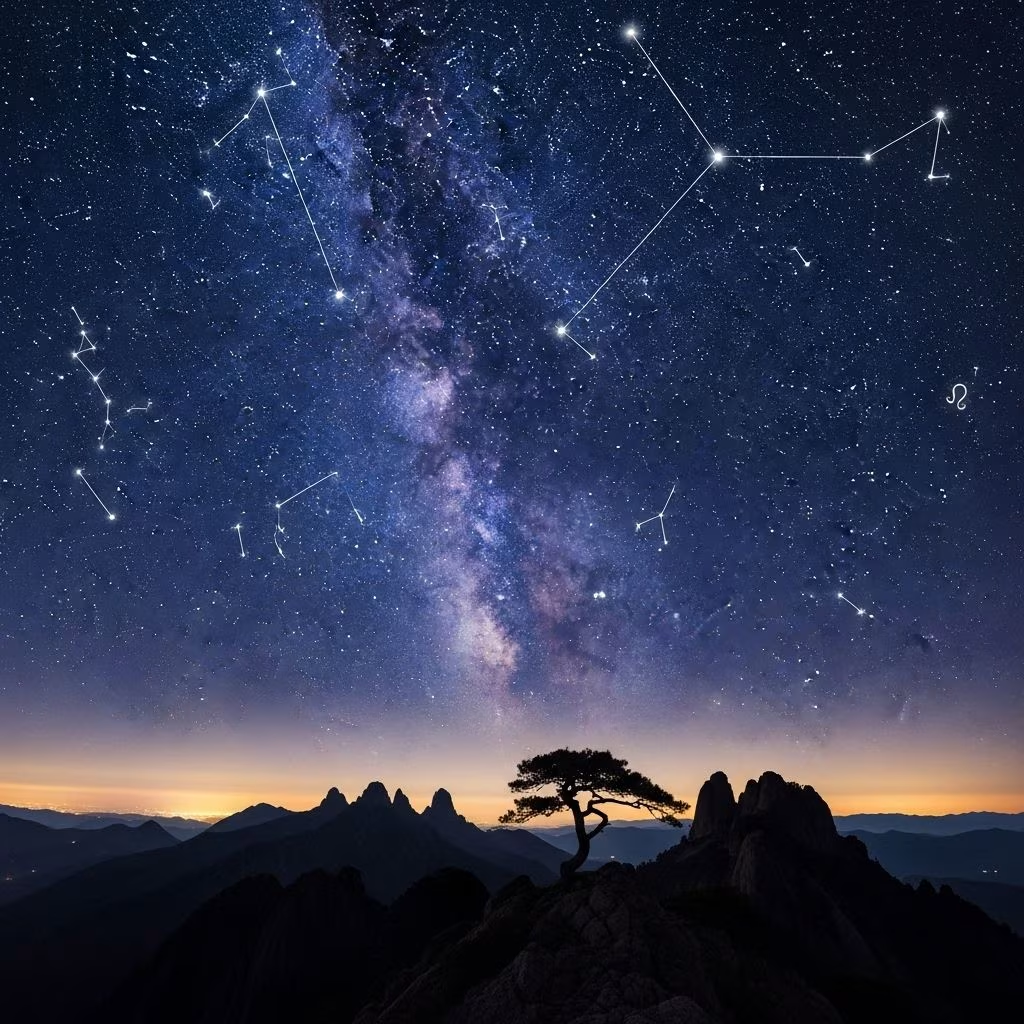
The night sky has captivated humanity for millennia. For ancient and modern stargazers alike, constellations—recognizable patterns of stars—have served as celestial maps, storytelling canvases, and navigational aids. Today, understanding these majestic star patterns remains fundamental to astronomy and our appreciation of the universe.
What Are Constellations?
Constellations are officially recognized groups of stars that form patterns, often resembling animals, mythological figures, or objects. These patterns have been named and interpreted by different cultures, but today, astronomers use a standardized list of 88 constellations to organize the night sky.
- Constellations help astronomers and skywatchers locate stars, planets, and other celestial objects.
- Many cultures have their own stories and myths attached to these patterns.
- The positions of constellations in the sky change over the course of the year due to Earth’s orbit around the Sun.
Understanding Asterisms
An asterism is a recognizable pattern of stars, often part of a larger constellation. Some asterisms are more popularly known than the constellations themselves. For instance, the Big Dipper is an asterism within Ursa Major.
- Not all asterisms are official constellations.
- Asterisms help amateur astronomers and beginners identify key areas in the sky.
- Examples include Orion’s Belt and the Summer Triangle.
Famous Constellations of the Northern Hemisphere
Below is an overview of some of the most prominent and notable constellations, their key features, stories, and the seasons in which they are best visible.
| Constellation | Shape / Asterism | Key Stars & Objects | Best Viewed | Mythology / Notes |
|---|---|---|---|---|
| Ursa Major | The Great Bear, Big Dipper | Dubhe, Merak, Mizar, Alkaid, Pinwheel Galaxy (M101) | Year-round (spring best) | Greek legend of Callisto. Big Dipper points to Polaris (North Star). |
| Ursa Minor | Little Bear, Little Dipper | Polaris (North Star) | Year-round | Represents Arcas, son of Callisto. |
| Cassiopeia | W or M shape | Shedir (Alpha Cassiopeiae) | Year-round (autumn/winter best) | Mythical vain queen; used to find Andromeda/Perseus. |
| Cepheus | House-like pentagon | Garnet Star (Mu Cephei) | Year-round | King Cepheus; home to Garnet Star, a red supergiant. |
| Draco | Dragon, winding pattern | Thuban (former North Star) | Year-round | Twists between Ursa Major/Minor; ancient mythologies. |
| Andromeda | Two lines leading to Andromeda Galaxy | Almach, Andromeda Galaxy (M31) | Autumn, Winter | Princess Andromeda chained to a rock; home to nearest spiral galaxy. |
| Pegasus | Great Square | Enif, the Great Square (Asterism) | Autumn | Winged horse; links with Andromeda/Persus myths. |
| Hercules | Kneeling figure | Great Hercules Cluster (M13) | Summer | Legendary hero; not very bright stars, but significant in sky. |
| Orion | Hourglass, Orion’s Belt | Betelgeuse, Rigel, Orion Nebula (M42) | Winter | Hunter of Greek myth; Belt guides to Sirius/Aldebaran. |
| Leo | Lion, Sickle | Regulus, Denebola, Sickle asterism | Spring | Greek myth Nemean Lion; Sickle forms lion’s mane. |
| Gemini | Twin stars | Castor, Pollux | Winter, Spring | Twins from Greek myth; bright paired stars. |
| Canis Major | Dog shape | Sirius (brightest star) | Winter | Orion’s hunting dog; home of Sirius. |
| Taurus | V-shape horns | Aldebaran, Pleiades cluster | Winter | Bull of myth; Pleiades and Hyades clusters nearby. |
Major Asterisms Explained
- The Big Dipper (Ursa Major): Formed by seven bright stars, this spoon-shaped pattern is a helpful navigational tool. The two stars at the end of its ‘bowl’ point directly to Polaris, the North Star. The Big Dipper is visible year-round in the northern hemisphere and helps locate other nearby constellations and even deep sky objects like the Pinwheel Galaxy (M101) and the Cigar Galaxy (M82).
- Orion’s Belt (Orion): A straight row of three bright blue stars—Alnitak, Alnilam, and Mintaka. These mark the midsection of Orion and have guided stargazers for centuries. The belt also helps locate the Orion Nebula (M42), a region of active star formation.
- The Sickle (Leo): A backward question mark shape standing for the lion’s head, with Regulus at the base. Useful for finding the Beehive Cluster (M44) in Cancer, not far from the Sickle’s curve.
- The Summer Triangle: Composed of three stars—Vega (in Lyra), Deneb (in Cygnus), and Altair (in Aquila). While part of separate constellations, the triangle dominates the summer sky.
Constellations and their Legends
- Ursa Major & Ursa Minor: In Greek myth, Callisto was transformed into a bear and placed in the sky as Ursa Major; her son Arcas became Ursa Minor. The Big and Little Dippers are part of these bears, forever circling the north celestial pole.
- Orion: The mighty hunter, whose boastfulness led to his placement in the stars. Orion’s Belt is world-famous; the stars that form his shoulders, knees, and feet are also bright and easy to distinguish.
- Cassiopeia and Cepheus: Cassiopeia’s vanity angered the gods, resulting in her daughter Andromeda’s sacrifice to a sea monster. King Cepheus, her husband, is represented by a nearby constellation.
- Andromeda & Perseus: Perseus saved Andromeda, and both are immortalized in the sky, often depicted near Pegasus, the winged horse.
- Leo: Represents the Nemean Lion, defeated by Hercules in his first labor.
- Gemini: Symbolizes the twins Castor and Pollux, granted eternal companionship in the heavens.
Constellation Facts: Visibility and Navigation
- Many northern constellations—such as Ursa Major, Cassiopeia, Draco, and Cepheus—are circumpolar. This means they are visible all year round, circling the pole without ever setting.
- Other constellations rise and set with the seasons.
- Constellations like Orion, Gemini, and Canis Major dominate the winter sky, while Pegasus and Andromeda are prominent in autumn.
- The Big Dipper and Cassiopeia can assist in finding the North Star, while Orion’s Belt helps locate Sirius and Aldebaran.
Observing Deep-Sky Wonders within Constellations
- Andromeda Galaxy (M31) in Andromeda: The closest spiral galaxy to the Milky Way and the most distant object visible to the naked eye.
- Orion Nebula (M42) in Orion: A birthplace of new stars, bright enough for basic binoculars.
- Pleiades (M45) and Hyades in Taurus: Beautiful open clusters visible with or without optical aid.
- Great Hercules Cluster (M13) in Hercules: Best seen with binoculars on a clear summer night.
- Pinwheel Galaxy (M101), Whirlpool Galaxy (M51) near Ursa Major: Faint but observable in dark skies with medium telescopes.
How to Find Key Constellations: Tips for Stargazers
- Start with the brightest asterisms, like the Big Dipper or Orion’s Belt. Use them as guideposts to hop between constellations.
- Note the season: Some constellations only appear at certain times of the year.
- Use a star chart, stargazing app, or planisphere to orient yourself.
- Seek out a dark location, away from city lights, to improve visibility of fainter stars and objects.
- Look for patterns, not just individual stars—the human brain is adept at recognizing shapes within the cosmic tapestry.
The Role of Constellations in Science and Culture
- Navigation: Polaris, found via the Big Dipper, aided navigation for centuries.
- Calendars: Many civilizations, such as Egyptians and Greeks, tracked time and seasons based on rising and setting constellations.
- Literature and Art: Constellations have inspired poets, artists, and writers from Homer to Van Gogh.
- Astronomy: Modern astronomers use constellations to define precise regions of the sky for identifying and cataloging objects.
Frequently Asked Questions (FAQs)
What is the primary difference between a constellation and an asterism?
A constellation is an officially recognized region of the sky containing a pattern of stars, while an asterism is a popular but informal star grouping that may be part of one or more constellations.
Can constellations be seen from anywhere in the world?
No. Some constellations are only visible from the Northern or Southern Hemisphere, while a few near the celestial equator are visible from most parts of the world during the right season.
Why do constellations appear to move during the year?
This movement is caused by Earth’s orbit around the Sun. As our perspective shifts, different parts of the sky become visible at night during each season.
Are all stars within a constellation physically related?
Usually not. Most stars in a constellation only appear close from Earth’s perspective, but they may be vast distances apart and unrelated physically.
How many constellations are officially recognized today?
The International Astronomical Union recognizes 88 official constellations that cover the entire sphere of the sky.
Further Stargazing: Expanding Your Knowledge
Once you’ve explored the major northern constellations, try seeking out other notable groupings:
- Pisces: Associated with the story of Aphrodite and Eros transforming into fish.
- Aquarius: Water bearer, visible in autumn.
- Cetus: The sea monster from Andromeda’s myth.
- Perseus: Hero near Andromeda; home to the Double Cluster, a pair of open star clusters.
- Cancer and Virgo: Fainter but rich with deep-sky objects.
The world of constellations is as profound as it is beautiful. With patience, a keen eye, and a bit of background knowledge, you can discover the stories and science woven into the night sky—season after season.
References
- https://www.centreofexcellence.com/35-constellations-northern-hemisphere/
- https://www.constellation-guide.com/asterisms/
- https://www.artofmanliness.com/skills/manly-know-how/15-constellations-every-man-should-know/
- https://www.youtube.com/watch?v=BD3cnBr6KwA
- https://sleepopolis.com/education/constellations-stars/
- https://www.go-astronomy.com/constellations.htm
- https://www.astronomy.com/observing/learn-the-constellations/
- https://en.wikipedia.org/wiki/Constellation